Omar Cóndor-Herrera, Pamela Acosta-Rodas, Carlos Ramos-Galarza (2021). Applying Minecraft Education to Pedagogical Teaching. In: Human Systems Engineering and Design (IHSED2021): Future Trends and Applications. AHFE Open Access, vol. 21. https://doi.org/10.54941/ahfe1001100
1 Centro de Investigación en Mecatrónica y Sistemas Interactivos MIST/ Centro de Investigación ESTec, Carrera de Psicología/Maestría en Educación mención Innovación y Liderazgo Educativo, Universidad Tecnológica Indoamérica Av. Machala y Sabanilla, Quito, Ecuador ↗
2 Facultad de Psicología, Pontificia Universidad Católica del Ecuador Av. 12 de Octubre y Roca, Quito, Ecuador ↗
Emerging teaching methodologies have reached restructuring educative scenario, leading to the implementation of novel teaching ways, using not conventional elements, such as videogames in the teaching process, it is the case of Minecraft education. This is a learning platform based in games, promoting creativity, collaboration and problem-solving in a digital immersive environment, that allow teachers to work with their students on lessons or projects of different subjects. Applying as basis, gamification and transforming educative scenarios into ludic environments, complementing them with STEM learning, which improves and increases students’ motivation.
Human Systems Engineering and Design (IHSED 2021) https://openaccess.cms-conferences.org/#/publications/book/978-1-7923-8987-0
INTRODUCTION
Videogames have transformed people’s daily-life, nowadays, are used with diversion purposes, furthermore of this usage, it is possible to develop games for teaching (Tomala-Gonzales et al., 2020). These count with an educative goal, immerse in the conceptualization of gaming in the educative context. Serious games and the usage of gamification have reached greater prominence in recent years, the concept of gamification was adopted by the scientific community around the year 2010, when it was diffused in symposiums and congresses (Deterding, Khaled et al., 2011). Nowadays, the term gamification is understood as the process where gaming aspects are integrated to situations and scenarios that are not ludic at all (Sanchez et al., 2017), leading to a modification in the nature of an activity, and, at the same time, the meaning of these interactions are modified, obtaining a dynamic and ludic working, but maintaining the learning objective. It means that, there are the same topics to work on, but the path has changed into a ludic one, reconfiguring the classroom scenario, usually supported by technological resources, not affecting the main objective, learning process.
BENEFITS OF USING EDUCATIVE VIDEO GAMES INTO LEARNING PROCESS As it was mentioned above, gamification integrates physical or digital gaming elements, through applications, platforms, serious games, etc. into educative process. It has been shown that not only improves motivation, also, it has been demonstrated that when generating students’ interest, it is possible to improve participation levels, hence, increasing the interest towards a determined subject (Smiderle et al., 2020). From the pedagogical point of view, it must be considered four main aspects of learning process, that are the nodal points for a successful learning, these are, attention, active participation, feedback and learning consolidation (Lamrani & Abdelwahed, 2020), for it, the implementation of educative video games must answer to learning methodologies that could affect students’ positively, increasing their interest in learning, which leads to increased attention levels towards the study object, thus, it is possible to evidence an improvement in the active participation in class (Benhadj et al., 2019).
Motivation is another positive and important factor in students’ learning process, since working with educative video games promote increasing students’ motivation, it brings the possibility of better learning consolidation, considering that, if students are highly motivated they will show higher predisposition of working, higher actively participation in class, hence, their learning results will be higher as well (Bovermann & Bastiaens, 2020). This methodology has been adopted worldwide by many schools and educative institutions, giving their students this type of teaching- learning process, based on a variety of games, such as virtual simulation, serious games, among others (Paulova et al., 2020).
Human Systems Engineering and Design (IHSED 2021) https://openaccess.cms-conferences.org/#/publications/book/978-1-7923-8987-0
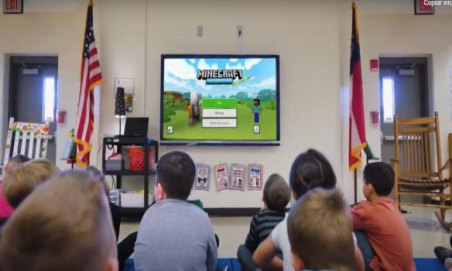
IMPLEMENTATION OF MINECRAFT EDUCATION INTO TEACHING PROCESS Minecraft education is a learning platform based on gaming, it promotes students’ creativity, collaboration, and, problem-solving in a digital immerse environment, as it is shown in Fig.1, it offers special functions to teachers, such as simple tutorials, tools for classroom management, secure beginning session, collaboration in class, and lessons, also, it counts with a global network of mentors and technical support (Microsoft, 2020).
Figure 1. Minecraft education in class.
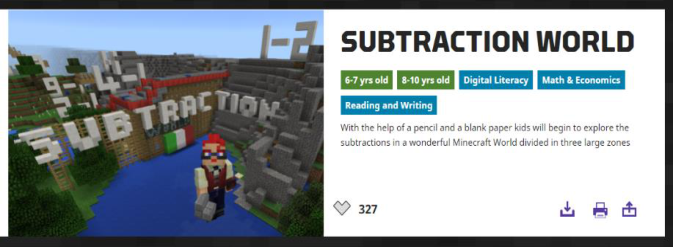
Teachers around the world are using Minecraft: Education Edition to teach a significant variety of subjects, such as history, chemistry, math, sciences, and foreign languages, as it is shown in figure 2 and could assign lessons linked directly to specific learning results and curricula standards online, designed for Minecraft Education Edition (Bar-EL & Ringland, 2020).
Figure 2. Minecraft Math lesson.
Human Systems Engineering and Design (IHSED 2021) https://openaccess.cms-conferences.org/#/publications/book/978-1-7923-8987-0
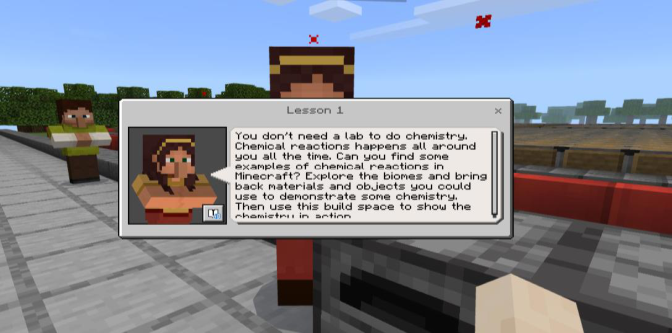
MINECRAFT EDUCATION EDITION: IMMERSIVE LEARNING WITH STEAM STEM is a curriculum based in the idea of teaching students in four specific disciplines: science, technology, engineering, and math, [STEAM includes arts] in an applied and interdisciplinary approach. Instead of teaching these disciplines separate and discretely (Future US, 2020). Educative interventions with STEM methodology point out that students learning with STEM express higher intentions of choosing sciences and engineering careers (Ortíz & Greca, 2020), since STEAM education changed traditional education to address the critical demand of transdisciplinary and creative learning (Cassie et al., 2020) (Bratitsis et al., 2019). Students may work in this version of the video game through lessons based in projects that are available in the video game Minecraft education edition, where students develop abilities such as collaboration, creative problem-solving, and digital citizenship, encouraging at the same time, cooperative work in this type of learning environments, where students are able to interact among them and help each other towards overcome the activities proposed from the projects presented (Figure 3).
Figure 3. Lessons in Minecraft education.
PREVIOUS STUDIES ABOUT THE USAGE OF MINECRAFT EDUCATION EDITION As mentioned above, Minecraft Education has several applications in the educational field, in recent years various investigations have been developed around this version of the game due to the potential it presents.
Human Systems Engineering and Design (IHSED 2021) https://openaccess.cms-conferences.org/#/publications/book/978-1-7923-8987-0
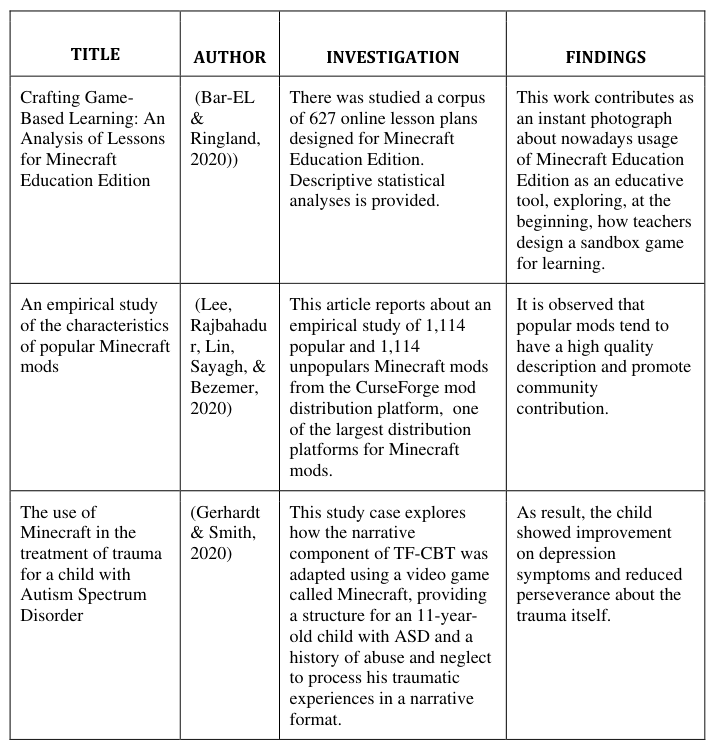
In table 1 you can see an abstract of three investigations carried out in 2020 on Minecraft Education Edition in which the objective of the investigation and its main findings are detailed, the investigations listed were focused on the analysis of the characteristics of the various modes and lessons found in Minecraft Education and the application of said game in the treatment of the trauma of a child with autism spectrum disorder.
Table 1: Previous studies on Minecraft Education Edition TITLE AUTHOR INVESTIGATION FINDINGS
CONCLUSIONS
The application of technological resources has allowed discovering uncountable opportunities of improving learning environments, offering students an education
Human Systems Engineering and Design (IHSED 2021) https://openaccess.cms-conferences.org/#/publications/book/978-1-7923-8987-0 according to their reality, where it is possible to innovate, promote and develop educative skills and capacities (Cóndor-Herrera & Ramos-Galarza, 2020). Many interventions show that there is an improvement in educative abilities and results as the effect of applying educative technological resource (Gerhardt & Smith, 2020). It is the case of applying an educative video game called Minecraft education edition, which has adapted its interface to a pedagogical scenario (Bar-EL & Ringland, 2020), that is being used by teachers worldwide. In this article, it has been developed an analysis of the potential usage of Minecraft education to improve teaching processes, also, there has been identified potential benefits of using this resource, such as increasing students’ motivation and a better predisposition towards learning, as well as encouraging collaborative work with STEAM methodology, through lessons based in different available projects concerning a diversity of subjects within the game. It is of great interest for the researcher team to study and propose, as future investigation, to measure the impact when applying the video game Minecraft education in an intervention project for primary and secondary students.
REFERENCES
Bar-EL, D., & Ringland, K. (2020). Crafting Game-Based Learning: An Analysis of Lessons for Minecraft Education Edition. 15th International Conference on the Foundations of Digital Games(90). doi:DOI: 10.1145/3402942.3409788 Benhadj, Y., Messaoudi, M., & Nfissi, A. (2019). Artificial intelligence in education:
Integrating serious gaming into the language class classdojo technology for classroom behavioral management. IAES International Journal of Artificial Intelligence, 8(4), 382-390. doi:10.11591/ijai.v8.i4.pp382-390 Bovermann, K., & Bastiaens, T. (2020). Towards a motivational design? Connecting gamification user types and online learning activities. Research and Practice in Technology Enhanced Learning, 15(1), 1-18. doi:10.1186/s41039-019- 0121-4 Bratitsis, T., Ioannou, M., & Palaigeorgiou, G. (2019). Critical Categorization of
Android and IOS Applications Available for STEAM Education in Early Childhood. 13th International Conference on Interactive Mobile Communication, Technologies and Learning, 1192, 178-188. doi:DOI: 10.1007/978-3-030-49932-7_18 Cassie, Q., Herro, D., Shekell, C., Cian, H., & Jacques, L. (2020). Connected Learning in STEAM Classrooms: Opportunities for Engaging Youth in Science and Math Classrooms. International Journal of Science and Mathematics Education, 18, 1441-1463. doi:https://doi.org/10.1007/s10763-019-10034-z Cóndor-Herrera, O., & Ramos-Galarza, C. (2020). The impact of a technological
intervention program on learning mathematical skills. Education and Information Technologies. doi:https://doi.org/10.1007/s10639-020-10308-y Cóndor-Herrera, O., & Ramos-Galarza, C. (2020). Virtual Learning Objects’ of Math Educative Process. International Conference on Human Systems
Human Systems Engineering and Design (IHSED 2021) https://openaccess.cms-conferences.org/#/publications/book/978-1-7923-8987-0
Engineering and Design: Future Trends and Applications, 1269. doi:https://doi.org/10.1007/978-3-030-58282-1_31 Deterding, S., Khaled, R., Nacke, L., & Dixon, D. (2011). Gamification: toward a definition. CHI 2011 Gamification Workshop Proceedings. Obtenido de http://gamification-research.org/wp-content/uploads/2011/04/02- Deterding-Khaled-Nacke-Dixon.pdf Future US. (2020). LIVE SCIENCE. Recuperado el 15 de 11 de 2020, de
https://www.livescience.com/43296-what-is-stem- education.html#:~:text=STEM%20is%20a%20curriculum%20based,an%2 0interdisciplinary%20and%20applied%20approach. Gerhardt, L., & Smith, J. (2020). The use of Minecraft in the treatment of trauma for a child with Autism Spectrum Disorder. Journal of Family Therapy, 42(3), 365-384. doi:DOI: 10.1111/1467-6427.12297 Lamrani, R., & Abdelwahed, E. (2020). Game-based learning and gamification to
improve skills in early years education. Computer Science and Information Systems, 17(1), 339-356. doi:10.2298/CSIS190511043L Lee, D., Rajbahadur, G., Lin, D., Sayagh, M., & Bezemer, C. (2020). An empirical study of the characteristics of popular Minecraft mods. Empirical Software Engineering, 25(5), 3396-3429. doi:DOI: 10.1007/s10664-020-09840-9 Microsoft. (2020). Minecraft education edition. Recuperado el 15 de 11 de 2020, de
https://education.minecraft.net/ Ortíz, J., & Greca, M. (2020). Intentions towards following science and engineering studies among primary education pupils participating in integrated STEAM activities. 11th International Conference on EUropean Transnational Education, ICEUTE 2020; Burgos; Spain, 1266, 40-49. doi:10.1007/978-3- 030-57799-5_5 Paulova, P., Cerna, M., Hamtilova, J., Malý, F., Kozel, T., Kriz, P., . . . Ulrych, Z.
(2020). Virtual Hotel – Gamification in the Management of Tourism Education. 17th International Conference on Remote Engineering and Virtual Instrumentation, REV 2020, 1231, 773-781. doi:10.1007/978-3-030- 52575-0_63 Sanchez , E., Young, S., & Jouneau-Sion, C. (2017). Classcraft: from gamification to ludicization of classroom management. Education and Information Technologies, 22, 497-513. doi:https://doi.org/10.1007/s10639-016-9489-6 Smiderle, R., Rigo, S., Marques, L., Peçanha de Miranda Coelho, J., & Jaques, P.
(2020). The impact of gamification on students’ learning, engagement and behavior based on their personality traits. Smart Learning Environments, 7(1). doi: 10.1186/s40561-019-0098-x Tomala-Gonzales, J., Guaman-Quinche, J., Guaman-Quinche, E., Chamba- Zaragocin, W., & Mendoza-Betancourt, S. (2020). Serious Games: Review of methodologies and Games engines for their development. 15th Iberian Conference on Information Systems and Technologies. doi:DOI: 10.23919/CISTI49556.2020.9140827
Human Systems Engineering and Design (IHSED 2021) https://openaccess.cms-conferences.org/#/publications/book/978-1-7923-8987-0
LISTED IN THE AHFE DIGITAL BOOKSTORE CATALOGUE
Explore the complete digital volume
Human Systems Engineering and Design (IHSED2021): Future Trends and Applications
Read this individual research paper free through the original publisher, or explore the full digital proceedings book.
ISBN 978-1-7923-8987-0
Explore this ISBN in the AHFE Bookstore ↗Listed in the July 2026 bookstore catalogue; search by ISBN to confirm current availability · Digital book purchase optional