Dorys Maribel Cumbe Coraizaca, Mike David Nunez Morales, Cesar Guevara, Vicente Bolívar Guzmán Bárcenes (2022). English Pronunciation IPA mobile Application. In: Usability and User Experience. AHFE Open Access, vol. 39, pp. 414–419. https://doi.org/10.54941/ahfe1001736
Technology has helped learners with their pronunciation at the moment of conveying a message, making it easier for them of English to communicate better. Hence, this research was conducted, with the objective to establish to analyze the relationship between the English Pronunciation mobile app in the pronunciation of the English language of students of third level from CTT de los Andes Language Center. To achievethe objectives, a mixed approach methodology was used, which included thirty students divided into two groups. One group was experimental, in which the strategy was applied and the other was controlled, in which the strategy was not applied. Both groups were evaluated using a rubric from the International English Language Testing System (IELTS) for the pre-test and post-test. After the pre-test, an introductory class to phonemes was given to the students. The next step for the experimental group was to get instructions on how to use the mobile app, which helped users with the recognition, awareness and production of English sounds. The development of this study showed that using the mobile app English pronunciation IPA benefits the improvement of the pronunciation from students of the experimental group. After the time period of the experiment, the segmental features of pronunciation used by students, were reinforced with the use of the mobile app.
Technology has given us many advantages in all fields and the development of smartphones are a great gadget to have in hand, with thousands of appli- cations to help the user in many activities. Nowadays, many teachers and institutions are being guided into using technology as beneficial in the tea- ching and learning process. Mobile technology is one of the most useful and effective tools that are trending in education (Kim et al., 2006).
The development of technology and communication together with mobile apps has created vast openings for EFL classrooms. Mobile learning is the use of mobile devices to for educational purposes. As a result of this, Mobile Assisted Language Learning (MALL) was developed to create applications for EFL teaching and learning. Students can benefit from this, since they do
not need to be in a fixed educational environment in order to learn or pra- ctice what they have learned, they can learn anytime and anywhere thanks to MALL (Pilar et al., 2013).
Mobile apps have been designed to support learning, and they have been introduced in the classroom to help students. They have features such as inte- ractive learning materials, simulations and learning games to assist teachers with their students. There are mobile apps to support single user and for collaborative activities as well. The mobile apps are designed after a careful study to decide whether they will be useful for students in an educational environment. The use of mobile apps has reflected an improvement in the development of students’ learning process (Leinonen et al., 2016).
Mobile apps are great for the improvement of English pronunciation. The use of a mobile app to assist students in a learning environment can help them improve. Mobile devices such as smartphones have the features of automatic speech recognition (ASR) that help students in their pronunciation. It gives them a better opportunity to learn and to correct pronunciation if they do it as autonomous work. The mobile app assesses students’ oral production giving the students the chance of identifying their needs, focus on particular pronunciation, interaction with the app, a comprehensible and accurate feed- back, and the development of strategies to gain understanding (Liakin et al., 2015). English Pronunciation IPA is a mobile app which contains the forty-four phonemes divided into vowels, diphthongs and consonants. Each phoneme shows interactive features to help the users understand the sounds. The first feature shows the user how to pronounce the word, with instructions of mouth movement and the reproduction of the sound. It includes speech reco- gnition to give feedback to the users until they get it right. The mobile app shows different activities for the user to practice such as recognizing the different sound and choosing the correct word for the sound.
Pronunciation is the production of sounds, in this case the production of English sounds. Learners are taught pronunciation by repeating sounds and making this into a habit. Pronunciation is key to be able to communicate, if the pronunciation is not correct the speaker will have difficulty at being understood. The focus of pronunciation instruction is not to have a native like pronunciation, but it must be understandable. The pronunciation of the English language is one of the most difficult skills for non-native speakers to learn (Gilakjani & Sabouri, 2016).
There is a lack of focus on pronunciation when teaching English to non-native speakers because of time limitations and curriculum objectives. Grammar and vocabulary are usually the main focus on all classes, there- fore there is no time for teaching pronunciation. In addition, pronunciation is not only essential for oral production but also for the language skills. The study also reflects that the use of ICT (information communication techno- logy) tools help users with stress, rhythm and intonation which help with pronunciation (Tlazalo & Basurto, 2014).
The importance on how pronunciation is taught in the classroom has chan- ged through times. A native-like accent is impossible for adult L2 learners, although pronunciation is still a very important feature of communication.
This will help with distinguishing dialects, formal and informal registers of speech, and how this will affect the social standings. In the past, pronuncia- tion was ignored in the classroom because of what was said before. In today’s world, pronunciation is key for English learners, so teachers in the classroom is taking more attention to pronunciation (Roccamo, 2015).
Nowadays, companies all over the world demand L2 users who are capable of communicating with people who have different backgrounds. Professors who teach a second language should focus on L2 learners obtaining under- standable speech features. As reported by previous research, having a good pronunciation assessment and strategies in the classroom, has shown a posi- tive effect on the pronunciation of L2 students. Another important point mentioned is that many times teachers are not keen to teach pronunciation because they do not have proper training, the correct skills or material needed (Sardegna et al., 2017).
People who have satisfactory pronunciation tend to improve in their language skills better than those who have faint pronunciation. English pronunciation is still ignored in many EFL classrooms and this is because pronunciation is usually seen as an additional activity and not as a lesson solely focused on pronunciation. They focused on two main reasons why pronunciation is ignored in the classroom, the first is lack of time and the second is a psychological factor because students are not sure of their pro- nunciation as well as their knowledge on grammar and lexis (Gilakjani & Sabouri, 2016). Based on what has been described, the objective of the rese- arch is to analyze the relationship between the English Pronunciation IPA mobile app in the English pronunciation.
The current research project has a mixed approach, quantitative and qua- litative. This research project is field based because it has direct contact with students of CTT de los Andes Language Center and teachers in their class- room, and the level or type of research is of exploratory, descriptive and experimental level. For students to use a wide range of pronunciation fea- tures, they will use the mobile app English Pronunciation IPA. The mobile app contains the forty-four phonemic sounds in English, which include vow- els, vowel diphthongs and consonants. Each phonemic sound comes with five sections to help the user, in this case the students to learn more about the phonemic sound. The first section is “how to pronounce” the phoneme, which helps the student to pronounce the phoneme correctly and also comes with signal identification and examples. The second section is “test voice”, where the students will record their voice (with given words, phrases and sen- tences) into the mobile app and they will receive immediate feedback. The third section is “select different sound”, where students will practice their pronunciation by selecting the word with a different phoneme sound from a list of four words. The fourth section is “fill suitable word”, where students will be given the phonemic symbols and they will have to transform it into a word. The fifth section is “choose words with -phonemic symbol- “, where students will have to choose words with the given phonemic symbol from a list of six words.
A questionnaire was applied to the students, in which they had to answer questions in a prompt manner. The questions were related to their homes
English Pronunciation IPA Mobile Application 417
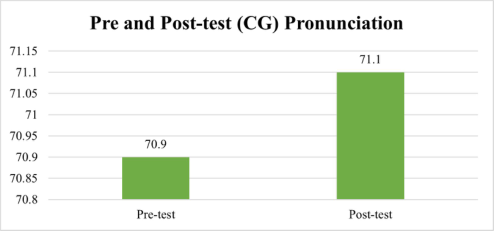
Figure 1: Pre and post-test control group (cg) pronunciation.
and the place where they live. These topics were selected because the students are familiar with them. A pre-test from the International English Language Testing System (IELTS) was taken by using a speaking rubric to check the pro- nunciation of students from third level (B1) from CTT de los Andes Language Center. This speaking rubric was used because of the complex descriptors, which helped to determine different aspects like fluency, coherence and pro- nunciation. The class was divided into two groups of fifteen students each, they were selected from the registration list by choosing the top half for the first group and the bottom half for the second group. The process was a one- on-one interview where the students were asked questions about their lives and preferences. The post-test was taken from the International English Lan- guage Testing System (IELTS) with the same speaking rubric as in the pre-test. The purpose of reusing the speaking rubric was to evaluate the pronunciation of the students and to check whether or not they have made improvements by using the mobile app English Pronunciation IPA.
The mean score of the group who did not use the mobile application for three weeks for the pre-test was 7.09 out of 10, which in percentage is equal to 70.9%. On the other hand, the mean of the same group for the post-test is 7.11 out of 10, which in percentage is equal to 71.1%. The difference between the mean of the pre-test and the post-test is equal to 0.2. This means, that the controlled group (CG) received a slightly higher score after three weeks. The difference between the pre and post-test average score is minimal.
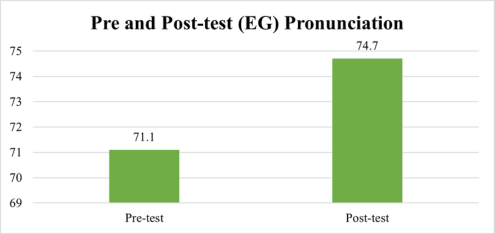
The mean score of the group who used the mobile application for three weeks for the pre-test was 7.11 out of 10, which in percentage is equal to 71.1%. On the other hand, the mean of the same group for the post-test is 7.47 out of 10, which in percentage is equal to 74.7%. The difference between the mean of the pre-test and the post-test is equal to 3.6. This means, that the experimental group (EG) received a higher score after three weeks of using the mobile app. This increase shows that the mobile app had a positive effect on the students.
In the table 1, we can observe that the mean score obtained from the pre- test equals 7.11, while the mean score of the post-test equals 7.47. The next step is to apply the student t-test to conclude whether or not the difference between the tests is significant or not.
In the table 2, we can observe that the p value equals 0.00, which is lower than the significance 0.05. The mobile app English Pronunciation IPA favors
Figure 2: Pre and post-test experimental group (eg) pronunciation.Table 1. Paired sample statistics EG.
Table available in the original PDF paper.
Mean N Std. Deviation Std. Error Maan Pre – test 7.11 15 0.790 0.204 Post – test 7.47 15 0.803 0.207
Table 2. Paired Samples Statistics – Paired Differences EG 95% Confidence Interval of the Difference
Table available in the original PDF paper.
Par 1 Pre-test/ Mean N Std. Std. Error Lower Upper T df Sig. Post-test Deviation Mean (2-failed) −0.36 15 0.15 0.04 −0.44 −0.28 −9.28 14 0.00
the pronunciation of the English language in the students of 3rd level at CTT de los Andes Language Center. The t-test was used to verify the hypothesis, to determine the differences between the EG and the CG.
CONCLUSION
Throughout the study of academic papers and researches, the mobile app English pronunciation IPA was supported theoretically. Mobile apps have been designed to support learning and its features can help assisting teachers. Pronunciation is key to be able to communicate; therefore, there should be a lot of effort put into its process.
It was determined that the elements of English Pronunciation IPA were identified as to help the experimental group on how to use the mobile app in a proper and useful manner. The process of English pronunciation used by the students was determined by using the cycle, first awareness, second production and finally recognition of phonemes. This cycle helped students to improve their pronunciation of the English language.
REFERENCES
Gilakjani, A., & Sabouri, N. (2016). Why Is English Pronunciation Ignored by EFL Teachers in Their Classes ? International Journal of English Linguistics, 6(6), 195– 208. https://doi.org/10.5539/ijel.v6n6p195
English Pronunciation IPA Mobile Application 419
Kim, S., Mims, C., & Holmes, K. (2006). An Introduction to Current Trends and Benefits of Mobile Wireless Technology Use in Higher Education. AACE Journal, 14(1), 77–100. https://www.learntechlib.org/primary/p/6158/ Leinonen, T., Keune, A., Veermans, M., & Toikkanen, T. (2016). Mobile apps for
reflection in learning: A design research in K-12 education. British Journal of Educational Technology, 47(1), 184–202. https://doi.org/10.1111/bjet.12224 Liakin, D., Cardoso, W., & Liakina, N. (2015). Learning L2 pronunciation with a mobile speech recognizer: French/y/. CALICO Journal, 32(1), 1–25. https://doi.or g/10.1558/cj.v32i1.25962 Pilar, R., Jorge, A., & Cristina, C. (2013). The Use of Current Mobile Learning
Applications in EFL. Procedia - Social and Behavioral Sciences, 103, 1189–1196. https://doi.org/10.1016/j.sbspro.2013.10.446 Roccamo, A. (2015). Teaching Pronunciation in Just Ten Minutes a Day : A Method for Pronunciation Instruction in First-Semester German Language Classrooms. A Journal of the American Association of Teachers of German, 48(1), 59–83. https://onlinelibrary.wiley.com/doi/full/10.1111/tger.10181 Sardegna, V., Lee, J., & Kusey, C. (2017). Self-Efficacy, Attitudes, and Choice of
Strategies for English Pronunciation Learning. A Journal of Research in Language Studies, 1–32. https://doi.org/10.1111/lang.12263 Tlazalo, A., & Basurto, N. (2014). Pronunciation Instruction and Students ’ Practice to Develop Their Confidence in EFL Oral Skills. PROFILE, 16(2), 151–170. http: //www.scielo.org.co/pdf/prf/v16n2/v16n2a11.pdf
LISTED IN THE AHFE DIGITAL BOOKSTORE CATALOGUE
Explore the complete digital volume
Usability and User Experience
Read this individual research paper free through the original publisher, or explore the full digital proceedings book.
ISBN 978-1-958651-15-5
Explore this ISBN in the AHFE Bookstore ↗Listed in the July 2026 bookstore catalogue; search by ISBN to confirm current availability · Digital book purchase optional