Anne-Mari Järvenpää, Jussi Kantola, Vesa Salminen (2022). How Information Flows in Industrial Symbiosis and what are the Gaps and Discontinuities?. In: Human Factors, Business Management and Society. AHFE Open Access, vol. 56, pp. 33–41. https://doi.org/10.54941/ahfe1002249
The aim of circular economy is the efficient use of materials, but it is hampered by lack of information. Literature shows that lack of information causes challenges to close the waste loop. Developing material flows require understanding about the challenges between companies. Our research question is: How information flows in Industrial Symbiosis and what are the gaps and discontinuities? As industrial symbiosis, we mean business relation, where waste material is circulated as an input to another company. This paper presents a qualitative case study in Finland with three cases with different material flow: biowaste, glass waste and e-waste. We noticed that the reason why accurate information is not shared, might relate to the information systems that company are using, as they might give estimations only in the meetings held quarterly, or they forget to inform other company of it. Another reason might be the business model, as the waste material using company might buy the material.
In the circular economy, the need to forecast the material flow depends on the type, volume, and variation of the supplied waste flow. For some business relation, this kind of forecast information is essential while some relation goes with steady volumes without variation (Järvenpää, Kantola and Salminen, 2021). Literature provides examples for an information related barrier to circular economy, that are relating to finding a suitable business partner and availability of waste materials (Antikainen, Uusitalo and Kivikytö-Reponen, 2018; Bakajic and Parvi, 2018; Maqbool, Alva and Van Eetvelde, 2018; Tura et al., 2019). This missing information causes challenges optimizing logi- stics and manage sufficient input for production. Digitalization and Industry 4.0 is expected to solve the information related issues in circular economy businesses, but even the technology is already available, the willingness of
companies to utilize it depends on the added value it brings by the optimi- zation of operations or higher returns. (Järvenpää, Salminen and Kantola, 2021). There is a gap in the knowledge of information sharing in ongoing and long-term industrial symbiosis. The research question is: How information flows in Industrial Symbiosis (circular economy value chain) and what are the gaps and discontinuities? As industrial symbiosis, we mean business relation, where waste material is circulated as an input to another company.
Why this research is important? Circular economy is promoted strongly the level of EU (A new Circular Economy Action Plan for a cleaner and more competitive Europe, 2020) as well as national level in Finland (Valtioneuvo- sto [Finnish Government], 2021). The Finnish Industrial Symbiosis System (FISS) model is a tool for implementing circular economy by facilitating syner- gies between companies by local facilitators. Boosting and developing circular material cycles with companies, requires an understanding about the infor- mation related challenges and requirements. The reason why information is not shared between business partners relates to the fact the information does not exist or the partner is not willing to share it. The regulated reporting might be a challenge as well in the means of unusable units of measures.
THEORETICAL BACKGROUND Industrial symbiosis refers to a model to implement circular economy by con- necting other company’s waste as an input to another company. Literature presents solutions to facilitate industrial symbiotic business relations betw- een companies (Fraccascia and Yazan, 2018; Wen et al., 2018; Ghali and Frayret, 2019; Yazdanpanah, Yazan and Zijm, 2019; Yeo et al., 2019). Rela- tion starts when the suitable partner has found, but what happen after that – will the companies develop the co-operation with a shared vision, depend on the partnering companies. In industrial symbiosis, there can be four kinds of companies: waste producers, waste users, waste treatment companies and waste transportation companies (Fraccascia et al., 2019). It should be noted that the waste using companies prefers long-term relation (Bakajic and Parvi, 2018). Maturity of industrial symbiosis can be assessed by a tool (Golev, Corder and Giurco, 2015) that shows five maturity stages: not recognized, initial efforts, active, proactive and forming the future. The tool includes seven barriers in industrial symbiosis development: information, commitment, co-operation, technology, regulation, community and, economy.
Lack of digitalization was reported as a technological barrier in waste management (Bakajic and Parvi, 2018). Waste producers need reporting and tracking tools, waste management operators need to control the material flows and quality throughout the supply chain. They identified the most significant barrier to waste exchange platforms are the lack of accurate infor- mation about waste and the fact that waste producers are not willing to share waste-related information, because they see it as a threat to business.
Information sharing-related barriers are unwillingness and inability (Kosmol, 2019). Unwillingness relates to the lack of trust and confidenti- ality while the inability to share information and knowledge relates to the
How Information Flows in Industrial Symbiosis (Circular Economy Value Chain) 35
difficulties in information sharing, lack of contacts and lack of available infor- mation. Kosmol (2019) asked an essential question: can information sharing be integrated into Supply Chain Management or is there information sharing mechanism to be copied in Industrial Symbiosis?
Zeiss (2019) identified four classes of information flows in circular eco- nomy practices: 1) market-related, 2) actor-related, 3) material object-related and 4) activity-related. Zeiss defines information “as structured data, which is accurate, relevant, timeliness, complete, and accessible to actors”. The information deficit was defined as “situations where structured data is either unavailable or available in poor quality”. By Market-related information flow Zeiss (2019) refers to “the availability of structured data about sup- ply and demand of material objects”. Actor-related information relates to “location, availability and behavior of an actor”. Material-object informa- tion means properties, utilization, location or condition”. Activity-related information relates to “instructions on using and transforming material obje- cts”. Circular economy practices rely critically on market-related information and the absence of this prevent to finding material.
Information flow modelling provides understanding for complex problems describing how information is transferred. By better understanding it is pos- sible to coordinate processes and manage information sharing as well as fix communication barriers (Durugbo, Tiwari and Alcock, 2013). Diagrammatic modelling can be used for integrative analysis with the visualizations of diffe- rent perspectives or perspective analysis to model the behaviour and structure of information flow.
METHODOLOGY
This research is a comparative and qualitative case study, with multiple cases. Case study provides deeper insight for a phenomenon in its real-life context and offers opportunity to compare similarities and difference (Yin, 2018). Multiple case study included three cases (A, B, C) with eight companies, all are located in Finland. Cases include three different waste material flows: biowaste, glass waste and e-waste. Table 1 represents a description of the case companies, where company 1 is waste utilizing company and company 2 and 3 are waste producers or waste collectors. In these cases, waste material is processed as products and raw materials.
Research data were collected by interviewing eight companies between January and March 2021. The aim of this paper is to point out gaps in information sharing in different types of waste flows. When interviewing companies, we asked them to describe 1) how waste material is supplied, 2) what kind of information they have for forecasting the material availability or supply and 3) what kind is the business relation between companies?
RESULTS
How companies, that utilizes waste, know how much material is available or when material will be supplied? Even the yearly volume has been agreed
Table 1. Description of the case companies.
Table available in the original PDF paper.
Case Company1 Company 2 Company 3 A Products from biowaste Food industry Food industry B Products and raw materials from glass waste Collector Collector C Raw materials from e-waste Collector
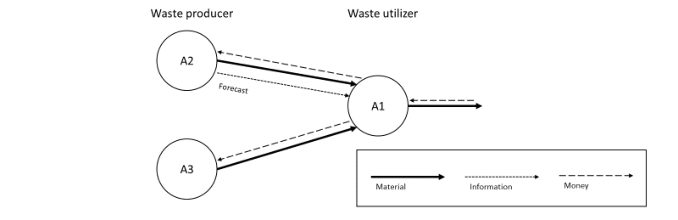
Figure 1: Case A.
by contract, it is not known exactly enough, when the material arrives at the plant.
Case A “We can’t buy a hundred tons of material today and produce something from it. We must make commitments to our clients. That is why we must secure the material flow”. Company A1
Company A1 that utilizes the waste material, is a material buyer. Company A1 has been searching new material sources three years ago and company A2 was found then. Company A1 produces value products from biowaste, and they state that they are just in the beginning, and they are not yet doing that, what they will be doing in the future. Company A1 and A2 started the co- operation by experimentation 2.5 years ago. At the time, A2 expanded their business. Together they build facilities where biowaste are collected. It should be noted that all biowaste from A2 are not valuable for A1, and the valuable material must be kept clean from other materials – if they are mixed, the value of the company A1 product will decrease. A1 states that they are interested to expand to other materials as well, but they must build the business piece by piece. If A2 begins to use certified raw material, that will affect the value of A1 end product providing higher profit. The business for A1 is not highly profitable yet, but they have plans and expectations for the future.
Company A1 gets a forecast from company A2 in Excel file by email, that includes estimated volume for raw material used by A2. With that informa- tion company A1 plans the production and logistics, as they pick up material by their truck. Annual amount of waste from A2 is around 1500 tons. The forecast covers two or three months and there are updates once or twice in a month. A1 states that they can’t manage only with the forecast, but they must keep in contact with the staff in company A2. For this reason, A1 see
How Information Flows in Industrial Symbiosis (Circular Economy Value Chain) 37
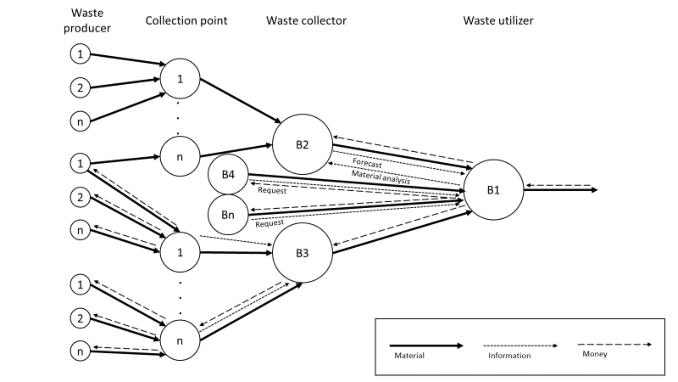
Figure 2: Case B.
the importance to develop interaction with company A2. Company A2 says that the estimation is based on their volume of orders, it is a certain percent of the production. However, it must be highlighted that the challenge here is the fact that the volume of orders can change rapidly for next week, and it is often forgotten to inform the company A1. This kind of situation already leaded to the interruption of co-operation for three-month period, as A1 was not able to handle “the high season” of A2. This causes a problem to A1 in optimizing the logistics and the production capacity can be exceeded. The volume that company A3 produces as a by-product, is relatively small and the flow is steady, so they have agreed the collection once a week. For this reason, there is no need to share any forecasts. Annual amount of waste from A3 is around 250 tons.
Case B “Each company optimizes its own operations, not the whole chain. The carbon footprint is not considered. “Company B1.
Company B1 that utilizes the waste material, is a material buyer. Company B1 business has been affected by the change in legislation in 2014 when they lost part of their business. Companies B2 and B3 have been established then, and today, B1 has a business relation with them both. B1 states that each company is optimizing their own operations, not the whole chain, and this is a typical way to operate if there is no trust between companies - it hampers the aims to reduce the carbon footprint of material recycling. Company B1 states that the reasons for not thinking about the carbon footprint, relate to the fact that B2 is operating to serve their legislative tasks, and the supply chain is not their priority.
Company B1 says that at the moment, forecasting is difficult. They get an estimation from the waste material supplier B2 in the meetings, that are held monthly or quarterly. They have been agreed in the contract of the yearly
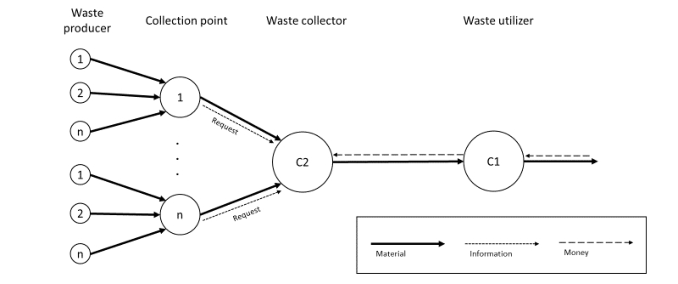
Figure 3: Case C.
volume, and in the meetings, B2 are trying to give an estimation for a month. However, the estimations are quite rough and B1 have noticed that the sup- pliers do not follow it actively. B1 has a large field, where the material is transported and from where it will be handled by B1, but it might cause inefficient production. Company B2 collects material from companies and consumers in collection points, and they are not able to estimate how much material will be collected in their terminals, but the flow is quite steady and there is not big variation. There is certain pattern in yearly accumulation. Company B3 collects material from companies and consumers in collection points and the volume that is transported to company B1 is agreed by con- tract. Material is transported first to terminals by the reverse logistics of partners, and then to company B1. Company B1 collects waste from com- panies (B4…Bn) as requested, but they wish to have opportunity to monitor the waste accumulation in their customers to enable the optimization of logi- stics as well as to expand the material collection all over the country. All together in 2019 company B1 received almost 100 000 tons of waste.
Case C Company C2 buys a service from company C1, but the monetary value of material is included in the contract. C1 states that they are a service provider for all customers, even though they are a material buyer as well, they offer services for customer who want to get rid of waste materials. Company C2 states, that C1 is not material buyer, but a partner with whom they are trying to develop operations. Company C1 and C2 have been collaborated for 15 years.
The main information for company C1 is data from the previous years and sales of new devices. When considering e-waste, it is typical that old devices have been replaced by new ones. C2 collects waste from several collection points, the volume cannot be predicted or monitored, the transportation will be ordered once it is requested from collection points. However, there is no information available to forecast the amount of incoming material that are supplied by C2 and it is not agreed in the contract. Annual amount of waste is around almost 10 000 tons. Company C2 gives a forecast for the annual
How Information Flows in Industrial Symbiosis (Circular Economy Value Chain) 39
Table 2. Information at the point of view of waste utilizing company.
Table available in the original PDF paper.
Company Market-related Actor-related Material-related Activity- related Available: Material quality.
A1 Must provide: Committed volumes for customers
Need more accuracy: Variation in availability, for planning the production and logistics.
Need more accuracy: Delivery time from suppliers.
B1 Need more accuracy: Volumes from small suppliers, for expanding the material supply.
Must provide: Material analysis to supplier.
Need more accuracy: Delivery time from suppliers.
Need more accuracy: Quality of delivered material from supplier. Must provide: Material analysis to the supplier. C1 Must provide: Committed volumes for customers.
volume, but they state that it is difficult to predict the volume as “the world is changing all the time”. C2 cannot measure the material, instead, C1 measures the material and reports to C2. Company C1 are “the eyes, ears and hands” for C2, meaning reporting of the sorting level and packaging of material.
Information Flows in Circular Economy Here we summarize the situation in each case by information flow categories identified by Zeiss (2019). Table 2 shows that there is an information deficit in each case, as the structured data is not available or in poor quality.
The situation is quite similar in cases A, B and C at the point of view of waste utilizing companies for whom it is important to optimize logistics and production as well as make commitments towards their own customers regarding the delivered end-product or (recycled) raw material. In this sense, actor-related information flows need to be developed to develop market- related information flow especially in cases A and C. This might apply to case B as well, but more importantly, company B1 needs market-related infor- mation flows from small waste suppliers all around Finland to expand their material supply network.
DISCUSSION
We aimed to point out the gaps and discontinuities in the information flow between companies. We search for an answer to the questions of: How infor- mation flows in Industrial Symbiosis (circular economy value chain) and what are the gaps and discontinuities?
We noticed that it is critical to that the supply matches with the capacity, if materials are perishable and cannot be stored. This is even more critical if the waste producing company requires one company to receive everything – this could become an obstacle and interrupt co-operation. With material that can be stored, it is essential to know when material will be supplied and in what quality to optimize production.
Reasons for why there is no updated or accurate information enough, might relate to information systems companies are using, and they might give estimations only in the meeting held quarterly. Another reason might be the business model, as the waste material using company is a material byer who might compete with other buyers. This highlight the co-operation and the mutual benefits, as industrial symbiosis is usually stated for.
Results give insight to regional industrial symbiosis facilitators about the information, commitment and co-operation related potential challenges, that should be tackled at first place when potential synergies have found between companies. As a recommendation, we suggest that facilitators would choose and use a modelling tool to visualize the required information flow between companies with respect to the material flow and optimization of operations.
Limitation in our research is the small number of cases, even they provided a view for three different material flows. Research could be widened with new cases with different material flows, for example textiles, plastics, and construction waste. It would be good to have interviewees, who could tell about used information systems as well. Another way to widen this research is to expand cases by interviewing other partners or customer in the network. This could be challenging because companies are not willing to reveal too much of their partners.
REFERENCES
A new Circular Economy Action Plan for a cleaner and more competitive Europe (2020). European Commission. Available at: https://eur-lex.europa.eu/legal-cont ent/EN/TXT/?uri=COM:2020:98:FIN. Antikainen, M., Uusitalo, T. and Kivikytö-Reponen, P. (2018) ‘Digitalisa- tion as an Enabler of Circular Economy’, Procedia CIRP, 73, pp. 45–49. doi: 10.1016/J.PROCIR.2018.04.027. Bakajic, M. and Parvi, A. (2018) Barriers to Closing Waste Loops in the Euro-
pean Union - Implications for circular economy platforms in waste management. Aalto University. Available at: http://urn.fi/URN:NBN:fi:aalto-201901181305 (Accessed: 17 January 2020). Durugbo, C., Tiwari, A. and Alcock, J. R. (2013) ‘Modelling informa- tion flow for organisations: A review of approaches and future challen- ges’, International Journal of Information Management, 33(3), pp. 597–610. doi: 10.1016/J.IJINFOMGT.2013.01.009. Fraccascia, L. et al. (2019) ‘A framework for industrial symbiosis systems for agentbased simulation’, Proceedings - 21st IEEE Conference on Business Informatics, CBI 2019, 1, pp. 419–428. doi: 10.1109/CBI.2019.00055. Fraccascia, L. and Yazan, D. M. (2018) ‘The role of online information- sharing platforms on the performance of industrial symbiosis netw- orks’, Resources, Conservation and Recycling, 136, pp. 473–485. doi: 10.1016/J.RESCONREC.2018.03.009.
How Information Flows in Industrial Symbiosis (Circular Economy Value Chain) 41
Ghali, M. R. and Frayret, J. M. (2019) ‘Social Semantic Web Framework for Industrial Synergies Initiation’, Journal of Industrial Ecology, 23(3), pp. 726–738. doi: 10.1111/jiec.12814. Golev, A., Corder, G. D. and Giurco, D. P. (2015) ‘Barriers to Industrial Symbiosis:
Insights from the Use of a Maturity Grid’, Journal of Industrial Ecology, 19(1), pp. 141–153. doi: 10.1111/jiec.12159. Järvenpää, A.-M., Kantola, J. and Salminen, V. (2021) ‘Information Sharing in Industrial Symbiosis’, in Kantola, J. I., Nazir, S., and Salminen, V. (eds) Adva- nces in Human Factors, Business Management and Leadership. Cham: Springer International Publishing, pp. 79–85. Järvenpää, A.-M., Salminen, V. and Kantola, J. (2021) ‘Industrial Symbiosis , Circular
Economy and Industry 4 . 0 – A Case Study in Finland’, 12(4), pp. 111–121. doi: 10.24425/mper.2021.139999. Kosmol, L. (2019) ‘Sharing is caring-Information and knowledge in industrial symbiosis: A systematic review’, Proceedings - 21st IEEE Conference on Business Informatics, CBI 2019, 1, pp. 21–30. doi: 10.1109/CBI.2019.00010. Maqbool, A. S., Alva, F. M. and Van Eetvelde, G. (2018) ‘An assessment of Euro-
pean information technology tools to support industrial symbiosis’, Sustainability (Switzerland), 11(1). doi: 10.3390/su11010131. Tura, N. et al. (2019) ‘Unlocking circular business: A framework of bar- riers and drivers’, Journal of Cleaner Production, 212, pp. 90–98. doi: 10.1016/J.JCLEPRO.2018.11.202. Valtioneuvosto [Finnish Government] (2021) Uusi suunta: Ehdotus kiertotalouden strategiseksi ohjelmaksi [New directions:The strategic programme to promote a circular economy]. Wen, Z. et al. (2018) ‘Approaches and policies for promoting industrial park
recycling transformation (IPRT) in China: Practices and lessons’, Journal of Cleaner Production, 172, pp. 1370–1380. doi: 10.1016/j.jclepro.2017.10.202. Yazdanpanah, V., Yazan, D. M. and Zijm, W. H. M. (2019) ‘FISOF: A formal industrial symbiosis opportunity filtering method’, Enginee- ring Applications of Artificial Intelligence, 81(July 2018), pp. 247–259. doi: 10.1016/j.engappai.2019.01.005. Yeo, Z. et al. (2019) ‘Tools for promoting industrial symbiosis: A systematic review’, Journal of Industrial Ecology, 23(5), pp. 1087–1108. doi: 10.1111/jiec.12846. Yin, R. K. (2018) Case Study Research and Applications : design and methods. 6th
edn. Los Angeles: SAGE Publications. Zeiss, R. (2019) ‘INFORMATION FLOWS IN CIRCULAR ECONOMY PRACTI- CES’, in. Proceedings of the 27th European Conference on Information Systems (ECIS), Stockholm & Uppsala, Sweden, June 8-14, 2019. ISBN 978-1-7336325- 0-8 Research Papers. Available at: https://aisel.aisnet.org/ecis2019_rp/38.
LISTED IN THE AHFE DIGITAL BOOKSTORE CATALOGUE
Explore the complete digital volume
Human Factors, Business Management and Society
Read this individual research paper free through the original publisher, or explore the full digital proceedings book.
ISBN 978-1-958651-32-2
Explore this ISBN in the AHFE Bookstore ↗Listed in the July 2026 bookstore catalogue; search by ISBN to confirm current availability · Digital book purchase optional