Tom Werner Hermann Albert Sommerlatte (2022). Interrelation of Organizational Climate of Trust and Business Performance. In: Human Factors in Management and Leadership. AHFE Open Access, vol. 55, pp. 111–115. https://doi.org/10.54941/ahfe1002239
Recent research on the role of trust for productivity, innovativeness and the effectiveness of change of business organizations (1) has shown a significant interaction of the individual trust profile of leaders, the psychological contract between the leadership of an organization and its members, and the trust climate of the organization.Trust climate in turn has been shown by empirical studies to have a so far underestimated bearing on how effectively people work together in business processes, how innovative ideas and projects are treated, and how strong the buy-in is in strategic and organizational change.The Trust Management Institute has – working with an academic advisory board and a business executives advisory board – built on these research findings to develop psychometric approaches for assessing the trust climate of organizations, the individual trust profile of leaders, and the quality of the (unwritten) psychological contract in organizations. Thus, we are able to trace weaknesses of an organization’s trust climate back to assessable flaws in the trust profile of its leaders in terms of their self-confidence, their interpersonal relations, their behavior in team situations and their decision-making patterns. In fact, the characteristics of the trust climate of an organization, e.g. the quality of communication, its employees’ commitment, cooperation and views of the future potential of the organization, has been shown to be largely conditioned by the trust profile of individual leaders and the employees’ reading of the psychological contract resulting from their behavior.Comparative case studies by the Trust Management Institute and others (2) in a number of companies, based on psychometric surveys with samples of employees and managers, indicate that a positive climate of trust favors readiness to constructively work towards a common result. A poor climate of trust, on the other hand, typically leads to more control and bureaucracy and slows down innovation.The approach to the assessment of the trust climate is to ask the participants in a structured sample to rate a battery of operational statements on a scale of true to false. The consolidated result reveals reasons for the extent to which trust exists or is missing, and the segmentation by functional and hierarchical sub-samples points to the causes of trustworthiness or mistrust.An interesting finding of our empirical work is that poor individual trust profiles and the resulting damage to the climate of trust in an organization is often the consequence of poor communication, a lack of openness and a control-minded leadership style. By creating awareness of these flaws and stimulating corrective behavioral changes, leaders have in many cases been enabled to rebuild the trust which their organization needs to improve performance. Publications:(1)Keuper, F., Sommerlatte, T., Vertrauensbasierte Führung – Devise und Forschung, Springer-Gabler, Berlin, Heidelberg, 2016(2)Sommerlatte,T., Fallou, J.-L., Quintessenz der Vertrauensbildung, Springer-Gabler, Berlin, Heidelberg, 2012
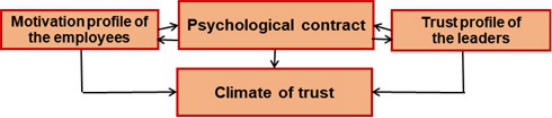
Ever since Niklas Luhmann’s first publication on trust as a mechanism for reducing social complexity in 1968 (Luhmann, 1968), a growing number of sociologists and organizational psychologists has investigated the phenome- non and the effects of trust in organizations. As it became evident that the role of trust for the economics of business organizations has so far been unde- restimated, research on trust also found its way into management/leadership theory and into organizational economics, relating to productivity, innova- tiveness and aptitude to change. However, companies wanting to apply this knowledge to actually work on their climate of trust were confronted with many only partial concepts emphasizing either the individual trust characte- ristics of humans or the characteristics of trust in systems and organizations. Since 2000, the Trust Management Institute (TMI) has taken stock of the various conceptual models proposed and of empirical studies on trust in orga- nizations and showed that the individual trust characteristics of humans, the psychological contract between a company’s leadership and its employees and the climate of trust of organizations are highly interdependent (see Figure 1).
To substantiate this interdependency, TMI developed, tested and zeroed in on workable trust assessment tools and gained a stock of case examples in which these tools and derived action programs helped companies to protect or build trust while going through change (Sommerlatte and Keuper, 2016, Sérieyx and Fallou, 2010).
Figure 1: Interdependency of the constituents of trust in an organization.
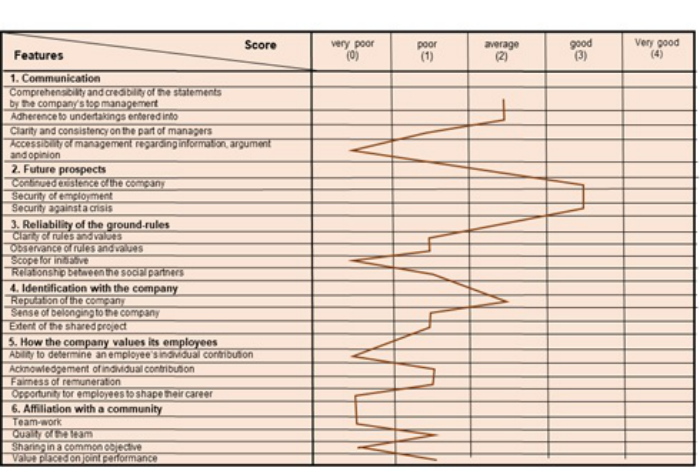
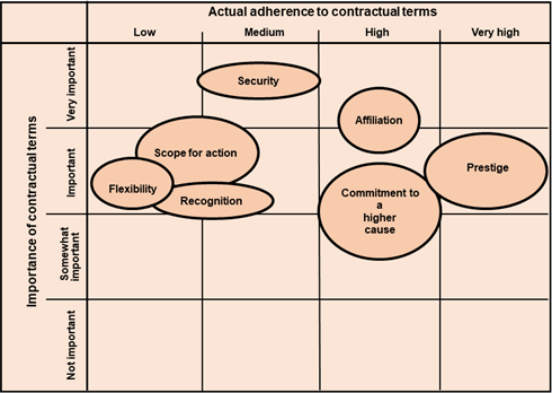
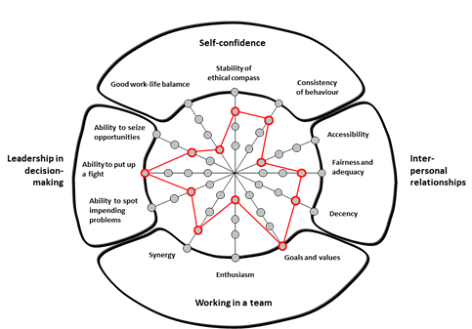
DEVELOPING TOOLS AND AN APPROACH FOR ASSESSING AND HELPING TO BUILD TRUST TMI’s first step when assisting companies to care about trust is to assess the status of their climate of trust. Our approach consists of looking at a number of indicators which contribute to what people feel as being the cli- mate of trust, e.g. the characteristics of communication in the organization, the reliability of the functioning of the organization, the perspectives of the organization, the identification of the employees with the organization, the appreciation of the employees by the leaders, and the sense of community. While the characteristics of the meteorological climate are measurable with instruments, in the case of the climate of trust we have to turn to a psycho- metric survey of the employees or a representative sample of them. They are invited to anonymously rate a number of statements which, in the aggregate, are translated into an overall profile of the climate of trust (see Figure 2) and can be broken down by hierarchical level, functional department and loca- tion. If and where this profile reveals weak spots, the second step is to look for causes by carrying out an assessment of the status of the psychological (unwritten) contract which, once brought to light, allows an insight into how the company meets the motivations of its employees and how, in turn, the employees respond in term of their commitment and loyalty. Discrepancies between the motivational needs of the employees and the degree to which these needs are met by the company (see Figure 3) are reasons for weaknesses of the climate of trust in the company. In most of our trust projects, we find that management is unaware of these discrepancies, and therefore deviations from or breaches of the psychological contract are one-sided without antici- pation of the negative effects on productivity, innovativeness and the buy-in for change. Be it because of this unawareness or because of other reasons (e.g. authoritarian leadership style), the individual trust profile of people in charge is in most cases at fault if the climate of trust is poor. The third step is the- refore to assess the trust profile of the company’s leaders. This is, of course, a delicate matter and has to be done, in order to be accepted, absolutely confidentially, leader by leader, and has to be kept inaccessible for anybody else. The psychometric indicators for the individual trustworthiness and abi- lity to trust others can be grouped in 4 dimensions: self-confidence, trust in one-to-one relations, trust in team situations, and trust in decision-making, each of these dimensions being the result of several specific characteristics. Each leader is invited to establish his or her own trust profile, exclusively for his or her own purpose, by rating a series of characteristics along a detailed checklist of descriptors (see Figure 4). In agreement with him/her, colleagues
Interrelation of Organizational Climate of Trust and Business Performance 113
Figure 2: Example of the assessment of the climate of trust.Figure 3: Example of an assessment of the status of a psychological contract.
such as a superior, a colleague at equal level and a colleague reporting to him/her can be asked to provide their assessment to be used confidentially to point out aspects where the self-assessment may have to be reconsidered. To have gained a clear picture of his/her trust profile and to be able to relate it to unsatisfactory aspects of the climate of trust and problematic deviations from what the terms of the psychological contract with the employees should be, creates in most cases the stimulus to work on one’s way of communica- ting, behaving and relating to others in the company and possibly to external contacts as well.
114 Sommerlatte
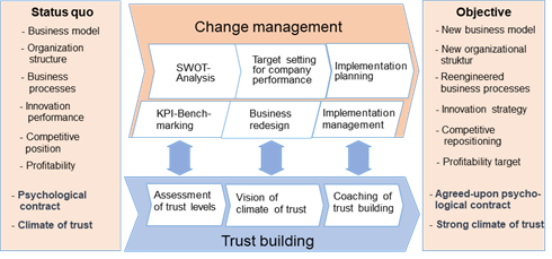
Figure 4: Example of the trust profile of a leader.Figure 5: Combining structure and process change management with trust building.
TRUST BUILDING IN TRANSFORMATIONAL PROCESSES The psychological contract and the climate of trust in an organization are particularly at stake when external and internal changes happen or are deliberately undertaken, especially under competitive pressure, to improve productivity, to restructure or to revise the company’s strategy. The known approaches to change management can be made considerably more effe- ctive by drawing on the methods of trust-building all along the process (see Figure 5).
In fact, empirical studies have shown that rationalizing business processes does not or only after several readjustments lead to the aimed at produ- ctivity improvement if trust relations have been neglected and negatively impacted in the process (Smollan, 2013, Sorensen, Hasle, Pejtersen, 2011, Klijn, Edelenbos, Steijn, 2010). Similarly, the innovativeness of a company can diminish if the psychological contract is one-sidedly changed as a result of reorganization or restructuring (Scott-Morgan, 1994). Trust building as an inherent part of any transformation therefore permits to secure a sub- stantial competitive advantage (Davis, Schoorman, Mayer, Tann, 2000). Our integrated model of assessing the climate of trust, the status of the psycho- logical contract and the individual trust profile of the leaders of a company
Interrelation of Organizational Climate of Trust and Business Performance 115
has allowed us in a growing number of cases to bring about a more effective approach to enhancing business performance (Sommerlatte, Keuper, 2016).
CONCLUSION
Trust-based leadership is becoming a growing requirement of today’s human resource management as a new generation of employees, the millennials with different values and ways of socializing, expects to understand and be invo- lved in what it is to participate in. It is therefore high time to transfer the results of sociological and psychological trust research into practical approa- ches of building trust. For this, TMI has developed tools to assess the factors and the quality of trust both at the individual and at the organizational level. Applying these and creating awareness of the effects of trust on productivity, innovativeness and organizational flexibility has proven as an important step to change behavior towards trust worthiness and readiness to trust. Examples of companies that have made good progress in moving towards trust-based management are AbbVie, Inc., Porsche AG, Heraeus GmbH, B.Braun Mel- sungen AG, and Schott AG. Their climate of trust has clearly contributed to their stable performance (re Sommerlatte and Keuper, 2016).
REFERENCES
Davis, J.H. Schoorman, E.D. Mayer, R.C. Tann, H.H. (2000). The trusted general manager and business unit performance: Empirical evidence of a competitive advantage. Management Journal, 21, 563–576 Klijn, E.-H. Edelenbos, J. Steijn, B. (2010). Trust in governance networks: Ist impact
on outcomes. Administration & Society, 42(2), 193–221 Luhmann, Nikolas (1968). Vertrauen: Ein Mechanismus der Reduktion sozialer Komplexität. Stuttgart: F. Enke Verlag Scott-Morgan, Peter (1994). The Unwritten Rules of the Game. McGraw-Hill
Professional Sérieyx, Hervé. Fallou, Jean-Luc (2010). La Confiance en Pratique: Des outils pour agir. Paris: Maxima Smollan, R.K. (2013). Trust in change managers: The role of affect. Journal of
Organizational Change Management, 26(4) Sommerlatte, Tom. Keuper, Frank, ed. (2016). Vertrauensbasierte Führung: Credo und Praxis. Berlin, Heidelberg: Springer-Gabler Sorensen, O.H. Hasle, P. Pejtersen, J.H. Trust relations in management of change.
Scandinavian Journal of Management, 27(4), 405–417
LISTED IN THE AHFE DIGITAL BOOKSTORE CATALOGUE
Explore the complete digital volume
Human Factors in Management and Leadership
Read this individual research paper free through the original publisher, or explore the full digital proceedings book.
ISBN 978-1-958651-31-5
Explore this ISBN in the AHFE Bookstore ↗Listed in the July 2026 bookstore catalogue; search by ISBN to confirm current availability · Digital book purchase optional