Emilsy Medina, Diana Londoño, Biviana Ramirez (2025). Workplace Burnout and its impact on productivity in the service sector of the city of Bogotá D.C., Colombia. In: Neuroergonomics and Cognitive Engineering. AHFE Open Access, vol. 167, pp. 83–92. https://doi.org/10.54941/ahfe1006130
The research evaluates job burnout in two service sectors in Bogota: the food industry, specifically in restaurants, and the beauty industry. The main objective is to measure the impact of job burnout on productivity in these organizations. The ProSalud-MBL instrument, which relates job burnout factors to productivity, was used and applied to a sample of 72 workers in three restaurants and two hairdressing salons.The mixed approach research required the informed consent of the participants, who were trained on the objectives and process of the study. The ProSalud-MBL instrument uses a Likert scale from 0 to 6, to indicate the frequency with all respondents identify themselves with various statements. This instrument makes it possible to establish alert levels of burnout, ranking them as high, medium and low, which helps in the implementation of interventions according to severity.According to the results, in the food sector, participants in the sample were mainly single men, with less than half of them being fathers; most of them had a university education and had been working for less than 36 months. In contrast, the sample in the beauty sector is made up mostly of women, 50% of whom have children, and with a predominant educational level of high school and technical school. Both groups report long working hours, exceeding 10 hours per day, and little time for recreational activities.Workers in both sectors consider their work to be repetitive, with few breaks, which contributes to fatigue. The attention required to perform tasks is perceived as medium to high, which can increase the risk of accidents. The most critical dimension reported by the participants is the Work-Family Relationship, which suggests the need for strategies to improve this aspect, common in all the organizations studied. The analysis of the five organizations revealed that restaurants presents the most worrying levels of Job Stress, Work-Health Relationship and Work-Family Relationship. However, the elements related to the dimensions of “Fulfillment of Organizational Goals” and “Self-Management and Organizational Support” were rated positively in all organizations.The use of the ProSalud-MBL instrument is fundamental for linking job burnout with productivity, making it possible to measure its impact on work performance. In addition, it facilitates the quantification of the gap between the current and ideal situation, which helps to identify weaknesses and establish appropriate corrective actions. The research highlights the importance of addressing job burnout to improve productivity in the sectors analyzed, especially by strengthening the work-family relationship, a dimension reported as the most compromised according to the perception of workers in the five organizations.
The research focuses on evaluating occupational burnout and productivity within the service sector in organizations located in Bogotá, D.C. To achieve this, a descriptive quantitative study was conducted as part of a project by the GINTECPRO research group of the Industrial Engineering Program at El Bosque University. The project, titled “Evaluation of Occupational Burnout for Measuring Its Impact on Productivity in Service Sector Organizations in Bogotá, Colombia,” involved two groups of undergraduate students. One group, led by Estupiñán (2022), focused on the food sector, while the other, led by González et al. (2022), concentrated on the beauty and cosmetics
sector. These students developed their degree projects and contributed data and findings, facilitating a comparative analysis of occupational burnout and productivity across these two service sectors in Bogotá.
Theories related to stress have gained prominence in the 21st century (Camacho, 2019). However, the beginnings of research on this subject date back to 1974, when psychiatrist Herbert J. Freudenberger used the term “burnout” to refer to a specific clinical symptomatology observed in workers whose work activities involve helping others. Subsequent studies by Edelwich & Brodsky (1980), Cherniss (1980), and Maslach & Jackson (1981) further explored this phenomenon. Notable contributions have also been made by Gil-Monte et al. (1995), Leiter (1988), Schaufeli & Dierendonck (1993), Yepez (2019), among others.
There are many definitions of the term “burnout” proposed by different authors. Notably, Grandjean (2001) defines work burnout as various human conditions that diminish resistance and work capacity. An important perspective is provided by Balseiro (2010), who considers burnout a consequence of exertion that leads to a lack of energy and motivation. Maslach & Jackson (1981) characterized burnout through three dimensions: emotional exhaustion, depersonalization, and a reduced sense of personal accomplishment According to Barrios & Illada (2014), healthy productivity can be achieved by managing the multifactorial scenarios that impact workers, including burnout and various organizational components. To address this, Barrios & Illada developed and applied the ProSalud-MBL instrument, which was also utilized in the present research.
There are several methods to measure burnout syndrome; however, the most widely used in related research is the Maslach Burnout Inventory, which has three version: MBI-Human Services Survey (MBI-HSS, Maslach & Jackson, 1981): MBI-General Survey (MBI-GS, Salanova & Llorens (1996), MBI-Educators Survey (MBI-ES, Schwab, 1986). However, these instruments do not directly relate occupational burnout to productivity as the ProSalud-MBL (Barrios & Illada, 2014) does.
MATERIALS AND METHODS
This study employs a descriptive and quantitative research design, utilizing a convenience sampling method, which involves selecting accessible cases that agree to participate (Otzen & Manterola, 2017). In the food sector, three restaurants accepted the invitation to participate in the study, resulting in a sample of 27 participants. The characteristics of these participants are detailed in Table 1.
Table 1: Sample characteristics of de food sector (authors, based on Estupiñan, 2022).
Table available in the original PDF paper.
Characteristics Restaurants Women 30% Men 70%
Continued
Workplace Burnout and Its Impact on Productivity in the Service Sector 85
Table 1: Continued Characteristics Restaurants
Table available in the original PDF paper.
Age range (years) 19-37 Single 93% Employees with children 40% High school level 13 Medium Technicians 1 Senior Technicians 5 University 7 Length of service (months) 1-36 Usually practice sports 26% Social Gatherings 12% No extras activities 62% Total staff 27 The job positions and the number of individuals in each role are as follows: waiters (11), chefs (3), assistant chefs (3), bartenders (3), customer recruiters (2), cashiers (3), and hostesses (2).
In the Beauty/Cosmetics sector, a hairdresser with two locations participated in the research, resulting in a sample of 45 employees (Table 2).
Table 2: Sample characteristics of Beauty/cosmetics sector (authors, based on Estupiñan, 2022).
Table available in the original PDF paper.
Characteristics Hairdresser (Both Location) Women 64,8% Men 29,17% Other 6,25% Age range (years) 18-69 Single 73,17% Children 51,21% High School level 19 Medium Technicians 14 Senior Technicians 3 University 4 Length of service (years) Less than 1 year 38% between 1 and 5 years 28,5% More than 5 years 33,3%. Usually practice sports 8,7% Social Gatehrings 23,9% No extra activities 67,4% Total staff 45
The job positions and the number of individuals in each role are as follows: hairdressers (16), manicurists and pedicurists (10), aestheticians (6), barbers (5), reception staff (3), general services (3), and security guards (2).
The total sample for both sectors consisted of 72 individuals who voluntarily participated in the research. They were informed about the objective and methodology of the study and agreed to sign an informed consent form.
To assess burnout syndrome and its impact on productivity, the ProSalud- MBL instrument (Barrios & Illada, 2014) was administered. This tool measures the impact of burnout-related factors on productivity, providing significant added value for job analysis and offering great relevance in the field of industrial engineering.
The instrument is divided into two parts. The first part collects data on the job and worker, the cognitive and mental demands of the job, health and quality of life, as well as information related to benefits and productivity. The second part gathers data on the five (5) dimensions included in the ProSalud- MBL to evaluate burnout and its effects on productivity:
Work Tension (TL*): Refers to both physical and emotional fatigue caused by daily work pressure, combined with a loss of motivation.
Work-Health Relationship (RTS*): Relates to the impact of burnout on the worker’s health.
Work-Family Relationship (RTF*): Concerns the balance between working hours and time dedicated to family and recreational activities.
Organizational Goal Fulfillment (CMO*): Involves the worker’s self- perception of their efficiency in meeting goals and contributing to organizational objectives.
Organizational Self-Management and Support (AAO*): Reflects management support in decision-making, task execution flexibility and autonomy, and personal satisfaction with the organizational climate.
*The acronyms used for each dimension correspond to the initials of their names in Spanish.
With this information, it is possible to quantify occupational burnout (wearout) — Equation 1 — and productivity — Equation 2 — as defined in the ProSalud-MBL method: Wearout = 1.948*10-12 + 0.887 *TL + 0,332*RTS + 0,129*RTF
(Wearout) Equation 2. Productivity as a function of wearout (Barrios & Illada, 2014) The first equation relates the dimensions of Work Tension (TL), Work-Health Relationship (RTS), and Work-Family Relationship (RTF) to determine the impact of these dimensions on occupational burnout. The second equation measures labor productivity, associated with Organizational Goal Fulfillment (CMO) and Organizational Self-Management and Support (AAO), both of which are affected by burnout-related factors.
The severity scale for the TL, RTS, and RTF dimensions is defined as follows: Values between 0 and 1: Low criticality / Low alert Values between 2 and 3: Medium criticality / Medium alert Values between 4 and 6: High criticality / High alert. Likewise, for the CMO and AAO dimensions, the scale is:
Values between 0 and 1: High criticality / High alert
Workplace Burnout and Its Impact on Productivity in the Service Sector 87
Values between 2 and 3: Medium criticality / Medium alert Values between 4 and 6: Low criticality / Low alert. Recommended intervention times based on alert levels are: High alert level: Immediate intervention at the workplace Medium alert level: Short- to medium-term intervention Low alert level: Safe condition, but requires regular monitoring to ensure continuity.
RESULTS
In the food sector sample, most workers were young and single, with 40% having children. About 48% had a high school education, and 26% had university-level education. Notably, few participants reported engaging in sports or social activities.
The participants reported having the possibility to take breaks during the workday. In all three organizations, 100% of the women reported being in excellent health, while among men, the perception of excellent health ranged between 28% and 50%.
The symptoms most commonly reported by workers over the last three months include a tendency to sweat and/or experience palpitations, as well as an increased tendency to eat, drink, or smoke more than usual. Regarding salary compensation, participants from restaurants 1 and 2 indicated that they are always or often able to meet their needs with their current wages. However, in restaurant 3, 88.8% of the workers stated that their salary only sometimes meets their needs, indicating they do not consider it sufficient.
In relation to the Work Tension (TL) dimension, a high alert was found in response to statement 9 – “I am emotionally exhausted by my job” – with 90% agreement, and statement 5 – “I feel physically tired from my job”– with 70% of respondents expressing agreement. Similarly, within the Work-Family Relationship (RTF) dimension, high alert was observed for statement 10 – “I do my work only for the remuneration” – and statement 11 – “My dedication to work limits the time I spend with family and friends”, both with 70% of participants in agreement.
However, the Work-Health Relationship (RTS) dimension showed high alert across all participants for statement 16 – “Lately, I have been more fatigued or tired than usual”. Additionally, 40% of respondents showed high alert for statement 14 – “The work I do impacts my personal health.”
For the Self-Management & Organizational Support (AAO) and Fulfillment of Organizational Goals (CMO) dimensions, participants did not report any high alert indicators in any of the workplaces. Figure 1 presents the consolidated results for the five dimensions evaluated in the food sector sample.
As shown in Figure 1, the first restaurant presents the highest risk of occupational burnout among its workers, with the dimensions of Job Stress (TL),Work-Family Relationship (RTF),and Work-Health Relationship (RTS) being the most affected.
Figure 1: Consolidated results for the food sector (authors, adapted from Estupiñan, 2022).
By calculating the values for these dimensions, the wearout and productivity levels for restaurant number 1 were determined using Equations 1 and 2 mentioned earlier. The wearout variable was found to range from 2.9 to 5.8, with an average of 4.64, which is above the general average (4.041). The job positions with the most critical values were: hostess (5.76), waiters (5.37), and cooks (5.32). Similarly, productivity values ranged from 3.69 to 4.98, exceeding the variable’s average value (3.37), with waiters reporting the lowest productivity level (3.69).
However, in the second restaurant, the wearout variable ranged between 0.58 and 2.42, which is below the overall average (4.041). Therefore, this restaurant does not exhibit critical values in this dimension, although critical values were reported among waiters. The productivity level in this restaurant ranged from 5.33 to 5.82, which is close to the maximum value (6.64).
Finally, in the third restaurant, wearout values ranged from 0.53 to 2.22, similar to the second restaurant. Productivity values ranged between 5.37 and 6.35, also nearing the variable’s maximum value.
Comparatively, restaurant number 1 had the highest levels of wearout, with critical values, while the other two restaurants showed similar results in terms of wearout and productivity, with restaurant number 3 reporting the best outcomes.
It is important to clarify that the relationship between wearout and productivity, as determined by the equations in the ProSalud-MBL method, is not directly proportional. In other words, the job position with the highest wearout value does not necessarily correspond to the lowest productivity value. This is because, if the AAO (Self-Management & Organizational Support) and/or CMO (Fulfillment of Organizational Goals) dimensions are at low alert levels, they can offset the wearout factor. Conversely, if these dimensions are also on high alert, they negatively impact productivity.
Workplace Burnout and Its Impact on Productivity in the Service Sector 89
Regarding the application of the ProSalud-MBL instrument in the beauty and cosmetics sector, the sample consisted of 64.58% women, 29.17% men, and 6.25% unspecified. The largest age group (38%) fell within the 30–39 age range, followed by 20% in the 19–29 age range. Of these participants, 42% were high school graduates, and 31% had middle-level technical education. Additionally, 60.8% of hairdressing employees worked 11-hour shifts in both locations, while 19% worked between 14 and 16 hours per day, making their workload highly demanding. Furthermore, 22% of workers who worked 10 or more hours per day were single parents, representing a complex social aspect.
Respecting cognitive load, 92.31% of participants at site 1 and 86.36% at site 2 perceived their job activities as repetitive, which contributes to burnout. Additionally, 73.1% reported that their tasks required a high level of attention, further impacting their physical and cognitive exhaustion due to prolonged exposure.
Most participants stated that they could take breaks beyond those mandated by regulations. However, 23.08% reported that they were unable to do so. In terms of health perception, significant differences were observed between the two sites. At site 1, 89.28% of workers reported their health as good, very good, or excellent, while at site 2, this percentage dropped to 59.09%. This finding was further supported by reports of symptoms experienced in the past three months: at site 1, 30.76% of workers reported experiencing muscle pain occasionally or at least once a month, while at site 2, this percentage increased to 63.3%. Another commonly reported symptom was headaches or migraines, with 34.51% of workers at site 1 and 42.2% at site 2 experiencing episodes in the past three months. Regarding salary, 30.77% of participants at site 1 and 47.38% at site 2 stated that their wages always or often covered their expenses. This indicates that most workers perceive their salaries as insufficient. However, when asked whether their salaries were fair based on their experience and job responsibilities, 57.9% to 65.38% of participants in each location responded affirmatively.
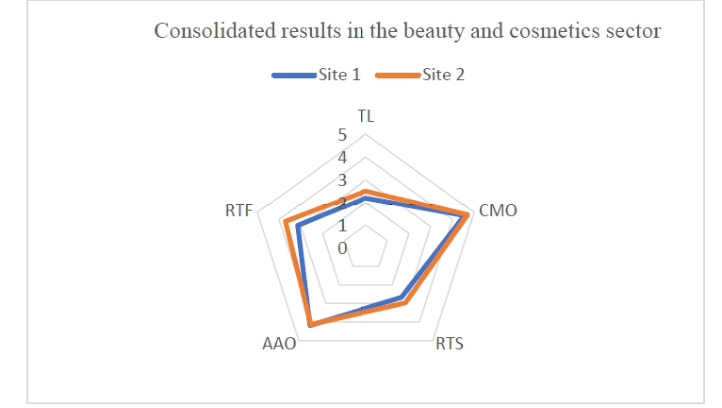
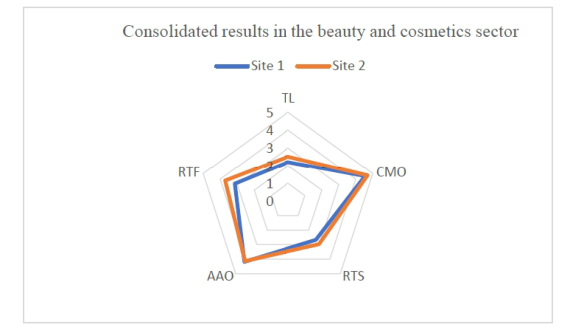
Figure 2: Consolidated results in beauty and cosmetics sector (authors, adapted from Gonzalez et al., 2022).
As illustrated in Figure 2, the most critical dimension across both locations is the Work-Family Relationship (RTF). This is primarily due to the extended working hours, with 80% of participants exceeding the standard 8-hour workday. At the time of the study, Article 161 of the Colombian Substantive Labor Code stipulated a maximum of 8 working hours per day or 48 hours per week. However, as of July 15, 2024, Law 2101 of 2021 has amended this, reducing the maximum workweek to 46 hours.
The dimensions related to Fulfillment of Organizational Goals (CMO) and Self-Management and Organizational Support (AAO) generally received positive evaluations at both locations. Nonetheless, some participants expressed concerns, particularly regarding the support provided by the organization to its employees.
The wearout scores were quantified at 3.21 for location 1 and 3.64 for location 2. Productivity scores were 3.79 and 3.78, respectively. Both wearout scores are below the average threshold of 4.041, indicating non-critical levels. Productivity scores in both locations are above the average value of 3.27, reflecting satisfactory performance.
Table 3: Sample characteristics of beauty/cosmetics sector (authors, based on Gonzalez et al., 2022).
The highest levels of Work-Tension (TL) are reported in Restaurant 1 and both hairdressing locations. This is attributed to both physical and emotional fatigue resulting from prolonged working hours and diminished motivation. Participants notably reported higher levels of fatigue in statements such as “I feel physically tired from my work” and “I am emotionally exhausted by my work,” reflecting the demanding nature of their customer service roles.
Elevated scores in Work-Health Relationship (RTS) align with the TL findings, particularly in the statement “Lately, I have been more fatigued or tired than usual”.
Work-Family Relationship (RTF) dimension exhibits the highest criticality, affecting 80% of the participating organizations. High scores were noted in statements like “I do my job only for the remuneration” and “My dedication to work limits time with family and friends,” indicating a significant impact on personal life and job satisfaction.
The Organizacional dimensions (CMO and AAO) show low risk levels. However, Restaurant 2 presents exceptions, with participants expressing concerns over limited flexibility and unclear instructions, leading to high alert levels in these areas. Despite this, Restaurant 2 reports the lowest wearout levels, suggesting that other factors may mitigate the impact of organizational shortcomings.
Workplace Burnout and Its Impact on Productivity in the Service Sector 91
Restaurant 3 stands out with the highest productivity score, combining low wearout levels with strong organizational support and goal fulfillment.
The food sector demonstrates up to 53% higher productivity compared to the beauty and cosmetics sector, as calculated using the ProSalud-MBL equations (Barrios & Illada, 2014).
Across both sectors, the Work-Family Relationship dimension consistently emerges as the most critical factor influencing job burnout, underscoring the need for interventions that address work-life balance.
CONCLUSION
The assessment of occupational burnout within Bogotá’s food and beauty/cosmetic service sectors provided valuable insights into the levels of burnout experienced by workers and its correlation with productivity. Utilizing the ProSalud-MBL instrument, based on the equations developed by Barrios and Illada (2014), the study evaluated five key dimensions: Work Tension (TL), Work-Family Relationship (RTF), Work-Health Relationship (RTS), Fulfillment of Organizational Goals (CMO), and Self-Management and Organizational Support (AAO). Among these, the Work-Family Relationship emerged as the most affected dimension, primarily due to the extended work shifts common in both sectors.
To address these challenges, it is recommended that organizations: review and adjust work schedules, align work shifts with legal standards to enhance employees’ work-life balance, facilitating participation in recreational and social activities; strengthen induction processes, clearly define roles and responsibilities to ensure employees have a comprehensive understanding of their duties and conduct ergonomic assessments to identify and mitigate biomechanical risks in the workplace to reduce physical fatigue associated with job tasks.
Proactive measures are essential in safeguarding workers’ health. Organizations should prioritize preventive strategies, fostering environments that promote both mental and physical well-being. Empowering employees through education and training can further enhance their capacity for self-care.
While high levels of burnout can sometimes be offset by strong organizational support, a holistic approach addressing all five dimensions is crucial for optimizing productivity. The ProSalud-MBL instrument proved effective in quantifying the gap between current conditions and ideal scenarios, enabling the identification of specific areas for improvement.
Implementing targeted interventions not only fulfills ethical and social responsibilities but also contributes to enhanced productivity, benefiting both employees and organizations. Future research should consider applying this instrument across diverse service sectors to derive more generalized conclusions and recommendations.
ACKNOWLEDGMENT
The authors extend their sincere gratitude to the participating organizations and volunteers whose contributions were invaluable to this research.
Appreciation is also directed to the students whose efforts enriched the project’s development. Lastly, acknowledgment is given to El Bosque University for its unwavering support and commitment to fostering research initiatives.
REFERENCES
Balseiro, L. (2010). Burnout syndrome. As an Occupational Risk Factor in Nursing Staff. Mexico. Editorial Trillas. Barrios M. and Illada R. (2014). Effects of Burnout, as a Psychosocial Risk, on
Productivity. Dissertation. University of Carabobo. https://mriuc.bc.uc.edu.ve/b itstream/handle/123456789/493/mbarrios.pdf Camacho C (2019). Una Mirada desde el Síndrome de Burnout hacia la Gerencia Integral en el siglo XXI. Instituto Internacional de Investigación y Desarrollo Tecnológico Educativo INDTEC, C. A. doi: https://doi.org/10.29394/Scientific.i ssn.2542-2987.2019.4.13.2.40-59 Cherniss, C. (1980). Agotamiento del personal. Londres: Sage Publications. Edelwich, J., & Brodsky, A. (1980). Burnout: Stages of disillusionment in helping
professions. New York: Human Sciences Press. Estupiñan, D. (2022). Evaluación del desgaste laboral en el sector de restaurantes de la ciudad de Bogotá. Universidad El Bosque, Colombia. https://repositorio.unbo sque.edu.co/handle/20.500.12495/7817 Gil-Monte, P. R., Peiró, J. M., & Valcárcel, P. (1995). A causal model of burnout
process development: An alternative to Golembiewski and Leiter Models. Paper presented at the VII European Congress on Work and Organizational Psychology. Gyor: Hungary. Gonzalez, D, Gonzalez C, & Granados, N (2022). Propuesta de mejora para la productividad de la mano de obra en la empresa Martin Vidal de la ciudad de Bogotá. El Bosque University. Colombia. https://repositorio.unbosque.edu.co/ha ndle/20.500.12495/9562 Grandjean, E. (2001). Encyclopaedia of Occupational Safety and Health (ILO). 3rd
Edition. Chapter 29. General fatigue. Geneva. Leiter, M. P. (1988). Burnout as a function of communication patterns. Group and Organization Studies, 13(1), 111–128. Otzen, T & Manterola, C. (2017). Sampling techniques on a population under study.
International Journal of Morphology. https://scielo.conicyt.cl/pdf/ijmorphol/v35n 1/art37.pdf Salanova, M & Llorens, S (1996). Estado actual y retos futuros en el estudio del Burnout. Papeles del Psicólogo. Vol. 29 (1), pp. 59–67. Schaufeli, W. B., & Dierendonck, D. (1993). The construct validity of two measures
of burnout. Journal of Occupational Behavior, 14, 631–647. Schwab R. (1986). Burnout in education. En: Maslach C, Jackson SE. Maslach Burnout Inventory: Manual. Palo Alto, California: Consulting Psychologists Press. Yépez A. (2019). Burnout syndrome, The suffering of workers who treat whit clients
and users. Visions from the ergonomic point of view. Research and Development Journal. Vol. 1(3): 55–74 ISSN 2452–4859. pp. 55–74. Burnout syndrome. https: //revistas.udec.cl/index.php/Ergonomia_Investigacion/article/view/1348/1977
LISTED IN THE AHFE DIGITAL BOOKSTORE CATALOGUE
Explore the complete digital volume
Neuroergonomics and Cognitive Engineering
Read this individual research paper free through the original publisher, or explore the full digital proceedings book.
ISBN 978-1-964867-43-4
Explore this ISBN in the AHFE Bookstore ↗Listed in the July 2026 bookstore catalogue; search by ISBN to confirm current availability · Digital book purchase optional