Jie Gao, Yifan Li (2022). From design to verification - Case Study of Vehicle Interaction and Experience design. In: Ergonomics In Design. AHFE Open Access, vol. 47, pp. 698–705. https://doi.org/10.54941/ahfe1002000
With the acceleration of scientific and technological innovation in the Internet, big data, cloud computing, artificial intelligence, 5G communications and other technologies, the digital economy driven by intelligent vehicles is becoming a key field that countries around the world are competing to develop. In the automotive industry with the implementation and development of the strategy of new energy, intelligence and network connection in the automobile industry, the design idea is also transformed from the "product-centered" to "user-centered".Interaction and experience design integrates the participation of consumers into the design. Experience is regarded as "stage", products as "props" and environment as "scenery", designers trying to make consumers feel good experience in the process. The purpose of experience design is to immerse users in beautiful and comfortable experience in the process of using the product, so as to recognize the value of the product, generate resonance and loyalty. In the field of product design, this concept has been widely used. In recent years, the authors have participated in the design work of a number of production cars and concept car projects, but follows the traditional styling development process of the automobile industry, and pays more attention to "style". In the future, based on the usage scenarios and user needs, the author will formulate design direction and carry out design and development through the experience design research of immersive cockpit. Based on the vehicle level project of a certain brand, this paper analyzes the workflow and method of vehicle interaction and experience design through four stages: design research, design definition, design development and design verification. At present, the authors are still using this methodology to implement design and validation in production vehicle projects.Keywords: Automotive design, Experience Design, Design process
Automobile styling design, as a branch of traditional industrial design, has always pursued the Bauhaus design philosophy of “function determines form”. For nearly a century, it has judged the merits and disadvantages of design based on the value of “product-centered” and improved it.
From Design to Verification - Case Study of Vehicle Interaction and Experience Design 699
In China, with the success of intelligent technology in the field of consu- mer electronics and household appliances, the automobile industry is also slowly transforming to the “New automobile four modernizations”, which respectively refers to: electrification, network connection, intelligence and sharing.
In the “new four modernizations”, the “electrification” as the basis, with “interconnection” as the link to achieve the collection of big data, gradu- ally achieve “intelligent” travel, may become a feasible way to achieve the ultimate goal of auto driving.
This paper is to analyze a case start in current background, which conduct experiential design research based on user needs, technical trends and brand positioning, clarify brand experiential design positioning, complete experie- nce, styling design and verification. The process and method reference ISO standard (ISO 9241-210, 2019).
METHODOLOGY
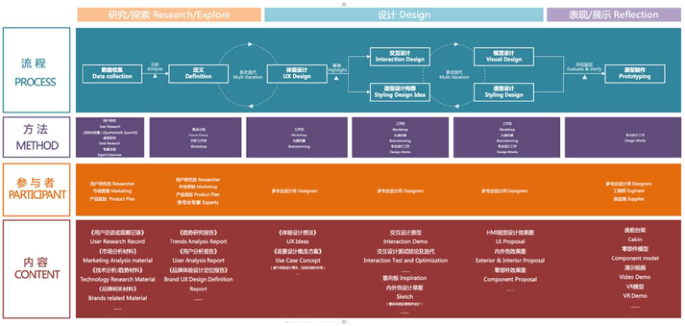
This case study is divided into four phases, which are: “research”, “defini- tion”, “design and development” and “verification”.
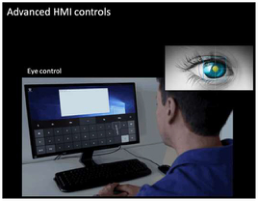
Research Phase In the design research stage, mainly carried out “user trend”, “brand trend”, “latest technology” (see Figure 1), “future driving force” four aspects of research and analysis.
The study collected 1127 future trends, from 34 expert interviews, exten- sive field research, analyzed global trends, out of the research emerged 11 key trends. All this research through the thorough process captured it into a mapping of different UX values for different brands of the company.
Definition Phase Design is really an act of communication (Norman. D, 1988). After resea- rch and analysis, this project aims at one of the electric vehicle brands of our company. The author and team members evaluated the previous desk research from the four dimensions of “virtual”, “reality”, “embrace” and “escape”, which were in line with the brand positioning.
Design and Development Phase Developed this UX vision that allows the customer to choose between having a lots of access to information, but thanks to intelligence of the car that people can detach and have more quiet moments.
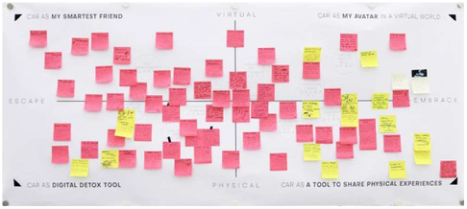
This phase started based on the future framework defined in the previous step. Ideas are mapped on the future framework considering role of the car in relation to the user (see Figure 2).
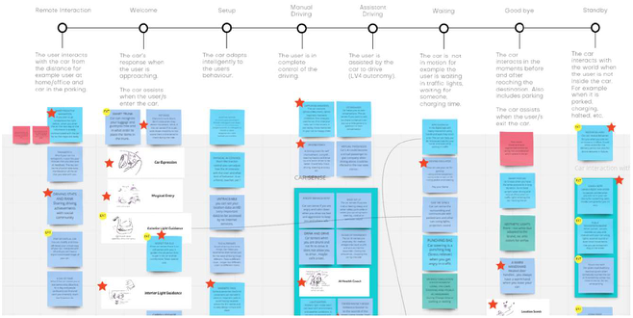
Ideas first mapped on the future framework and then general user journey (see Figure 3).
Key moments during a car journey, as a framework for the interactive car experience. Many ideas distributed across the key moments. The team mem- bers selected the top 25 interaction ideas, removed some of the less impactful
700 Gao and Li
Figure 1: One of the advanced HMI controls - Eye Control.Figure 2: Ideation research map.Figure 3: General user journey.
key moments, Combed the key moments into new areas of interest, resulted in 8 opportunity areas. For example, one of the ”key moment” is Autonomy, Manual Driving & Controls (see Figure 4). It’s inspire team members that the upcoming abilities of AI will introduce a new key transition: switching between autonomous and manual driving.
Eight opportunity areas as a basis for the 25 interaction ideas. For example, one of the UX idea is about “Eye tracking and UX model ” which related to the trend analysis to “the first phase” and the “Key Moments”.
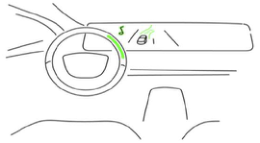
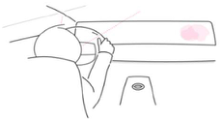
Peripheral Awareness (see Figure 5)
From Design to Verification - Case Study of Vehicle Interaction and Experience Design 701
The dashboard interface is designed to help driver focus on the road and avoid distractions by only showcasing abstract visuals in driver peripheral vision. These communicate the status of certain car settings and act as a logical starting point for making changes. Some are static others are more active, such as communicating if the cabin is actively being heated or cooled. The abstract communication is showcases on the material around the display using embedded LEDs.
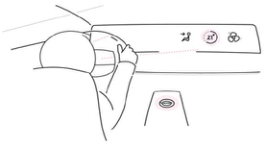
Eye Focus (see Figure 6) The dashboard interface understands when driver want to know more, which his naturally express by looking at the abstract visualization. When doing so, it adjusts to a more detailed state where he can highlight each of the more elaborate elements individually with gaze. It provides just the right information for his glance while also adding a hint where driver can take control to make changes.
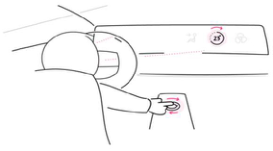
Tangible Control (see Figure 7) The dashboard interface changes to a control state when the driver touches the ”phygital” control element on the tunnel, allowing changes to be made. Eye contact does not need to be maintained as long as the ”phygital” control element is used, allowing the driver to safely make changes. This ”phygi- tal” control element could be moved to the steering wheel and a similar control interface could be in the armrests of all other passengers.
Based on these values the study has developed user journeys. Starting when people is still at home all the way to when he is back at home or at work parking. These hundreds of ideas were selected and translated into use cases.
Use cases define and describe what people can do in the car, why they will love to do that and also what technologies we need to be able to do that. Peo- ple can see the descriptions of what they can do in the car, the technologies needs and what actions are in the car. That is the root of the study, defining what customers to do in a car of the future. Those different use case described many different situations give insights for the content of the ideal interior of the next generation. People can see it in a structured approach that gives the study insight of all contents that are needed for the different parts of the car. All that together in visualization 3D interactive model that now allows the study to better show the final result. Doing that should went through different steps, working with 3D interactive models, testing it and also implementing the styling and constantly working back and forth. Hundreds of loops were done to get to the result.
That result is proposed the same ideas on two different layouts. But the UX principles are the same--”Reachability, Visibility, Flexibility Platform”.
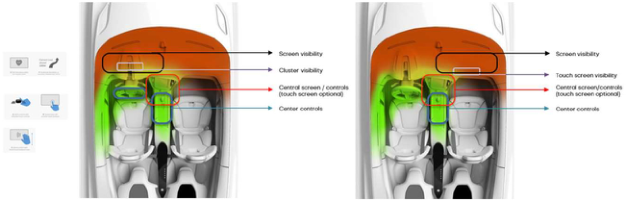
The best ergonomic position should consider not only driver but also passenger’s position (see Figure 8).
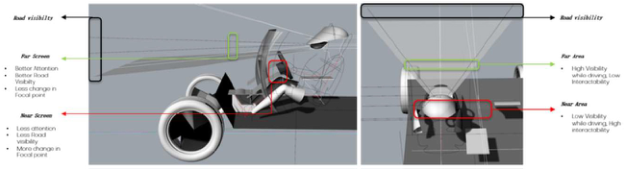
High and far screen positions have better visibility with low fatigue and are good for visual content. Low and near screen positions have less visi- bity with higher fatigue but are good for interactive content (see Figure 9).
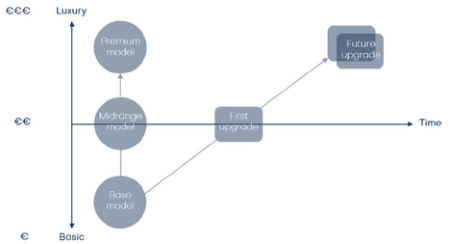
All necessary elements are positioned based on ergonomic analy- sis as a foundation for the base platform. They are designed in a way to be flexibly upgradeable with more advanced technologies. The base plat- form can be both scaled to more Premium models, as well as upgraded over time (see Figure 10).
From Design to Verification - Case Study of Vehicle Interaction and Experience Design 703
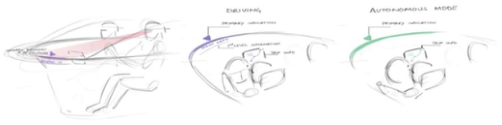
In the design and development stage, “experience design” drives “styling design”, and combines the method of “Sprint” commonly used by Internet companies on the basis of the traditional “waterfall flow”process. For exam- ple, designers will base on that method to use their sketch skill design the “eye tracking and UX model” solution (see Figure 11).
Make the center screen as another example. There are three different sta- ges. First, if people don’t look at the screen it has more pleasant aesthetics. Second, if people look at its screen start to see more information, and third, when people move their hand close to it will get the controls. So, this is the intelligence of the car, the information is shown to people when they actually need it, when they actually give attention to it.
The central control screen will interact intelligently with cluster, steering wheel, control panel, seats and other components in the interior, and provide users with a complete and continuous experience.
At the beginning of the creation of all design proposals, software engineers are involved to assist in making interactive prototypes, and constantly test the usability and ease of use of the proposals. The design proposal is not only
704 Gao and Li
Figure 12: The data of “UX test mockup”.Figure 13: Validation environment.Table 1. Examples of process implementation.
Table available in the original PDF paper.
Key Moment Use Case Design express Verification
Process Design Research Example Eye tracking
Based on the design principal design the proposals.
Peripheral Awareness Eye Focus Tangible Control
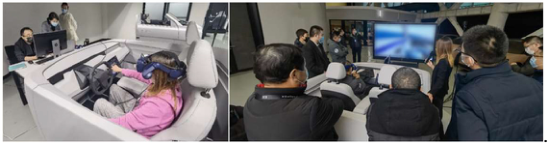
Tester sit in the hard model and ware VR headset to verify the eye control experience.
Communicate with vehicle like human being, especially during autonomy, manual driving & Controls.
Figure 14: Vehicle Interaction and Experience Design process.
expressed through classical rendering proposals, but also presented through physical modeling and VR simulation tests, we call it as “UX test mockup” (see Figure 12).
From Design to Verification - Case Study of Vehicle Interaction and Experience Design 705
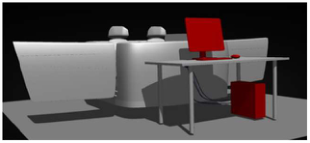
Verification Phase After the “UX test mockup” be build, the physical hardware is provided with an inductive surface,that this is used together with the VR headset to give a complete experience. In that VR headset, people could immersible use the steering wheel, cluster, door panel, dashboard and seats in the digital envi- ronment as same as in the environment. Besides tester themselves. In addition to the testers, observers can also be around to watch the experience design being tested simultaneously (see Figure 13). This mockup has some sensers and camaras, so team members could verify the “eye tracking” effect in this mockup.
CONCLUSION
With the user research, the author and team members defined what people would like the users to experience in the car, and the prototype at the end the study can allow everybody to experience that use cases and evaluate and validate it (see Table 1).
The processes (see Figure 14) and methods developed in this study can be applied to the experience design requirements of most cars, and have a certain guiding role in mass production projects in the era of intelligence. No matter how simple or complicated your business is, there’s one thing that determines if it’s a success or not: the customer (Miller, 2015).
REFERENCES
36kr: China autonomous Driving Industry Research Report (2021-2022). https:// 36kr.com/academe.html Ergonomics of human-system interaction-Part 210: Human-centered design for interactive systems. Reference number ISO 9241-210:2019(E). Iyiou: 2021 China Automotive Cockpit intelligent development Market demand
research report. https://www.iyiou.com/research Miller, Luke. The Practitioner’s Guide to User Experience Design. New York: Grand Central Publishing. 2015. Norman. D. The design of everyday things. New York: Doubleday. 1988. Shanghai Intelligent Vehicle Test and Demonstration Promotion Working Group:
Shanghai Intelligent Vehicle Development Report. Shanghai: 2022.
LISTED IN THE AHFE DIGITAL BOOKSTORE CATALOGUE
Explore the complete digital volume
Ergonomics In Design
Read this individual research paper free through the original publisher, or explore the full digital proceedings book.
ISBN 978-1-958651-23-0
Explore this ISBN in the AHFE Bookstore ↗Listed in the July 2026 bookstore catalogue; search by ISBN to confirm current availability · Digital book purchase optional