Benjamin Bush, Katherine Chastain (2022). Cardi B meets Chuck Taylors : Immersing high school students into the design process through a shoe design workshop. In: Design for Inclusion. AHFE Open Access, vol. 45, pp. 184–189. https://doi.org/10.54941/ahfe1001884
In the fall of 2020 a university recruiter and an industrial design faculty member met to engage and inform high school students through an hour and a half long workshop. Specifically, we wanted to target underrepresented people groups from within our state and give them a glimpse of what working in a creative profession might look like. As we started to develop the workshop we learned that we needed to strike a balance between three main criteria. We needed to reference practicing professional designers and share their experiences. We needed to champion a collaborative and iterative design processes. And we needed to make the content accessible and entertaining. The method by which we join and convey these criteria is through a shoe design workshop. Why shoes one may ask? Because all students have experience with footwear and all students have an option about their choice of fashion.From the very conception of the workshop we have held conversations with professional shoe designers on how to run this workshop. While industrial design faculty are well versed in the design process they frequently lack the real world experience of designing a shoe from idea to manufacturing and marketing. To compensate for a lack of knowledge we reach out to prominent shoe designers at Q4 Sports, Adidas, Cole Hann, and Fear of God. These designers stress conducting rigorous research and beginning any visual development using the lateral view. In addition, they gifted the workshop with the drawings of their most popular shoes so each student could use the same underlying framework that the professionals use. The second challenge is to champion the collaborative and iterative process. Sadly, the abundant mechanism of high school testing discourages conversations with peers and multiple correct answers. To boost collaboration we encourage students to support each workshop with the most recent information via social media. We allow them to use their phones during class so long that they add culturally relevant information to the existing framework. To encourage iteration we take the before mentioned conversations and collectively turn them into multiple visual concepts. And not only that, we reinforce collaboration by empowering students to tell the professor what concepts work and which ones do not.All the prep work comes down to choosing a topic of investigation that is entertaining, thought provoking, and relevant all while being able to be quickly translated into 2 dimensional shoe based artwork. Get it right and we will successfully introduce the next generation of students to the design profession. Get it wrong and become another ineffective outreach program that tries too hard. Now in our fifth iteration of the workshop, we wish to share our methodology as how we engage high school students with modular content that empowers them to learn the design process through the intersection of shoe wear and celebrity.
Cardi B Meets Chuck Taylors : Immersing High School Students into the Design Process 185
THE INTENTIONS Human There is a problem. Public colleges are becoming more exclusive and more homogenous. Test scores requirements rise, tuition increases, scho- ols place additional recruiting efforts recruiting higher paying students such as out-of-state and international students to support the increased cost of attending universities that share startling similarities to country clubs.
This trend is especially alarming when certain public institutions are desi- gnated as land grant universities. According to the Morrill Act of 1862 land-grant institutions are to emphasize agriculture and mechanical arts for the purpose of create opportunities for local working people previously exclu- ded from higher education (Morril, 1862). In a previous paper, “Design for All: Members Need Only Apply”, examined how a lack of diverse thought creates inferior design students (Bush, 2021).
Prior to the radical changes of the Covid-19 pandemic it was easy to gain an audience with a host of high school students and run in-person design exercises. In person workshops afford one to one interaction, custo- mization of feedback, and simulates the typically back and forth conver- sations that refine conceptual ideas. Without the predictability and intera- ctivity of the “in person classroom”, my colleague and I knew we needed to plan.
We had three goals entering the formation of the workshop. We knew that it must be entertaining. Edutainment, is possibly the only successful approach then engaging high schoolers who have come to rely on the instant gratification of social media. We wanted them to think critically and think outside the box. Many of the schools we wanted to engage with lacked art classes. We knew they could think in a literal sense, depending on their history, math, and science classes but we wanted them to feel free to que- stion not only what should be on a shoe, but rather what could be on a shoe.
We wanted them to embrace collaboration. Outside of team sports, high school students are typically assessed on their own merit, test scores, term papers, and homework. We wanted to mimic the professional design studio, as we do in our college studio classes, and have them build upon each other’s ideas. We embrace the presence of low-level chaos where everyone speaks out of turn and talks simultaneously. For this approach to work, we would need to give the students a topic they wanted to talk about.
And lastly, we knew we needed to stress the importance of communica- tion through presentation. Sharing one’s work is important but sharing one’s thought process has even more value in the design classroom. We have long past the age where everyone “colors”. Truthfully, only a select few high sch- ool students have been encouraged to pursue artistic endeavors. Knowing this, we purposefully asked all the students to draw and add color to their designs. We understood that a lack of confidence in visual skills causes stu- dents to not share their work. To address this, we encouraged students to write out their thoughts, and add “call-outs” on their paper to accompany the shoe design elements.
186 Bush and Chastain
HOW SHOE DESIGN ADDRESSES THESE CHALLENGES Design has a purpose, it’s not simply artistic expression. In many cases, desi- gns are created for certain targeted groups of people. We knew that we wanted to stress the importance of designing with a client in mind. We also knew that we needed to be very tactful with selecting our hypothetical cli- ents. For our workshop, the client served as a starting point for discussion and design objectives. To effectively engage high school students, we knew we needed individuals who were dynamic, atypical, and colorful. People who embodied texture and a complex, uplifting personality. We chose the following “celebrity” clients to aid in brainstorming collaboration.
Steph Curry | Steph is a household name. He is widely touted as being the “Michael Jordan of 3 Point shots”. While it takes height, explosiveness and leaping ability to dunk a basketball, anyone, with practice, can hit a - point shot. Steph is engaged with multiple initiatives beyond basketball such as “Nothing But Nets”, a charity that sends three malaria-preventing mosquito nets to Africa for every 3-pointer he makes.
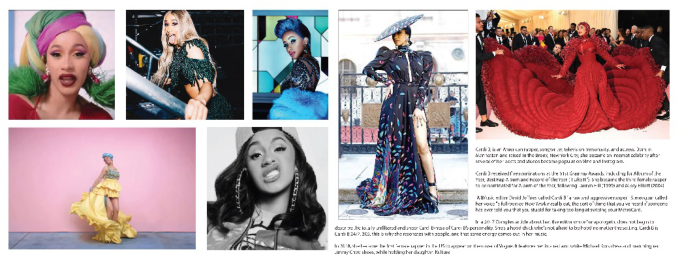
Cardy B | An artist that is overflowing with colorful personality. She is best known for her music; however, she got her start on social media. She has been described as a “raw and aggressive rapper”, and “a “hood chick who’s not afraid to be hood no matter the setting.” Her authenticity, her out- spoken nature, and complex cultural background makes Cardi B an exciting personality to discuss during workshops.
Misty Copeland | Misty Copeland is an American ballet dancer for Ameri- can Ballet Theatre (ATB), one of the three leading classical ballet companies in the United States. In 2015, Copeland became the first African Ameri- can woman to be promoted to principal dancer in ABT’s 75-year history. She has an incredible power to align both performance art and music com- munities. Not only has she spearheaded the dance industry by being an original, but she also holds many endorsements and philanthropic initi- ates. Beyond integrating dance into various spaces where it has not yet been considered, she is also an accomplished author and highly endorsed athlete.
Lin Manuel Maranda | Lin’s might be the most indirectly spoken about celebrity in our list. With the widespread fanfare of “Hamilton”Lin has fused hip-hop with American history. Beyond his work on Hamilton, he has also contributed to the Star Wars franchise, Mary Poppins, The Heights, Disney’s Moana, Vivo, and Encanto. He is of Puerto Rican descent and champions the story of the immigrant
Collaboration Proliferates Conversation We believe that everyone has an opinion about shoe design. The design object of “shoes” was specifically chosen because of their accessibility. We feel like shoes offer a low barrier to entry because we all have shared experiences in that space. It would be radically different if we challenged the students to design the interior of a private jet. It was our intention to draw out stu- dents’ opinions by referencing the previously mentioned clients and apply these opinions to the “canvas” of shoe wear.
Cardi B Meets Chuck Taylors : Immersing High School Students into the Design Process 187
Figure 1: Cardi B Mood Board.
Our collegiate design classroom is not only a place to debate opinions, rather we use this space to build upon one another’s ideas. We are simulta- neously open to the idea of building upon an opinion or walking one back. We realized this will most likely be counter to a typical high school environ- ment that not only discourages multiple speakers but also frequently submits that there is only one answer to a given problem. To offset these challen- ges, we actively did three things: we modeled collaborative brainstorming, we encouraged cell phone use to research specific areas of interest, and we openly confessed that some of our own design directions were not fruitful.
To kick off the collaborative brainstorming we supplied the students with images of their “clients” as well as two paragraphs regarding their profes- sional work and various contributions. These “mood boards” served as a catalyst in the event that our students were less familiar with the selected “client of the day”. There were levels of chaos to this phase, but we kept the discussions focused towards answering the question of “how do we identify the strongest character traits of this client?”
We also allowed in-class research. While looking at one’s cell phone is typi- cally discouraged, we wanted students to bring ultra-relevant conversations to the discussion. Students played an active role in the evolution of the design workshop, on a weekly basis, by contributing to the discussion via resea- rch. It was news, it was entertainment, and it helped keep the conversations relevant.
The concept of “failure” has such a negative connotation. We wanted to reveal to the high school students that weaker or underdeveloped ideas are just a natural part of the design process. We stressed that these less than fruitful explorations are not to be categorized as failures, rather, we consider them necessary elements leading us in the correct direction. It made sense for the workshop leaders to model this aspect of design in front of them; to encourage a flat hierarchy and create an environment where everyone pushes each other’s ideas forwards.
Presentation The shoe themed workshop does little to address the potential fears that accompany presenting one’s work to a classroom of peers. We needed to ask
188 Bush and Chastain
ourselves two things: how to best structure presentations and how to best incentivize presentations.
From the very beginning of the workshop, we communicated that we wan- ted participants to share their ideas. It is true that one can more easily share an intellectual thought point opposed to a production of a visual work. How- ever, the more students talk about their work, the more they begin to believe in that same piece of work. What we wanted them to do was bring some fulfillment and closure to what they had already brought to the class wide conversation.
To offset some of the fear and compensate for a potential lack of visual acuity we encouraged the students to use “call outs”. “Callouts” are conden- sed remarks that verbally describe an intended feature in a design. Now that the students had a means to gain credit where visual skills might lack, the next challenge would be for the students to speak about their work. For the presentation portion we gifted the students an outline.
Hi, my name is _____ and I am from ______. The celebrity I chose to design for is _________ and I feel that their most important traits are ___________. I wanted to express these traits by including ________________ in the shoe designs.
And once the student had gotten cleanly out of the gates, the rest of the presentation was much easier.
As an added component to the workshop, we felt it was important to give credit where credit was due. Of course, we made sure to recognize the pro- fessional shoe designers who made the workshop possible. But what about the students’ work? To reinforce that design has a purpose, we promised that every student that shared their work we would recognize them in two ways. First, we would display their work on our school’s social media. We wanted to publicly recognize the students for your intellectual property. And second, we would send the work to our contact/ professional shoe designer where he or she can choose to pursue or integrate your design into a future pair of shoes
REFINEMENTS As we continued to run the workshop, we learned that a few things needed to be tweaked to enhance both the students’ experience and the outcomes. Since our workshops last approximately 75 minutes it became increasingly helpful for one workshop leader to oversee the creative content and one to manage the phases of the workshop: research, brainstorming, iteration, and communication.
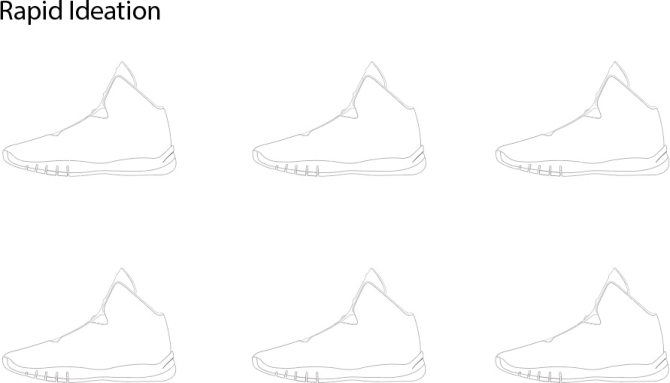
Another phase that needed emphasis was reinforcing the power of itera- tion. We found that students were not acclimated to developing multiple ideas so to address this we did two things. We produced a worksheet that was specifically formatted for rapid ideation. To reinforce the speed and variety of ideation one workshop leader modeled the translation of brainstorming to iterations. Then, with the assistance of the other workshop leader, we promptly eliminated two thirds of the iterations before moving onto the final
Cardi B Meets Chuck Taylors : Immersing High School Students into the Design Process 189
Figure 2: Rapid Ideation Worksheet.
concept. We found it imperative to stress that the ideas that were left behind were not failures, but instead they were essential in pointing us to stronger ideas.
REFERENCES
Bush, B., Chastain, K. (2021) Design for All: Members Need Only Apply. Alabama Academy of Sciences, Volume 92, p.157. aasjournal.org/index.php/journal/index United States Code, The Morrill Act, July 2, 1862, Ch. 130, 12 Stat. 503 (7 U.S.C.
301 et seq
LISTED IN THE AHFE DIGITAL BOOKSTORE CATALOGUE
Explore the complete digital volume
Design for Inclusion
Read this individual research paper free through the original publisher, or explore the full digital proceedings book.
ISBN 978-1-958651-21-6
Explore this ISBN in the AHFE Bookstore ↗Listed in the July 2026 bookstore catalogue; search by ISBN to confirm current availability · Digital book purchase optional