Ana Clara Roberti, Helena Santos, Daniel Brandão (2022). Sobreiro: participation and intervention of local communities in the historical and artistic construction of a stigmatized neighborhood. In: Design for Inclusion. AHFE Open Access, vol. 45, pp. 144–152. https://doi.org/10.54941/ahfe1001879
This paper intends to discuss a collaborative initiative, carried out within the scope of a doctoral scientific research in the field of Arts and Design and an institution that supports socio-economically vulnerable communities. The work took place in the Sobreiro Social Housing, located in the city of Maia, in Portugal, home to more than 600 families. By using methodologies specific to arts and cultural studies, three main outputs were created: a documentary film, a photo exhibition, and a series of community forums that happen throughout 2018. The purpose of this participatory study was to tell the story of the neighborhood with the help of its first residents and to stimulate the young residents (between 13 and 16 years old) reflection on the present and the future of the community. The whole process was conducted through proximity to the local population and the neighborhood Community Center. This article presents and discusses the ethnographic repertoire gathered within this research, which includes oral and visual memory thanks to the direct participation of the residents in the research process, which valued their own perspective, creativity and points of view.
The project presented in this paper was carried out in 2018, as part of a doctoral research called Island City (Roberti, 2020) and upon invitation by European Anti-Poverty Network (EAPN, 1990). A documentary film and a photo exhibition were developed under the coordination of the researcher in the Sobreiro Social Housing, located in the city of Maia, in Portugal.
Sobreiro is home to more than 600 families. Some residents came from nearby the city of Maia, but the neighborhood was born with people coming from all regions of Portugal and even from other countries and continents. Diverse ethnicities, cultures, and life trajectories coexist in the blocks and high buildings of Sobreiro since the 1980s. At the time this work was developed,
Sobreiro: Participation and Intervention of Local Communities 145
the dwellers felt that they were stigmatized for living in a social neighborh- ood, often related to an environment of violence and poverty and, in this specific case, drug traffic and consumption.
The purpose of this work was to fight these stigmatization and social exclu- sion identified by young (between 13 and 16 years old) and elderly (65 and older) residents, through inclusive artistic practices. The ethnographic fieldw- ork, especially with the young people, was constantly rethought throughout the project, in order to adapt the methodologies and the materials produced according to the demands (physical, identity, and social) of the other, that is, of the subject of study. Together with the residents and the neighborhood community center, in addition to the documentary and the photo exhibition, discussion forums open to the entire community were held.
The young people were challenged to photograph the neighborhood with analog cameras and to film the experience with a digital camera. As for the elder people, they were interviewed and filmed by the researcher in order to address historical issues, expectations and desires for the future of the neighborhood.
This initiative was part of a larger project, involving other cities, neigh- borhoods and actions. The proposal of the study described in this paper was, through the active participation of the residents (some chosen by the researcher, others by the neighborhood’s community center), to create an arti- stic content capable of telling the story of the neighborhood and helping to demystify the stereotypes faced by them.
SOBREIRO AND THE ISLAND CITY Island City (Roberti, 2020) is a concept developed within the scope of a doctoral research that addressed, essentially, the cities that exist within a city. These cities are composed by socioeconomically vulnerable populati- ons that act as microcosms, different from everything that is geographically around them due to different characteristics – spatial morphology; forms of occupation of houses, common and public spaces; fluency of non-residents in the streets; commerce and public transportation; relationship between neigh- bors; etc. – and that are undergoing profound transformations in recent years, for external reasons that the residents do not control, related, for example, to commercial, tourist and governmental issues. As highlighted by Debord (1958), these are psycho-geographic transition points:
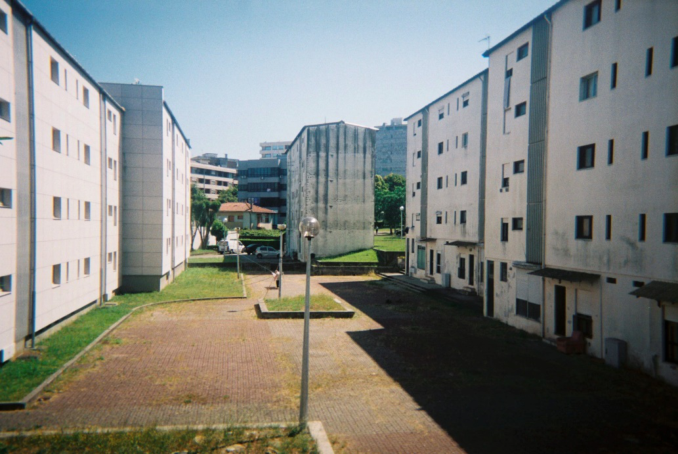
We arrive to the main hypothesis of the existence of psycho-geographic transition points. While the distances that effectively separate two regi- ons of a city are measured, they may have very little relation to the physical distance between them. (Debord, 1958) After visiting the neighborhood with members of the Residents’ Asso- ciation of Sobreiro and the Community Center to learn more about the area, we have confirmed that Sobreiro fit in this concept of island city. The arrangement of the housing blocks concentrated in an exclusive common space, seemed, at first sight, to involve its inhabitants in a community reality (Figure 1). They had no direct neighbors outside their own neighborhood.
Figure 1: Image of Sobreiro taken by young residents of the neighborhood in 2018.
However, they were a short distance away from the most noble and busy area of the city of Maia. This neighborhood houses hundreds of families and is located in a prime area of the city, but it wasn’t always like this. According to the residents’ testimonies, Sobreiro was built with the purpose of help eco- nomically disadvantaged populations, and, at the time (1980s), its location was not so favored in terms of urbanistic structures as it is now.
The reasons for these places being isolated in the heart of the urban envi- ronment, as in the case of Sobreiro, may not be solely related to residents’ own decision. In some cases, they exclude themselves precisely because they are excluded by the very city they inhabit. It is not always a lifestyle option, but a way of surviving. They become small (or large) islands dispersed around the city, hidden and at the same time right in front of the eyes of non-resident citi- zens and the public authorities. On the other hand, when these areas become economically attractive and then too exposed, their residents suffer another sort of risk: being forced to leave the place where they live. The heads of the Residents’ Association interviewed throughout the project reported the interest of private companies in buying the land to build higher value hou- sing and, for this, the residents of the social housing would be re-allocated to other areas and neighborhoods in the city of Maia.
Maia grew around the Sobreiro, evolved in its surroundings, while the nei- ghborhood was home to workers coming from different regions, countries and continents in search of better living conditions. As the city developed, transportation services (such as the subway), theaters, commerce, and restau- rants are very close to the towers of this social district. In this sense, in a symbolic way, the senior residents who participated in the project descri- bed the neighborhood as “the heart of Maia”: its land has been gradually valorized from a commercial point of view. Throughout the Island City
Sobreiro: Participation and Intervention of Local Communities 147
research it was possible to identify other places that went through similar processes, such as the Rainha Dona Leonor Social Housing, located in the city of Porto, a few kilometers from Sobreiro:
According to testimonies of the residents themselves, the area where the social homes were built was, at the time, far from the city center, with poor accesses and resources. As the years went by, the city grew and rea- ched the neighborhood, while the hillside of Douro river was becoming a very expensive land in the city of Porto. Nowadays, the area where Dona Leonor is located is coveted by the upper classes (...) (Roberti et al., 2021: 130)
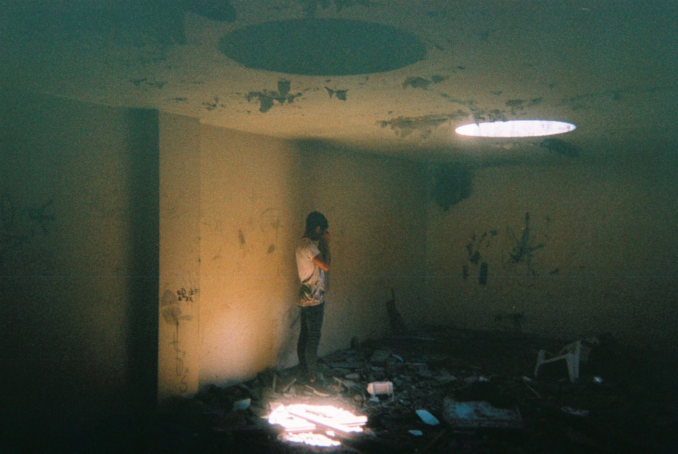
The paradox is that, despite being in the midst of all this urban accessibility, entertainment options and comfort, Sobreiro has become insulated. Despite the proximity to the central area of Maia, the residents reported that people are afraid to pass in the surroundings, or in the neighborhood streets. They fear being robbed or face consumption and sale of illicit drugs. A considerable part of the buildings and common areas, at the time this work was developed, were abandoned and degraded (Figure 2), and therefore hardly used, especi- ally the sports zone – as portrayed by the young boys in this project, it was locked with chains and abandoned. As the neighborhood is coordinated by the City Council, the residents had been waiting for the government to do the renovations for a few years, these were restarted soon after the completion of this project, in 2018.
Figure 2: Image of Sobreiro’s abandoned sports zone taken by young residents, 2018.
APPROACH AND ENGAGEMENT The aim of the project was to contribute, through inclusive artistic practices, to break this frequent stigmatization to which the inhabitants of this social housing are subjected, a common problem identified by many residents and families.
Since Sobreiro is a neighborhood of almost 1000 inhabitants, it was neces- sary to create strategies to approach different groups of residents, identify possible participants and have a broader and more heterogeneous notion about this local population, in order to break preconceived and simplistic ideas about them. Thus, before starting the production of the documentary and the photo exhibition, we held discussion forums open to all members of this community: the first for the elderly and the second, more intimist, for young people. These moments were fundamental to help understand the reality and the local way of life, expectations and demands that these people had, and what makes them belong to that place.
Some themes stood out in those sessions. The residents believed that the neighborhood was always seen with an outsider’s perspective and that for many years they had carried on their shoulders the stigma of living in Sobreiro, a social neighborhood. Although they felt safe inside the place, and this was one of the great positive points highlighted by them, the testimo- nies about the impressions of non-residents was similar: they were afraid to enter the neighborhood. Also, the complaints about the bad housing condi- tions were recurrent, they said they were tired of the political promises and of the circumstances in which they lived at that moment. However, when tel- ling personal and neighborhood stories, the participants were unanimous on one point: they considered themselves very lucky to have gotten a house in Sobreiro, “the heart of Maia”.
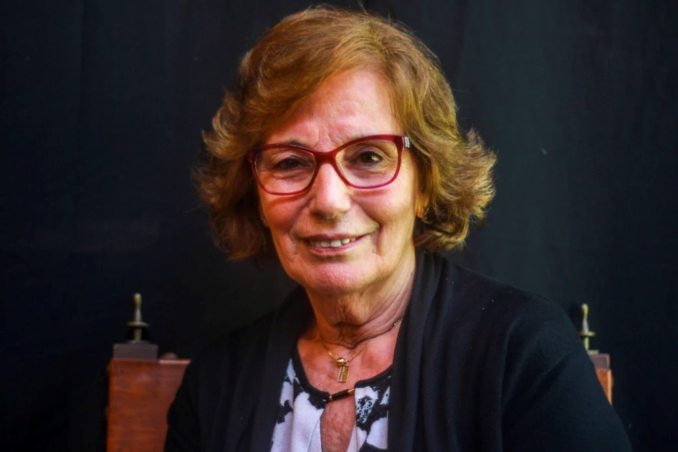
In order to begin an outreach to the senior group, an individual / family portrait session was proposed at the end of the forum (Figure 3). They were invited by the researcher, emphasizing that she would then take the photo- graphs to those who participated. The initiative was very well accepted, it was a relaxed moment and gave opportunity for a next meeting: the handing over of the portraits.
In both forums, the decision was not to record video. It was the first contact with those people, and it was necessary to establish a relationship of trust, make them comfortable to talk more openly about the proposed themes, many of them delicate. Thus, it was possible to establish a more unimpeded dialogue, especially in the case of young people.
Based on these forums, the documentary (Roberti, 2018) addresses two types of characters: the first residents of the neighborhood, already elderly, and a group of young people between the ages of thirteen and sixteen. With distinct life stories, the elderly tell why and how they came to live in Sobreiro, how they feel about the place, and how they thought they were perceived by outsiders. The young people, through their experiences with the analog camera and with filming, show their vision of the neighborhood and the way they inhabit it.
Sobreiro: Participation and Intervention of Local Communities 149
Figure 3: Portrait taken by the researcher of one of the project participants, 2018.
We were invited by the elderly residents who participate in the documen- tary, to visit their homes and the interior of the buildings. Getting to know the details of these spaces – the arrangement of objects, family photos, care of plants and pets, the relationship between neighbors – was very important to better understand the multiplicity of life stories built in and with Sobreiro. We agree with Lefebvre when he says that “(...) each ‘subject’ is situated in a space in which he recognizes or loses himself, which he enjoys or modifies” (Lefebvre, 2000: 61). The modifications made over the years by the residents (even when people don’t own the houses, they just rent them), the expectation for better conditions of the structures of the buildings and common spaces, and the care for the houses, say a lot about how the Sobreiro social housing was lived in that moment, right before the rehabilitation process.
During the forum, the young participants talked about particular themes that were later brought into the documentary: expectations of what they wan- ted to be when they were older, and, as in the case of the elderly, about the stigma they faced for living in that neighborhood. They considered that they were discriminated at school and in everyday situations outside Sobreiro, “when we are out walking together, a lot of people get scared, they cross the street, they say we are going to rob them”. The positives, however, were the friendships and freedom they had within the neighborhood. Since they were very young, they felt at ease to walk around and play without worrying about the time, “the mothers trust us here”.
With this group it was essential to have a methodology that allowed con- stant recalibration, being able to adapt the approach to the location and especially to the participants. The meetings with them were scheduled by the neighborhood community center and the EAPN, so access to the place was limited. This meant a shorter time to contact with these young people
which, in turn, required patience and availability in order to gain trust and acceptance.
Giving the cameras (analog and digital) to the teenagers and creating a public photo exhibition with the results was a way of gaining some of this trust; moreover, it was an effective tool for understanding their vision of the neighborhood and the way they occupied it, through the images they made. More than that, valuing the work this group produced allowed us to create a space to hear their reflections about where they live and how they feel about the stigma they face from people outside the neighborhood.
OUTPUTS AND PARTICIPATION Fieldwork has meaning and value for those who have allowed it to happen in their midst. (Castañeda, 2006: 86)
From the beginning, one of the principles of the Island City research and of the project presented here was to guarantee that those who took part in the study and in the creation of the artistic pieces would have access to the material produced. Thus, it was agreed that the final event of the project would be held in a theatre near the neighborhood, where the film1 and photo exhibition would be shown. The entrance should be free and the residents (current and former residents) of Sobreiro, the project funders, members of local and national government, and members of the EAPN would be invited.
Before being shown to the general public, all the material produced by the young people – videos and analog and digital photographs – was presented to them in exclusive sessions, attended only by the group, the researcher and the EAPN member who followed the whole process. At these sessions, the boys were able to watch the film they had done, look at the photographs one by one (on film and printed) and discuss together what they thought of the result and if there was anything they did not want to put in the final editing of the film and in the exhibition.
The researcher was responsible for the final editing of the film, as well as the analysis of the images for the printing. The preparation for the exhibition was done together with the young group: the choice of images, the order in which they would be placed, and the subtitles. The seniors who participated in the film also produced a large handmade piece for the opening of the exh- ibition. This process was faced with great enthusiasm and commitment by both groups.
The aim was, besides recognizing the importance of the participation of the residents themselves in the construction of pieces that address their own history and way of life, to understand whether they are comfortable with the portrait produced. Documentary filmmaker Eduardo Coutinho summarizes this idea in a few words: I am extremely grateful that these people have talked to me. And I hope that when they find someone from the community who saw them, they think highly of them. That’s what I hope. (Coutinho, 2009: 134)
1Film available at: vimeo.com/297154816/13d1db727e
Sobreiro: Participation and Intervention of Local Communities 151
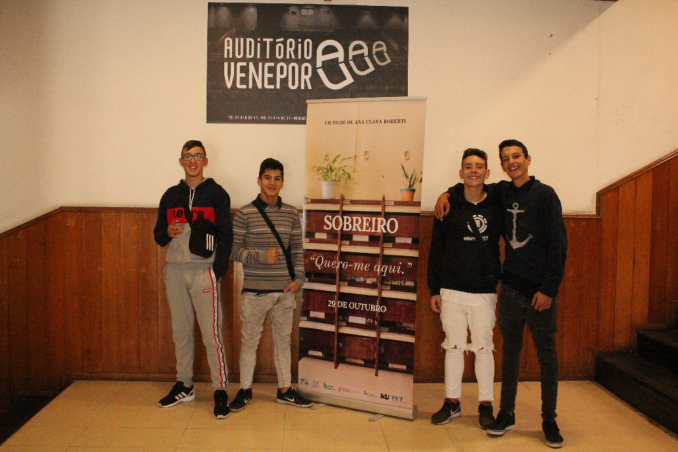
Figure 4: Young residents of Sobreiro on the day of the film premiere, 2018.
The way this audience reacted to the film was one of the great validati- ons of this project. So was the emotional speech and gratitude of the elderly who participated in the documentary, which helped to highlight the commi- tment established with the characters through a fair and respectful portrayal of them.
On the day of the premiere, the young people behaved like the authors, the ones responsible for the exhibited pieces, and were proud of what they had to present as a result (Figure 4). They circulated around the exhibition, photographed themselves in front of the film poster and together with the institutions and public figures that were in the opening. They also gave inte- rviews to the media that covered the event. They were outside the boundaries of the neighborhood, but they felt empowered, safe, and prestigious.
CONCLUSION
This paper reported and reflected on a participatory art project developed in the Sobreiro Social Housing, in the city of Maia, Portugal, describing part of the researcher’s ethnographic fieldwork, the approaches to establish a tru- sting relationship with the residents and the outputs that were produced in a collaborative way. This process was based on three main elements: commu- nity discussion forums; the production of a documentary film; and a photo exhibition.
Through the rolls of analog photography film shot by the new generation and the stories shared by the first residents, the documentary film and photo exhibition show different realities, dramas, joys and expectations that inhabit Sobreiro. The researcher was responsible for the final cut of the film, but always taking into account the whole process of collective construction and
the dialogues with those who participated in the process in different ways, namely, the residents of the Sobreiro.
Working with people of different age, gender, households and professions in the neighborhood reinforced the importance of recognizing and highli- ghting the heterogeneity of the residents rather than representing them as a single group. The Island City concept presented in this paper is therefore not intended to look at all these microcosms identically, in a simplistic way. Quite the contrary, adapting strategies and approaches taking into account the par- ticularities of each resident is something that was already being worked on in the mentioned research and gained strength with this project.
In the same way, we believe that in addition to the importance of stimu- lating the collaborative production of outputs in research and/or artistic and social initiative, it is fundamental to return the results to those who were part of the producing process.
ACKNOWLEDGMENT
This work was financed by national funds through the FCT – Fundação para a Ciência e a Tecnologia.
REFERENCES
Castañeda QE (2006) The Invisible Theatre of Ethnography: Performative Principles of Fieldwork. Anthropological Quarterly 79: 75–104. Coutinho E (2009) A entrevista como método: Uma conversa com Eduardo Couti-
nho. In: Frochtengarten F (ed). São Paulo: USP, 125–138. Debord G (1958) Théorie de la dérive. Internationale situationniste 2: 19–23. EAPN (1990) European Anti-Poverty Network. Available at: https://www.eapn.eu/. Lefebvre H (2000) La production de l’espace. Paris: Éditions Anthropos. Roberti AC (2018) Sobreiro: Quero-me Aqui. Portugal, 25min. Roberti AC (2020) Cidade Ilha: o documentário etnográfico autoral como alternativa à exotização, a partir da cidade do Porto. Universidade do Porto, Porto. Roberti AC, Santos H and Brandão D (2021) From intimacy to urban landscape: ima-
ges of the transformations of the Rainha Dona Leonor social housing. Sophia Jour- nal 6 (Visual Spaces of Change: photographic documentation of environmental transformations): 129–139.
LISTED IN THE AHFE DIGITAL BOOKSTORE CATALOGUE
Explore the complete digital volume
Design for Inclusion
Read this individual research paper free through the original publisher, or explore the full digital proceedings book.
ISBN 978-1-958651-21-6
Explore this ISBN in the AHFE Bookstore ↗Listed in the July 2026 bookstore catalogue; search by ISBN to confirm current availability · Digital book purchase optional