Kouyou Otsu, Tomoko Izumi (2022). An investigation of user perceptions of anthropomorphic linguistic expressions in guidance from home appliances. In: Affective and Pleasurable Design. AHFE Open Access, vol. 41, pp. 37–43. https://doi.org/10.54941/ahfe1001778
With the progress of using voice recognition technology and artificial intelligence, interactive home appliances that communicate with users in natural language and provide appropriate guidance are becoming widespread. Such intelligent artifacts not only provide advanced guidance to users but may also be the key to changing the relationship between humans and artifacts.In the field of cognitive science, it is known that human tends to perceive artifacts as if they were living things. It is known as the concept of the "media equation." Therefore, interaction design that makes such home appliances behave as more anthropomorphic entities may provide a means to make users perceive them as more relatable. However, many studies about animacy perception for interactive systems have focused on humanoid artifacts and their physicality. Therefore, there has been limited interaction design knowledge for making non-humanoid artifacts behave as anthropomorphic entities. In particular, an object's verbal expression may be considered an important factor affecting the perception of anthropomorphism toward the object. However, there is no sufficient discussion on whether the introduction of anthropomorphic linguistic expressions into the speech scenario of an object can become a factor to change how that object is perceived. In addition, it is not clear how the introduction of anthropomorphic expressions in situations of guidance by interactive systems affects the degree of comprehension of the content.In this study, we investigated how differences in the strength of anthropomorphism in the "speech" of home appliances affect users' perceptions of its guidance. This survey was conducted as a web-based questionnaire, and 132 Japanese-native speakers participated in it. In the experiment, participants were presented with a text of a scenario in which a microwave oven recommends a menu to a user and guides users on how to use" him/herself" to facilitate the user's task of preparing the menu. Then, they were asked to answer a questionnaire while watching the text. In this experiment, we prepared five sentences with different intensities of anthropomorphizing of the microwave oven written in the sentences. These sentences were designed to change the intensity of the anthropomorphism of the object without changing the content or intention of the sentences by using four anthropomorphic strategies: from third-person description to the introduction of first-person expressions (e.g., "I"), physical expressions (e.g., "my stomach"), casual expressions, and expressive emotional statements. Participants were instructed to answer the questionnaire in the same way for each of these five types of sentences.As a result, it was suggested that by increasing the intensity of anthropomorphism in the linguistic expressions expressed by the object, it is possible to change the way people perceive the object as if the object itself were speaking. In addition, there was no difference in the degree to which users understood the speech intentions of the appliances due to changes in the anthropomorphic expressions. These results suggest that anthropomorphizing the object based on linguistic expressions may help enhance the relationship with a human in interaction scenes where the artifact itself provides guidance.
Interactive home appliances that communicate with users in natural language are becoming widespread owing to advancements in voice recognition and artificial intelligence. For example, the COCOROBO robotic vacuum cleaner (Sharp Global, n.d.) can interact with users through natural language. Such guidance from intelligent artifacts not only be a method to provide some information to users clearly but may also be key to improving interactions between human and home appliances.
Cognitive science suggests that humans tend to perceive artifacts as living things: this is known as the media equation concept (Reeves and Nass, 1996). Users may find artifacts (e.g., home appliances) that are designed to beh- ave in a more anthropomorphic way to be more relatable. Many studies of animacy perception for interactive systems have only focused on humanoid artifacts and their physical actions. Few studies have investigated interaction design knowledge for making nonhumanoid artifacts behave as anthropo- morphic entities (e.g., Herdel et.al, 2021). Some have aimed to robotize home appliances by attaching movable parts to them to provide guidance (Osawa et al., 2009), and another attempt to move items for sales like robots in order to attract the attention and promote purchase intention (Iwamoto et al., 2021). These studies focused on anthropomorphic appearance and
physical behavior; however, limited knowledge is available about designing intelligence unique to anthropomorphic objects for them to be accepted by users. In particular, an object’s verbal expression can be considered an impor- tant factor relating the design of anthropomorphized intelligence toward the object along with nonverbal elements such as the impartation of physicality and facial expressions. However, studies have not yet explored whether the introduction of anthropomorphic linguistic expressions into speech scenarios of an object can change how that object is perceived. In addition, how the introduction of anthropomorphic expressions in guidance scenarios by inte- ractive systems affects the degree of comprehension of the content remains unclear.
In artistic works such as animations and novels, we sometimes see anth- ropomorphic characters of objects such as toys and cars interacting with humans using natural language. In such context, linguistic expressions usu- ally used only for living things are sometimes used to make the object seem subjective. For example, the subjects “I” and “He/She” suggest that humans are the actors. This concept of linguistic anthropomorphism is known as animacy in linguistics (Yamamoto, 1999). Expressions related to body owner- ship, such as describing equipment malfunctions as “the machine is crying”or parts of the equipment as “arms” or “shoulders,” also make the object seem like a living thing. Such anthropomorphic linguistic expressions ,which have been discussed in linguistics and artistic works, may help make interactive guides seem more intelligent and familiar.
We investigate some linguistic anthropomorphism techniques mentioned above and discuss how home appliances’ speech can be designed to make them easy to understand and friendly to users. Through a survey, we exa- mine how the strength of anthropomorphism in natural language guidance of home appliances affects the impression of these appliances. In addition, we examine whether the perception of anthropomorphic home appliances differs depending on the age of the user.
WEB-BASED SURVEY To examine the effects of introducing anthropomorphic language expressi- ons into the voice guidance of home appliances, we experimented with a web-based survey. This investigation focuses on anthropomorphic lingui- stic techniques in written expressions to examine how the introduction of expressions affects the perceptions of objects and whether they are useful for understanding in the context of a guide.
Techniques of Anthropomorphic Expression Techniques of anthropomorphism based on linguistic expressions may affect the perception of animacy. For a detailed analysis of this factor, we categori- zed these techniques into the following four types: (a) first-person subject expressions, (b) expressions suggesting body-ownership and animacy, (c) casual linguistic expressions, and (d) explicit emotional expressions. In this section, we discuss how each technique may enhance the sense of anthropomorphism of appliances.
An Investigation of User Perceptions of Anthropomorphic Linguistic Expressions 39
(a) First-person subject expressions: Using first-person subject expressions like “I” in speech is essential to suggest that the actor is a living being. Using appellative expressions (e.g., “Mx.” in English, “San” in Japanese) may also help suggest that the actor is living.
(b) Expressions suggesting body-ownership and animacy: Expressions sug- gesting body-ownership (e.g., referring to the microwave oven compartment as “my stomach”) may be important in perceiving an object as an intelli- gent being with a virtual body. In Japanese, the verb expressions used for human or animal subjects differ from those used for other subjects (e.g., the verbs “Iru”and “Aru”to express existence). Further, passive expressions with emotionless objects as the subject are not used often. However, such verbs are sometimes applied to objects in lyrical works. Therefore, we interpreted these expressions as expressive elements suggesting body-ownership.
(c) Casual linguistic expressions: Casual linguistic expressions are known as one of the positive politeness strategies in politeness theory and are gene- rally used to establish relationships with others (Brown et al., 1987). Using such expressions may help anthropomorphize nonphysical media such as objects, especially to express an attitude of trying to interact with the user.
(d) Explicit emotional expressions: Expressing explicit emotions such as the word “happy!” might give a sense of animacy and suggest that an object is intelligent and anthropomorphic. Therefore, we interpreted these expressions as one of category.
METHOD
We conducted a web-based experiment and compared the results obtained with and without the four anthropomorphic linguistic expression elements mentioned above to clarify the impact of each element on the sense of animacy toward an object.
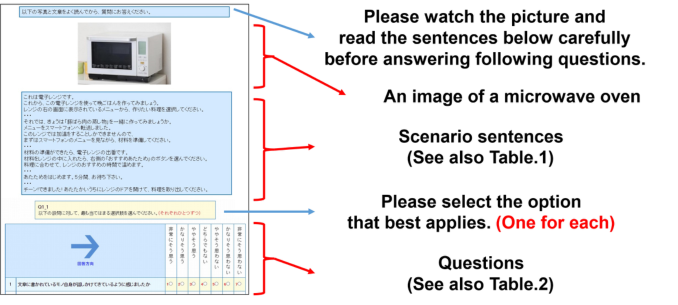
This experiment was conducted through a web-based questionnaire survey with 128 Japanese speakers of all ages (range = 15–85 years, mean = 40.2, sd = 17.5). The participants answered the questionnaire through their own smartphones or PCs. The questionnaire page presented an image of a micro- wave oven and a narrative text, as shown in Figure 1. The participants viewed these and then answered the questions. The text narrated a scena- rio in which the microwave oven recommends a menu to the user and guides the user on how to prepare the menu smoothly. To quantitatively examine the effects of the abovementioned anthropomorphic elements, five different Japa- nese sentences, A–E, with different intensities of anthropomorphism of the microwave oven were presented to the participants. Sentence A described the microwave oven from a third person viewpoint without any anthropomor- phic elements. Sentences B–E were created based on A by respectively adding elements (a)–(d) from the previous section without changing the content or intention.
Participants were instructed to complete the same questionnaire for each of these five types of sentences (i.e., five questionnaires in one experiment). Participants were asked about their perception of the narrator, level of understanding of the guide, and familiarity; Table 2 lists these questions. A
40 Otsu and Izumi
Figure 1: Screenshot of web-based survey presented to the participants.Table 1. English translations of the Japanese sentences presented to the participants.
Table available in the original PDF paper.
The baseline sentence A and sentence E with four elements based on baseline sentences A are shown. The corresponding parts of sentences B, C, D, and E are underlined to enable inferring the contents of the transformation at each stage of transformation.
Sentences A (Baseline) Sentences E (A + (a)+(b)+(c)+(d)) This is a microwave oven. From now on, let’s make dinner using this microwave oven. Please select the dish you want to cook from the displayed menu on the screen to the right side of the microwave. Then, let’s make “steamed pork belly” today. The menu has been transferred to the smartphone. This microwave oven only has the function of heating. First, prepare the materials while looking at the menu on your smartphone. When the materials are ready, it’s time for the microwave oven. After putting the ingredients in the microwave, select the “Recommended Warm” button on the right. Then, the food will be warmed up for the recommended time. Start warming up. Please wait for 5 minutes. Ding! It’s done! Please open the microwave’s door while it’s warm and take out the food.
I’m a microwave. From now on, let’s make dinner with me. Nice to meet you. Select the dish you want to cook from work displayed on the screen of my left arm. Then, let’s make “steamed pork belly” together today. I handed the menu to (Mx.,) smartphone. I’m very sorry, but I can only heat it. First, I want you to prepare the materials while looking at (Mx.,) smartphone’s menu. When the materials are ready, it’s my turn. Once you have the ingredients in my stomach, select the “Recommended Warm” button on the right. I’ll warm it up for the recommended time according to the food. I will do my best! I’ll start warming up. Wait for 5 minutes. Ding! It’s done! While it’s warm, open my door and take out the food.
An Investigation of User Perceptions of Anthropomorphic Linguistic Expressions 41
Table 2. List of questions.
Table available in the original PDF paper.
No. Question Q1 Did you feel that the object described in the text was talking to you? Q2 Did you find the explanations in the text easy to understand? Q3 Did you feel a sense of familiarity with the object described in the text? Q4 Who did you feel was the narrator who wrote this sentence?
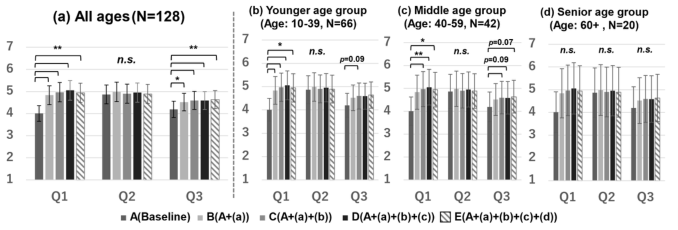
Figure 2: Mean scores for Q1–Q3 of questionnaire: (a) results for all ages and (b)–(d) results for specific age groups. Error bars indicate the standard deviation. Items with significant differences in multiple comparisons are highlighted (**: p < .01, *: p< .05).
seven-point Likert scale is used for Q1 to Q3, and Q4 is a three-choice que- stion: “Guide person explaining the things shown in the photo,” “Guidance character built into the object as a function,” and “Object itself.”
RESULT AND DISCUSSION
(a) Impression evaluation
Figure 2 shows the results of Q1–Q3 on the seven-point Likert scale. At the beginning, a Friedman test was conducted on the results of each question, and the main effect was confirmed for Q1. Therefore, Bonferroni’s multiple comparison test was performed for the questions that showed a main effect. A significant difference was found between the two groups, suggesting that the anthropomorphic element affects the sense of speech and perception of clo- seness. No significant difference was found for the comprehension question Q2, implying that using anthropomorphic expressions does not significantly affect comprehension in the context of the guide. Moreover, to examines the effects based on age differences, the collected data were divided into three age groups: younger, 10–39; middle, 40–59; and senior, 60+. Then, a significance test was conducted for each group. As a result, for Q1 and Q3, the younger age group showed significant differences in scores ,whereas the middle and senior age groups did not, suggesting that such anthropomorphic linguistic expressions may be particularly useful for the younger age group. No diffe- rence was seen in the degree of comprehension(Q2) between the age groups as a result of the addition of the expression elements. Although these results are not considered the characteristics of the objects or cultural differences of participants, they suggest that the use of anthropomorphic representations
42 Otsu and Izumi
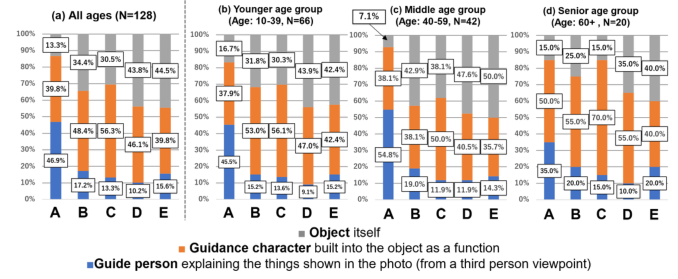
Figure 3: Responses to Q4 of questionnaire: (a) results for all ages and (b)–(d) results for different age groups (note: sample sizes for each group are different). On the horizontal axis, A–E represent the five sentences.
in guides has a minor impact on contextual understanding and may instead contribute to the perceived ease of familiarity and agency of the objects.
(b) Who did participants recognize as the object described in the text?
Figure 3 shows the results for Q4. Overall, upon adding anthropomorphic elements from the baseline (A), the respondents felt that the guide chara- cters were built into the objects and the objects themselves were speaking to them. This result matched that for Q1. The most effective anthropomorphic expression elements were the first person and casual expressions. When these elements were added, the percentage of responses for the “object itself”in the total increased by 21.1% (in Sentence B) and 13.3% (in Sentence D), respecti- vely, compared to the previous condition. Also, adding emotional expression contributed to the 0.7% increase in the “object itself”responses. These results suggest that anthropomorphism may be a factor that changes the perception of things by transforming the perception of sentences from external explana- tions of things to internal explanations by things. However, in this study, we did not confirm that the “object itself” response increased when the expres- sion suggesting body ownership was added. In this case, since the response score of the “guidance character”increased, the participants may imagine the object’s speech as if a human-like guidance character was speaking it.
As for Q1–Q3, we divided the data into three age groups and analyzed it by age. Looking at the number of responses for the “object itself,” the tende- ncy for the younger and middle age groups was generally the same as for all age groups. However, the number of responses in the sentence B in the middle age group increased significantly (+35.7% from the baseline). Therefore, the addition of the first-person expression tended to have a relative effect com- pared to the addition of casual expressions and emotional expressions. In the older age group, the number of responses was similar to that of all age groups. However, in the sentences B to E in which some kinds of anthropomorphic expressions were added, the responses recognizing the narrator as the “object itself” tended to be lower than that of other age groups. These results suggest
An Investigation of User Perceptions of Anthropomorphic Linguistic Expressions 43
that changes in perception owing to linguistic anthropomorphism are more likely to occur in younger people.
CONCLUSION
In this study, we conducted a survey of Japanese speakers to investigate how the intensity of anthropomorphism in voice guidance from daily object affects people’s perceptions of it. The results indicated that enhancing the intensity of anthropomorphism in speech may change the impression of objects from a third person’s perspective to that of the objects themselves. Furthermore, the comprehension question implies that using anthropomorphic expressions does not significantly affect comprehension in the context of the guide. Alth- ough the results are based on questions about the individual’s senses and not based on quantitative indicators(e.g., the degree of memory), using anthropo- morphic expressions may be effective in guiding contexts where explanations are required to promote understanding of the content. In addition, it was found that the guidance provided by such anthropomorphic objects looks more familiar to younger users. These results are based on an online survey, and it remains to be verified whether similar results can be obtained for home appliances operating in the real field. In future work, we plan to investi- gate whether experiments with real-world objects can reproduce the present results and study the interaction of modalities such as pronunciation and inflection.
ACKNOWLEDGMENT
This work was supported in part by the Ritsumeikan Global Innovation Research Organization (R-GIRO), Ritsumeikan University and the Telecom- munications Advancement Foundation.
REFERENCES
Brown, P., Levinson, S.C. and Levinson, S.C. (1987). Politeness: Some universals in language usage (Vol. 4). Cambridge university press. Herdel, V., Kuzminykh, A., Hildebrandt, A., and Cauchard, J.R. (2021). “Drone in
love: Emotional perception of facial expressions on flying robots”, Proceedings of the 2021 CHI Conference on Human Factors in Computing Systems (CHI ‘21), no. 716, 1–20, New York, NY, USA. Iwamoto, T., Baba, J., Nishi, K., Unokuchi, T., Endo, D., Nakanishi, J., Yoshikawa, Y., and Ishiguro, H. (2021). “The effectiveness of self-recommending agents in advancing purchase behavior steps in retail marketing”, Proceedings of the 9th International Conference on Human-Agent Interaction (HAI’21), 209–217, New York, NY, USA. Osawa, H., Ohmura, R., and Imai, M. (2009). “Using attachable humanoid parts
for realizing imaginary intention and body image”. International Journal of Social Robotics, 1(1), 109–123. Reeves, B. and Nass, C. (1996). The media equation: How people treat computers, television, and new media like real people. Cambridge University Press. Sharp Global (n.d.). AI Engines - Robotic vacuum cleaner, Sharp Global Inc. Website:
https://global.sharp/products/robotic_appliance/tech/ voice-operation/ Yamamoto, M. (1999). Animacy and reference. Amsterdam Philadelphia.
LISTED IN THE AHFE DIGITAL BOOKSTORE CATALOGUE
Explore the complete digital volume
Affective and Pleasurable Design
Read this individual research paper free through the original publisher, or explore the full digital proceedings book.
ISBN 978-1-958651-17-9
Explore this ISBN in the AHFE Bookstore ↗Listed in the July 2026 bookstore catalogue; search by ISBN to confirm current availability · Digital book purchase optional