As a first step toward supporting physical exercise habituation suitable for individual personalities, we investigated the values and attitudes toward exercise that are effective in motivating people to exercise, when competition with others is stimulated. We developed an experiment, wherein agents posed as competitors to the participants, so that the competition among the participants could be controlled.The results of the experiments show that competition with others and the difference in exercise performance between others and oneself influences motivation. The relationship between the user's attitude factors, especially confidence, and motivation were also discussed.
Exercise is widely known as one of the means to maintain not only physical health, such as the prevention of lifestyle-related diseases, but also mental health. In Japan, physical education is included in primary and secondary education—a period during which students exercise regularly. However, after that, the number of people who exercise decreases significantly, excepting those who are sports-oriented. Therefore, it is necessary to encourage such individuals to engage in daily physical exercise.
RELATED RESEARCH Sport England classified young people into six personality groups based on gender and age as well as lifestyle and sport-related factors, showing that people have different attitudes toward exercise and promoting sports for
The Relationship between the Attitudes to Physical Exercise and Exercise Habit 51
each personality group (Sport England, 2014, 2015, 2015, 2016). Nagai et al. applied the abovementioned classification to Japanese high school stu- dents, showing that the degree of one’s desire to win differs among personality groups, which suggests that competition with others is effective in motivating some individuals to exercise and not others (Nagai et al. 2018).
Furthermore, various methods of promoting exercise have been studied; among them, many exercise motivation systems have been proposed that use a sense of competition to make people compare their records with those of others. This study investigated the relationship between attitudes toward exercise and the motivational effect of competition with others.
THE EXPERIMENT The study participants comprised Japanese high school students, who were classified into seven clusters using the questionnaire on attitudinal factors etc. and latent class analysis used in the study by Nagai et al. (Nagai et al. 2018). Eight participants were selected from each of the seven clusters in the order of increasing probability of attribution. When there were several subjects with the same probability of belonging, the ratio of males to females in the clusters was chosen to be close to 1:1. If the number of participants in a cluster was less than eight, all individuals belonging to that cluster were selected.
To investigate the timing of high motivation levels for exercise, we included the questionnaire items used by Toriba et al. and surveyed them using a 7- point Likert-type scale (Toriba et al. 2018).
We asked the participants to perform “Radio Calisthenics No.1”, one of the well-known exercises among Japanese people, once or twice a day for three weeks and to input their performance status into our web application (Japan Post Insurance Co., Ltd). In the application, along with the partici- pants’ records, different information was presented every week: no agent, agent A’s record, and agent B’s record. The order in which the informa- tion about the agents was presented was assigned to each participant in six different patterns.
As the participants were high school students, the system used in this experiment was designed as a web application that can be accessed using both smartphones and PCs. The user’s and the agent’s exercise records are superimposed as a line graph to enable comparison.
We prepared two types of agents, A and B, with different ways of determining the score.
Un : Cumulative value of the user for the nth day Un : Score of the user for the nth day An : Cumulative value of agent A for day n an : Score of agent A on day n Dan = An−1 – (Un−1 + un) Bn : Cumulative value of agent B on day n bn : Score of agent B on day n Dbn = Bn−1 – (Un−1 + un)
We assume that the scores of agent A and agent B are defined as follows: Day 1–6 an = max(0,min(2,(rand(2,4) – Dan))) bn = min(2,max(0,(rand(−4,−2)) – Dbn)) Day 7 an = max(0,min(2,(3 – Dan))) bn = min(2,max(0,(−3 – Dbn))) Analysis of variance was used to test the mean number of times each cluster responded to the stimuli presented by no agent, agent A, and agent B.
RESULTS
Responses to the questionnaire were obtained from 371 people, who were then classified into seven clusters. Table 1 presents the variables used in the classification of each cluster, based on Nagai et al (Nagai et al. 2018).
Among the attitudinal factors, the item “desire to win” showed the largest variation among the clusters.
Table 2 reports the additional questionnaire items by cluster, based on Toriba et al.
Clusters 2, 4, and 6 in Table 2 have relatively high scores for involvement in sports. Moreover, the variance among the clusters was the largest for item 7.
Based on the results of the questionnaire survey, 51 people were asked to participate in the experiment, out of which 17 participated. Table 3 summarizes the number of implementation in each cluster.
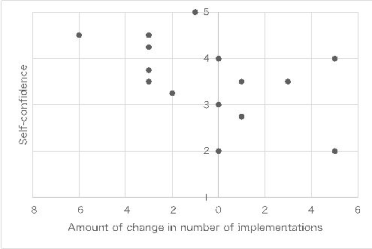
No statistically significant difference was found at a significance level of 5% between no agent, agent A, and agent B in the mean number of implemen- tations. Cluster 2 was excluded from the test due to lack of sufficient number of participants to test. Therefore, we investigated the correlation between the change in the number of implementations of each user when the presen- ted stimuli were changed and each attitude factor. The correlation coefficient between the amount of change in the number of implementations when the stimulus was changed from no agent to agent A and the self-confidence of the attitude factor was −0.46, indicating a slightly negative correlation. Figure 1 depicts the scatter plot. No significant correlations were found for any of the other items.
DISCUSSION
First, with regard to the additional questionnaire items, the participants with high sports involvement scores were considered to have relatively high moti- vation to exercise in all situations because they experience low hurdles to exercise. Furthermore, the large variability in item 7, “When you are stressed out” suggests that those with a high sport involvement score believe that exe- rcise can relieve stress, while those with a low sport involvement score feel stressed by the act of exercising itself.
With regard to the experiment, although there seems to be a difference in the average number of times each cluster was performed, no statistically significant difference could be detected, which may be because the sample size was quite small.
The Relationship between the Attitudes to Physical Exercise and Exercise Habit 53
Table 2. Overview of additional questionnaire items by cluster.
Table available in the original PDF paper.
1. After waking up in the morning before going to school M 1.75 5.33 2.69 2.71 1.32 3.70 1.91 SD 0.87 1.53 1.82 1.84 0.72 2.17 1.86 2. During lunch break (at school) 2.67 4.00 3.32 3.82 1.95 4.70 2.70 1.92 2.65 1.95 2.16 1.65 2.27 2.40 3. When there is no one around 3.00 6.33 4.56 5.47 3.64 5.86 3.04 1.71 1.15 1.98 1.60 1.92 1.42 2.31 4. When there is not much to do 4.08 6.67 4.95 5.92 3.50 6.27 2.57 1.62 0.58 1.97 1.30 1.92 1.12 2.25 5. After school 3.25 6.00 4.11 5.43 2.05 6.32 2.70 1.48 1.00 2.11 2.10 1.53 1.06 2.29 6. When there are other people around 3.42 4.00 3.53 4.51 1.82 5.30 1.96 1.51 2.65 1.89 2.16 1.18 1.92 1.74 7. When you are stressed out 3.00 5.33 4.28 5.33 1.77 6.32 2.78 1.65 1.53 2.09 2.03 1.31 1.40 2.37 8. Before going to bed 2.42 3.33 3.34 3.78 2.95 4.56 2.13 1.44 0.58 2.09 2.37 2.32 2.13 1.77 9. When there is a lot to do 2.08 2.67 2.15 2.76 1.27 3.29 2.00 1.31 0.58 1.58 2.10 1.08 2.03 1.95 10. On holidays 4.00 6.33 4.50 5.51 2.68 6.25 2.87 1.71 1.15 1.94 1.80 1.94 1.24 2.30 11. When you are with friends 3.33 4.33 4.29 5.27 3.00 5.87 2.48 2.31 1.15 1.92 1.88 1.72 1.74 2.15 12. When you’re not too stressed out 3.17 5.67 4.30 5.51 3.00 6.05 3.04 1.40 1.53 1.93 1.86 1.88 1.43 2.29
The Relationship between the Attitudes to Physical Exercise and Exercise Habit 55
Table 3. Summary of each cluster for number of implementation.
Figure 1: Scatter plot of change in number of times performed and self-confidence items.
The slightly negative correlation between the amount of change in the number of implementations when the stimulus is changed from no agent to agent A and the self-confidence of the attitude factor indicates that peo- ple with low self-confidence increase their number of times they exercise in response to agents who exercise more than them. This could be because people with low self-confidence tend to determine the number of times they exercise by comparing themselves with others. In other words, for users with low self-confidence, it may be possible to promote exercise by presenting them with an agent that exercise more than the user.
CONCLUSION
This study revealed the attitudinal factors that are highly related to the motivational effect of competition with others. However, the number of participants in the experiment and the number of actual exercise sessions were small, suggesting that the competition factor may not work effecti- vely for some people who are not active in exercise. Therefore, to encourage these people to exercise, other methods, such as those that appeal to their values, may be necessary. Moreover, in the questionnaire for participants and non-participants, some answered that they already had enough exercise through club activities. Therefore, in future surveys, it is necessary to con- struct a system that can record exercises performed by methods other than the specified ones.
ACKNOWLEDGMENT
We would like to express our deepest gratitude to the teachers and students of Tamagawa Academy Secondary Program Division for their cooperation in this survey.
This research was supported by the Institute of Science and Engineering, Chuo University, and by JSPS KAKENHI Grant Number JP20K11314.
REFERENCES
J. Nagai, K. Kanbe, E. Ogasawara, A. Mikura, F. Sakaori, T. Kato (2018): How should we approach various personalities for Japanese high school students?, The 14th Asia Association for Sport Management Conference Japan Post Insurance Co., Ltd.: https://www.jp-life.japanpost.jp/radio/index.html
(Last search date: January 21, 2022) Masanari Toriba, Toshikazu Kato, Fumitake Sakaori, Etsuko Ogasawara (2018): Typing attitudes toward exercise and investigating motivation suitable for TPO, AHFE 2018: Advances in affective and pleasurable design, pp. 215–219 Sport England (2014): Youth insight pack (https://www.sportengland.org/media
/10113/youth-insight-pack.pdf) (Last search date: January 21, 2022) Sport England (2015): Go where women are (https://sportengland-production-files.
s3.eu-west-2.amazonaws.com/s3fs-public/gowherewomenare_final_01062015f inal.pdf) (Last search date: January 21, 2022) Sport England (2015): Under the skin (https://sportengland-production-files.s3.eu-w est-2.amazonaws.com/s3fs-public/youth-insight_under-the-skin.pdf) (Last sea- rch date: January 21, 2022) Sport England (2016): This Girl Can: inspiring millions to exercise (https://marketingsociety.com/sites/default/files/thelibrary/Sport%20England %20-%20This%20Girl%20Can.pdf) (Last search date: January 21, 2022)
LISTED IN THE AHFE DIGITAL BOOKSTORE CATALOGUE
Explore the complete digital volume
Kansei Engineering
Read this individual research paper free through the original publisher, or explore the full digital proceedings book.
ISBN 978-1-958651-16-2
Explore this ISBN in the AHFE Bookstore ↗Listed in the July 2026 bookstore catalogue; search by ISBN to confirm current availability · Digital book purchase optional