Yaniel Torres, Sylvie Nadeau, Kurt Landau (2022). Analysis of Assembly Errors using Systems Thinking Approach: Application of the HFACS Framework. In: Human Error, Reliability, Resilience, and Performance. AHFE Open Access, vol. 33, pp. 60–66. https://doi.org/10.54941/ahfe1001568
Using a systemic and human-centered approach to analyze quality deficiencies in complex manual assemblies can help to shift the focus towards the role of systems failures instead of focusing on the operators' actions. This paper features the Human Factors Analysis and Classification System (HFACS) framework, to identify several contributing factors to quality deficiencies in a manufacturing environment. Overall, 34 factors were identified. Some 56% were associated with the human operator and operating environment, while 44% were related to organizational influences and supervisory factors. The latter included inadequate design/update of working instructions, variability in production demands, high complexity of product design, and lack of guidelines on shift scheduling and overtime allocation best practices. Although HFACS was able to provide a "big picture" of the situation analyzed, it requires that the user possess a good understanding of the operational aspects of the system and have ample access to data and information. Particularly for latent conditions, which are not so easy to detect.
Over the last few decades, the systems thinking approach has gained accepta- nce and is now used to better understand the complex causality of accidents in a diverse range of contexts, particularly in safety-critical sectors such as aviation, maritime or nuclear (Hulme et al., 2019b). In this appro- ach, accidents are understood as a system phenomenon occurring from the interconnectivity between multiple contributory factors at different levels within the system (Carayon et al., 2015). The underlying philosophy is that to optimize whole systems, we must move beyond focussing on operator failures (errors and violations) to analyzing systems failures (Read et al., 2021). Several accident analysis methods have been developed based on the systems thinking approach and have been applied to complex accident sce- narios, including methods such as AcciMap (Rasmussen & Svedung, 2000), HFACS (Shappell & Wiegmann, 2000), STAMP (Leveson, 2004) and FRAM
Analysis of Assembly Errors Using Systems Thinking Approach 61
(Hollnagel, 2012). While manufacturing is not considered a safety-critical sector, product quality is sometimes related to product safety in specific manufacturing contexts such as aerospace, automobile manufacturing and consumer products (Marucheck et al., 2011). Historically, the analysis of quality deficiencies in manufacturing has followed a data-driven approach that uses different statistical tools for quality control (Tennant, 2017). The application of systemic analysis methods in manufacturing, particularly for the analysis of assembly errors, is extremely rare if not inexistent. This paper intends to analyze assembly errors from a system thinking perspective with the aim of identifying the different contributing factors to assembly errors and classify them according to the four levels of the Human Factors Analysis and Classification System (HFACS) framework. Our working hypothesis is that systems analysis methods, primarily used in safety-critical sectors, can also be used in manufacturing to study error-related quality deficiencies. This aligns with a more contemporary perspective on human errors emphasizing the need to search for systems failures (Read et al., 2021).
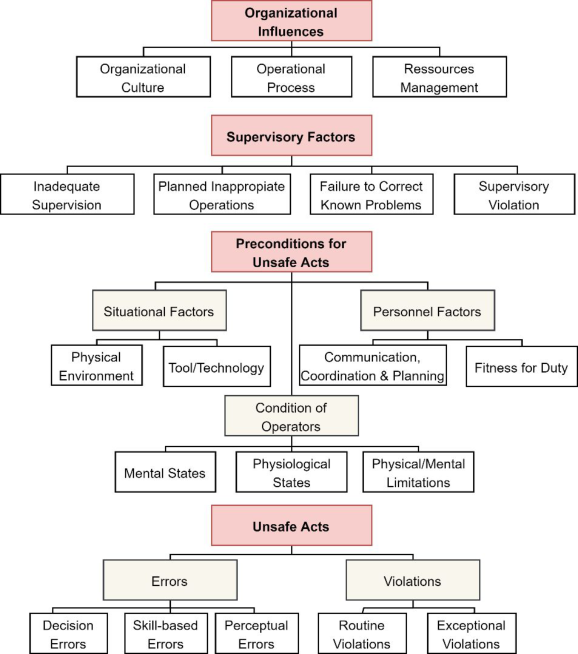
MATERIALS AND METHOD The HFACS framework was used to analyze assembly errors in a manufa- cturing environment. The reason this method was selected is that it offers a formal structure that facilitates factor identification and categorization, and it is based on a well-known underlying theoretical model. HFACS was developed to improve the process of aircraft accident investigations (Shappell & Wiegmann, 2000). However, its uses have expanded to include accident analysis in several sectors outside aviation such as maritime, rail, mining (Hulme et al., 2019b) and even healthcare to analyze dosing errors (O. Igene & Johnson, 2018). HFACS is a taxonomy-based systemic analy- sis method that was developed using the accident causation model known as the Swiss Cheese Model (SCM) (Reason, 1990). HFACS uses the same four levels as the SCM model, i.e., organizational influences, unsafe supervision, preconditions for unsafe acts and unsafe acts, to which the authors added 19 categories distributed among these four levels (See Figure 1). An analyst- oriented approach was used to apply the HFACS framework to a realistic case of a complex manual assembly task. Data for this was obtained from a project that was carried out at an industrial aeronautical manufacturing facility. For this analysis, we selected quality deficiencies associated with the incorrect installation of brackets. The brackets are used to fix clamps that hold cables to the assembly object’s structure. A more detailed explanation can be found in Torres et al. (2021).
RESULTS
In total, 34 contributory factors were identified and classified according to categories at each level contained in the HFACS taxonomy (See Table 1). The distribution among the four levels of HFACS was as follows: 13 in the orga- nizational influence level (38.3%), two in the supervisory factors (5.8%), 12 in preconditions for unsafe acts (35.2%) and seven in unsafe acts (20,7%).
Figure 1: HFACS framework (adapted from Shappell & Wiegmann, 2000).
We were able to identify contributory factors to assembly errors at all levels of the HFACS taxonomy. The supervisory factors level had the least number of factors identified (only two). The only category with no factor identified was communication, coordination and planning.
DISCUSSION
If we split HFACS into upper and lower levels, 44% of factors correspond to the upper level while 56% correspond to lower levels. This relatively even distribution contrasts with Hulme et al. (2019a), who reviewed 43 studies of HFACS applications. They found that a more significant number of con- tributory factors were associated with ‘unsafe acts’ and ‘preconditions for unsafe acts’, which included different types of errors, violations, and physical environments. Thus, the proportion of factors at the upper and lower levels was more inclined towards the latter—a somewhat contradictory finding considering the systemic nature of HFACS.
Nevertheless, according to Hulme et al. (2019a) this may well be the result of the information and data available at the moment of the analy- sis rather than an inherent feature of the HFACS framework. Indeed, it has
Analysis of Assembly Errors Using Systems Thinking Approach 63
Table 1. Identified factors according to the categories of HFACS.
Table available in the original PDF paper.
Organizational Influences Organizational culture
Quality investigations (lack of integration of human factors/ergonomics perspective)
Low risk perception of quality deficiencies (complacency from reliance on quality controls, i.e., automated visual inspection)
Data-driven approach to assembly errors (aerospace industry regulations) Operational process
Inadequate design/update of working instructions
Lack of integration of end user requirements into the Manufacturing Execution System (MES)
Variability in production demands (low/high production pressures)
Industrial regulations
High level of design complexity of the product Resources management
Instability in the parts supply chain
Variation in required staffing levels
Deadlines contracted with clients (scheduled deliveries pressures)
Wage policy incentives accumulation of overtime
Budget priority allocation (IT strategy need significant funds for technological upgrade) Supervisory Factors Inadequate supervision
Failure to provide guidelines on shift scheduling/overtime allocation practices Planned Inappropriate Operations
Assignment of work that include extended hours. Preconditions for Unsafe Acts Physical environment
Workplace layout affects visibility/accessibility of working instructions (fixed PC station).
Easy, inadvertent access to the assembly cell (interruptions) Tool/Technology
High task complexity
Use of low fidelity 2D images in assembly instructions
Lack of tools providing tracking and immediate feedback during task execution
Flows in assembly instruction delivery system
Limitation of human visual inspection Mental States
Chronobiological fatigue associated with insufficient resting time (sleep hygiene). Unsafe Acts Decision Errors
Failure to create mental model due to misinterpretation of relevant information in the assembly instructions Skill-based errors
Wrong bracket selected for installation (different model)
Bracket misaligned (shifted holes in the assembly object)
Bracket installed in wrong direction.
Omission of a step within the task
Manual application of torque outside of specifications Routine violations
Group validation of the assembly steps with the assembly instructions
been recognized that systemic accident analysis methods require a thorough understanding of the system object of analysis and access to information and the availability of large amounts of data (Salmon et al., 2012). In our case, the action research orientation of the project may well have served to go upstream in the HFACS levels. This means that the analyst had recurrent access to primary sources of data and information, including direct contact with assembly workers and interviews and meetings with assembly line supe- rvisors, follow-up meetings with quality managers, quality specialists and production managers, and milestone meetings with company executives. This contrasts with what is usually observed. Quite frequently, the studies that applied systemic methods relied largely on the information contained in acci- dent reports (Goncalves Filho et al., 2019; O. O. Igene & Johnson, 2020; Kee et al., 2017; Salmon et al., 2012) which was not our case.
The fact that assembly work in this study is not a teamwork task by nature may explain why no factor was identified in the category communication, coordination & planning (preconditions for unsafe acts). This category is particularly relevant for sectors such as aviation or maritime, where inte- raction among crew members during operations is common. It should be noted that several external factors needed to be relocated as HFACS does not have a level for outside factors. The relocated factors included: instability of parts suppliers; delivery schedules contracted with clients and industrial regulations. In contrast, methods like AcciMap (Rasmussen & Svedung, 2000) and STAMP (Leveson, 2004) identify factors outside the organiza- tion’s boundaries. Similarly, a linkage between factors at lower levels and factors at higher levels is not possible with HFACS. This was pointed out by Hulme et al. (2019a) when they underlined that 60% of the studies used some technique to understand better and quantify the relationships among contributory factors. This could help managers who must make decisions.
Analysis of Assembly Errors Using Systems Thinking Approach 65
LIMITATIONS In this paper, only the HFACS framework was used to analyze assembly errors. However, it has been mentioned that applying several systems thin- king methods to the same situation is useful because several insights can be developed simultaneously (and shortcomings in one method can be countered by other methods) (Salmon & Read, 2019). Therefore, future analysis may benefit from including at least an additional systemic analysis method. This is even more relevant if one considers that the Swiss Cheese Model, on which the HFACS framework is based, contains several drawbacks (Reason et al., 2006) which more recent models of accident causation have tried to address (Leveson, 2011). Also, in this study, the analyst identified and classified con- tributory factors a posteriori. This means that the collection of information and data occurred prior to the analysis itself. In the future, this could be car- ried out in concert, which would imply an appropriation of the system vision from the beginning.
CONCLUSION
Even if the systemic nature of HFACS emphasizes the role of organizational factors and latent determinants, systemic methods require a good understan- ding of the operational aspects of the system object of analysis, given that latent conditions are not so easy to detect. For this reason, during the analy- sis process, it would be advantageous to involve or at least have access to different stakeholders from several organizational levels. Recurrent access to primary sources of information, data and stakeholders can significantly sup- port the analysis and facilitate going upstream the HFACS taxonomy levels. To this effect, an action research orientation of the analysis process could be valuable. Our study supports the idea that the quality management disci- pline in a manufacturing environment could benefit from using the systems thinking approach and methods. Quality specialists and managers might be trained in systemic analysis methods to be less dependent on external analysts.
HFACS may well benefit from adding a fifth level to the taxonomy to include ‘external factors’. Furthermore, a taxonomy specifically tailored to the context of manufacturing and manual assembly could add benefits to the analysis. Finally, the absence of linkages between factors and the impossibility of assessing the relative weight of the factors identified may limit the use of HFACS as a decision-making tool. This can be remedied by introducing other complementary methods.
REFERENCES
Carayon, P., Hancock, P., Leveson, N., Noy, I., Sznelwar, L., & van Hootegem, G.
(2015). Advancing a sociotechnical systems approach to workplace safety – developing the conceptual framework. Ergonomics, 58(4), 548–564. https://doi.org/10.1080/00140139.2015.1015623 Goncalves Filho, A. P., Jun, G. T., & Waterson, P. (2019). Four studies, two methods, one accident – An examination of the reliability and validity of Accimap and STAMP for accident analysis. Safety Science, 113, 310–317. https://doi.org/10.1016/j.ssci.2018.12.002
Hollnagel, E. (2012). FRAM, the functional resonance analysis method: modelling complex socio-technical systems. Ashgate Publishing, Ltd. Hulme, A., Stanton, N. A., Walker, G. H., Waterson, P., & Salmon, P. M. (2019a).
Accident analysis in practice: A review of Human Factors Analysis and Classi- fication System (HFACS) applications in the peer reviewed academic literature. Proceedings of the Human Factors and Ergonomics Society Annual Meeting, 63(1), 1849–1853. https://doi.org/10.1177/1071181319631086 Hulme, A., Stanton, N. A., Walker, G. H., Waterson, P., & Salmon, P. M. (2019b).
What do applications of systems thinking accident analysis methods tell us about accident causation? A systematic review of applications between 1990 and 2018. Safety Science, 117, 164-183. https://doi.org/10.1016/j.ssci.2019.04.016 Igene, O., & Johnson, C. (2018). Comparing HFACS and AcciMaps in a health informatics case study—the analysis of a medication dosing error (Safety and Reliability–Safe Societies in a Changing World (pp. 3–10). CRC Press. Igene, O. O., & Johnson, C. (2020). To Computerised Provider Order Entry system:
A comparison of ECF, HFACS, STAMP and AcciMap approaches. Health Infor- matics Journal, 26(2), 1017–1042. https://doi.org/10.1177/1460458219859992 Kee, D., Jun, G. T., Waterson, P., & Haslam, R. (2017). A systemic analysis of South Korea Sewol ferry accident – Striking a balance between learning and accounta- bility. Applied Ergonomics, 59, 504–516. https://doi.org/10.1016/j.apergo.2016. 07.014 Leveson, N. G. (2004). A new accident model for engineering safer systems. Safety
Science, 42(4), 237–270. https://doi.org/10.1016/S0925-7535(03)00047-X Leveson, N. G. (2011). Engineering a safer world: Systems thinking applied to safety.
The MIT Press. Marucheck, A., Greis, N., Mena, C., & Cai, L. (2011). Product safety and security in the global supply chain: Issues, challenges and research opportunities. Journal of Operations Management, 29(7), 707–720. https://doi.org/10.1016/j.jom.2011. 06.007 Rasmussen, J., & Svedung, I. (2000). Proactive risk management in a dynamic society
(1st ed.). Swedish Rescue Services Agency. Read, G. J. M., Shorrock, S., Walker, G. H., & Salmon, P. M. (2021). State of science: evolving perspectives on ‘human error’. Ergonomics, 1–24. https://doi.org/10.1080/00140139.2021.1953615 Reason, J. (1990). Human error. Cambridge University Press. Reason, J., Hollnagel, E., & Paries, J. (2006). Revisiting the Swiss cheese model of accidents. EUROCONTROL Experimental Centre. https://www.eurocontrol.int/ sites/default/files/library/017_Swiss_Cheese_Model.pdf Salmon, P. M., Cornelissen, M., & Trotter, M. J. (2012). Systems-based accident
analysis methods: A comparison of Accimap, HFACS, and STAMP. Safety Science, 50(4), 1158–1170. https://doi.org/10.1016/j.ssci.2011.11.009 Salmon, P. M., & Read, G. J. M. (2019). Many model thinking in systems ergonomics: a case study in road safety. Ergonomics, 62(5), 612–628. https://doi.org/10.1080/ 00140139.2018.1550214 Shappell, S., & Wiegmann, D. (2000). The Human Factors Analysis and Clas-
sification System-HFACS. U.S Department of Transportation, Federal Aviation Administration. Tennant, G. (2017). Six Sigma: SPC and TQM in manufacturing and services.
Routledge. Torres, Y., Nadeau, S., & Landau, K. (2021). Classification and quantification of human error in manufacturing: a case study in complex manual assembly. Applied Sciences, 11(2), 749. https://doi.org/10.3390/app11020749
LISTED IN THE AHFE DIGITAL BOOKSTORE CATALOGUE
Explore the complete digital volume
Human Error, Reliability, Resilience, and Performance
Read this individual research paper free through the original publisher, or explore the full digital proceedings book.
ISBN 978-1-958651-09-4
Explore this ISBN in the AHFE Bookstore ↗Listed in the July 2026 bookstore catalogue; search by ISBN to confirm current availability · Digital book purchase optional