Akide Cerci, Ismail ekmekci (2026). Human Error and Artificial Intelligence Interaction in Occupational Safety. In: Safety Management and Human Factors. AHFE Open Access, vol. 227, pp. 142–149. https://doi.org/10.54941/ahfe1007926
The study begins with a brief overview of the concept of artificial intelligence, which is now closely affecting individuals, social life, and all sectors. It then examines the development process of artificial intelligence, its areas of application, and the impact of the Internet of Things technology—which is increasingly being integrated into new applications—on the new generation of humans. It also emphasizes the importance of adopting a hybrid approach that combines machines' automation power with humans' ethical, intuitive, and contextual competencies for a sustainable and reliable future. Artificial intelligence, which has been rapidly accepted in professional work life and personal life, has created risks and problems both in specific sectors and in individuals' private lives, alongside its effects of simplifying life and increasing quality in every area. Despite concerns that human behaviour inherently carries greater risk than machine behaviour, analyses of errors made by artificial intelligence and errors made by humans reveal that, despite commonalities, the types, probabilities, effects, and consequences of these two types of errors differ significantly. For example, it is believed that the current capabilities of artificial intelligence technologies are insufficient to meet certain critical human competencies. It is seen that human-specific qualities such as ethical evaluation, contextual analysis, creative problem solving, and strategic reasoning cannot be fully performed by artificial intelligence. The biggest challenge facing artificial intelligence stems from the fact that a significant percentage of the data on which AI systems rely comes from humans. Such data is largely the result of the irrationality and subjectivity of people acting in their own self-interest. Human errors can be skill-based, rule-based, or knowledge-based. Skill-based errors are application errors, while the other two are planning-based. Studies show that most human errors are skill-based, such as carelessness and inattention, and are more likely to be detected. As a result, artificial intelligence should continue to be a complement in areas where the human factor is critically important and should maintain its indispensability. The proportion of human error is much greater than the proportion of artificial intelligence errors. And fundamentally, the source of artificial intelligence errors is human error. To mitigate their effects, investments are needed to improve error detection for both types of errors. As both humans and machines evolve, the likelihood of new errors emerging increases, while the likelihood of old errors persisting decreases, necessitating adequate risk management efforts.
With the advancement of digitalization and technology, jobs and work tasks are constantly changing. The development of cutting-edge technologies such as artificial intelligence or advanced robotics is profoundly affecting human life as one of the most transformative technologies of the 21st century. Although artificial intelligence research is relatively new, the origins of the concept of artificial intelligence date back to the 1940s. Alan Turing was one of the first mathematicians to explore the mathematical possibility of artificial intelligence by posing the question, “Can a machine think like a human?” (Pishgar et al., 2021). Another study defines artificial intelligence as “enabling a machine to behave in a way that could be considered intelligent, as if it were human” (Aslan et al., 2023). The term artificial intelligence generally emerged at the Dartmouth College conference in the United States in the summer of 1956. Since then, although this field has experienced some ups and downs, it has shown strong growth, as noted in numerous historical records. Thanks to investments by technology giants in particular, there has been an explosion in the field of artificial intelligence, and it has become an indispensable part of daily life. Among all industrial and economic sectors, the science and research sector is one of the earliest and most enthusiastic adopters of artificial intelligence technology. Artificial intelligence is a general-purpose technology that can increase the cost-effectiveness, speed, safety, and quality of research in virtually all fields of work (Hajkowicz et al., 2023 & Tobina et al., 2029). Furthermore, artificial intelligence is paving the way for innovative and exciting developments in the workplace, thanks to the increasing availability of big data and the ability to process data through algorithms, leading to fundamental and widespread changes in how work is done (EU-OSHA, 2021). Artificial intelligence refers to the simulation of human intelligence in machines programmed to think and learn like humans. This involves developing algorithms and computational models that enable machines to perform tasks traditionally requiring human intelligence. These tasks include problem solving, decision making, speech recognition, language translation, visual perception, and more (El-Helaly, 2024). In summary, artificial intelligence can also be defined as a computer’s ability to process information and produce results that mimic human learning, decision- making, and problem-solving (Pishgar et al., 2021). Thus, although artificial intelligence research is relatively new, it has permeated every area of our lives and has become a comprehensive and diverse field of research that has gained decisive importance over the years. Artificial intelligence can also play an important role in the distribution of power and resources by revealing new structures in the labor market, efficiently finding the right skills for each task, and matching supply and demand (Mattfolk, 2025).
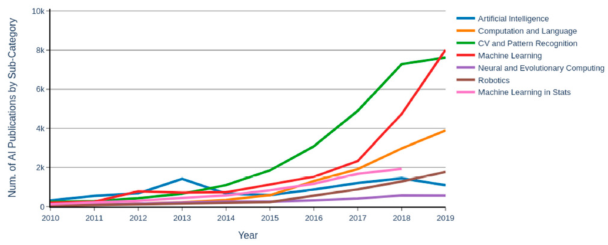
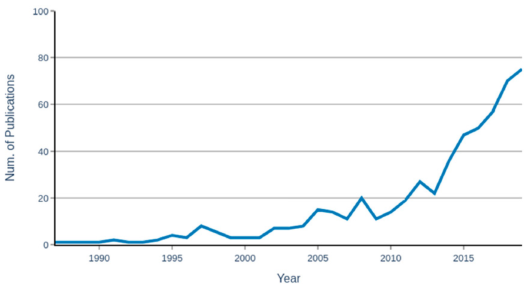
Today, artificial intelligence is actively used in many fields, including education, healthcare, transportation, agriculture, manufacturing, finance, and defence (see Figure 1). There is a wide range of applications, from personalized education systems to smart production lines, from early diagnosis of diseases to autonomous vehicles. Recent studies highlight the significant impact of artificial intelligence on occupational health and safety
144 Ogmen and Ekmekci (see Figure 2). AI-driven technologies are revolutionizing workplace safety by providing real-time monitoring and risk mitigation strategies, as well as real- time monitoring and predictive insights. In high-risk sectors such as mining, construction, and oil and gas, artificial intelligence applications include sensor networks, computer vision, and machine learning for hazard detection and risk management. Generative artificial intelligence is creating transformation in various sectors, from healthcare to finance, and applications extend to these sectors. These developments highlight the potential of artificial intelligence to improve workplace safety, decision-making processes, and productivity across multiple sectors, while also underscoring the necessity of responsible innovation and ethical considerations (Aslan et al., 2023, & Andrea Falegnami et al., 2024).
Figure 1: This graph shows the number of artificial intelligence papers in ArXiv by subcategory over time from 2010 to 2019. The x-axis of the graph (data collected from 2010 to 2019) and the y-axis show the distribution of the number of artificial intelligence papers on ArXiv according to subcategories of artificial intelligence research. The data was provided by Stanford’s 2019 AI Index Reports.Figure 2: This graph shows the number of publications on the use of artificial intelligence in occupational health and safety from 1986 to 2019. The X-axis represents the year of publication, while the Y-axis represents the number of artificial intelligence articles published in the field of occupational health and safety (Pishgar et al., 2021 & Perrault et al., 2019).
ARTIFICIAL INTELLIGENCE AND OCCUPATIONAL HEALTH AND SAFETY In an era marked by dynamic technological developments, workforce well-being remains the cornerstone of sustainability and progress. The evolving industrial landscape in the modern world has a significant impact on occupational health and safety (OHS). Occupational health and safety research is vital for sustainable social development, focusing on preventing and reducing physical and psychological harm in the workplace. Occupational Health and Safety concern the fundamental rights of workers to life and health, the sustainable development of businesses, and broader social stability. The fundamental challenge is to reduce occupational health risks through engineering-based prevention and systematic management. In recent years, with ongoing industrial restructuring, namely the advancement of industrialization and modernization, traditional occupational health hazards have been inadequately controlled, while emerging occupational health problems have become increasingly apparent (Tong et al., 2025). Ensuring employee well-being and creating safe working environments is not only an ethical imperative, but also essential for maintaining operational efficiency and productivity (Shah et al., 2024). For this reason, this study reviews the application of artificial intelligence in occupational safety and health across various industries. While these publications do not cover the full scope of AI applications in occupational safety and health, they provide a general overview. As the number of artificial intelligence applications in the workplace continues to grow, there is a growing need to understand the potential impacts of artificial intelligence on occupational health and safety. This theoretical study seeks to answer the question of how human- caused errors have changed in light of the rise in AI-induced errors, and offers recommendations on what can be done to mitigate the impacts of both types of errors.
Benefits of Artificial Intelligence in Occupational Health and Safety The use of artificial intelligence technology in addressing occupational safety issues is not entirely new, and various studies have been conducted on this subject for a long time. AI-focused technologies revolutionize organizations’ approach to health and safety, not only minimizing accidents and hazards but also enabling a more proactive and responsive approach to protecting the workforce by providing predictive insights, real-time monitoring, and risk mitigation strategies. At the situational level, studies exist in the literature on the perception of hazardous situations, the assessment of whether personnel are wearing protective equipment correctly, health aspects and how self- management can be supported in this regard, the investigation of health management, and the planning of medical examinations. In addition, accident prediction has also been a subject of research in recent times (Westhoven, 2022). Fundamentally, when looking at the positive effects of artificial intelligence, many innovations that make life easier stand out. In the field of healthcare, early diagnosis of diseases, personalized learning programs in education, and smart navigation systems in transportation are just a few of the advantages offered by artificial intelligence. Thanks to big data analysis in particular, doctors can make more accurate diagnoses, and students can access content tailored to their own learning pace. Additionally, automation systems in the
146 Ogmen and Ekmekci manufacturing sector have increased productivity and reduced error rates. This situation saves time and contributes to economic growth. Another study examined the impact of artificial intelligence on occupational health and safety and noted that although the integration of artificial intelligence into the field of occupational health and safety is still in its infancy, it has found numerous applications in the workplace. Some of these applications, such as the continuous monitoring of workers’ health and safety and the workplace environment through wearable devices and sensors, were highlighted as providing countless benefits for workers’ health and safety (El-Helaly, 2024 & Weerts et al., 2022). Smart building systems improve energy efficiency and employee comfort, reducing environmental impacts while meeting employee expectations for safety and comfort. They also lower operating costs and provide economic benefits. Furthermore, smart robots used in production processes utilize flexible sensor technology and provide pre-programmed services. Moreover, they improve employee ergonomics by reducing the risk of adopting improper postures and can lower the risk of human error.
Disadvantages of Artificial Intelligence in Occupational Health and Safety The negative effects of artificial intelligence on humans should not be overlooked. The development and validation of occupational health and safety methodologies face challenges, including the need for accurate and ethically collected data and obstacles arising from data protection laws. The production of synthetic data using artificial intelligence has emerged as a potential solution to related problems, enabling data use and sharing in situations where real-world data is inaccessible or insufficient. Various machine learning approaches are being researched for occupational health and safety applications. Despite its potential, barriers to the adoption of artificial intelligence in occupational health and safety include high costs, lack of qualified personnel, and ethical concerns. The use of AI-enabled sensors offers promising advantages for occupational health and safety but also presents potential obstacles. One of these issues relates to ethical concerns regarding the use of AI-powered sensor technologies to comprehensively monitor and track employee performance. In general, as AI is integrated into workplaces, while it presents significant opportunities for workplace development and increased productivity, fundamental concerns about occupational health and safety arise. An increasing number of companies are adopting “sensor technology,” “cloud-based human resources systems,” and “machine learning-supported data analytics” as part of a strategic approach known as “human analytics.” Human analytics plays a significant role in supporting management activities such as recruitment performance management, employee retention, and workforce planning. However, it should be noted that excessive monitoring of employee behavior can lead to negative consequences such as privacy violations, a sense of loss of personal identity, and increased stress levels among employees, which in turn leads to human error. Additionally, due to the smart robots used in production processes, some employees struggle to adapt to changes in their job responsibilities, which leads to a decline in their emotional well-being
Human Error and Artificial Intelligence Interaction in Occupational Safety 147 and brings with it the risk of human error (Aslan et al., 2022). In digitalized workplaces, psychosocial hazards, including physical aggression, may arise due to factors such as discrimination, stress, musculoskeletal problems, increased job insecurity, work intensity, and even the possibility of job loss. These identified hazards are further exacerbated when artificial intelligence is used to develop or introduce new technological tools for workplace design and management. Undoubtedly, the implementation of artificial intelligence in digitalized workplaces increases risks related to occupational health and safety. This is largely due to significant human error factors that contribute to increased levels of stress and anxiety.
RESULTS
There are concerns that artificial intelligence could be dangerous for humanity. However, the study of machine behaviour and human behaviour reveals that human behaviour inherently carries a greater risk than machine behaviour. While there are commonalities in the analysis of errors made by artificial intelligence and those made by humans, the types, effects, probabilities, and consequences of these two types of errors differ significantly. As artificial intelligence becomes more widespread and an important factor of production in many industries, the consequences of these errors can also be serious. The biggest challenge facing artificial intelligence stems from the fact that a significant percentage of the data on which artificial intelligence systems rely comes from humans. Human errors can be rule-based, skill-based, or knowledge-based. Rule-based and knowledge-based errors are planning errors, while skill-based errors are execution errors. Most human errors are skill-based, such as inattention and carelessness, and are more likely to be detected. Other errors occur less frequently and are less likely to be detected. A common factor in both artificial intelligence and human errors is that both affect people. Only the degree of impact may vary. One of the most important differences between artificial intelligence errors and human errors is the element of predictability. Artificial intelligence errors are much more predictable than human errors, partly because they are systematic and, unlike humans, machine behaviour can be modelled. Artificial intelligence errors are easier to predict, which means that correcting and even preventing them is also easier. No matter how advanced artificial intelligence systems become, they will always be less creative than humans; this is generally a positive outcome, because artificial intelligence cannot go too far unless humans intervene and make the necessary corrections.
CONCLUSION
Human error accounts for a much larger share than artificial intelligence errors. The source of artificial intelligence errors is human error. To reduce the impact of both types of errors, investments are needed to improve error detection for both types. As both humans and machines evolve, the likelihood of new errors emerging will increase. For this reason, a hybrid approach that combines the automation power of machines with the ethical,
148 Ogmen and Ekmekci intuitive, and contextual competencies of humans—commonly known as augmented intelligence or the human-machine collaboration model— should be adopted. The fundamental goal of this approach is to combine the accuracy, speed, and scale advantages of machines with the ethical reasoning, creativity, empathy, and contextual understanding capabilities of humans. The fundamental logic of the hybrid approach is to leverage the strengths of machines in data analysis, repetitive tasks, pattern recognition, and prediction, while utilizing the strengths of humans in ethical evaluation, final decision-making, contextual interpretation, and exceptional situation management, rather than relying on full automation. Furthermore, fully automated systems have certain limitations, such as algorithmic bias, missing context, lack of ethical reasoning, and vulnerability to unexpected situations. Humans, on the other hand, understand complex social contexts, can make value-based decisions, perform intuitive risk assessments, and empathize. For this reason, the hybrid model aims to balance the weaknesses of both sides. The hybrid approach is moving towards a “technology that empowers humans” paradigm rather than systems that completely exclude humans. This model is expected to become the norm, especially in high- risk sectors (defence, healthcare, finance, public policy). This approach is actually more of a design and ethical management issue than a technology issue: In this approach, the question should not be “Machine or human?” The real question should be “Who is more competent at which stage of which decision?” This ensures higher accuracy, more ethical decisions, greater trust, greater accountability, and reduced risks.
REFERENCES
Andrea Falegnami A., Andrea TomassiA., Corbelli G., Nucci F.S. and Romano E., (2024).
A Generative Artificial-Intelligence-Based Workbench to Test New Organisational Health and Safety, Appl. Sci. 14(24), 11586; https://doi.org/10.3390/app142411586 Aslan I., Benharkat N.E.H., Bentaallakaced S., (2023). The Applications of Artificial Intelligence in Occupational Health and Safety, ICESSER 7TH international conference on emprical social sciences, economy, management and education research November 10 - 12, Jakarta – Indonesia El-Helaly, M., (2024). Artificial Intelligence and Occupational Health and Safety, Benefits and Drawbacks, Med Lav; 115 (2): e2024014 Hajkowicz S., Sanderson C., Karimi S., Bratanova A., Naughtin C., (2023). Artificial
intelligence adoption in the physical sciences, natural sciences, life sciences, social sciences and the arts and humanities: A bibliometric analysis of research publications from 1960-2021, Technology in Society 74,102260 Impact of Artificial Intelligence on Occupational Safety and Health, European Agency for Safety and Health at Work (EU-OSHA), (2021), http:// osha.europa.eu Mattfolk C. and Wikander S., (June 2025). How organisational structures and the
role of humans transform in the age of AI, The Future of Labour (pp. 155–182), DOI: 10.4324/9781003391333-13 Perrault, R., Shoham, Y., Brynjolfsson, E., Clark, J., Etchemendy, J., Grosz, B., Lyons, T., Manyika, J., Mishra, S., Niebles, J.C., (2019). The AI Index 2019 Annual Report; AI Index Steering Committee, Human-Centered AI Institute; Stanford University: Stanford, CA, USA.
Human Error and Artificial Intelligence Interaction in Occupational Safety 149 Pishgar, M., Issa, S.F., Sietsema, M., Pratap, P., Darabi, H., (2021). REDECA: A Novel
Framework to Review Artificial Intelligence and Its Applications in Occupational Safety and Health. Int. J. Environ. Res. Public Health, 18, 6705. https:// doi. org/10.3390/ijerph18136705 Shah I.A. and Mishra S., (2024). Artificial intelligence in advancing occupational health and safety:an encapsulation of developments, Journal of Occupational Health, 66(1), uiad017 Tobina S., Jayabalasinghamb B., Huggettc S. and Kleijnd M., (2019). A brief historical
overview of artificial intelligence research, Information Services & Use, 1–6 Tong C., Wang Y., Liu H., Tong B., Zhu J., Kou M., (December 2025). From risk management to AI-driven safety: A bibliometric review of occupational safety and health research, Results in Engineering Volume 28, 107440 Weerts, S., Naous, D., El Bouchikhi, M., Clavien, C., (September 6-8, 2022). AI
Systems for Occupational Safety and Health: From Ethical Concerns to Limited Legal Solutions, Electronic Government: 21st IFIP WG 8.5 International Conference, EGOV 2022 Linköping, Sweden, Proceedings Pages 499 – 514 https://doi.org/10.1007/978-3-031-15086-9_32 Westhoven M., (2022). Requirements for AI Support in Occupational Safety Risk Analysis, MuC ‘22: Mensch und Computer, htps://dl.acm.org/ doi/10.1145/3543758.354757
LISTED IN THE AHFE DIGITAL BOOKSTORE CATALOGUE
Explore the complete digital volume
Safety Management and Human Factors
Read this individual research paper free through the original publisher, or explore the full digital proceedings book.
ISBN 979-8-950676-03-1
Explore this ISBN in the AHFE Bookstore ↗Listed in the July 2026 bookstore catalogue; search by ISBN to confirm current availability · Digital book purchase optional