Rodrigo Dominguez, Javiera Ayala, Sebastian Amaro, Alex Rojas, Cristian Acevedo (2026). Risk Assessment in a Biotechnology Laboratory Using the EMKG Method: Guide to Best Practices and Procedures. In: Safety Management and Human Factors. AHFE Open Access, vol. 227, pp. 1–9. https://doi.org/10.54941/ahfe1007911
Information on the production of biomaterials through electrospinning has been reported; however, it is necessary to ensure the safety of students, teachers, and researchers who may be inadvertently exposed to biomaterials during laboratory tasks such as weighing, solution preparation, polymer solution loading, and cleaning. Aim: The aim is to contribute to increasing knowledge in this area by assessing the hygiene risks of activities involving hazardous substances in the biomaterials laboratory where scaffolds with potential biomedical applications are produced. Method and materials: The occupational risk assessment was performed according to EMKG Tools Workplace & Chemicals due to its ease of use, speed, and clarity compared to COSHH and INRS methods. Accessible parameters are used to estimate hazards and associate them with control strategies, which are implemented using the control guide (operating procedures and solution preparation protocol). Of the thirty-five chemicals used in the biomaterials laboratory, the following nine were assessed using the EMKG method: dimethylformamide, acetic acid, acetonitrile, methanol, hexane, lithium chloride, acetone, and ethanol, considering their respective Safety Data Sheets (SDS). Exposure estimates were based on parameters such as effective area, contact duration, quantity group, release group, and control strategy. Results: Of the nine chemicals identified, dimethylformamide and chloroform were classified as risk level 3, representing a significant hazard. Acetic acid, acetonitrile, methanol, hexane, and lithium chloride were classified as risk level 2, indicating the need for technical and organizational measures. Finally, acetone and ethanol were assigned a risk level 1, in line with good laboratory practices. Conclusions: Hygienic risks for teachers, students, and researchers were identified during laboratory activities, even when substances were used at low concentrations. Therefore, it is essential to implement measures that standardize procedures and minimize the possibility of unwanted incidents.
The development of new biomaterials has gained relevance in various areas of science, particularly in tissue engineering. Various types of natural and synthetic polymers with diverse characteristics have been successfully electrospun to produce nanofibers (NFs) (CeCe et al., 2024). In tissue engineering, it is essential that synthetic scaffolds closely mimic native
tissue and provide a suitable microenvironment (De Giorgio et al., 2024). Many factors can hinder proper and rapid wound healing. These include the possibility of microbial infection, loss of wound moisture, and scar formation (Ali et al., 2022). With the development of biotechnology, the emergence of multifunctional wound dressings and nanofiber scaffold materials has alleviated, to some extent, the problem of skin transplantation (Zhang et al., 2024). One of the most widely used techniques in this field is electrospinning, a process that allows the production of nanofibers and microfibers from polymer solutions by applying a high-voltage electric field and can be considered the best option for achieving multifunctional and cost-effective products (such as wound dressings) (Talukder et al., 2021).
The effective application of electrostatic forces to stretch and solidify the solution distinguishes electrospinning from other traditional fiber spinning techniques (Abdulhussain et al., 2023). The electric field evenly distributes the induced charges on the surface of the polymer droplet (Rostami et al., 2025). This technique is valued for its low cost, ease of tuning, and simple configuration, making it versatile for multiple applications (Patel et al., 2025).
The dimensions and design of electrospun fibers resemble the extracellular matrix (ECM) of the skin, which significantly promotes rapid wound healing (Ghomi et al., 2023). The alignment and arrangement of nanofibers are also influenced by electrospinning conditions, such as temperature and humidity (Venmathi et al., 2024). By adjusting the process parameters, it is possible to produce nanofibers of different sizes (Zhang et al., 2024). The preparation of solutions with appropriate concentrations is a key parameter (Keshvardoostchokami et al., 2020).
Surface area, mechanical strength, and porosity are significantly influenced by nanofiber diameter, which is determined by the electrospinning voltage and solution viscosity. Achieving a well-defined Taylor cone is essential to ensuring the stability of the electrospinning process, as it allows for control of both the diameter and morphology of the nanofibers (Subeshan et al., 2024). The electrospinning technique has been widely used to produce nanofiber membranes in recent decades due to its flexibility, diversity, and efficiency (Xie et al., 2022). While this technique offers significant advantages in terms of versatility and efficiency, it also entails occupational hazards associated with the use of volatile organic solvents, particulate materials, and high- voltage equipment. It should be noted that laboratory activities carry a high potential for various risks to users and the surrounding environment (Atma et al., 2024).
In this context, the present research aimed to conduct a qualitative assessment of the occupational hazards that may arise in a biomaterials laboratory. The assessment was conducted to identify and characterize the possible exposure scenarios to which laboratory personnel may be exposed. To this end, a methodology based on qualitative risk analysis tools was employed, allowing for an initial diagnosis that serves as the basis for implementing preventive and corrective measures in the workplace. These tools quickly distinguish between hazardous and non-hazardous situations,
Risk Assessment in a Biotechnology Laboratory Using the EMKG Method 3 providing a conservative estimate of exposure based on certain determinants (Rahmawati et al., 2024). The assessment not only seeks to contribute to the safety of laboratory personnel but also to promote a culture of prevention in the academic and scientific fields.
MATERIALS AND METHOD The case study investigated corresponds to a qualitative assessment of the chemical substances used in the biomaterials laboratory. In the biomaterials laboratory, scaffolds with potential biomedical applications are fabricated using the electrospinning technique. Due to the current importance of having burn wound dressings, tissue engineering is one of the practices implemented in the laboratory (Enrione et al., 2017; Acevedo et al., 2019; Taborda et al., 2023; Arroyo et al., 2024), (Acevedo et al., 2018; Enrione et al., 2018; Jaques et al., 2021).
Selection of the Method The selection of the method, as shown in Table 1, was based on the criteria of ease (degree of simplicity in application), speed (time required to carry out the method), and clarity (ease of understanding the application structure).
Table 1: Evaluation criteria for hygienic risk assessment.
Table available in the original PDF paper.
Evaluation Criteria Coosh Method INRS Method EMKG Method Ease of use 4 3 5
Speed 4 3 5 Clarity 4 3 4 SCORE 10 9 14
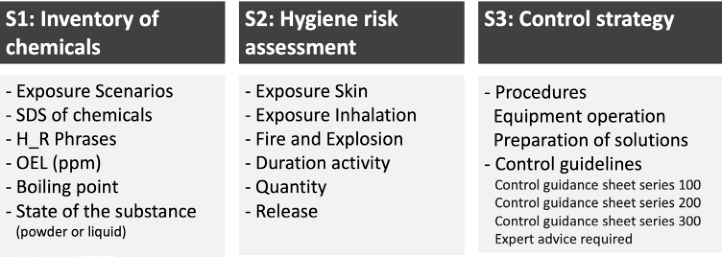
Based on the results obtained from Table 1, it was decided to apply the EMKG method (14 points), compared to the COSHH method (10 points) (Shekarloo et al., 2023) and the INRS method (9 points) (Amorim et al., 2021). The study was divided into three stages as described in Figure 1.
Figure 1: Outline of the study´s methodology.
The primary focus was on evaluating the contributing exposure scenarios (CESs) associated with these substances. The selection criteria for the chemical substances were based on their usage frequency and potential hazard as indicated by their H-statements. An initial inventory identified thirty five chemicals routinely used in the laboratory, from which nine were classified as hazardous. This classification was guided by criteria outlined in the Globally Harmonized System of Classification and Labelling of Chemicals (GHS). The study was carried out in a controlled laboratory environment adhering to standard safety protocols to minimize risks to personnel.
Data Acquisition Data acquisition involved a systematic inventory of chemicals, followed by a detailed occupational exposure assessment. The laboratory environment was maintained at a constant temperature of 20°C, with humidity levels controlled at 45% to ensure consistency in data collection. Data were collected over a six-month period. The primary data sources were safety data sheets (SDS) for each chemical, which provided critical information on H-statements and occupational exposure limits (OELs). These data were supplemented by direct observations and interviews with laboratory personnel to understand routine practices and potential exposure scenarios.
The study employed the EMKG method for risk assessment, selected for its simplicity, speed, and clarity in application. This method was compared against the COSHH and INRS methods, which scored lower in our preliminary evaluation. The risk assessment process was divided into three main stages: S1: Inventory of Chemicals
An exhaustive list of all chemicals used in the laboratory was compiled. Each chemical was evaluated based on its H-statements, which provide information on health hazards, and its frequency of use in the laboratory. Hazardous substances were those that met criteria for acute toxicity, carcinogenicity, or reproductive toxicity. The inventory process involved cross-referencing with SDS and contribuiting exposure scenarios (CESs ) to ensure accuracy, as shown in Table 2.
Table 2: Extract from list of substances.
Table available in the original PDF paper.
Chemical Substance State CAS Supplier Acetic Acid Liquid 64-19-7 Merck
D (-) Sorbitol Solid 50-70-4 Merck Ethanol Liquid 64-17-5 Supelco
Gallic Acid Solid 149-91-7 Merck Gelatin from bovine skin – Type B Solid 9000-70-8 Sigma Aldrich
Gelatin from cold – water fish skin Solid 9000-70-8 Sigma Aldrich
S2: Hygiene Risk Assessment This stage involved a detailed analysis of potential exposure routes, including dermal and inhalation exposure. For dermal exposure, the risk group classification was based on the H-statements, and the effective exposure area was determined through direct observation of laboratory procedures. The duration of contact was estimated using time-motion studies conducted over multiple laboratory sessions. While, fire and explosion hazard assessment, involved identifying relevant hazard statements related to flammability and explosiveness. The quantity of each substance used in typical laboratory procedures was estimated, and substances were categorized into release groups based on their potential to form explosive atmospheres.
S3: Control Strategy Once the assessments for each exposure route were completed, the results obtained allowed access to the control strategies section of the method, where the final risk level associated with each chemical substance was determined, along with the recommended control measures for their handling, as shown in Table 3.
Table 3: Risk levels and control strategies for hazardous substances.
Table available in the original PDF paper.
RESULTS
The study aimed to evaluate the occupational exposure risks associated with the use of various chemicals (Table 2) in the preparation of polymer solutions in a biomaterials laboratory.
The description of all the CESs, the assessed exposure routes and related exposure estimations identified along the life cycle of the case-study NBM is reported in Table 4.
Table 4: Description of the chemicals used in the preparation in the main laboratory tasks.
Table available in the original PDF paper.
CESs Chemicals Quantity State Frequency Weighing Powder Table 2 Small Solid Weekly Solution Preparations Powder Table 2 + Solvent Small Liquid Weekly
Loading of the solution Polymer Solution Small Liquid Daily Cleaning Ethanol, Water Small Liquid Daily
The application of the EMKG method revealed a stratification of risk levels among the thirty-five chemicals assessed. Table 4 provides a comprehensive description of the chemicals used, detailing their quantities, physical states, and frequencies of use in the laboratory tasks. This table serves as a foundational reference for understanding the context of chemical usage and different contributing exposure scenarios. Each chemical’s characteristics are systematically outlined, facilitating a clear understanding of the exposure dynamics.
The risk assessment process, as applied to DMF, is illustrated in Table 5. This table exemplifies the step-by-step application of the EMKG method, highlighting the identification of risk groups, analysis of effective exposure areas, estimation of contact duration, and determination of control strategies. The risk level for DMF was determined to be Level 3, indicating a higher potential for exposure-related hazards compared to the other chemicals. The table provides a template for assessing similar chemicals, ensuring consistency and reproducibility in the risk assessment process.
Table 5: Example of the application of the EMKG method for the assessment of hygiene risk.
Table available in the original PDF paper.
Equation reproduced from the original PDF.
2 Effective Area: Large 10 mL used [Equation or mathematical symbol available in the original paper PDF] Quantity Group: Small
10 mL used [Equation or mathematical symbol available in the original paper PDF] Quantity Group: Small
3 Duration of skin contact: Short
Liquid, boiling point 153°C [Equation or mathematical symbol available in the original paper PDF] Release Group: Low
Liquid, boiling point 153 °C [Equation or mathematical symbol available in the original paper PDF] Release Group: Low
4 Control Strategy: Level 3 Control Strategy: Level 1 Control Strategy: Level 1
DISCUSSION
Of the nine risk chemicals analyzed, N,N-dimethylformamide (DMF) and chloroform reached risk level 3 for dermal contact and inhalation, respectively; while the other seven substances fell into risk levels 2 and 1, as shown in Table 6.
Risk Assessment in a Biotechnology Laboratory Using the EMKG Method 7 According to the data extracted from Table 6, DMF and chloroform were classified as risk level 3, highlighting their relative hazard compared to the other substances, which were classified at lower risk levels. This stratification provides a clear view of the different levels of risk associated with each chemical, allowing for the implementation of strategic control measures.
Table 6: Results obtained after applying the method used in the preparation polymer solutions.
Table available in the original PDF paper.
In summary, the results indicate that N,N-dimethylformamide (DMF) and Chloroform pose a higher risk of occupational exposure compared to the other chemicals evaluated, necessitating improved control measures to mitigate potential risks. The study’s findings constitute a valuable contribution to the field of occupational health, offering a replicable methodology for risk assessment and a basis for informed decision-making in laboratory safety management.
CONCLUSION
From the hygiene risk analysis conducted using the EMKG method, the findings demonstrate that while most chemicals used in the biomaterials laboratory present a moderate level of risk (Level 2), the identification of at least two substances with a higher level of risk (Level 3) requires immediate attention in their handling procedures. This study makes a unique contribution to the field by providing a detailed risk assessment, highlighting the potential escalation of risk levels if the concentration of chemical agents increases. This knowledge is crucial for advancing laboratory safety protocols and ensuring staff well-being. The implications of the study extend beyond immediate laboratory practices, offering a basis for the development of standardized operating procedures and effective preventative measures that could inform broader policy decisions on laboratory safety regulations. By integrating the risk assessment approach, institutions can proactively manage chemical risks, thereby protecting human health and scientific integrity.
Looking ahead, we recommend further research exploring the dynamic relationship between chemical concentrations and risk levels in biomaterials laboratories, including the development of more refined risk assessment tools that adapt to different laboratory conditions.
ACKNOWLEDGMENT
The authors would like to express their thanks for the financial support from Proyectos Internos USM 2024, PI_D_24_01.
REFERENCES
Abdulhussain, R., Adebisi, A., Conway, B. R., & Asare-Addo, K. (2023). Electrospun nanofibers: Exploring process parameters, polymer selection, and recent applications in pharmaceuticals and drug delivery. Journal of Drug Delivery Science and Technology, 90, 105156. Acevedo, C. A., Olguín, Y., Briceño, M., Forero, J. C., Osses, N., Díaz-Calderón,
Ortiz, R. (2019). Design of a biodegradable UV-irradiated gelatin-chitosan/ nanocomposed membrane with osteogenic ability for application in bone regeneration. Materials Science and Engineering: C, 99, 875–886. Acevedo, C. A., Orellana, N., Avarias, K., Ortiz, R., Benavente, D., & Prieto, P.
(2018). Micropatterning technology to design an edible film for in vitro meat production. Food and Bioprocess Technology, 11, 1267–1273. Ali, I. H., Ouf, A., Elshishiny, F., Taskin, M. B., Song, J., Dong, M. & Mamdouh, W. (2022). Antimicrobial and wound-healing activities of graphene-reinforced electrospun chitosan/gelatin nanofibrous nanocomposite scaffolds. ACS omega, 7(2), 1838–1850. Amorim, APA, Figueiroa Filho, CLS, y de Assis, EM (2021). Evaluación del método
del árbol de causas del INRS para el análisis de accidentes complejos: Aplicación al accidente de la central nuclear de Fukushima. Análisis de Fallos de Ingeniería, 120, 105062. Arroyo-Reyes, B. L., Gómez-Muñoz, C. L., Zaca-Morán, P., Galindo-Ramírez, F., & Morales-Sánchez, M. A. (2024). Fabrication of a PLA/PVA-BIO-HA Polymeric Membrane by the Electrospinning Technique. Fibers, 12(4), 33. Atma, H. M., Sujoso, A. D. P., & Nugraha, A. S. (2024). Risk Identification of
Hazardous Biological and Chemical Substances in Work Safety Efforts. Jurnal Kesehatan Lingkungan Indonesia, 23(2), 191–199. CeCe, R., Jining, L., Islam, M., Korvink, J. G., & Sharma, B. (2024). An overview of the electrospinning of polymeric nanofibers for biomedical applications related to drug delivery. Advanced Engineering Materials, 26(1), 2301297. De Giorgio, G., Matera, B., Vurro, D., Manfredi, E., Galstyan, V., Tarabella, G.,
... & D’Angelo, P. (2024). Silk fibroin materials: Biomedical applications and perspectives. Bioengineering, 11(2), 167. Devmare, S. B., & Bais, S. K. A Review: Good Laboratory Practices. Enrione, J., Blaker, J. J., Brown, D. I., Weinstein-Oppenheimer, C. R., Pepczynska, M., Olguín, Y., ... & Acevedo, C. A. (2017). Edible scaffolds based on non-mammalian biopolymers for myoblast growth. Materials, 10(12), 1404. Enrione, J., Pino, K., Pepczynska, M., Brown, D. I., Ortiz, R., Sánchez, E., &
Acevedo, C. A. (2018). A novel biomaterial based on salmon-gelatin and its in vivo evaluation as sterile wound-dressing. Materials Letters, 212, 159–164. Ghomi, E. R., Lakshminarayanan, R., Chellappan, V., Verma, N. K., Chinnappan, A., Neisiany, R. E., ... & Ramakrishna, S. (2023). Electrospun aligned PCL/gelatin scaffolds mimicking the skin ECM for effective antimicrobial wound dressings. Advanced Fiber Materials, 5(1), 235–251. Jaques, A., Sánchez, E., Orellana, N., Enrione, J., & Acevedo, C. A. (2021). Modelling
the growth of in-vitro meat on microstructured edible films. Journal of Food Engineering, 307, 110662. Keshvardoostchokami, M., Majidi, S. S., Huo, P., Ramachandran, R., Chen, M., & Liu, B. (2020). Electrospun nanofibers of natural and synthetic polymers as artificial extracellular matrix for tissue engineering. Nanomaterials, 11(1), 21. Patel, D. K., Won, S. Y., Jung, E., & Han, S. S. (2025). Recent progress in biopolymer-
based electrospun nanofibers and their potential biomedical applications: A review. International Journal of Biological Macromolecules, 139426.
Risk Assessment in a Biotechnology Laboratory Using the EMKG Method 9 Rahmawati, R., & Tejamaya, M. (2024). Chemical Dermal Exposure Risk Assessment
in the Water Treatment Plant of Fertilizer Industry. The Indonesian Journal of Occupational Safety and Health, 13(2), 241–251. Rostami, M., Gharibshahian, M., Mostafavi, M., Sufali, A., Golmohammadi, M., Barati, M. R., ... & Beheshtizadeh, N. (2025). A supervised machine-learning analysis of doxorubicin-loaded electrospun nanofibers and their anticancer activity capabilities. Frontiers in Bioengineering and Biotechnology, 13, 1493194. Shekarloo, M. V., Sadat, S. M., Moradpour, Z., & Zendehdel, R. (2024). Evaluation
of Control of Substances Hazard to Health (COSHH) Essentials Model by Measuring Occupational Exposure in a Chemical Production Industry. Journal of Chemical Health Risks, 14(2). Subeshan, B., Atayo, A., & Asmatulu, E. (2024). Machine learning applications for electrospun nanofibers: a review. Journal of Materials Science, 59(31), 14095–14140. Taborda, M. I., Catalan, K. N., Orellana, N., Bezjak, D., Enrione, J., Acevedo, C. A.,
& Corrales, T. P. (2023). Micropatterned nanofiber scaffolds of salmon gelatin, chitosan, and poly (vinyl alcohol) for muscle tissue engineering. ACS omega, 8(50), 47883–47896. Talukder, M. E., Hasan, K. F., Wang, J., Yao, J., Li, C., & Song, H. (2021). Novel fibrin functionalized multilayered electrospun nanofiber membrane for burn wound treatment. Journal of Materials Science, 56(22), 12814–12834. Venmathi Maran, B. A., Jeyachandran, S., & Kimura, M. (2024). A review on the
electrospinning of polymer nanofibers and its biomedical applications. Journal of Composites Science, 8(1), 32. Xie, Y., Chen, J., Zhao, H., & Huang, F. (2022). Prediction of the fiber diameter of melt electrospinning writing by kriging model. Journal of Applied Polymer Science, 139(21), 52212. Zhang, S., Yang, W., Gong, W., Lu, Y., Yu, D. G., & Liu, P. (2024). Recent progress of
Advances in wound dressing based on electrospinning nanofibers. Journal of Applied Polymer Science, 141(1), e54746.
LISTED IN THE AHFE DIGITAL BOOKSTORE CATALOGUE
Explore the complete digital volume
Safety Management and Human Factors
Read this individual research paper free through the original publisher, or explore the full digital proceedings book.
ISBN 979-8-950676-03-1
Explore this ISBN in the AHFE Bookstore ↗Listed in the July 2026 bookstore catalogue; search by ISBN to confirm current availability · Digital book purchase optional