Katelyn King, Sarah Gonzalez, Leia Stirling (2022). Assessing the Effect of a Powered Ankle Exoskeleton on Human Agility with Inertial Measurement Units. In: Human Factors and Wearable Technologies. AHFE Open Access, vol. 29, pp. 73–81. https://doi.org/10.54941/ahfe1001476
Human agility describes the capacity to quickly adjust body movements in response to the environment. This study quantifies agility through performance on 0º, 45º, 90º, and 180º turns on an outdoor agility course. Participants (n=17) walked the course while wearing an ankle exoskeleton in powered and unpowered states, and their own shoes before and after the exoskeleton trials. Agility was quantified using Inertial Measurement Units placed on the feet. All metrics varied significantly with turn type and exhibited larger effect sizes than with changes in condition. Stride duration moderately increased in both exoskeleton conditions on 0º, 45º, and 90º turns. On 180º turns, the unpowered exoskeleton moderately decreased radial acceleration while the powered exoskeleton moderately increased speed and tangential acceleration. The results suggest that the evaluated ankle exoskeleton would be unobtrusive for similar healthy young users in their daily environments. The methods propose a framework for further study of exoskeletons and agility in a broader set of users with additional exoskeleton systems.
Human agility refers to the capacity to quickly respond with body movements to the environment. New technologies, such as exoskeletons, must minimally impact agility to enable users to perform in diverse settings. Exoskeletons are mechatronic devices fitted to the human body to enable, augment, assist, or enhance the user’s motion, and have proposed applications in clinical, logi- stic, industrial, military, and sports contexts (de Looze et al., 2017). Agility studies are beginning to shift focus from speed and completion time to exa- mine whole-body factors and stride characteristics (Eke et al., 2017), while lower-body exoskeleton studies primarily focus on straight-level walking or a treadmill (Sawicki et al., 2020). There is a need to formalize methods for assessing human-exoskeleton agility in alternate tasks, including methods of quantifying users’ ability to navigate turns.
By leveraging technologies such as wearable sensors, it is possible to assess human performance in outdoor environments. An inertial measurement unit (IMU) is a body-worn sensor with gyroscopes and accelerometers for esti- mating orientation and acceleration. Previous studies have shown that IMU- based calculations are comparable to those estimated with motion capture, with mean stride length measurements differing by 1% between calculati- ons from IMU and motion capture data (Rebula et al., 2013). Data collected via IMUs enable quantification of kinetic, kinematic, and gait parameters, supporting progression from task timing toward inferring individual strate- gies. Turning strategies may be identified using IMUs to measure path length, speed, and step counts. Literature describes turning strategies, such as an inverse relationship between velocity and curvature (Hicheur et al., 2005), as well as deceleration into and acceleration out of turns (Zaferiou et al., 2017).
This paper assesses the impact of a powered ankle exoskeleton on human agility by using IMUs to quantify locomotion during turns in an overground walking course. We hypothesize that (1) individuals will vary their turning strategy with turn angle magnitude and (2) the powered exoskeleton will pro- pel users to maintain a greater average speed around turns, preventing them from cutting tightly around the turn. The outcomes of this study illustrate the potential for exoskeletons to assist human locomotion in operational environments and present a framework for evaluating exoskeleton agility.
METHODS AND MATERIALS Participants included 17 novice exoskeleton users (10 female, 7 male; age: 21.9 ± 2.6 years; height: 1.71 ± 0.11 m; weight: 71.2 ± 12.0 kg; mean ± standard deviation). All participants gave voluntary, informed, written con- sent. The procedure was approved by the MIT Committee on the Use of Humans as Experimental Subjects.
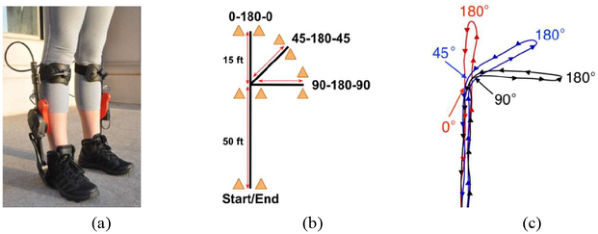
This study utilized the Dephy ExoBoot (Dephy, Inc., Maynard, MA, USA) (Figure 1a), an autonomous wearable exoskeleton designed to reduce the energy cost of walking by providing torque about the ankle joint (Mooney et al., 2014). Data collection included a balance beam task, as well as the agility task presented here. Participants wore IMUs (Opal, APDM, Inc., Por- tland, OR, USA) on the chest and atop each foot, although for the agility task, metrics were calculated using only the foot-mounted IMUs. Each individual supported a load of about 4 kg, with the largest ExoBoot weighing 1.53 kg, and a backpack of exo equipment weighing 2.5 kg. Participants completed an outdoor agility course consisting of a three-pronged path on level ground (Figure 1b). Performance was evaluated across four conditions: the partici- pants’ own shoes prior to the exoskeleton trials, the Dephy ExoBoot in a powered state, the Dephy ExoBoot in an unpowered state, and a repeat of the participants’ own shoes post using the exoskeleton. The order in which participants experienced each exoskeleton state was randomized. Each parti- cipant completed sixty trials through the course over about 1.5 hours. Prior to data collection, participants practiced walking with both exoskeleton states for at most thirty minutes.
Assessing the Effect of a Powered Ankle Exoskeleton on Human Agility 75
Figure 1: The Dephy ExoBoot on a researcher (a) along with the layout of the agility course (b, c). Each trajectory (c) includes 3 turns of varying magnitude (0, 45, 90, 180 degrees). Arrows indicate direction through course (c). Cones mark the start and end of the course and turns (b).
METRIC DEFINITION AND DATA PROCESSING Eke & Stirling (2018) found that expert raters prioritize (a) acceleration into and out of turns, (b) path efficiency, (c) quickness, and (d) short, (e) quick steps to discriminate high performance on agility tasks. According to these observations, a total of five performance metrics were evaluated: (a) tangen- tial acceleration, (b) radial acceleration, (c) body speed, (d) stride length, and (e) stride duration.
Data were processed using Matlab version 2020b (Mathworks, Natick, MA, USA). IMU measurements were aligned to an anatomical reference frame and segmented into phases of the gait cycle using the process outlined by Cain et al. (2016). Accelerometer measurements from the IMU on each foot were processed using the algorithms described by Zaferiou et al. (2017) to obtain tangential acceleration. The magnitude of tangential acceleration at each time point was calculated by averaging the magnitude of acceleration for the left and right foot. The foot’s acceleration was integrated to obtain velo- city and position using the ZUPT method (Ojeda & Borenstein, 2007). Error correction of acceleration and velocity measurements was performed using algorithms described by Zaferiou et al. (2017). To correct for drift in position measurements, each foot’s trajectory was smoothed using the Matlab cubic spline function (threshold input = 1e-6) and rotated to match the straight- away alignment (Figure 1c). Body speed was estimated at each time point by averaging the speed of each foot. The average curvature of each foot’s traje- ctory over time was multiplied by the square of body speed to obtain radial acceleration. Stride length was the hypotenuse of the triangle formed by the X and Y displacements of each stride, normalized by leg length from troch- anter to ankle. Stride duration was defined as the time between consecutive heel strikes on the same foot.
Based on these time-dependent calculations, all metrics except radial acce- leration were averaged over each segment of the trajectory. The median was chosen to represent radial acceleration due to the metric’s right skew distri- bution from quick pivots, particularly on 180° turns. Each trajectory was automatically divided into turn and straightaway regions by inflection points
Table 1. ANOVA results for main and interaction effects of Condition and Turn Type on five performance metrics: (a) body speed, (b) tangential acceleration, (c) radial acceleration, (d) stride length, and (e) stride duration.
Table available in the original PDF paper.
Condition Turn Type
Condition & Turn Type
Equations and mathematical formulas are available in the original paper PDF.
in the rate at which the trajectory changed direction. To quantify the rate of direction change, the magnitude of the time derivative of the unit tangent vector to each foot’s trajectory was calculated and averaged across each foot. After smoothing the averaged magnitude with a low-pass Butterworth filter, major peaks in the data were identified, and the inflection points at the start and end of each peak used to define the start and end of turns. The effect of turn type and condition on each metric was evaluated by fitting a multi- factor ANOVA with fixed effects of Condition, Turn Type, and the Order in which each exoskeleton state was presented, as well as the random effect of Participant nested in Order. Post-hoc dependent t-tests were applied where ANOVA indicated significant effects.
RESULTS
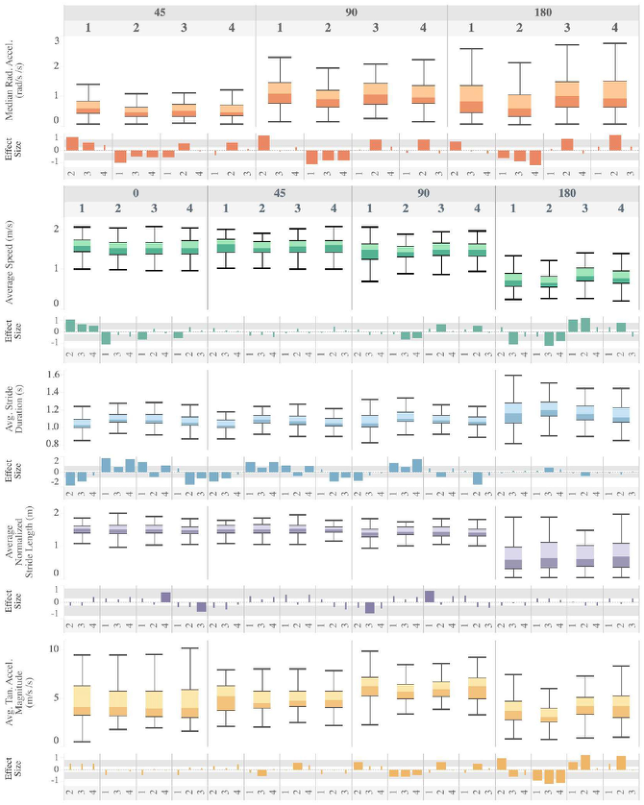
The interaction between Condition and Turn Type significantly affected body speed, tangential acceleration, and radial acceleration (Table 1). The effect of Condition on stride duration was significant and consistent across turn types, with stride duration being longest with the unpowered exoskeleton compared to the other conditions (Figure 2). Stride length did not vary significantly with condition, though all five metrics differed across turn types. The order in which participants experienced each exoskeleton condition had no effect on any of the metrics included in this analysis.
Condition affected body speed, tangential acceleration, and radial acce- leration differently at each turn type (Figure 2). For body speed on straigh- taways (0° turn), participants were fastest with the pre-exo shoe compared to the other conditions. There were no significant differences and only small effects for 45° turns. On 90° and 180° turns, participants were fastest with the powered exo and slowest with the unpowered exo. Changes in condition produced no significant differences in tangential acceleration during strai- ghtaways (0° turns). With the unpowered condition, tangential acceleration
Assessing the Effect of a Powered Ankle Exoskeleton on Human Agility 77
Figure 2: Effect of condition by turn type on gait metrics. Thick bars for effect size indicate significant effects (p < 0.05), while a thin bar shows that the effect was not significant. Gray bands distinguish moderate effect sizes (0.2 < |d| < 0.8) from small (|d| < 0.2) and large (|d| > 0.8) effect sizes. Conditions are numbered as follows: (1) pre-exo shoe (2) unpowered exo (3) powered exo (4) post-exo shoe.
decreased in magnitude on 90° and 180° turns relative to all other conditi- ons, and relative to the powered condition on 45° turns (Figure 2). Radial acceleration decreased with the unpowered exo relative to all other conditi- ons on 45°, 90°, and 180° turns. On 45° turns with the pre-exo shoe, radial acceleration was significantly greater than with the powered exo.
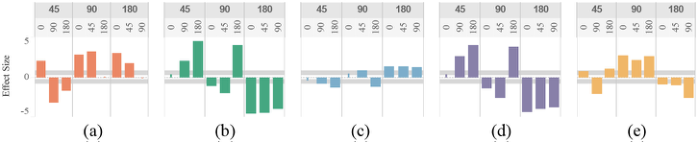
All metrics varied significantly with turn type and exhibited larger effect sizes compared to changes in condition (Figure 3). The trends across turn angle were non-linear, with metrics changing significantly compared to 180° turns, and not significantly between 0° and 45° turns for body speed, stride duration, and stride length (Figure 3b-d). Radial acceleration exhibited the
Figure 3: Effect of turn type on gait metrics. Metrics are labeled as follows: (a) radial acceleration (b) speed (c) stride duration (d) stride length (e) tangential acceleration. Thick bars indicate significant effects (p < 0.05), while a thin bar shows that the effect was not significant. Gray bands distinguish moderate effect sizes (0.2 < |d| < 0.8) from small (|d| < 0.2) and large (|d| > 0.8) effect sizes. Conditions are numbered as follows: (1) pre-exo shoe (2) unpowered exo (3) powered exo (4) post-exo shoe.
opposite trend, with 90° and 180° turns being similar to each other and grea- ter than 0° and 45° turns. Overall participants were slower on the 180° turns compared to the other angles, corresponding to increased stride duration and reduced stride length. Tangential acceleration was also lowest on 180° turns despite increasing across 0°, 45°, and 90° turns.
DISCUSSION
Agility strategy can be inferred by considering the metrics of radial acce- leration, stride length, stride duration, speed, and tangential acceleration together. This method was used to evaluate agility both within and across turn regions, allowing for analysis of the impact of the exoskeleton and turn angle magnitude. Regarding the latter factor, the hypothesis that individuals will vary their turning strategy with turn angle magnitude was supported. To negotiate larger curves, participants increased their linear deceleration, resul- ting in a reduction in average body speed mediated by shorter strides and a longer stride cycle (Figure 2). Previous studies have likewise observed increa- sed braking impulses when initiating directional changes (Patla et al., 1991), as well as reduced mean body speed associated with increased stride dura- tion (Patla et al., 1991) and reduced stride length (Orendurff et al., 2006). These results demonstrate that agility may be adequately characterized by synthesizing trends in individually captured metrics.
The hypothesis that the powered exoskeleton would propel users to main- tain a greater average speed around turns, preventing them from cutting tightly around the turn, was supported for 180° turns only. During 180° turns with the powered exoskeleton, speed and tangential acceleration incre- ased without changing radial acceleration significantly. Radial acceleration is a function of speed and curvature, where sharper turns at high speeds is consistent with larger radial accelerations. The absence of a change in radial acceleration at elevated speeds indicated that participants followed a traje- ctory with lower curvature on 180° turns with the powered exoskeleton, but were able to maintain a similar radial acceleration as when the exoskeleton was not present. On 45°, 90°, and 180° turns, the unpowered exoskele- ton reduced radial acceleration compared to all other conditions, indicating that the boot inhibited participants’ ability to vary their speed while turning.
Assessing the Effect of a Powered Ankle Exoskeleton on Human Agility 79
When wearing the unpowered exoskeleton, participants did not attain the speeds observed in other conditions, ultimately turning more slowly while maintaining their curvature compared to when no exoskeleton was worn. In this regard, the effect of the exoskeleton mimicked that of a leg weight, which prior studies have correlated with increased stride duration during straight walking (Barnett et al., 1993). In this study, both exoskeleton conditions increased stride duration on 0°, 45°, and 90° turns, although stride length was unchanged (Figure 2). Relative to the unpowered exoskeleton, the pow- ered exoskeleton had a lesser effect on stride duration, with effect sizes being smaller across 0° and 45° turns and absent on 90° and 180° turns. The diffe- rence in effect size between exo conditions suggests that actuation partially counteracted the weight of the boot. Further study of torque profile characte- ristics is needed to develop an exoskeleton controller that can further offset the weight of the boot across turn angles.
Relative to changes between turn types, the effect of condition was small. The largest effect sizes for condition (|d| ≈1.2) (Figure 2) were among the smaller effect sizes observed for turn type (Figure 3). To contextualize the effect of the exoskeleton, consider that the unpowered boot reduced radial acceleration (|d| ≤1.28), while the effect size for a 45° to 90° without exoske- leton was |d| ≈3.2. We see that adding the exoskeleton had a smaller effect than changing the turn angle by 45°. However, additional studies are needed to assess the magnitude of turn angle that would be similar to the effect of wearing the exoskeleton.
LIMITATIONS AND FUTURE WORK This study examined five distinct metrics that together describe the strategy of a participant through the course. There is opportunity to define a fused metric of agility that uses an importance weighting derived from expert evalu- ators, which may require different relative importance to discriminate agility performance based on the desired context. Future work should also examine these factors among a greater variety of users and exoskeletons. The results of this study reflect the interactions of healthy, young, novice exoskeletons users with a particular lower-limb exoskeleton (the Dephy Exoboot). Additi- onal work is needed to understand the effects of alternate exoskeleton designs with broader user populations.
CONCLUSION
This study investigated the impact of an ankle exoskeleton on the agility of participants performing 0°, 45°, 90°, and 180° turns. The results contribute to an improved understanding of exoskeleton performance in dynamic sce- narios, indicating that agility for healthy adults was not impacted by the observed ankle exoskeleton to an extent that would hinder users during daily activity. The effect of the exoskeleton was small, particularly compared to the differences observed across turn angles. Changes in stride duration and radial acceleration due to the unpowered exoskeleton were small or absent with the powered exoskeleton. The impact of the unpowered exoskeleton
during turning extends existing knowledge of the impact of leg weight on walking, indicating a reduction in radial acceleration in addition to the incre- ase in stride duration previously observed during straight walking. Overall, the method of quantifying agility presented in this study provides a general framework for further study of exoskeletons in a broader set of users with additional exoskeleton systems.
ACKNOWLEDGMENT
Data analysis was supported through funding from the Department of Indu- strial and Operations Engineering at the University of Michigan. Original data collection was sup-ported through an Arthur Gelb Fellowship, provided by the Massachusetts Institute of Technology Department of Aeronautics and Astronautics.
REFERENCES
Barnett, S. L., Bagley, A. M., & Skinner, H. B. (1993). Ankle Weight Effect on Gait: Orthotic Implications. Orthopedics, 16(10), 1127–1131. https://doi.org/10.3928/0147-7447-19931001-08 Cain, S. M., McGinnis, R. S., Davidson, S. P., Vitali, R. v., Perkins, N. C., & McLean, S. G. (2016). Quantifying performance and effects of load carriage during a chal- lenging balancing task using an array of wireless inertial sensors. Gait & Posture, 43, 65–69. https://doi.org/10.1016/J.GAITPOST.2015.10.022 de Looze, M. P., Krause, F., & O’Sullivan, L. W. (2017). The Potential and Acceptance
of Exoskeletons in Industry. In J. González-Vargas, J. Ibáñez, J. Contreras-Vidal, H. van der Kooij, & J. Pons (Eds.), Wearable Robotics: Challenges and Trends, 16, 195–199. Springer, Cham. https://doi.org/10.1007/978-3-319-46532-6_32 Eke, C., Cain, S., & Stirling, L. (2017). Strategy quantification using body worn inertial sensors in a reactive agility task. Journal of Biomechanics, 64, 219–225. https://doi.org/10.1016/j.jbiomech.2017.09.030 Eke, C., & Stirling, L. (2018). Effect of rater expertise on subjective agi-
lity assessment. Advances in Intelligent Systems and Computing, 603, 3–14. https://doi.org/10.1007/978-3-319-60822-8_1 Hicheur, H., Vieilledent, S., Richardson, M.J.E. et al. Velocity and curvature in human locomotion along complex curved paths: a comparison with hand move- ments. Exp Brain Res, 162, 145–154 (2005). https://doi.org/10.1007/s00221-004- 2122-8 Mooney, L.M., Rouse, E.J. & Herr, H.M. (2014). Autonomous exoskeleton redu-
ces metabolic cost of human walking during load carriage. J NeuroEngineering Rehabil, 11(80). https://doi.org/10.1186/1743-0003-11-80 Ojeda, L., & Borenstein, J. (2007). Non-GPS Navigation for Security Personnel and First Responders. Journal of Navigation, 60(3), 391–407. https://doi.org/10.1017/S0373463307004286 Orendurff, M. S., Segal, A. D., Berge, J. S., Flick, K. C., Spanier, D., &
Klute, G. K. (2006). The kinematics and kinetics of turning: limb asymme- tries associated with walking a circular path. Gait & Posture, 23(1), 106–111. https://doi.org/10.1016/j.gaitpost.2004.12.008 Patla, A. E., Prentice, S. D., Robinson, C., & Neufeld, J. (1991). Visual Control of Locomotion: Strategies for Changing Direction and for Going Over Obstacles.
Assessing the Effect of a Powered Ankle Exoskeleton on Human Agility 81
Journal of Experimental Psychology: Human Perception and Performance, 17(3), 603–634. https://doi.org/10.1037/0096-1523.17.3.603 Rebula, J. R., Ojeda, L. v., Adamczyk, P. G., & Kuo, A. D. (2013). Measurement of foot placement and its variability with inertial sensors. Gait & Posture, 38(4), 974–980. https://doi.org/10.1016/j.gaitpost.2013.05.012 Sawicki, G.S., Beck, O.N., Kang, I. et al. (2020). The exoskeleton expansion:
improving walking and running economy. J NeuroEngineering Rehabil, 17(25). https://doi.org/10.1186/s12984-020-00663-9 Zaferiou, A. M., Ojeda, L., Cain, S. M., Vitali, R. v., Davidson, S. P., Stirling, L., & Perkins, N. C. (2017). Quantifying performance on an outdoor agi- lity drill using foot-mounted inertial measurement units. PLoS ONE, 12(11). https://doi.org/10.1371/journal.pone.0188184
LISTED IN THE AHFE DIGITAL BOOKSTORE CATALOGUE
Explore the complete digital volume
Human Factors and Wearable Technologies
Read this individual research paper free through the original publisher, or explore the full digital proceedings book.
ISBN 978-1-958651-05-6
Explore this ISBN in the AHFE Bookstore ↗Listed in the July 2026 bookstore catalogue; search by ISBN to confirm current availability · Digital book purchase optional