Yonnel Giovanelli, Fréderic Puel, Camélia Mahdi, Arnaud Gouelle, William Bertucci (2022). Comparative evaluation of cervical exoskeletons using IMUs. In: Human Factors and Wearable Technologies. AHFE Open Access, vol. 29, pp. 127–133. https://doi.org/10.54941/ahfe1001483
Musculoskeletal disorders and pain in the neck and shoulders are commonly reported in workers whose activities imply overhead tasks. Repetitive passive head support or traumatic movements of the neck can cause damage to the ligaments and tendons of this region, with mild to severe long-term consequences. Exoskeletons are one of the solutions to help workers and their evaluation requires scientific methods and protocols to prove their effectiveness and make recommendations (Crea et al., 2021) (De Bock et al., 2022). Cervical exoskeletons could therefore be a valuable ergonomic solution to reduce stress on the neck and shoulders. However, while the growth of exoskeleton technology has led to multiple systems available on the market, it is still difficult to objectively determine which type or model of neck exoskeleton is the best adapted for overhead work and if the user’s perception matches with biomechanical outcomes.In this randomized crossover design study, 8 participants (3 women) performed dynamic and static extensions of the head in sitting position without trunk support for a period of 3 minutes (then 3 minutes of rest) while wearing three different head/neck exoskeletons in comparison with a situation without an exoskeleton. This allowed us to evaluate comfort, utility, usability, safety and impact (AFNOR, 2017) (Giovanelli & Touchard, 2018). A solution, based on synchronized merger of wireless inertial sensors, EMG signals, Polar OH1+ optical heart rate sensor (Hettiarachchi et al., 2019) and videos of the task (Motion CAPTIV, TEA, France) (Peeters et al., 2019) was used to examine joint angles of the head and spine movements, the bioelectrical activity of the sternocleidomastoid muscle and heart rate. Further these biomechanical and physiological outcomes, the perception of intensity was assessed by the Borg scale (Meyer, 2014) : CR10 Scale for the cervical and lumbar spine as well by the Rated Perceived Exertion (RPE) Scale for the global level of activity.The synthesis of this comparative analysis was carried out and compiled in the form of a conceptual basis from the C-K theory (Hatchuel & Weil, 2003) from the analysis of the design logic of exoskeletons.The results of this comparative analysis showed differences in terms of comfort, utility, usability, safety depending on the design logic of the solutions tested, but also depending on the morphology of the testers.
Musculoskeletal disorders (MSD) are non-traumatic, work-related pain or symptoms which affect tendons, muscles, ligaments, tissues around the joints or nerves. More specifically, within the scope of the NOMADe project (https://nomadeproject.eu/), La Paglia et al. (2021) defined neuro-musculo- skeletal disorders as “a set of dysfunctions and/or affections of progressive or traumatic installation that affect the locomotor system” and appearing within the “framework of complex interactions between the skeletal, muscu- lar, and nervous systems responsible for movement”. MSD account for 87% of occupational diseases in France (CNAMTS, 2021) and affect part of the workforce. Many methods and tools are available for assessing MSD risks (Norval, 2019), however it is still a challenge to promote and to implement technical, organizational and human prevention measures to control for these risks. New technologies for physical assistance, such as exoskeletons, offer
new possibilities for prevention. An exoskeleton can be defined as a “fully or partially worn device whose purpose is to assist in the execution of the movements, by compensating for the efforts of the individual and/or increa- sing their physical performance to perform their occupational duty, with the objective of productivity, facilitation of use, and reduction of musculoske- letal disorders” (AFNOR, 2017). Exoskeletons can be classified as passive, semi-active, or active (Crea et al., 2021) depending on the type of assistance provided. While exoskeletons might represent a way to limit MSD, this tech- nology must be considered only after a workstation analysis during which the occupational risks would have been assessed and other preventive measures deemed unfeasible (Kouadio et al., 2018). Numerous studies have focused on the evaluation of different types of assistive devices, such as handling or hol- ding arms up (De Bock et al., 2022). Regarding cervical exoskeletons, only a few articles have really given interest on their potential. To our knowledge, only Garosi et al. (2022) demonstrated (i) a significant decrease in cervical and shoulder discomfort, (ii) a decrease in the muscular activity of the ster- nocleidomastoid muscles, and (iii) an increase in the muscular activity of the trapezius muscles, while wearing a passive head/neck supporting exoskeleton for overhead work use. Then, the unanswered question is how this informa- tion could be used to help for the choice of the best solution within several models or how it could orientate the development of a new exoskeleton.
In the current study, we will compare different cervical exoskeletons to determine the effects of wearing them on joint motions, muscle activity, heart rate and to get the subjective discomfort felt by participants. From these infor- mation, we propose a formalization of the exoskeleton concepts from the standpoint of the C-K theory (Hatchuel et al., 2003), a design theory defined as a double expansion process based on both the Concept and the Knowledge spaces.
METHODS
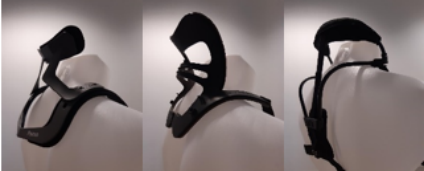
Eight healthy adults (27.4±12.3 years; 1.72±0.09 m, 3 women) voluntarily participated in this study. Three exoskeletons were tested: the Paexo Neck (Ottobock, 2019), the Skelex Neck (Skelex, 2019) and the Moon (HMT, 2021) (Figure 1). These exoskeletons all three consisted in an interface in contact with the base of the skull, and only differ by the way they are atta- ched to the body. The Paexo Neck and the Skelex Neck use a support on the shoulders and the upper back. The whole system is held in place by straps attached to the front of the pants’ belt. As for the Moon, a system of strap around the shoulders maintains the device. The Paexo Neck is made by two independent parts which allow to adjust the exoskeleton. The interface of the Moon can also be adjusted with a strap.
For each model of exoskeleton, the participants performed movements of cervical extension for a 3-minute dynamic test and a 3-minute static test. Both tests were performed while the subject was seated on a chair. The same tests were also performed without exoskeleton to provide baseline outcomes. Trials were randomized for both the model of exoskeleton and the type of activity (static or dynamic). Between two trials, the subjects had a 3-minute
Comparative Evaluation of Cervical Exoskeletons Using IMUs 129
Figure 1: Paexo Neck, Skelex Neck and Moon exoskeletons rest phase. No specific information was given neither about the range nor the frequency of the flexion extension movements. A Motion CAPTIV solution (TEA, France) was used to get synchronized signals from the wireless inertial sensors, the surface electromyographic sensors (sEMG) , a Polar OH1 opti- cal heart rate sensor (Hettiarachchi et al., 2019) and videos captured by a webcam (Peeters et al., 2019).
We evaluated (i) the average physiological cost, through the changes in the heart rate expressed as a relative cardiac cost (RCC) (Boudet et al., 2018), (ii) the range of motion of the head and spine movements, and (iii) the sEMG activity of the sternocleidomastoid muscle. The global and local perceptions of the task intensity have also been assessed using the Borg scales (Meyer, 2014) : the Rated Perceived Exertion (RPE) Scale for the physiological level of activity, as well as CR10 Scale for the cervical and lumbar spine. Wilcoxon tests for paired samples were run and analyzed with p<0.05 as the significant level.
RESULTS
The heart rate mean demonstrated only a decrease when using the Moon exo- skeleton (69±12 beats/min) in comparison to a static test performed without exoskeleton (71±11 beats/min) (p = 0.018).
The RPE mean value was lower with the Moon than with the Paexo (p = 0.028). When considering the subjective feelings perceived by the participants, CR10 values were decreased with the Moon and the Skelex models compared to a situation without exoskeleton (Figure 2).
Compared to the trial without exoskeleton, the static neck extension has been reduced in trials implying the use of a Paexo or a Skelex exoskele- ton (Figure 4). In a dynamic condition, the neck extension was found to be reduced with a Moon or a Skelex exoskeleton (Figure 3).
The figure 5 presents, for a participant, the mean and standard deviation for the extension cycle recorded during trials without an exoskeleton, with the Moon and with the Skelex.
DISCUSSION
Exoskeletons that provide support for the head and assistance in extending the head also cause physical strain. The subjective evaluation of the support
Subjective evaluation CR10
CR10 Scale
Exoskeletons Without Exoskeleton Moon Paexo Neck Skelex Neck
Figure 2: Subjective evaluation CR10. Significant differences are indicated by an asterisk.
Figure 3: Dynamic neck extension range. Significant differences are indicated by an asterisk.
Figure available in the original PDF paper.
for static activity was convincing. However, the results for electromyographic analysis were not significant.
Only the Moon allowed to keep an overall amplitude close to the situation without exoskeleton. This can be explained by the larger arc of rotation of the system. The Paexo Neck and the Skelex Neck offer more flexibility in the part which supports the interface, and this contributes to the assistance.
Figure 4: Static neck extension range. Significant differences are indicated by an asterisk.
Figure available in the original PDF paper.
Figure 5: Neck extension expressed as a percentage of the cycle.
Figure available in the original PDF paper.
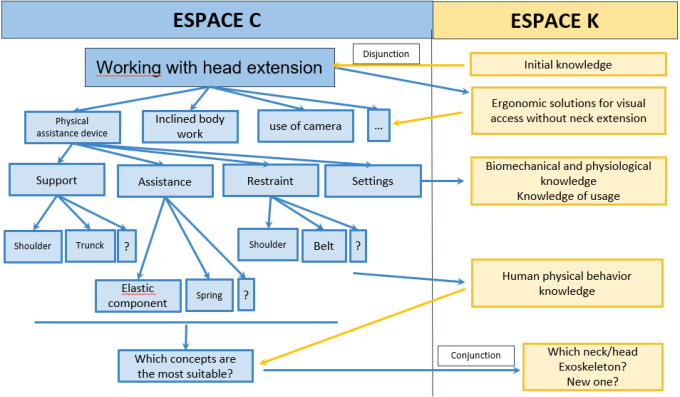
From these results, a C-K theory conceptualization can be made. The C-K theory is an innovative design approach proposing an asymmetric structure (Hatchuel et al., 2003) of the C (Concept) and K (Knowledge) spaces. Inno- vative design methods derived from C-K allow for a continuous dialogue between C and K spaces. This makes it possible to reason in the known and the unknown and, starting from an initial undecidable concept, to propose decidable concepts. The space C shows a partition of Concepts. The space K
Figure 6: The logic of cervical exoskeletons according to a C-K conception shows knowledges which contribute to define new concepts. By this way, new research questions can arise, and new products can be designed (Figure 6).
CONCLUSION
This intervention is part of a broader evaluation program with the ambition of proposing a study protocol that will allow to compare exoskeletons pro- viding the same type of assistance and to evaluate the combination of several exoskeletons during a single task.
Considering the results of this study, some parameters will have, to be considered differently (frequency of the movements, duration of the phases) for the next experiments with new generations of exoskeletons.
ACKNOWLEDGMENT
Authors would like to thank all participants involved in this study and the Ottobock company, for the loan of the Paexo Neck exoskeleton. Auth- ors would like to thank TEA, France for the technical support and the participation in fees for attending the AHFE conference.
REFERENCES
AFNOR (2017) ‘AC Z68-800 Dispositifs d’assistance physique à contention de type exosquelettes robotisés ou non. Outils et repères méthodologiques pour l’évaluation de l’interaction humain-dispositif’. Agence Française de NORmali- sation. Boudet, G., Chamoux, A. and Dutheil, F. (2018) ‘L’astreinte cardiaque est individuelle
et doit être évaluée’, Archives des Maladies Professionnelles et de l’Environnement, 79(3), p. 334. doi:10.1016/j.admp.2018.03.273.
Comparative Evaluation of Cervical Exoskeletons Using IMUs 133
CNAMTS (2021) Rapport annuel 2020 de l’Assurance Maladie - Risques professionnels Éléments statistiques et financiers. Caisse Nationale d’Assurance Maladie des Travailleurs Salariés Crea, S. et al. (2021) ‘Occupational exoskeletons: A roadmap toward large-scale
adoption. Methodology and challenges of bringing exoskeletons to workplaces’, Wearable Technologies, 2. doi:10.1017/wtc.2021.11. De Bock, S. et al. (2022) ‘Benchmarking occupational exoskeletons: An evidence mapping systematic review’, Applied Ergonomics, 98, p. 103582. doi:10.1016/j.apergo.2021.103582. Garosi, E. et al. (2022) ‘Design and ergonomic assessment of a passive head/neck sup-
porting exoskeleton for overhead work use’, Applied Ergonomics, 101, p. 103699. doi:10.1016/j.apergo.2022.103699. Hatchuel, A. and Weil, B. (2003) ‘A new approach of innovative design: an introduction to C-K Theory’, p. 15. Hettiarachchi, I.T. et al. (2019) ‘Validation of Polar OH1 optical heart rate sensor
for moderate and high intensity physical activities’, PLOS ONE. Edited by D. Boullosa, 14(5), p. e0217288. doi:10.1371/journal.pone.0217288. HMT (2021) ‘Moon’. https://www.hmt-france.com/fr/ourExoskeletons/moon consulted 2022-05-05 Kouadio, J.-J.A., Kerangueven, L. and Turpin-Legendre, E. (2018) ‘Acquisition et
intégration d’un exosquelette en entreprise’, p. 36. La Paglia, V. and Telliez, F. (2021) ‘Les facteurs de risque en matière de troubles neuro-musculo-squelettiques: vers une définition socio-psychobiologique’. Meyer, J.-P. (2014) ‘Évaluation subjective de la charge de travail. Utilisation des
échelles de Borg’, p. 18. Norval, M. (2019) Les outils simples d’évaluation du risque d’apparition des troubles musculo-squelettiques (TMS) : quelle intégration de la marge de manoeuvre situationnelle (MMS) dans le cadre du repérage des situations à risques ? . Thèse de doctorat Université Angers. Ottobock (2019) ‘Paexo neck’. https://paexo.com/paexo-neck/?lang=en consulted
2022-05-05 Peeters, T. et al. (2019) ‘Full Body Three Dimensional Joint Angles Validation Using TEA Ergo Inertial Measurement Units’, in Ahram, T., Karwowski, W., and Taiar, R. (eds) Human Systems Engineering and Design. Cham: Springer International Publishing, pp. 879–884. doi:10.1007/978-3-030-02053-8_133. Skelex (2019) ‘Skelex neck’. https://www.skelex.com/register-skelex-neck-support/
consulted 2022-05-05
LISTED IN THE AHFE DIGITAL BOOKSTORE CATALOGUE
Explore the complete digital volume
Human Factors and Wearable Technologies
Read this individual research paper free through the original publisher, or explore the full digital proceedings book.
ISBN 978-1-958651-05-6
Explore this ISBN in the AHFE Bookstore ↗Listed in the July 2026 bookstore catalogue; search by ISBN to confirm current availability · Digital book purchase optional