Sohyung Cho, Greg Wiles (2025). Assistive Exoskeleton Technologies for Age-Related Mobility Impairments. In: Human Factors in Design, Engineering, and Computing. AHFE Open Access, vol. 199, pp. 1518–1528. https://doi.org/10.54941/ahfe1006963
The global demographic shift toward an aging population has intensified the demand for innovative solutions to support elderly individuals in maintaining mobility and independence. Among emerging technologies, exoskeletons—wearable robotic devices that augment human movement—show great promise in this area. This literature review synthesizes recent research on the use of exoskeletons to assist elderly individuals with mobility impairment. Studies indicate exoskeletons significantly enhance mobility, balance, and gait performance in older adults, particularly those affected by conditions such as stroke, Parkinson’s disease, and osteoarthritis. Technological advancements, including the integration of lightweight materials, improved actuator systems, and adaptive control algorithms, have contributed to the usability and effectiveness of these devices. Moreover, the incorporation of biomechanical modeling and Internet of Things (IoT) connectivity has enabled personalized and real-time feedback mechanisms, further enhancing user experience. Despite these advancements, challenges remain in terms of device affordability, accessibility, and long-term adherence. Usability studies emphasize the importance of intuitive interfaces, aesthetic design, and minimal physical strain to encourage adoption among elderly users. Clinical trials and case studies demonstrate positive outcomes, yet limitations such as small sample sizes, short intervention durations, and lack of standardized evaluation metrics hinder the generalizability of findings. This review also highlights the growing trend of open-source exoskeleton platforms, which foster collaborative development and customization. In conclusion, while exoskeletons hold substantial potential to improve the quality of life for elderly individuals, further research is needed to address existing limitations and ensure equitable access. Future directions include the development of cost-effective models, longitudinal studies to assess sustained benefits, and policy frameworks to support integration into healthcare systems.
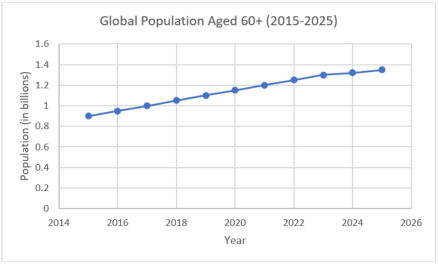
As life expectancy increases, the elderly population has grown significantly as shown in Figure 1, specifically from approximately 0.89 billion in 2015 to 1.36 billion in 2025, marking a nearly 53% increase over the decade. As of 2025, it is estimated that approximately 35% to 40% of adults aged 60 and older experience difficulties with mobility and maintaining independence, which includes challenges with walking, climbing stairs, or
Assistive Exoskeleton Technologies for Age-Related Mobility Impairments 1519
performing activities of daily living (ADLs) such as bathing, dressing, and transferring from bed to chair. These limitations are often linked to chronic conditions, which are highly prevalent in this age group. Over 85% of seniors live with at least one chronic disease and 56% manage two or more chronic conditions, such as arthritis, cardiovascular disease, or diabetes (NACH, 2024).
Figure 1: Global population aged 60+ from 2015 to 2025 (adapted from united nations population division).
The following is the list of chronic conditions that impair physical functions and affect emotional well-being, increase dependency on caregivers, and elevate healthcare costs (Zhang et al., 2023).
Osteoarthritis (OA) leads to difficulty walking, climbing stairs, and performing basic movements.
Osteoporosis weakens bones, increasing the risk of fractures, especially in hips and spine.
Rheumatoid Arthritis (RA) results in chronic pain and difficulty with fine motor tasks and walking.
Cardiovascular diseases like heart failure and peripheral artery disease reduce stamina and physical capacity, limiting mobility.
Diabetes increases the risk of falling and impairs walking ability.
Chronic Obstructive Pulmonary Disease (COPD) often leads to reduced participation in daily activities.
Depression and cognitive decline reduce motivation and ability to engage in physical activity, further worsening mobility.
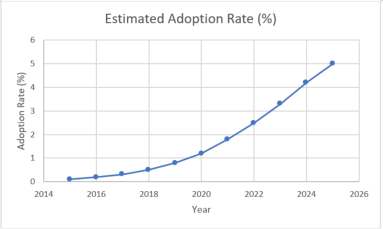
As an effort to overcome these challenges in maintaining mobility and independence among elderly individuals, there is an increasing demand for assistive technologies that can enhance mobility, independence, and quality of life for older adults. The data indicates a steady increase, highlighting the growing need for supportive technologies (Maresova et al., 2023) and Figure 2 shows an increasing trend of exoskeletons for elderly adults with mobility issues (Laic et al., 2024).
1520 Cho and Wiles
Figure 2: Adoption trend of exoskeletons among elderly adults with mobility impairments (2015 to 2025).
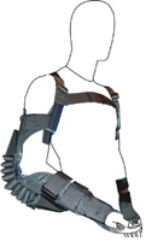
EXOSKELETONS–ASSISTIVE TECHNOLOGY Exoskeletons, wearable robotic devices designed to augment human movement, have emerged as a promising solution to address age-related mobility impairments. Figures 3 and 4 show examples of exoskeletons that are used as a promising solution.
Figure 3: Example of leg exoskeletons (Image, 2025).
Figure available in the original PDF paper.
Figure 4: Example of elbow exoskeletons (Nassour et al., 2021).
Assistive Exoskeleton Technologies for Age-Related Mobility Impairments 1521
Using exoskeletons offers a range of benefits for seniors, particularly those experiencing age-related mobility impairments. Some of the key advantages are: (Lakmazaheri et al., 2024, Nassour et al., 2021, Pinelli et al., 2024, Supriyono et al., 2025, Yao et al., 2024).
Improved Mobility
Enhanced walking ability: Exoskeletons assist with gait and balance, helping seniors walk more steadily and confidently.
Support for weakened muscles: They provide mechanical support to compensate for muscle weakness or joint instability.
Reenable use of the elbow: These systems enable the mechanical transfer of power to produce two primary types of joint motions: flexion–extension and supination–pronation.
Rehabilitation and Recovery
Post-stroke therapy: Exoskeletons are used in rehabilitation to retrain walking patterns and promote neuroplasticity.
Fall prevention: By improving posture and balance, they reduce the risk of falls—a major concern for older adults.
Increased Independence
Daily activity support: Seniors can perform tasks like standing up, walking, or climbing stairs with less assistance.
Reduced caregiver burden: With improved mobility, seniors may require less help from family or professional caregivers.
Smart Monitoring
Real-time feedback: Many exoskeletons are equipped with sensors and IoT features that monitor movement and provide feedback.
Data tracking: Useful for clinicians to assess progress and adjust therapy plans.
Psychological and Social Benefits
Boosted confidence: Regaining mobility can improve self-esteem and reduce feelings of dependence.
Social engagement: Increased mobility allows for more participation in social and community activities.
Table 1 provides a comparison of notable exoskeletons designed to assist elderly individuals with mobility impairments based on body segments they assist. It highlights their key features, purpose, and examples (Laic et al., 2024).
1522 Cho and Wiles
Table 1: Sample human systems integration test parameters (Folds et al., 2008).
Table available in the original PDF paper.
Exoskeleton Type Description Examples Lower Limb Exoskeletons Designed to assist with walking, standing, and balance by supporting the hips, knees, and ankles.
EksoNR (Ekso Bionics): Used in stroke and spinal cord injury rehab.
HAL Lower Limb (Cyberdyne): Uses bioelectric signals to assist movement.
MyoSuit (MyoSwiss): Lightweight, soft-powered suit for daily mobility.
WanderCraft Atalante: Self-balancing exoskeleton for paraplegics and elderly rehab.
ReWalk Personal 6.0 (Lifeward): Enables walking and stair climbing.
Full-Body Exoskeletons Support both upper and lower limbs, often used in advanced rehab or for individuals with severe impairments.
Indego Therapy (Parker Hannifin): Modular system for full-body support.
LifeBloom One: Combines wheelchair and exoskeleton for hybrid mobility.
Superflex (SRI International): Textile-based suit for muscle support.
Soft Exosuits Made from flexible fabrics and actuators, ideal for elderly users with mild to moderate mobility issues.
Wyss Institute Soft Exosuit: Developed at Harvard, licensed by ReWalk Robotics for stroke and MS patients.
HeroWear Apex: Designed to reduce back strain and assist posture.
Continued
Assistive Exoskeleton Technologies for Age-Related Mobility Impairments 1523
Table 1: Continued Exoskeleton Type Description Examples
Table available in the original PDF paper.
Hip and Pelvis Support Exoskeletons
Target the pelvis and hips to improve balance, posture, and gait stability.
Active Pelvis Orthosis (APO): Assists hip movement and reduces fall risk.
Honda Walking Assist Device: Lightweight hip exoskeleton for elderly gait training.
WIM by WiRobotics: Compact wearable with hip support and multiple mobility modes.
TECHNOLOGICAL ADVANCES Recent developments in exoskeleton technology have focused on enhancing usability, comfort, and adaptability for elderly users. According to a 2024 systematic review published in MDPI Sensors (MDPI, 2024), a wide range of lower limb exoskeletons (LLEs) such as Ekso, HAL, Stride Management Assist, and soft robotic suits have been employed to improve physical function in older adults. These devices incorporate advanced sensors and control algorithms to provide personalized assistance during walking and other activities. Recent innovations in exoskeleton design include lightweight materials, improved actuators, and adaptive control systems. Biomechanical modeling has enhanced the customization of devices to individual users, improving comfort and efficiency (Smith & Lee, 2024).
A key literature source is the chapter titled ’Exoskeletons in Elderly Healthcare’ by (Sposito et al., 2022). This chapter explores the transition of exoskeletons from clinical rehabilitation tools to wearable systems for daily use. It emphasizes the importance of human-centered design, usability, and integration with IoT (Internet of Things) for enhancing Activities of Daily Living (ADLs). The authors discuss the challenges of adoption, including social stigma, device complexity, and adaptability to unstructured environments. The chapter provides a comprehensive overview of the technological and social considerations necessary for successful implementation of exoskeletons in elderly care.
Technological Evolution: It traces the transition of exoskeletons from clinical rehabilitation tools to wearable systems for daily use.
Types of Exoskeletons: – Stationary systems: Common in clinical settings for rehabilitation. – Wearable systems: Emerging for home and daily use, though still limited by cost, complexity, and performance.
1524 Cho and Wiles
Design Considerations: – Emphasis on Human-Centered Design (HCD) to ensure usability, comfort, and aesthetic appeal. – Integration with IoT and wearable sensors to enable context-aware assistance in Activities of Daily Living (ADLs).
Challenges: – Adoption is influenced by factors like ease of use, social stigma, and compatibility with daily routines. – Technical barriers include weight, battery life, and adaptability to unstructured environments.
Some articles emphasized that the growing use of sensing modalities such as EMG or electromyography can be a driving factor toward interpreting the user’s intent and transferring to a responsive motion control unit on the exoskeleton. The EMG device itself has been in operation since 1942 to detect electrical impulses through nerves and help doctors treat abnormalities. This detection method can also be applied to exoskeleton research. New algorithms are improving to aid in customizing and fine- tuning modular solutions toward individual users (Supriyono et al., 2025, Yao et al., 2024). The 3 main areas of exoskeleton designs include the mechanical structure (either rigid, soft, or hybrid), the actuator method, and the sensing technology. Each has their own advantages and disadvantages. Currently, rigid type exoskeletons can offer superior control accuracy and motor torque, but may compromise comfort, and long-term wearability. Soft- material and cable-driven designs enhance ergonomics and user experience but can fall short in delivering the desired human expected responsiveness or force required. The critical focus in future innovations must consider balancing functional performance with human-centered design (Supriyono et al., 2025).
CLINICAL APPLICATIONS Clinical studies have demonstrated the efficacy of exoskeletons in improving mobility and functional performance in elderly individuals with conditions such as stroke, Parkinson’s disease, and osteoarthritis. The MDPI review highlighted improvements in key performance metrics including the 10 Meter Walk Test and Timed Up and Go test. Additionally, the 2022 SpringerLink (MDPI, 2024) chapter emphasized the role of stationary and wearable exoskeletons in rehabilitation settings, promoting recovery and independence.
Clinical studies have demonstrated the efficacy of exoskeletons in improving gait, balance, and muscle strength in elderly patients. Applications span rehabilitation for stroke survivors, mobility support for Parkinson’s patients, and assistance for individuals with osteoarthritis (Kumar & Zhao, 2022). This review (Firouzi et al., 2025) categorizes biomechanical models into conceptual and detailed types. Conceptual models, such as the spring-loaded inverted pendulum (SLIP), offer simplified representations of
Assistive Exoskeleton Technologies for Age-Related Mobility Impairments 1525
gait mechanics and are useful for understanding fundamental locomotion principles. Detailed models, including musculoskeletal and neuromuscular simulations, provide in-depth insights into muscle dynamics, joint forces, and neural control mechanisms.
These models are used in:
Design: Predicting the effects of exoskeletons on gait and energy expenditure before physical prototyping.
Control: Developing adaptive and personalized control strategies using model-based and EMG-driven approaches.
Assessment: Evaluating the physiological impact of exoskeletons, such as joint loading and muscle activation.
Estimation: Inferring hard-to-measure variables like metabolic cost and internal joint forces.
USABILITY AND ACCEPTANCE Usability and user acceptance are critical factors in the adoption of exoskeletons by elderly users. The SpringerLink chapter (MDPI, 2024) discussed the importance of human-centered design (HCD) principles, which prioritize user comfort, aesthetics, and integration into daily life. Efforts to reduce device weight and improve ease of use have contributed to greater acceptance among older adults. Furthermore, the use of wearable sensors and Internet of Things (IoT) technologies has enabled context-aware assistance in unstructured environments.
One of the main goals of exoskeleton research is to help older adults and those who experienced spinal cord injury achieve quality-of-life. It is important to understand how these devices are being used and accepted by the patients. Any emerging technology such as robotic assistive devices must achieve a high level of optimization as viewed by the lens of the patient. These patients or older adults can have feelings of frustration, embarrassment, and could possibly abandon their devices. Today, many of these emerging devices are considered cumbersome, require heavy short-lived battery packs, actuators and such presenting itself as complex and designed to operate under certain conditions. These adults want to be able to “wear” these assistive devices and be accepted in society as the wheelchair, eyeglasses, hearing aids, smart watches, fitness trackers, medical alert systems, etc. were adopted. “Robotic assistive devices have the potential to inspire and encourage a quality of life without barriers or stigma experienced” (Zhang et al., 2024, Mamipour at al., 2024, Shore et al., 2022, Halicka, 2024, Chen & Wang, 2025).
CHALLENGES AND FUTURE DIRECTIONS Despite promising results, several challenges remain in the widespread adoption of exoskeletons for elderly care. These include high costs, limited accessibility, and the need for individualized calibration. A recent study (Chen & Wang, 2025) on biomechanical modeling emphasized the importance of refining simulation models to enhance the accuracy and effectiveness of
1526 Cho and Wiles
assistive devices. Simulations and modeling techniques give researchers more insight into exoskeleton mechanics before actually spending the money to produce prototypes. Simulation packages are used, such as OpenSim, that help designers quickly achieve a solution with current attributes. It is an effective design guidance method (Yu et al., 2019). Other studies claim that through simulation and modeling, aspects of anti-interference ability of the sensing system, perfect the experimental platform regarding wearable devices, lend itself more toward real world conditions, employing advanced analytical algorithms to help enhance stability and refine the controls (Yanhe et al., 2015). Other needs in future modeling methods are to create actuators and advanced materials with properties closer to true biological tissues (Tchomeni Kouejou, & Alugongo, 2025).
Further enhancements that are anticipated include the integration of machine vision and advanced human-machine interaction. This might be perpetuated by adding more sensors and actuators leading to design changes that can contribute to the individual’s quality of life (Yao et al., 2024). Cost reduction is of crucial concern. To become more comfortable with exoskeletons and for to have widespread use and “ensure they are accessible to people from all socioeconomic backgrounds” (Penelli et al., 2024), the device costs need to be reduced (Yao et al., 2024). Current barriers toward unfulfilled expectations were identified such as a fear of falling, maintaining an active lifestyle, and the motivation to continue. These types of barrier factors, along with age, must be overcome by considering future efforts to improve design, functionality, and its accessibility. There is a bright future addressing these barriers to potentially improve the individual’s quality of life (Penelli et al., 2024, Shore et al., 2022). Future research should focus on developing affordable, lightweight, and adaptable exoskeletons tailored to the needs of elderly users.
CONCLUSION
Exoskeletons represent a transformative technology with the potential to significantly improve the quality of life for elderly individuals. Recent literature underscores their effectiveness in enhancing mobility, supporting rehabilitation, and promoting independence. Continued advancements in design, usability, and clinical validation will be essential to realize their full potential in elderly healthcare.
REFERENCES
Chen, L., & Wang, M. (2025). Biomechanical modeling for exoskeleton development in aging populations. Robotics in Medicine, 8(2), 134–150. North American Community Hub (204), 10 Statistics About Chronic Disease in
Seniors You Need to Know for 2025, North American Community Hub, 13 Dec. 2024. Firouzi V, Seyfarth A, Song S, Stryk1 O, and Sharbafi MA (2025), Biomechanical models in the lower-limb exoskeletons development: A review, Journal of Neuro- Engineering and Rehabilitation, 22:12. https://doi.org/10.1186/s12984–025- 01556-5.
Assistive Exoskeleton Technologies for Age-Related Mobility Impairments 1527
Halicka, K. (2024). Assessment of Chosen Technologies Improving Seniors’ Quality of Life in the Context of Sustainable Development. Technological & Economic Development of Economy, 30(1), 107–128. https://doi.org/10.3846/ tede.2024.20614. Image source (2025), https://rebotics.co.uk/rewalk-6–0-personal-exoskeleton. Kumar, R., & Zhao, Y. (2022). Exoskeletons in elderly healthcare: From rehabilitation to daily use. In Assistive Robotics (pp. 89–104). Springer. Laic RAG, Firouzi M, Claeys R, Bautmans I, Swinnen E, and Beckwee D (2024).
A State-of-the-Art of Exoskeletons in Line with the WHO’s Vision on Healthy Aging: From Rehabilitation of Intrinsic Capacities to Augmentation of Functional Abilities, Sensors, 24, 2230. https://doi.org/10.3390/s24072230. Lakmazaheri, A., Song, S., Vuong, B. B. (2024). Optimizing exoskeleton assistance to improve walking speed and energy economy for older adults. J NeuroEngineering Rehabilitation 21, 1. https://doi.org/10.1186/s12984–023-01287–5. Mamipour, H., Hoseini, S. A., Negahban, H. et al. (2024). The effect of using the
hip exoskeleton assistive (HEXA) robot compared to conventional physiotherapy on clinical functional outcomes in stroke patients with hemiplegia: A pilot randomized controlled trial. BMC biomed eng 6, 7. https://doi.org/10.1186/ s42490–024-00082–0. Maresova P, Krejcar O, Maskuriy R, Bakar NAA, Selamat A, Truhlarova Z, Horak J, Joukl M, Vitkova L (2023). Challenges and opportunity in mobility among older adults – key determinant identification, BMC Geriatrics, 23:447. https://doi.org/10.1186/s12877–023-04106-7. MDPI Sensors (2024). Systematic Review on Lower Limb Exoskeletons. https://ww
w.mdpi.com/journal/sensors. Nassour, J.; Zhao, G.; Grimmer, M. Soft (2021). Pneumatic elbow exoskeleton reduces the muscle activity, metabolic cost and fatigue during holding and carrying of loads. Scientific Reports, 11, 12556.. Pinelli, E., Zinno, R., Barone, G., & Bragonzoni, L. (2024). Barriers and facilitators
to exoskeleton use in persons with spinal cord injury: A systematic review. Disability & Rehabilitation: Assistive Technology, 19(6), 2355–2363. https:// doi.org/10.1080/17483107.2023.2287153. Shore, L., de Eyto, A., & O’Sullivan, L. (2022). Technology acceptance and perceptions of robotic assistive devices by older adults – implications for exoskeleton design. Disability & Rehabilitation: Assistive Technology, 17(7), 782–790. https://doi.org/10.1080/17483107.2020.1817988. Smith, J., & Lee, A. (2024). A systematic review of lower limb exoskeletons for
elderly mobility. Journal of Geriatric Technology, 12(1), 45–62. Sposito, M. et al. (2022). Exoskeletons in Elderly Healthcare. In: Scataglini, S., Imbesi, S., Marques, G. (eds) Internet of Things for Human-Centered Design. Studies in Computational Intelligence, vol. 1011. Springer, Singapore. https:// doi.org/10.1007/978–981-16–8488-3_17. Supriyono, C. S. A., Dragusanu, M., & Malvezzi, M. (2025). A Comprehensive
Review of Elbow Exoskeletons: Classification by Structure, Actuation, and Sensing Technologies. Sensors (14248220), 25(14), 4263. https://doi.org/10.3390/ s25144263. Tchomeni Kouejou, B. X., & Alugongo, A. A. (2025). Modeling and control of dynamical biomechanical arm systems with elastic joints sensitive to the effect of an external load. Measurement & Control (0020–2940), 58(8), 1019–1038. https://doi.org/10.1177/00202940241267743.
1528 Cho and Wiles
Y. Wu, A. Zhu, H. Shen, Z. Shen, X. Zhang and G. Cao, (2019). Biomechanical simulation analysis of human lower limbs assisted by exoskeleton, 2019 16th International Conference on Ubiquitous Robots (UR), Jeju, Korea (South), pp. 765–770, doi: 10.1109/URAI.2019.8768685. Yanhe Zhu, Guoan Zhang, Chao Zhang, Gangfeng Liu, & Jie Zhao. (2015).
Biomechanical modeling and load-carrying simulation of lower limb exoskeleton. Bio-Medical Materials & Engineering, 26, S729–S738. https://doi.org/10.3233/ BME-151364. Yao, Y., Shao, D., Tarabini, M., Moezi, S. A., Li, K., & Saccomandi, P. (2024).
Advancements in Sensor Technologies and Control Strategies for Lower-Limb Rehabilitation Exoskeletons: A Comprehensive Review. Micromachines, 15(4), 489. https://doi.org/10.3390/mi15040489. Zhang J, Wang J, Liu H and Wu C (2023), Association of dementia comorbidities with caregivers’ physical, psychological, social, and financial burden, BMC Geriatrics, 23:60. https://doi.org/10.1186/s12877–023-03774-9. Zhang, Y., Zhao, W., Wan, C., Wu, X., Huang, J., Wang, X., Huang, G.,
Ding, W., Chen, Y., Yang, J., Su, B., Xu, Y., Zhou, Z., Zhang, X., Miao, F., Li, J., & Li, Y. (2024). Exoskeleton rehabilitation robot training for balance and lower limb function in sub-acute stroke patients: A pilot, randomized controlled trial. Journal of NeuroEngineering & Rehabilitation (JNER), 21(1), 1–10. https://doi.org/10.1186/s12984–024-01391-0.
LISTED IN THE AHFE DIGITAL BOOKSTORE CATALOGUE
Explore the complete digital volume
Human Factors in Design, Engineering, and Computing
Read this individual research paper free through the original publisher, or explore the full digital proceedings book.
ISBN 978-1-964867-75-5
Explore this ISBN in the AHFE Bookstore ↗Listed in the July 2026 bookstore catalogue; search by ISBN to confirm current availability · Digital book purchase optional