Deail Lee, Heejae Lee, Jonghyun Kim (2022). Robust AI for Accident Diagnosis of Nuclear Power Plants Using Meta-Learning. In: Artificial Intelligence and Social Computing. AHFE Open Access, vol. 28, pp. 16–25. https://doi.org/10.54941/ahfe1001442
Application with artificial intelligence (AI) techniques is considered for nuclear power plants (NPPs) that seem to be the last industry of the technology. The application includes accident diagnosis, automatic control, and decision support to reduce the operator’s burden. The most critical problem in their application is the lack of actual plant data to train and validate the AI algorithms. It is very difficult to collect the data from operating NPPs and even more to obtain the data about accidents in NPPs because those situations are very rare. For this reason, most of the studies on the AI applications to NPPs rely on the simulator that is software to mimic NPPs. However, it is highly uncertain that an AI algorithm that is trained by using a simulator can still work well for the actual NPP. This study suggests a Robust AI algorithm for diagnosing accidents in NPPs. The Robust AI is trained by the data collected in an environment (e.g., simulator) and can work under a similar but not exactly the same environment (e.g., actual NPP). Robust AI algorithm applies the Prototypical Network (PN), which is a kind of Meta-learning to extract major features from a few datasets and learn by these features. The PN learns a metric space in which classification can be performed by computing distances to prototype representations of each class. With the PN, the Robust AI algorithm extracts symptoms from the training data in the accident and uses these symptoms in the training of diagnosing accidents. The symptoms of accidents are almost identical between the simulator and the actual NPP, although the parametric values can be different. The suggested Robust AI algorithm is trained using a simulator and tested using another simulator of a different plant type, which is considered an actual plant. The experiment result shows that the Robust AI algorithm can properly diagnose accidents in different environments.
Applying artificial intelligence (AI) techniques has been actively considered for nuclear power plants (NPPs) where this technology seems to be used lastly. The application includes accident diagnosis, automatic control, and decision
Robust AI for Accident Diagnosis of Nuclear Power Plants Using Meta-Learning 17
support to reduce the operator’s burden (Kim et al., 2020; Lee et al., 2020; Lee and Kim, 2022).
The most critical issue in their application to NPPs is the lack of actual plant data to train and validate the AI algorithms. Generally, an AI algorithm requires a large training dataset on the situations to solve problems. However, it is difficult (almost impossible) to collect sufficient data from NPPs under operation. First of all, the data relevant for the AI training are not collected in NPPs except for some digitalized plants that have the capability of storing the operational history and log. In addition, collecting data about accidents or abnormal situations is even more difficult because those situations rarely occur in actual NPPs (Purba, 2014).
In order to cope with the data scarcity, many researchers use simulators or thermal-hydraulic codes (Choi et al., 2021; Kim et al., 2021; Yang and Kim, 2020). Simulators are generally developed for the purpose of operator training, whereas thermal-hydraulic codes are used to analyze transients and accidents in NPPs (Petruzzi and D’Auria, 2008). The data produced from simulators or codes are then utilized for training and validating AI algorithms.
Although simulators and thermal-hydraulic codes can mimic the behavior of NPPs, the data may differ from the actual NPPs since the simulator con- figuration is normally simplified. For example, the actual plant behaviors, such as temperature and pressure, may differ from the simulated data. Thus, an AI algorithm that is even well trained with the simulator may not work correctly for actual NPPs.
The meta-learning method can find the features or patterns from data. Using the extracted feature, the meta-learning method can categorize the data having similar features. Compred to exiting learning methods for AI algori- thm, meta-learning can be performed well in the environment having a few training datasets since the grouped data has similar features. Furthermore, the meta-learning can make the AI algorithm to work in a new environ- ment that has not encountered during the training. With these advantages, the meta-learning has been used in siamese (Koch et al., 2015), matching (Vinyals et al., 2016), prototypical (Snell et al., 2017), and relation (Sung et al., 2018) networks.
In this light, this study suggests Robust AI that can work in an environment different from the training one. The Robust AI is trained by the data collected in an environment (e.g., simulator or thermal-hydraulic codes) and can work under a similar but not exactly the same environment (e.g., actual NPP or different simulator). The Robust AI applies the Prototypical Network (PN), a kind of meta-learning method. The meta-learning method extracts major features from a few datasets and learns by these features. This study suggests a Robust AI algorithm combined with the PN for the diagnosis of acci- dents in NPPs. To do this, the algorithm was first trained using the compact nuclear simulator (CNS), of which the reference plant is the Westinghouse 900 MWe pressurized water reactor (PWR). The algorithm was then tested under the condition generated by PCTRAN that simulates the APR1400 type reactor.
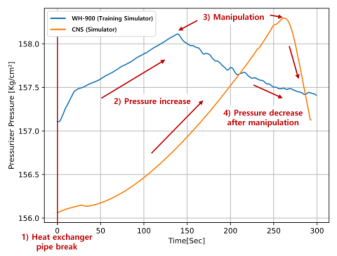
Figure 1: Trend of the pressurizer pressure during the heat exchanger pipe break event in CNS and training simulator in actual NPP.
CONCEPT OF ROBUST AI For the NPP application, AI agents are generally trained with data such as the parametric values and status of systems or components, which are collected from simulators or thermal-hydraulic codes. However, this information at the data level from these artificial NPPs cannot be exactly the same as the actual plant because it is impossible for the software to replicate the actual NPP. Therefore, it is not guaranteed that the agent trained from the simulator data can work correctly in the actual environment.
Although the simulator and actual plant differ at the data level, the higher level of information, i.e., the symptoms or trends of parameters in abnormal or emergency situations, is quite identical between them. For instance, in the loss of coolant accident (LOCA) at PWRs, the exact values in the pressure and level of pressurizer are likely to be different between types of reactors, or between the simulator and the actual plant, but the tendency of parameter change is similar, e.g., both the pressure and level are decreasing in the acci- dent. Figure 1 shows an example for the pressurizer pressure in the LOCA. One dataset is obtained from the simplified simulator, i.e., CNS, whereas the other is collected from the more accurate simulator, that is, the training simu- lator in the actual NPP. It can be found that the values at the data level are different, but the trends are identical between the different sources. The pres- sure increases after the initiation of even, and then starts to decrease after the manipulation.
The Robust AI is a novel approach that uses meta-knowledge extracted from the low level of data. Specifically, this study utilized the trend of para- meters in diagnosing accidents of NPPs. The extracted meta-knowledge from the trend in real-time is then classified into accident categories.
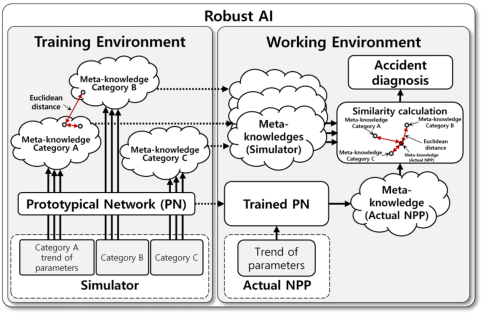
The Robust AI is trained and works as illustrated in Figure 2. The training environment is where the Robust AI learns the extraction of meta-knowledge from each accident category. The Robust AI applies PN that can derive the vectorized matrix on meta-knowledge by calculating the Euclidean distance between each category. The PN is trained to reduce the distance between the matrixes in the same category and increase the distance to the different cate- gory. At the working environment, the trained PN generates the matrix from
Robust AI for Accident Diagnosis of Nuclear Power Plants Using Meta-Learning 19
Figure 2: Architecture of Robust AI for classification.
the current situation and compares it with the trained matrixes by using the Euclidean distance. Then, the accident category that has the shortest distance from the current matrix is identified as the diagnostic result.
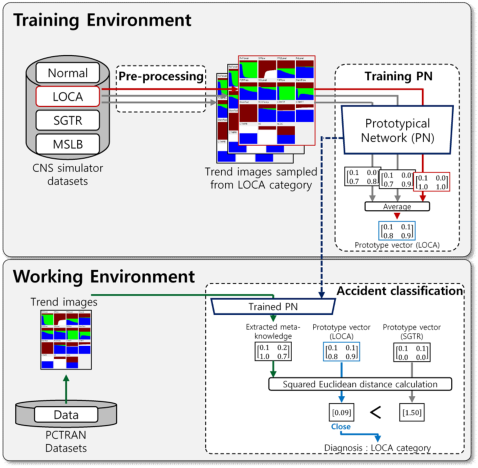
ALGORITHM FOR ACCIDENT DIAGNOSIS USING THE ROBUST AI CONCEPT This study proposes an accident diagnosis algorithm based on the concept of Robust AI, as shown in Figure 3. In the training environment, the Robust AI algorithm is trained for normal, loss of coolant accident (LOCA), steam gene- rator tube rupture (SGTR), and main steam line break (MSLB) categories. Trend images sampled from each category are applied to the PN to extract meta-knowledge. The PN generates prototype vectors, where the vector is an average of the sampled meta-knowledge.
In the working environment, prototype vectors from the training environ- ment are compared with the meta-knowledge extracted from the data of real world. Calculating the Euclidean distance, the Robust AI algorithm finds the closest category and diagnoses the accident.
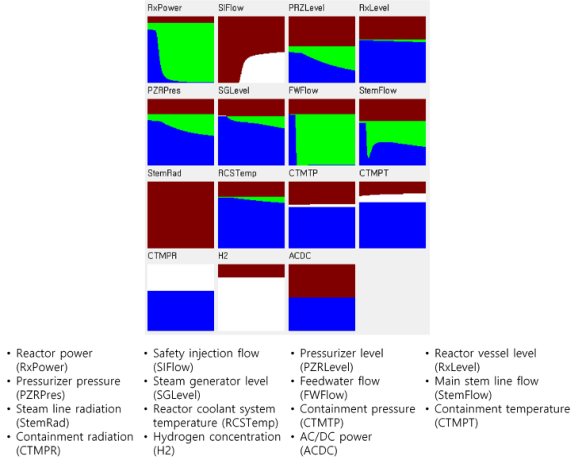
Pre-Processing for Generating Trend Image The purpose of pre-processing is to properly make inputs relevant for the Robust AI algorithm. The pre-processing first converts the value of an input parameter in time into a color-coded graph and secondly integrates the graphs in a bundle. Fifteen parameters were selected by analyzing the emergency operating procedures in Korean NPPs.
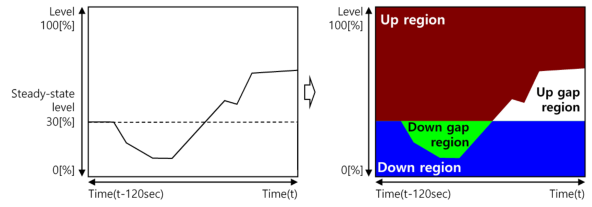
The value of each input parameter is used to generate a graph. Figure 4 (left) shows an example of the graph for the pressurizer level variation in 120 seconds. The graph is then split by comparing the current value with the steady-state. Figure 4 (right) illustrates the divided four regions with color- coding as Up (red), Up-gap (white), Down-gap (green), and Down (blue). Similarly, each input parameter is converted into a color-coded graph.
Figure 3: Architecture of the Robust AI algorithm for accident diagnosis.Figure 4: Pre-processing for converting the value of an input parameter in time into a color-coded graph.
The converted graphs from each input parameter are integrated into a bundle. Each bundle consists of fifteen graphs on input parameters, as illu- strated in Figure 5. As an input, the Robust AI algorithm uses the trend image that is the bundle.
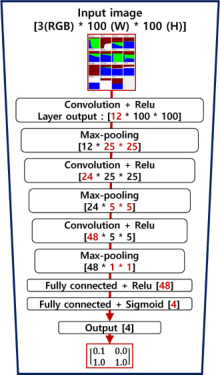
Training of Prototypical Network This study designed the PN structure for the Robust AI algorithm, as shown in Figure 6. The PN utilizes the Convolution Neural Network (CNN), which is well known for extracting major features in an image (Goodfellow et al., 2016). The CNN layer can extract spatial and topological information by slicing the image with filters to the computed inner product. The layer is then combined with a max-pooling layer that can decrease the dimension of the image. The trend image is connected to the CNN layer with the Recti- fied Linear Units (Relu) activation function and the max-pooling layer. Then,
Robust AI for Accident Diagnosis of Nuclear Power Plants Using Meta-Learning 21
Figure 5: An example of the trend image consisting of fifteen graphs for LOCA category.Figure 6: Structure of prototypical network.
the output from this combination is processed by the fully connected layer. Consequently, the PN derives the vectorized matrix on meta-knowledge.
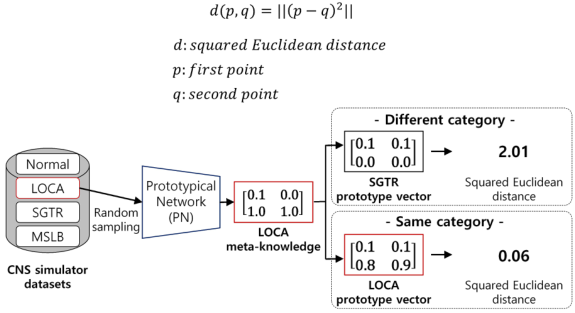
The PN is trained to reduce the distance between meta-knowledges in the same category. To calculate the distance between meta-knowledges, the PN uses a squared Euclidean distance formulation that can calculate the distance between two points in geometric space. Figure 7 shows the squared Euclidean distance formulation and an example of the same and different categories. For example, the PN extracts the meta-knowledge by randomly sampling the trend image from LOCA category. Then, the PN calculates the distance
Figure 7: Calculation distance using squared Euclidean distance.
between the meta-knowledge and the prototype vectors of each category. The training PN is proceeded by minimizing the distance in the same category and maximizing the distance in the different categories. After training, the PN extracts meta-knowledges from CNS datasets and generates a prototype vector, an average of vectors from the sampled meta-knowledge.
Accident Classification Using Euclidean Distance The Robust AI algorithm diagnoses an accident from the datasets of real NPPs (generated by the PCTRAN in this study) by calculating the Euclidean distance. The Robust AI algorithm uses the pre-trained PN to extract the meta-knowledge given from the PCTRAN datasets. Here, the given data is neither included in training datasets nor related to the PN training. Alth- ough the extracted meta-knowledge from PCTRAN is not consistent with those from CNS datasets, the Robust AI algorithm can find the category clo- sest to the meta-knowledge. For example, the pre-trained PN extracted [0.1, 0.2, 1.0, 0.7] as the meta-knowledge from the PCTRAN data, as shown in Figure 3. Using the squared Euclidean calculation, the distance between this meta-knowledge and other vectors of LOCA and SGTR is calculated as respe- ctively 0.09 for LOCA and 1.50 for SGTR. Since the meta-knowledge from the PCTRAN has the minimum distance with prototype vectors from CNS datasets, the Robust AI algorithm consequently diagnoses that the plant state is in the LOCA category.
TRAINING AND VALIDATION In this study, the CNS simulator and PCTRAN were used respectively for training and validation. Training data for the Robust AI were collected from the CNS, a compact simulator for the reference plant (Westinghouse 900 Mwe PWR). The CNS was originally developed by the Korea Atomic Energy Research Institute (KAERI) (KAERI, 1990). Then, the validation data for the Robust AI algorithm were collected from a PCTRAN for Advanced
Robust AI for Accident Diagnosis of Nuclear Power Plants Using Meta-Learning 23
Figure 8: Snapshots of CNS and PCTRAN interface.Table 1. Database used for training and validating Robust AI.
Table available in the original PDF paper.
Accident category CNS (Training) PCTRAN (Validation) Number of Number of
scenarios
Number of trend images scenarios
Number of trend images
30 2,700 10 900
Normal condition 1 30 1 30 Loss of coolant accident (LOCA)
15 1,350 10 900
Steam generator tube rupture (SGTR)
36 3,240 10 900
Main steam line break (MSLB) Total 82 7,320 31 2,730
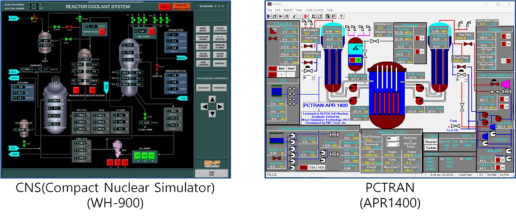
Power Reactor 1400 (ARR1400). Figure 8 shows snapshots of the CNS and PCTRAN for the reactor coolant system.
The data were collected with a sampling period of 10 seconds for 113 scenarios, where 82 scenarios were from the CNS and 31 scenarios from the PCTRAN. Table 1 shows the number of scenarios and trend images for training and validation respectively. The LOCA, SGTR, and MSLB scenarios contain data for 900 seconds after the accident occurred. The data for nor- mal scenario were also collected for 300 seconds. The trend image, a bundle containing fifteen color-coded graphs of input parameters, is sampled from the scenarios at 10 seconds intervals. Here, the color-coded graph is made for 120 seconds. For instance, if one accident scenario starts at 0 second, the first trend image includes the color-coded graphs from 0 to 120 seconds. Then, the second trend image is sampled from 10 to 130 seconds. The number of trend images is consequently calculated as 90. This study used trend images of 7,320 for training and trend images of 2,730 for validation.
The suggested Robust AI algorithm has been trained with 82 scenarios and 7,320 trend images listed above in Table 1. This study also designed a deep neural network (DNN) to check whether a normal DNN can diagnose accidents without the Robust AI. The network was then trained with the same datasets. The training accuracy with CNS datasets is 96.0% for the Robust AI algorithm and 99.7% for the DNN. The Robust AI algorithm
Table 2. Accuracy comparisons of the Robust AI algorithm and the DNN.
Table available in the original PDF paper.
Accident category DNN (Correct/Total scenarios)
Robust AI algorithm (Correct/Total scenarios)
7/10 10/10
Normal condition 0/10 10/10 Loss of coolant accident (LOCA) 0/10 10/10 Steam generator tube rupture (SGTR)
0/10 6/10
Main steam line break (MSLB)
with CNS datasets could correctly diagnose accidents at most trend images except immediately after the accident.
Table 2 presents the comparative results of the Robust AI algorithm and the DNN. The scenario accuracy is determined by how correctly the network in the scenario diagnoses the accident category. In the PCTRAN datasets, the Robust AI algorithm diagnosed 100% for normal, LOCA, and SGTR scenarios. However, the DNN could not diagnose events. This result shows that the Robust AI algorithm can properly diagnose accidents in the different environments.
CONCLUSION
This study suggested a Robust AI algorithm that comes up with by the auth- ors. The algorithm was trained using a simulator and tested using another simulator of a different plant type, which was considered an actual plant. The algorithm was trained with the compact nuclear simulator (CNS), of which the reference plant is Westinghouse 900MWe pressurized water rea- ctor. Then, it was tested in a different simulator, called PCTRAN for the Advanced Power Reactor-1400. In this study, the Robust AI algorithm can properly operate to diagnose accidents even in different environments.
ACKNOWLEDGMENT
This work was supported by the National Research Foundation of Korea (NRF) grant funded by the Korean Government (Ministry of Science and ICT) (No. 2018M2B2B1065651 and NRF-2016R1A5A1013919).
REFERENCES
Choi, Y., Yoon, G., and Kim, J. (2021). Unsupervised learning algorithm for signal validation in emergency situations at nuclear power plants. Nuclear Engineering and Technology. Goodfellow, I., Bengio, Y., and Courville, A. (2016). Deep learning. MIT press. KAERI. (1990). Advanced Compact Nuclear Simulator Textbook. Nuclear Training
Center in Korea Atomic Energy Research.
Robust AI for Accident Diagnosis of Nuclear Power Plants Using Meta-Learning 25
Kim, H., Arigi, A. M., and Kim, J. (2021). Development of a diagnostic algorithm for abnormal situations using long short-term memory and variational autoencoder. Annals of Nuclear Energy, 153, 108077. Kim, J., Lee, D., Yang, J., and Lee, S. (2020). Conceptual design of autonomous
emergency operation system for nuclear power plants and its prototype. Nuclear Engineering and Technology, 52(2), 308-322. Koch, G., Zemel, R., and Salakhutdinov, R. (2015). Siamese neural networks for one-shot image recognition. ICML deep learning workshop, Lee, D., Arigi, A. M., and Kim, J. (2020). Algorithm for autonomous power-
increase operation using deep reinforcement learning and a rule-based system. IEEE Access, 8, 196727–196746. Lee, S., and Kim, J. (2022). Design of computerized operator support system for technical specification monitoring. Annals of Nuclear Energy, 165, 108661. Petruzzi, A., and D’Auria, F. (2008). Thermal-hydraulic system codes in nulcear
reactor safety and qualification procedures. Science and Technology of Nuclear Installations, 2008. Purba, J. H. (2014). Fuzzy probability on reliability study of nuclear power plant probabilistic safety assessment: A review. Progress in Nuclear Energy, 76, 73–80. Snell, J., Swersky, K., and Zemel, R. S. (2017). Prototypical networks for few-shot
learning. arXiv preprint arXiv:1703.05175. Sung, F., Yang, Y., Zhang, L., Xiang, T., Torr, P. H., and Hospedales, T. M. (2018).
Learning to compare: Relation network for few-shot learning. Proceedings of the IEEE conference on computer vision and pattern recognition, Vinyals, O., Blundell, C., Lillicrap, T., and Wierstra, D. (2016). Matching networks for one shot learning. Advances in Neural Information Processing Systems, 29. Yang, J., and Kim, J. (2020). Accident diagnosis algorithm with untrained acci-
dent identification during power-increasing operation. Reliability Engineering & System Safety, 202, 107032.
LISTED IN THE AHFE DIGITAL BOOKSTORE CATALOGUE
Explore the complete digital volume
Artificial Intelligence and Social Computing
Read this individual research paper free through the original publisher, or explore the full digital proceedings book.
ISBN 978-1-958651-04-9
Explore this ISBN in the AHFE Bookstore ↗Listed in the July 2026 bookstore catalogue; search by ISBN to confirm current availability · Digital book purchase optional