Based on the usage patterns and scenarios of vitamin D3 drops for children in the existing market, this paper designs the packaging and experience of the products according to the needs of users. Emotional needs should be integrated into the packaging design of medical and health care products, fully considering the use scenarios, use processes, pain points and demand points of target groups, user psychology and other factors, reflecting the characteristics of ease-of-use, fun and convenience of health care products, and fulfilling the needs of users' psychological level. Solve the problems of inconvenient carrying, difficult capsule opening and children's resistance, and better embody the humanized design. Finally, through the design practice of floor-to-floor products, a set of optimized design schemes suitable for the packaging design of children's health care products are explored, so as to truly meet the use needs of consumption.
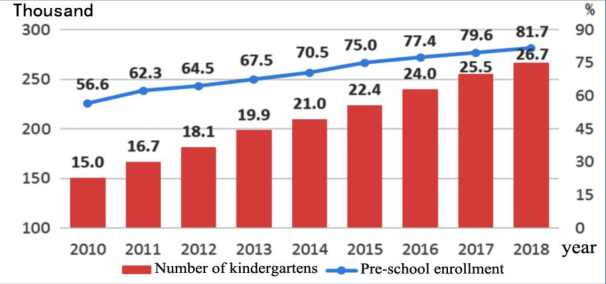
With the sustained development of China's economy and the continuous implementation of the three-child policy, the birth rate and health level of children in China are constantly improving. According to the relevant data of preschool education in China in recent years, in 2018, preschool education accounted for 4.8% of the national financial education funds, an increase of 0.2 percentage points over the previous year. There are 267,000 kindergartens in China, 2.581 million full-time kindergarten teachers and 46.564 million preschool children, with an increase of 6.1% and 1.2% over the previous year, respectively, and the trend continues to rise (as shown in Figure 1) (China Children's Development Program, 2011-2020).
Children's healthy growth and nutrition and health problems are concerned by parents, so the base of children's nutrition and health care products users is constantly expanding. Various children's health care products are quietly emerging in the health food industry, and the packaging design of such products has also received more attention (Yuan M-L, 2017). Enhanced packaging design has become an important form of packaging safety design for medical and health products. The packaging of children's health care products should not only meet the aesthetic needs of consumers, but also meet their functional demands (Zhou W, 2020). Based on the existing 999 vitamin D drops for children, this paper summarizes the pain points and opportunities in the process of users' use through investigation, so as to output the strategy of packaging design for children's health care products.
Figure 1. Number of kindergartens and enrollment rate of preschool education in 2010-2018 (China Children's Development Program, 2011-2020).
INVESTIGATION AND RESEARCH Design research based on visual cognition theory should accurately grasp the visual physiological characteristics of user groups and the design elements of health care
Human Interaction & Emerging Technologies (IHIET-AI 2022) Artificial Intelligence & Future Applications https://openaccess.cms-conferences.org/#/publications/book/978-1-7923-8989-4 products packaging (Aradhna K, et al. 2017). In this paper, by means of qualitative interviews and collecting information from third-party platforms, the pain points of users of existing products in the market were found, and the drug use characteristics of vitamin D3 drops for children were investigated. The user group of Vitamin D3 drops, a health care drug, is mainly children. We take the age of 3 as the cut-off point. It is necessary to take vitamin D3 drops with the help of adults at the age of 0~3, and you can take vitamin D3 drops by yourself at the age of 3~16.
Through investigation, the cognitive characteristics of users of vitamin D3 drops are as follows: 1) Before using the drops: every time you take medicine, the instructions will come out together, and the instructions are not clear; There are too many health products to find quickly. 2) Drops in use: children don't cooperate every time; The capsule is too small and needs to be cut with tools, which is inconvenient to use, relatively complicated to operate, and it is easy to get stuck in the throat after swallowing the whole capsule. 3) After using the drops: it is easy to leak oil, and it will be messy all over the place every time the medicine is fed, and the use experience is extremely bad.
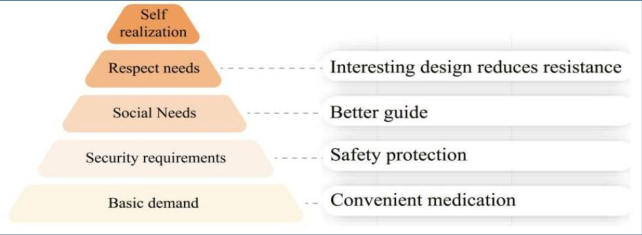
In view of the above situation, the design pain points to be solved in this paper are as follows: 1) Before use, the drops have an easily identifiable outer package, which is highly recognizable, simple, quick and clean to use. 2) Drops in use: reduce children's resistance to drugs, give drugs easily and effectively, and have safe outer packaging design. 3) After use of drops: it can be conveniently and quickly stored after administration, and it is easy and pleasant to use. According to Maslow's hierarchy of needs (as shown in Figure 2), the pain points mentioned above can be classified into different levels of needs, and different levels of psychological needs can be met, and there are different needs for product packaging. Through the improvement of the function and appearance of the inner and outer packaging of the product, the higher psychological needs of consumers can be met, and consumers' goodwill and trust in the product can be improved, which is helpful to increase the sales volume of the product.
DESIGN STRATEGY Packaging box modeling of health care products is the presentation carrier of the whole packaging design, which can directly affect the semantic elements of packaging and the effectiveness of functional services. Packaging often determines the volume of the container, and the size of the packaging should be suitable for the quantity of health care products to avoid over-packaging and waste of resources. Paying attention to the internal relationship between form and information communication and modeling style is the basic principle of semantic design of packaging modeling (Peng X-T, 2015).
Packaging layout design refers to the in-depth study of the expression forms and distribution positions of visual elements such as text information, pictures, lines and surfaces, colors, etc. (Fang W, 2015). Sort out the relationship between levels of medication information, arrange important information in a conspicuous position above the layout, and design unnecessary medication information in a position that is relatively difficult to attract users' visual attention. Walgreens approved Be better over-the-counter health care product packaging design series, which uses the design form of adjusting font size, font, color and line division to arrange and combine, so that users can know the information such as shelf-life date, therapeutic efficacy, health care product name, and taking method at a glance (Tian Z-Z, 2020).
Guidance and effectiveness Graphic language has more appeal and visual impact than written expression, and graphic information needs to conform to users' cognitive level and living habits (Yuan E-P et al. 2013). Graphic language is rich in visual expression and emotional care. Bosnian designer designed the health care package for ZADA health care products manufacturer, which is represented by hand-painted graphics of treatment parts. Its design goal is to make the package more attractive to users' eyes and convey it accurately. Prompt visual semantic information design is to prompt symbolic design for words, colors, graphics, shapes, etc., to achieve functional visibility. Safety and Interesting
Packaging is not only the carrier of health care products, but also the protective barrier of safety and hygiene. The sense of security of health care products is to ensure the safety of medication for users under normal used (Zhang L-J, 2020). Accurate information transmission of health care products is one of the factors that reflect medication safety. Users can clearly read the product name, therapeutic efficacy, usage and dosage, warning slogans, etc., to ensure users' "visual safety" (Lin L et al. 2019). Safety is also reflected in the packaging structure and materials, ensuring the correct application of materials and the safe use of the packaging structure. Designers embody the humanistic spirit in the packaging design of health care products.
Injecting emotional principles into the packaging design can create colorful design forms, thus embodying the connotation of packaging design.
DESIGN PRACTICE In order to verify the effectiveness and implemontability of the packaging design strategy proposed in this paper, the design practice of 999 vitamin D3 drops was carried out, and the effectiveness of the design practice was tested by satisfaction survey and cognitive performance test after the design was completed. Optimal design of outer packaging
Product outer packaging is the first contact medium between consumers and products, which has different demands in terms of functionality and aesthetics, so it is very elegant in color, pattern and text. As the first impression of a product meeting with a consumer, the outer packaging needs to accurately convey the product information to the consumer. At present, the existing products in the market have the following similar problems:
In order to attract attention, colors with higher saturation are often used, which makes the outer packaging of products too fancy, unable to clearly convey product information, and reduces parents' trust in products.
Some products didn't pay attention to the difference between children's and adults' health care products, which could not be reflected in the product packaging.
Although some products realized the difference, they didn't give careful consideration to the design of outer packaging, and used some existing low- impact cartoon images, and the typesetting was random. By exploring the characteristics of product continuity, strong color contrast, interest and geometric elements through external packaging design, it is helpful to improve product packaging design. At the same time, referring to the packaging design of some excellent products, several excellent reference points are obtained:
Quasi-physical design to enhance the interest of products.
Cute patterns and figures to attract children, with clear user attributes.
Serialization has the property of delay.
Emotional design makes children feel no resistance to such products.
Interesting packaging design has psychological implication and educational significance. In conclusion, when designing the outer packaging of 999 vitamin D3 drops, the design strategy must be reflected. In scheme 3-1, the main cartoon character chooses the shape of the letter D to make it cute and express the feeling of enjoying the sunshine. Cartoon characters sign with thumbs up to express a sense of encouragement, holding a gift box with a "3" label, which means vitamin D3 is a gift for children to grow up. In terms of color, the orange system with low saturation and high brightness is selected, and the transparent feeling of the capsule is expressed by
Human Interaction & Emerging Technologies (IHIET-AI 2022) Artificial Intelligence & Future Applications https://openaccess.cms-conferences.org/#/publications/book/978-1-7923-8989-4 the overlapping of colors. Scheme 3-2 is based on the image of vitamin D soft capsule raw materials (marine fish) and combined with the letter D to abstract and cartoon, so as to shorten the distance between the content and users, and help to reduce resistance and enhance brand memory. No matter what kind of design scheme (as shown in Figure 3), the pattern design with white background and flat low saturation accounts for a small proportion, which clearly shows the name of the product and its functional features, and achieves the clarity of information transmission while satisfying the attraction. Funny cartoon images help to reduce children's resistance.
An important component of the human systems integration plan should be a verification and validation process that provides a clear way to evaluate the success of human systems integration. The human systems integration team should develop a test plan that can easily be incorporated into the systems engineering test plan. The effectiveness and performance of the human in the system needs to be validated as part of the overall system. It may seem more attractive to have stand-alone testing for human systems integration to show how the user interacts with controls or displays, how the user performs on a specific task. This methodology can address the performance of the human operator or maintainer with respect to the overall system. The most important thing is to develop a close relationship between human systems integration and systems engineering.
Figure 4. Schematic diagram of innerFigure 3. Schematic of the outer packaging of vitamin D3 drops.
packaging of vitamin D3 drops. Emotional interaction design of inner packaging Although the inner packaging is not as high in design and color as the outer packaging, it has higher design requirements in hygiene, safety, convenience and guidance.
Children's health care products are mostly used orally, and secondary pollution should be avoided as much as possible. The inner packaging of most existing products is mainly aluminum compound bag, which has several advantages as inner packaging, such as clean sealing, hard aluminum plate, low cost and integration, and all health care products are on aluminum plate. However, as a children's product, its
Human Interaction & Emerging Technologies (IHIET-AI 2022) Artificial Intelligence & Future Applications https://openaccess.cms-conferences.org/#/publications/book/978-1-7923-8989-4 shortcomings are also obvious. 1) Because of the nature of aluminum plate material, it can't be printed in a large area. Most products are printed on the aluminum plate only with the trademark of health care products company, which lacks the guidance for children's medication. 2) Aluminum plates are thin and hard, and children are easy to scratch users when using because of their young age and fragile skin. 3) The aluminum plate is hard and can't be easily folded, so it is not easy to carry when it comes to products with large board surface. 4) Lack of humanistic care for children's psychology can easily lead to resistance, and more interesting elements should be added to the inner packaging.
For the reference of inner packaging design, we can start with the key words of emotion, convenience and guidance, and visually combine the use methods to enhance the interest of products. Emotional design is embodied in the way of use. Strengthening the interaction between parents and children is helpful to enhance feelings and get a happy mood.
Capsule design Capsule, as the most direct package used by consumers, has higher requirements in functionality. At the same time, considering children as users, its appearance is also under design consideration.
Through statistics, it is concluded that there are several major pain points in capsules of existing products. 1) It is easy to leak oil and be damaged. 2) For users aged 0-5, they can't swallow the whole capsule, and such users need to cut the capsule and squeeze it into the baby's mouth. 3) Children have resistance to capsules, which makes it difficult for parents to easily open capsules for feeding while comforting children.
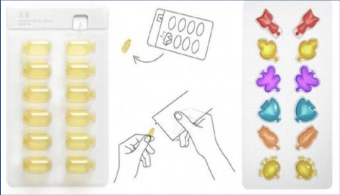
In view of the above pain points, the corresponding strategies were made. 1) Change the appearance, make candy, animals or change the color to make it more interesting, so as to reduce children's resistance. 2) Make changes at the mouth of the capsule to make it easier for the capsule to open for feeding. 3) The shape is simple and easy to extrude. Although it can't be taken as a whole because of the convex shape, its opening design is beneficial to opening and can prevent oil leakage to a certain extent. 4) Convenient opening design can reduce the probability of touching the contents and the risk of secondary pollution. The emotional design of the capsule is shown in Figure 5.
User satisfaction evaluation.
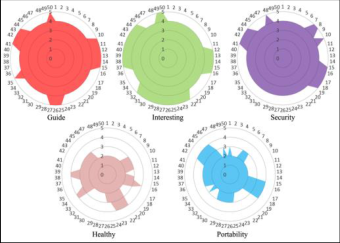
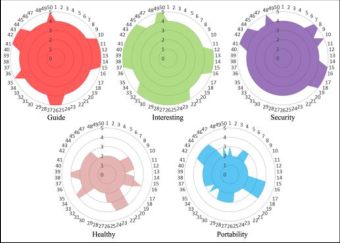
In this paper, Likert scale research method is used as the evaluation method of design satisfaction (Likert R, 1932). Likert scale is a commonly used and widely used psychological response scale, which has had a great impact on the field of social sciences since its birth (Likert R et al. 2006). In the design satisfaction survey of this paper, 50 users were selected to evaluate the optimized design from five important dimensions: guidance, interest, safety, hygiene and portability. Each dimension is divided into five levels: very dissatisfied (1), dissatisfied (2), generally satisfied (3), satisfied (4) and very satisfied (5). Select the average word number of questions measured by the scale as a variable to discuss its relationship with the sequential effect of options. The statistical results are shown in Figure 6. The average test results of guiding, interesting and hygienic dimensions are all above 4, which indicates that the user group is satisfied with the optimized design of this paper, and proves the effectiveness of the design strategy of this paper.
CONCLUSIONS
At present, most children's health care products on the market, although considering the different user groups, have not made in-depth substantive emotional interaction design, and most of them just stay on the surface. The users of 99 vitamin D3 drops are mainly children with stunted physical function and immature intelligence. In the packaging design, it is necessary to take into account the particularity of children when using, and it is impossible to understand the use method of the product, whether there is resistance to emotions, whether it is clean and sanitary, etc. through words. For younger children, parents are the decision makers and users of product selection. Whether the product packaging can accurately express product information, be easy to carry or be convenient enough for use is an important factor that designers need to consider. By optimizing the packaging structure to meet the needs of users, applying emotional interaction design to the packaging of children's health care products can reduce children's resistance to health care products and enhance parents' trust and goodwill towards the products. Good use experience and warm parent-child interaction in the process of use will help parents and children to improve their acceptance of products. Excellent internal and external packaging design can enable
Human Interaction & Emerging Technologies (IHIET-AI 2022) Artificial Intelligence & Future Applications https://openaccess.cms-conferences.org/#/publications/book/978-1-7923-8989-4 enterprises to continue to enjoy the IP dividend brought by this product in the next product sales, and further enhance the brand awareness.
ACKNOWLEDGMENTS
We express our gratitude to all participants for their contribution to the study. This paper is supported by The Art Project of National Social Science Found of China 2019 (Grant No. 19BG110).
REFERENCES
China Children's Development Program (2011-2020) [EB/OL]. National Working Committee on Children and Women Under State Council,2019-12-06 Yuan M-L. Study on the packaging design of children health products-illustrated by
the case of 3-6 years old preschool children[D]. Beijing Institute of Technology, (2017) Zhou W. Research on Application of Information Visualization in Packaging Design[J]. Science and Technology & Innovation, 2020, 19 Aradhna K, Luca C. Sensory Aspects of Package Design [J]. Journal of Retailing
93,2017,01 Peng X-T. The packaging design of the children's nutrition “AMY” under the supermarket based selling model[D]. Hunan university of technology, (2015) Fang W. The Packaging Text Based on the Information Convey Visual Elements[J].
Packaging Engineering, 2015, 36(02): 26-29 Tian Z-Z. Research on Barrier-free Design of Medicine Information Under the Inclusive Concept[D]. Donghua University, (2020) Yuan E-P, Zhu P-Y. Research on Barrier-free Design of Children′s Food
Packaging[J]. Packaging Engineering, 2013, 34(06): 1-4 Zhang L-J. Research on Aging-resistant Design of Pharmaceutical Packaging Based on Visual Semantic Cognition[D]. Nanjing University of Science and Technology, (2020) Lin L, Gao Y-K, Yang M-Q. Product Shape Optimization Design Method Based on
Visual Cognition Theory[J]. Packaging Engineering, 2019, 40(08):16-22 Likert R. A Technique for the Measurement of Attitudes[J]. Archives of Psychology, 1932, 22(140): 1-55 Likert R, Roslow S, Murphy G. A Simple and Reliable Method of Scoring the
Read this individual research paper free through the original publisher, or explore the full digital proceedings book.
ISBN 978-1-7923-8989-4
Explore this ISBN in the AHFE Bookstore ↗Listed in the July 2026 bookstore catalogue; search by ISBN to confirm current availability · Digital book purchase optional