Cesar Guevara, Lorena Espinosa, Roilys Suarez (2021). Improvement of the English Training Project III, Through Training Action Research from Socioformation. In: Human Systems Engineering and Design (IHSED2021): Future Trends and Applications. AHFE Open Access, vol. 21. https://doi.org/10.54941/ahfe1001133
1 Universidad Tecnlógica Indoamérica, Mechatronics and Interactive Systems Center (MIST) Quito, Ecuador ↗
2 Universidad Tecnlógica Indoamérica, Languages Department, Quito, Ecuador, 2 Universidad Tecnlógica Indoamérica, Mechatronics and Interactive Systems Center (MIST), Quito, Ecuador ↗
Many are the educational models and approaches that have been used throughout decades in the world. These have had their variations and changes such as evolution and epistemology of educational processes. Despite this, many times teaching continues under traditional models that do not open the full development of students and do not favor sustainable social development in general. Applying the methodology of training projects from socioformation favors key goals such as forming and consolidating the ethical life project, having entrepreneurship, developing the necessary skills to face the challenges of the context, and working collaboratively. On the other hand, it consists on a strategy in which articulated activities are proposed in order to solve challenges or problems of the context, favoring the communities or areas where it is applied. And it is applied from the socioformation since it is a new approach based on the ethical project of life, entrepreneurship, the development of skills and collaborative work. In this way, the problems to be solved through the training projects would be significant for the students, since it makes them feel active entities in the process, and in turn, useful to the society where they develop as individuals. For this reason, the application of training projects is proposed from socioformation in education, especially at the university level. When applying the research, the deficient planning of the training project from the socio-formative model of the Indoamérica Technological University could be detected as a problem. The purpose is to present an improvement in the planning of a training project in the area of English. The applied methodology is the analysis of a training project from the socioformation, with the aim of improving the planning processes following certain educational references such as trans disciplinarity, collaborative work, the rubric, and the final product, contributing to the solution of a real problem of the context. Results were obtained such as the evaluation of the didactic planning practice of the training project, achievements and aspects to be improved were identified and on that basis a new planning of the project was proposed from the socioformation. It was possible to verify as conclusions that the methodology proposed from the socioformation to develop the didactic planning in the training project presents very positive aspects, since the activities are articulated to achieve a desired end as a final product. In addition, students learn in a contextualized way, solving environmental challenges, contributing to sustainable social development.
Educational models and approaches, throughout their epistemological process, have had a favorable evolution for society. Although it should be noted that in the educational systems of the world, the traditional education is still applied, which is focused on the contents of the different subjects. Information society is closely related to changes and transformations in society. The term knowledge society was used for the first time in 1969 by Druker, where the harmony of industrial society began to change and social changes such as serial production, the role of workers and social development began to appear. In the emergence of this new society, the tendency is to value knowledge more than raw materials and capital, elements that were more important in industrial society (Tobón, Guzmán, Silvano and Cardona, 2015). The knowledge society emphasizes the power to create and integrate new knowledge and to be able to access information (Unesco, 2005). This requires an educational process focused on students learning to learn and undertake through projects. Training projects in socioformation are based on articulated activities aimed at solving problems in the context, considering collaboration. All this includes complex thinking, transversality, flexibility and evaluation, all oriented to learning, promoting continuous improvement through feedback (Huanca, Quispe and Mamani, 2021). Socioformation is a new educational approach that seeks to respond to the challenges of training for the knowledge society based on the implementation of transversal training projects. It allows to move towards sustainability, which indicates, form people with a holistic vision, identified with the progress of humanity (Iñiguez, Martínez, Tobón, and Soto, 2021). Socioformation is based on enhancing the talent of people and groups, to achieve the knowledge society and so, sustainable social development by solving problems in the context. Therefore, collaborative projects are used to improve the living conditions of the communities (Lara and Tapia, 2019). It arises in Latin America thanks to the contributions of Morin for the search for new strategies according to complex thinking. Already in 2004, further progress was made, presenting its methodology, provided by Tobón, which is applied in Latin America and other countries such as Spain and Portugal. Other researchers have focused their work on the axes of the approach, such as: García Fraile, López Calva, López Rodríguez, and Aguilar Álvarez, 2012; Pepper, 2011. A very positive aspect is that socioformation goes beyond learning, passes to training and is guided to collaborate with the rest of the members, it is articulated with the context and technology, with the aim of achieving sustainable social development (Tobón, 2021).
TRAINING PROJECT METHODOLOGY It is important to emphasize that in a training project from socioformation, aspects such as: the title, the transversality, the competences, the problem of the context, the activities to be developed, the evidence or products and the resources must be considered. These are shortly explained below: Title: attractive, eye-catching and related to the problem to be solved. Transversality: it covers different disciplines and areas of knowledge. Competences: The criteria or learning are proposed based on the established competencies. Context problem: context problem to be solved, related to competencies and criteria.
Human Systems Engineering and Design (IHSED 2021) https://openaccess.cms-conferences.org/#/publications/book/978-1-7923-8987-0
Activities: related actions to identify, interpret, argue and solve the problem that arises; the appropriation of the necessary knowledge and the metacognitive process. Evidence: products that students present as they progress through the activities. Resources: materials, means or equipment used to carry out the activities to finally present the evidence. The evaluation of competences is the process in which the student obtains pertinent feedback to improve and develop talent and performance facing problems based on different knowledge, seeking to advance towards a higher level of performance with concrete actions in the student, classroom, teaching strategies, resources, teacher tutoring and support from family and society. This article aims to present improvements of a training project at the Indoamérica Technological University, which applies the socioformative model that has the characteristics of solving real problems of the context, critical and continuous research, motivation of students and teachers towards entrepreneurship (Tobón, 2019). Also, describes the didactic planning for the English training project III, third level face-to-face modality, which consists of the planning and development of activities that contribute to the collection of waste in the community, and improve the conditions in the community (Tobón, 2017). The perceived objectives are: 1) to self-evaluate a training project with its achievements and aspects to improve, 2) to plan a training project for English subject at the third level, considering the methodology of socioformation; and 3) socialize this didactic planning through training projects to contribute to the work of teachers and have a positive impact on the training of students.
METHODOLOGY AND TYPE OF STUDY An analysis of a training project is carried out from the socioformation, with the aim of improving the planning processes following certain educational references. According to Duque and ideas from Tobón, in his article Improvement of the Training Project of Learning Environments in the Basic Education Career, in which has been raised how important research is in the transformation of social processes, always considering socioformation (Duque, 2020). Procedure The analysis and planning process based on training projects was developed considering ideas raised by Huanca and the rest of the authors, considering phases for the analysis, evaluation and elaboration of the new training project, applying the socioformative approach. This article only presents the final result obtained from the improvement of the training project, which can serve as a basis and guide for teachers (Molina, Guevara, and Suarez, 2021).
Human Systems Engineering and Design (IHSED 2021) https://openaccess.cms-conferences.org/#/publications/book/978-1-7923-8987-0
THE REFERENCES SECTION The socioformative approach at Indoamérica Technological University and its more specific application in the teaching of English as a foreign language is presented. For many reasons the Indoamérica University follows the postulates and foundations of socioformation, which are mentioned:
1. Good results are obtained in the curricular, didactic and evaluation areas. 2. It is an updated approach and responds to the expectations and objectives of today's higher education.
3. By applying, it contributes to the development of the knowledge society, and therefore, to sustainable social development.
4. The four functions of the institution are fulfilled: management, training, research, and professional practice training.
5. Inter and trans disciplinarity is promoted. 6. It is based on complex thinking and prompts research based on the needs of society. 7. Entrepreneurship is contributed. Applying this socioformative approach contributes to enhancing the talents of students to solve problems in society, not the mere understanding and learning of content and knowledge of different subjects, or specifically English.
Therefore, the institution bases its work on the following aspects of socioformation: Management: The entire university community is capable of managing and co-creating knowledge with the aim of solving the community's problems. In this way, collaborative work is contributed.
Training: To train enterprising people, with the capacity to carry out training projects to improve the conditions of the community.
Research: Apply critical analysis in lines of research. Students build, appropriate and apply knowledge through rigorous sources of knowledge to solve problems in the environment.
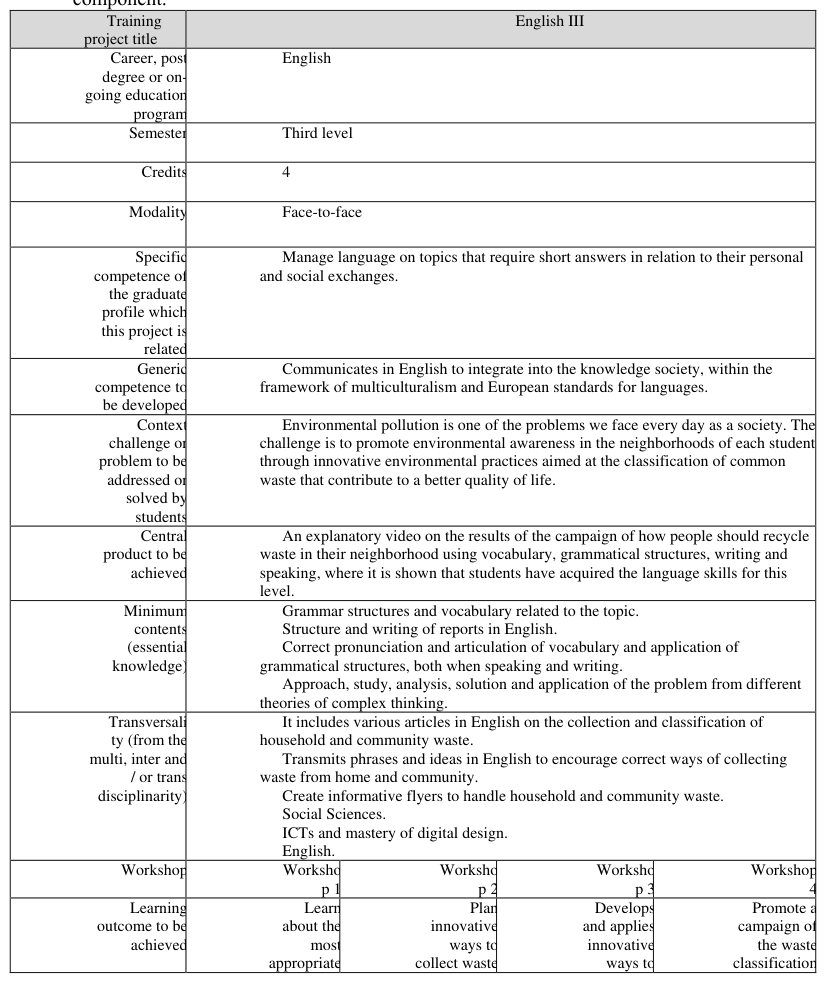
Professional practice training: The training project links the student with the community, contributing to the identification, interpretation, argumentation, and resolution of real problems in the context, creating opportunities and collective benefits. Proposal for a Training Project Considering the Socioformation Methodology The English training project does not focus on content, but on solving real problems in society. The teacher has the task of guiding students to detect these social problems such as: housing, human values, etc. Through the contents and knowledge of the language the teacher can use them to work with the students and be treated as a means for the students to present the expected final product, such as reports, essays, or oral presentations. Fulfilling all this, it would be contributing to the functions of the university, which are: management, training, research and professional practice training. Table 1 shows actions to improve the deficiencies detected, bearing in mind aspects of socioformation. The improvements represent: 1) focus on competencies; 2) detection of context problems; 3) planning the diagnosis to identify students' previous knowledge; 4) planning activities that contribute to collaborative work; 5) planning of partial products by workshops and final product; 6) solution to the problem of the context, achieving a more realistic training according to the needs of the community; 7) planning relevant assessment instruments.
Human Systems Engineering and Design (IHSED 2021) https://openaccess.cms-conferences.org/#/publications/book/978-1-7923-8987-0
Table 1. Improvements in the planning of the English training project regarding its didactic component.
Human Systems Engineering and Design (IHSED 2021) https://openaccess.cms-conferences.org/#/publications/book/978-1-7923-8987-0 and improve collect waste forms and importance that promote
Human Systems Engineering and Design (IHSED 2021) https://openaccess.cms-conferences.org/#/publications/book/978-1-7923-8987-0 know about the collection and management of and any rigorous source that provides
Human Systems Engineering and Design (IHSED 2021) https://openaccess.cms-conferences.org/#/publications/book/978-1-7923-8987-0
CONCLUSIONS
The planning of the first training project evaluated did not consider aspects and fundamental axes of socioformation and these were improved, such as: real problem of the context, evaluation focused on competencies and skills and not on content, solving the problem of the community benefit and its sustainable social development.
The methodology used in the improved training project has positive aspects in its methodology, as it conceives the activities and processes in an articulated way to achieve a proposed end as a final product, which is mentioned by many authors and researchers who work on socioformation. The new training project overcomes the previous one in many aspects, as it focuses on the solution of a real problem of the context from the English subject, with a successful didactic planning of training projects from socioformation.
REFERENCES
D. L. Saúl Lara, Franklin Tapia, Camino al Éxito: Modelo Educativo, Pedagógico, y Curricular, vol. 53, no.
9. 2019. H. Huanca, G. Quispe, and R. Mamani, “Proyectos formativos: experiencia de planeación didáctica en el curso de inglés para tercero de secundaria,” ResearchGate, 2021. M. Duque, “Mejora del Proyecto Formativo de Ambientes de Aprendizaje en la Carrera de Educación Básica,”
ResearchGate, p. 14, 2020. M. -Iñiguez, J. E. Martínez-Iñiguez1, S. Tobón2, and J. A. Soto-Curiel1, “Ejes claves del modelo educativo socioformativo para la formación universitaria en el marco de la transformación hacia el desarrollo social sostenible,” vol. 14, no. 1, pp. 53–66, 2021, doi: 10.4067/S0718-50062021000100053. Molina-Villarroel, J. P., Guevara, C., & Suarez-Abrahante, R. (2021, February). Gamification for Teaching-
Learning Mathematics in Students of Basic Education. In International Conference on Intelligent Human Systems Integration (pp. 235-240). Springer, Cham) S. Tobón, “Análisis de la Pertinencia de Algunos Enfoques y Modelos Pedagógicos para la Sociedad del Conocimiento Analysis of the Relevance of Some Approaches and Pedagogical Models for the Knowledge Society,” 2019. Accessed: Feb. 15, 2021. [Online]. Available: http://cife.edu.mx/huds. S. Tobón, “Cartografía conceptual de los proyectos formativos,” CIFE, 2019. S. Tobón, “Ejes esenciales de la sociedad del conocimiento y la socioformación.,” CIFE, 2017. Tobón, Sergio, Guzmán, Clara Eugenia, Silvano Hernández, José, & Cardona, Sergio. (2015). Sociedad del
conocimiento: Estudio documental desde una perspectiva humanista y compleja. Paradígma, 36(2), 7-36. Recuperado en 27 de octubre de 2021, de http://ve.scielo.org/scielo.php?script=sci_arttext&pid=S1011- 22512015000200002&lng=es&tlng=es. Unesco (2005). Hacia las sociedades del conocimiento. Paris: UNESCO.
Human Systems Engineering and Design (IHSED 2021) https://openaccess.cms-conferences.org/#/publications/book/978-1-7923-8987-0
LISTED IN THE AHFE DIGITAL BOOKSTORE CATALOGUE
Explore the complete digital volume
Human Systems Engineering and Design (IHSED2021): Future Trends and Applications
Read this individual research paper free through the original publisher, or explore the full digital proceedings book.
ISBN 978-1-7923-8987-0
Explore this ISBN in the AHFE Bookstore ↗Listed in the July 2026 bookstore catalogue; search by ISBN to confirm current availability · Digital book purchase optional