Juan Paredes, Cesar Guevara (2021). Virtual learning environment applying digital narratives methodology. In: Human Systems Engineering and Design (IHSED2021): Future Trends and Applications. AHFE Open Access, vol. 21. https://doi.org/10.54941/ahfe1001128
The world in recent times has experienced an unprecedented advance in the development of Information and Communication Technologies (ICT), as indicated by United Nations Organization (UN) in 2019. The UN highlights that the influence of new digital technologies has transformed society, reaching more than 50% of the world's population in the last 20 years. In this context, education as a key piece in the development of society, must become a benchmark when innovating its teaching processes, with the purpose of reaching more and more segments of the population with affordable technological tools that provide quality educational processes. Thus, virtual learning environments (VLE) have become spaces where it has been possible to move the classroom to virtual world. This technology has introduced new methodologies, interactive material, and various ways of presenting information. This study proposes the development of a virtual learning environment as a space to study the topic of internal combustion engines, applying digital narratives methodology. Through bibliographic and documentary research, it has been found that this strategy fosters various capacities in students, based on visual and auditory stimulation, facilitating learning and retention of information. For the development of the virtual classroom, the theme will focus on the theoretical study of the internal combustion engine operating cycle. To accomplish this, the Moodle platform has been used, considering it the most suitable because its design provides both students and teachers with a personalized, robust, and safe environment. The functionalities of the virtual classroom will consist of providing the student with a visually attractive space both in structure and content. For this, there will be tools, Moodle environment typical activities and others that are available online, which facilitate the creation of educational content. The proposed prototype seeks to become a space that complements the work developed in conventional learning. Thus, the contents of the virtual classroom are intended to bring the student closer to the subject to be developed in class and afterwards consolidate what has been learned. With this, it is expected to improve academic performance through constant motivation towards the study of the subject, also contributing to collaborative work before, during and after face-to-face sessions.
Expansion of using information and communication technologies has caused that research about their implementation in different fields increased. In this sense, the use of virtual learning environments and their methodologies, including digital narratives, have led to various investigations. In this section some articles related to this topic, objectives, methodologies and results obtained, have been collected.
In (Munaro & Vieira, 2016) the objective is to verify the effectiveness of the use of digital storytelling in the teaching and learning process. For this purpose, an investigation of the existing literature on the subject was carried out, finding that the studies carried out have been exploratory and, in some cases, they contain errors in the implementation of the strategy in the classroom. Despite the above, the work shows that the use of transmedia storytelling has given very good results in the learning and students’ involvement.
Similarly, the article (Kocaman-Karoglu, 2016) by Kocaman-Karoglu, A., sets the objective of examining the use of digital storytelling in a university course and the perceptions that participants have had when using this tool. Research results show that the use of digital storytelling provides positive learning outcomes. Furthermore, the participants perceived the methodology as an innovative way to share valuable ideas during the classes.
In this order of ideas, the study (Chan et al., 2017) seeks to examine the factors that affect the achievement of digital literacy when using transmedia storytelling. In the study, participants submitted a short initial personal presentation video. After that, they learned digital storytelling activities and had to present a story as final work. The
Human Systems Engineering and Design (IHSED 2021) https://openaccess.cms-conferences.org/#/publications/book/978-1-7923-8987-0 results suggest pedagogical benefits of the strategy used, such as the participation and motivation of the students, as well as the development of filming techniques, video editing and story generation.
At the same time, in (Derboven et al., 2017), the form of design that teachers give to learning activities using virtual environments is addressed. Research showed that some educators focus their use of platforms on a limited number of resources. In addition, the results have implications for the design of virtual learning environments since their design could be focused on providing open tools for the appropriation of content.
For its part (Schmoelz, 2018) presents how students interact in the classroom when using digital storytelling as a creative tool. The study used a qualitative methodology and is based on five studies applied in basic, secondary, and higher sections. The findings show two relevant phases: writing and producing digital stories. In the first, committed action and control were observed in the participants, while in the second, they experienced shared enjoyment and fun when producing their work.
Subsequently, (Jantakoon et al., 2019) published by the Canadian Center for Science and Education proposes the use of immersive virtual environments based on the use of digital storytelling in order to improve the learning of undergraduate students. The results obtained reflect that the strategy is useful to increase the motivation of students, promote collaborative work and develop spatial skills.
In the same year, (Azman et al., 2019) proposed as an objective, the evaluation of a conceptual production model of educational comics based on digital narrative made by the student. The findings obtained from the research revealed that the project is ex-tended, flexible, complete and understandable, which gives the guideline that the student, with the help of digital tools, is able to generate educational experiences that can be shared with their peers, creating a feeling of empowerment of the learning process.
To continue, section 2 of the research initially describes the methodology used in the development of the prototype and as a second part, the technological tools that were used to accomplish the objectives of the research. In the third section the proposal of the prototype is detailed, including the curricular plan of the subject of study. Next, section 4 consists on the results obtained from the implementation of the proposal and finally in section 5, some conclusions and recommendations are given for the development of future works that reinforce the use of the proposed tool.
METHODS AND MATERIALS In this section, the methods that have served as the basis for the development of the virtual classroom prototype will be reviewed and the technological tools used for the presentation and application of the prototype will be detailed.
Human Systems Engineering and Design (IHSED 2021) https://openaccess.cms-conferences.org/#/publications/book/978-1-7923-8987-0
Methods The methodology in the educational field is understood as the set of strategies, actions and procedures developed by the teacher to achieve learning objectives.
ADDIE method The ADDIE methodology, named after the acronym analysis, design, development, implementation and evaluation; is a model used in instructional design for teaching. It has its origin in Florida, United States, in the 70s, twentieth century.
ADDIE presents a simple theoretical scheme covering the phases of any training activity including material design, making it a model to follow for structuring courses.
The first phase of the method, the analysis, identifies all the variables to con-sider in the development of the course, such as characteristics of the students, environment, available resources, etc. In the design phase, the objectives of the course and the characteristics of the tools that will be used to fulfill them will be identified. For the development phase, all the materials designed in the previous step will be elaborated. In the implementation, on the other hand, all the method-ology and materials developed are put into practice, that is, the course is applied to finally, in the evaluation phase, give feedback on the entire process in order to rescue the strengths and solve the weaknesses to be observed.
This model has proven to be a very useful instructional method in the development and structuring of materials for teaching in electronic media. This can be reviewed in (Allen, 2017).
Digital narratives Digital narratives are a combination of narratives and digital content which includes images, video and sound, in order to create a product with a high impact on the student, and from there, a better assimilation of the transmitted message. Several authors have highlighted the benefits of this methodology, such is the case of (Schmoelz, 2018) who points out that students develop participation and cooperation skills.
Materials The use of appropriate tools in the design of a virtual classroom is key in the process of achieving the learning objectives and ICTs play a fundamental role. In this sense, (Morales Chan et al., 2019) points out that including this type of instrument brings benefits for both the student and the teacher, since it allows the use of innovative, multimedia, highly visual and attractive tools.
Virtual learning environment (VLE)- Moodle It is a learning platform whose design seeks to provide students, teachers and digital system managers a personalized, robust and safe environment. Its characteristics, among which we can mention easy use, personalization and tools such as tests, forums, chats, etc., provide a stable and dynamic work environment. This is what (Badia et al., 2019; Guevara & Coronel, 2020), points out by highlighting that
Human Systems Engineering and Design (IHSED 2021) https://openaccess.cms-conferences.org/#/publications/book/978-1-7923-8987-0 the activities indicated are the most used by teachers.
Technological tools Audio and video In this research, Powtoon, Padlet and EDpuzzle were used as generators of audio- visual material, since their characteristics of access through the network and easy use for the development of educational videos, collaborative murals and video evaluations respectively, allow to create content with a great sensory content.
Images and animations Educaplay has been used to create crossword puzzles and alphabet soup. Canva for the graphic design of the virtual classroom and finally, Genially for creating interactive presentations.
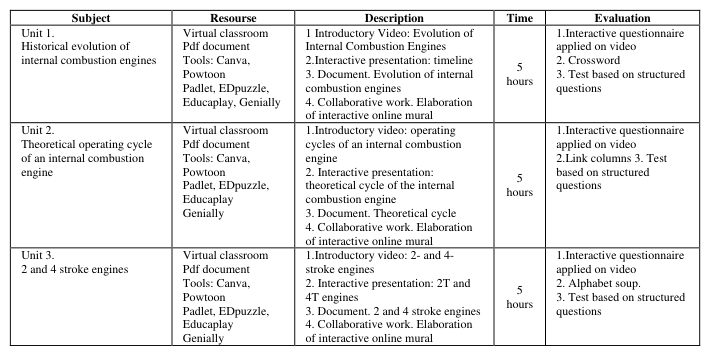
Syllabus of the subject Internal combustion engines (ICE) subject has been taken as a topic. Subject that is part of the automotive electromechanical specialty of the syllabus for second year of technical high school, blended modality in “Centebad” school, located in Sucumbíos province, eastern part of the Republic of Ecuador. The study included 12 students divided into two groups balanced in number. The first of these received the subject in the usual way dictated (control group) while the second worked with the proposed methodology (experimentation group). Table 1 shows the topics to be developed in the virtual classroom, as well as the digital resources used for each item, a brief description of the activities to be carried out, duration and proposed evaluation method.
Table 1: Study topics in the virtual classroom.
Human Systems Engineering and Design (IHSED 2021) https://openaccess.cms-conferences.org/#/publications/book/978-1-7923-8987-0
PROTOTYPE In the development of the virtual classroom, a structure has been used that in its general form is ruled by the phases of the ADDIE methodology: analysis, design, development, implementation and evaluation. The prototype will be implemented to address the topic Internal Combustion Engines (ICE) subject. This corresponds to the automotive electromechanical specialty, of a theoretical-practical nature. The already pragmatic structure in the virtual classroom presents a block diagram made up of an initial block, an academic and a closing block. In the zero or initial block, all the general information of the subject is detailed, consisting on the main title, a presentation and welcome video, documents with information about the course and teacher data, a section with the suggested bibliography and a presentation participants forum. The next block corresponds to the academic one, that is made up of study units. Each unit has three sections: study material, learning activities, and tutorials. In the first, the participant can find material related to the theme of the unit distributed in an introductory video, an interactive presentation and a base document. In the learning activities section, resources have been developed for the practice and evaluation of knowledge through the use of online software such as Padlet, EDpuzzle, Educaplay and finally a test created from an activity of the Moodle environment. To close the academic block there is a tutoring section, where participants can share their concerns with the subject tutor using a chat. Finally, the virtual classroom is complemented with the closing block, formed by two sections: one in which the teacher shares with the students’ links of interest related to the subject of the course, some of application within the subject and also a survey of satisfaction that will serve as a guideline to collect the opinions of the participants about the use.
RESULTS
In the development of the research, 12 students participated divided into two groups balanced in number. The first or control group received the matter in the traditional way. The second group or experimental group used the virtual class-room prototype under investigation. To obtain the results two aspects were considered, one quantitative and the other qualitative. Quantitative data were obtained from structured base tests per-formed at the end of each unit in both, the control and experimental groups, in order to make the appropriate comparisons. On the other hand, the research group was also asked a survey to gather information about their experience (ease of navigation and quality of content) when working in the classroom. From the quantitative point of view, the results reveal an improvement in the performance of the students who worked with the prototype, achieving an in-crease of 13% in the performance obtained with the tests. On the other hand, from the survey carried out with the students of the experimental group who used the proposed prototype, the results indicate that the experience has
Human Systems Engineering and Design (IHSED 2021) https://openaccess.cms-conferences.org/#/publications/book/978-1-7923-8987-0 been positive in general. The satisfaction percentages obtained from some evaluated indicators such as motivation when working in the classroom, format, ease of navigation, contents, evaluation processes, interaction tools, clarity in the processes, instructions and general opinion about the tool range between 80% and 90%.
CONCLUSIONS AND FUTURE WORK The results obtained regarding the implementation of the virtual classroom proto- type, in its feasibility of use and at the learning level, have revealed positive aspects and some disadvantages. Among the positive aspects, the degree of motivation achieved by the students can be noted. This is understood because traditional teaching systems with master classes (in the face-to-face model) or using virtual learning environments used as a simple repository of text files or links, can lead to apathy or demotivation in students. It is important to note that using digital tools as a means of disseminating knowledge, contributes transversally to a process of digital literacy. This point is very important, since the influence of new technologies in all fields including education is perceptible, which leads to a constant update in its management by students and teachers. On the other hand, referring to the internet as a means required for the use of the tool, it should be mentioned as a limitation when applying this type of tool in a massive way, since depending on some social or technological factors like deficiencies in access to the service. Finally, it is worth mentioning that during the development of this research, some questions have been found that could be the basis for future research. The use of digital narratives should be applied in a more general way in various branches of knowledge. It has been found that its use is broader at the level of basic education and in subjects related to the field of social sciences, language study, while in technical subjects such as mechanics, electricity, etc., it has not been very widespread. “Telling stories” as a fundamental idea of storytelling is constituted as an important mechanism for transmitting information and conducting studies to strengthen and expand its use. It constitutes a valuable contribution to the continuous advancement of education, particularly when it is transmitted by digital means.
REFERENCES
Allen, M. (2017). Designing Online Asynchronous Information Literacy Instruction Using the ADDIE Model. Distributed Learning: Pedagogy and Technology in Online Information Literacy Instruction, 69–91. https://doi.org/10.1016/B978- 0-08-100598-9.00004-0 Azman, F. N., Zaibon, S. B., Shiratuddin, N., & Dolhalit, M. L. (2019). Evaluation
of Production Model for Digital Storytelling via Educational Comics. Lecture
Human Systems Engineering and Design (IHSED 2021) https://openaccess.cms-conferences.org/#/publications/book/978-1-7923-8987-0
Notes in Networks and Systems, 67, 513–524. https://doi.org/10.1007/978- 981-13-6031-2_45 Badia, A., Martín, D., & Gómez, M. (2019). Teachers’ Perceptions of the Use of Moodle Activities and Their Learning Impact in Secondary Education. Technology, Knowledge and Learning, 24(3), 483–499. https://doi.org/10.1007/S10758-018-9354-3/TABLES/4 Chan, B. S. K., Churchill, D., & Chiu, T. K. F. (2017). Digital Literacy Learning In
Higher Education Through Digital Storytelling Approach. Journal of International Education Research (JIER), 13(1), 1–16. https://doi.org/10.19030/JIER.V13I1.9907 Derboven, J., Geerts, D., & De Grooff, D. (2017). Appropriating virtual learning environments: A study of teacher tactics. Journal of Visual Languages & Computing, 40, 20–35. https://doi.org/10.1016/J.JVLC.2017.01.002 Guevara, C., & Coronel, D. M. V. (2020). Multisensory Learning System Applying
Augmented Reality. Advances in Intelligent Systems and Computing, 1211 AISC, 336–342. https://doi.org/10.1007/978-3-030-50896-8_48 Jantakoon, T., Wannapiroon, P., & Nilsook, P. (2019). Virtual Immersive Learning Environments (VILEs) Based on Digital Storytelling to Enhance Deeper Learning for Undergraduate Students. Higher Education Studies, 9(1), 144– 150. https://doi.org/10.5539/hes.v9n1p144 Kocaman-Karoglu, A. (2016). Personal voices in higher education: A digital
storytelling experience for pre-service teachers. Education and Information Technologies, 21(5), 1153–1168. https://doi.org/10.1007/S10639-014-9373- 1/TABLES/3 Morales Chan, M., Barchino Plata, R., Medina, J. A., Alario-Hoyos, C., & Hernandez Rizzardini, R. (2019). Modeling Educational Usage of Cloud- Based Tools in Virtual Learning Environments. IEEE Access, 7, 13347– 13354. https://doi.org/10.1109/ACCESS.2018.2889601 Munaro, A. C., & Vieira, A. M. D. P. (2016). Use of Transmedia Storytelling for
Teaching Teenagers. Creative Education, 07(07), 1007–1017. https://doi.org/10.4236/CE.2016.77105 Schmoelz, A. (2018). Enabling co-creativity through digital storytelling in education. Thinking Skills and Creativity, 28, 1–13. https://doi.org/10.1016/J.TSC.2018.02.002
Human Systems Engineering and Design (IHSED 2021) https://openaccess.cms-conferences.org/#/publications/book/978-1-7923-8987-0
LISTED IN THE AHFE DIGITAL BOOKSTORE CATALOGUE
Explore the complete digital volume
Human Systems Engineering and Design (IHSED2021): Future Trends and Applications
Read this individual research paper free through the original publisher, or explore the full digital proceedings book.
ISBN 978-1-7923-8987-0
Explore this ISBN in the AHFE Bookstore ↗Listed in the July 2026 bookstore catalogue; search by ISBN to confirm current availability · Digital book purchase optional