Juan Freire, Cesar Guevara (2021). Application of Decision Tree to Banking Classification Model. In: Human Systems Engineering and Design (IHSED2021): Future Trends and Applications. AHFE Open Access, vol. 21. https://doi.org/10.54941/ahfe1001130
In this research, we will focus on INSOTEC NGO, an entity dedicated to granting microcredits to entrepreneurs with limited economic resources. This company is present in rural areas of Ecuador, increasing its income in recent years. The organization plans to become a bank in the long term and expand its operations to near countries such as Colombia and Peru. However, the entity's customer classification processes have had many drawbacks because it is currently a manual procedure that generates a high operational burden, slow response times to customers, huge inefficiency rates, and a great problem to continue growing. Therefore, the process is no longer sustainable as long as the organization continues growing. Competitors in the banking sector have implemented artificial intelligence projects with machine learning classification methods such as neural networks, decision trees, etc. This has led them to improve efficiency, increase reliability, reduce costs, and decrease the operating burden. These banks have taken advantage of these technological advances to reduce credit risk, control bank fraud such as money laundering, improve their marketing campaigns, and enhance their products and services to be more attractive and competitive in the market. INSOTEC plans to emulate these advances in customer rating processes to take advantage of the benefits mentioned above. This project proposes to model an artificial intelligence algorithm that classifies the organization's clients based on the different variables that are considered convenient for the analysis. The method selected to meet this objective is a decision tree, a supervised learning method that builds models that are easy to interpret. Its implementation complexity is very low, it allows continuous and categorical values, and it handles noise from data from different sources very well. This investigation has the right to use the information of the organization that is hosted in a SQL SERVER 2016 database, which contains the daily transactional details of the current portfolio, the default of loans, and the information of the main client: age, gender, credit range and type of products granted. Also, the dataset has historical data for the last three years but could include preliminary information if necessary. Model evaluation is an essential element of the investigation. In this case, a confusion matrix is a method selected to evaluate the results, it is expected to obtain a level of precision greater than 95%. This evaluation method is used to find the number of false positives to ensure the reliability of the model. The model must have high precision because if it fails, loans could be delivered to people who are not creditworthy and cannot meet the payments, which would be counterproductive for the organization since it would increase the default of loans and operating costs. In short, the machine learning model will automatically classify customers according to the different variables using a decision tree. This implementation will reduce the operational burden, response times to customers, and improve the competitiveness of the organization. This new process will guide the organization to implement these models in other areas such as risk, finance, auditing, and operations.
Human Systems Engineering and Design (IHSED 2021) https://openaccess.cms-conferences.org/#/publications/book/978-1-7923-8987-0
1. INTRODUCTION
In recent decades, the economy of the different productive sectors has developed thanks to the expansion of financial services, the loans provided by these entities offer the opportunity to obtain income to boost the different businesses, deferring payments for the following months (Lanzarini et al., 2017).
Credit classifiers that use statistics were introduced in the 1950s, are now used worldwide, and have become a fundamental part of the credit granting process. The main objective is to evaluate the payment behavior of the lenders, in order to reduce the percentage of error (Zhang et al., 2019).
There are investigations that implement algorithms for the classification of credit clients, in which neural networks, naive bayes, sensory vector machines and decision trees are used. However, in this study Random Forest (RF) was selected because it has been shown to have high precision in several investigations (Ziemba et al., 2020).
From several of the related works Pradhan et al. (2020) it compares some algorithms such as neural networks, decision trees, SVN and RF in a data set of credit clients, which has 4,600 records and 47 variables. First, it used the “feature selection” technique which reduced the set to 31 variables, in the experiment the RF algorithm obtained better results with a precision of 85% and an error rate of 10%.
A similar experiment was carried out by Arora & Kaur (2019) where several classifiers were also com-pared for a data set of credit clients from the “Len-ding Club” database. This dataset is found in kaggle, which has 42,530 records and 143 variables with a history from 2007 to 2011. Subsequently, the chi-square, gain ratio, relieff and Bolasso techniques were applied, reducing the set to 36 variables. In the application of classification models, Random Forest obtained an accuracy of 97.9%, an AUC of 93.4% and an error rate of approximately 2.1%.
In another study carried out by Siswanto et al. (2019), a model with C4.5 decision trees is proposed to a credit customer base, which has 1044 records and 8 attributes. The result of the model was an accuracy of 93.5%, with an error rate of 8.8% of which 92 were FP and 0 were FN.
Another important contribution was proposed by Subasi & Cankurt (2019), to evaluate the payment behavior of clients in one of their loan products. In this work some algorithms were compared as in Arora & Kaur (2019) and Pradhan et al. (2020), in the experiment the data set is composed of 25,000 records and 23 variables. After applying the different classification algorithms, RF obtained the highest percentage of accuracy with 89.01%, an AUC of 95% and an error rate of 11.68%.
Finally, the objective of this research is to create a customer classification model with a high
Human Systems Engineering and Design (IHSED 2021) https://openaccess.cms-conferences.org/#/publications/book/978-1-7923-8987-0 level of precision, for which the necessary data preprocessing techniques will be used and an algorithm based on Random Forest will be used for the model. Additionally, as a result of this research, the risk assessment processes, the credit rating of customers and the percentage of error in the classification of the organization's customers will be improved.
The research is structured as follows: in section 2, the methods and materials used in the study are presented. The database used in the analysis, the method for the selection of variables, which is chi-squared, and RF, which is the algorithm selected for the classification of the data set with Insotec clients, is described.
In section 3 the proposed model is explained, in addition, the data preprocessing that includes the elimination of atypical data and selection of attributes with the chi square technique is detailed.
Section 4 describes the model proposed in the research. Subsequently, in section 5 the results are analyzed to be compared with related works. Finally, section 6 contains the conclusions and future lines of this research.
2. METHODS AND MATERIALS
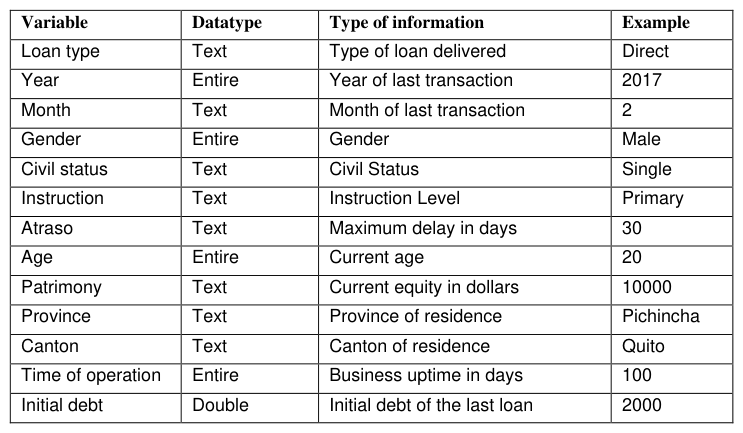
In this section, the methods and materials used in this document will be described theoretically, in the first point the data set used in the study is detailed, later, the chi-square technique is analyzed for the selection of variables and RF as an algorithm of prediction.
Table 1. Detail of the data set variables.
Human Systems Engineering and Design (IHSED 2021) https://openaccess.cms-conferences.org/#/publications/book/978-1-7923-8987-0
The customer data set is made up of two classes GP and BP, the absolute frequency of the GP is 58,472 instances while the BP have 5,424 records. On the other hand, the relative frequency for GP is 92%, while for BP it is only 8%, which is why it is concluded that the data set is unbalanced since there is a much higher percentage of GP. 2.2. RANDOM FOREST (RF) Random Forest RF is an algorithm that arises from the combination of decision trees without correlation, subsequently averages its results, in this way it is an assembled method that combines the results of the different trees to obtain a value for the entire set of trees (Safari, 2020).
This technique introduced by Breiman (2001) can consider a data set 𝑥, where 𝑥𝑖 represents each of the iterations that are formed from a random sample obtained from the original set, 𝑇𝑏 represents each of the trees and 𝐵 the number of trees that are found in the forest regression, this regression is represented in equation 1 (Uthayakumar et al., 2020).
1
𝑦̂(𝑥𝑖) =
Equation reproduced from the original PDF.
2.3. CHI SQUARE
Chi square is an independence test that helps determine the degree of correlation between the variables. It is used to reduce the number of columns in a data set, for which the variables that have a greater degree of dependency must be selected, when the value is greater there is greater dependency with the class Ramya & Kumaresan (2015). The formula proposed by Hidalgo et al. (2020) and (Guevara & Peñas, 2020) is shown in equation (2), in this case c are the degrees of freedom, x represents the values of the client data set and m the expected values. Additionally, the m observations are classified into k classes, in this case they are 2 corresponding to the GP and BP.
Human Systems Engineering and Design (IHSED 2021) https://openaccess.cms-conferences.org/#/publications/book/978-1-7923-8987-0
𝑘 (𝑥𝑖−𝑚𝑖)2 (2) 𝑥𝑐2 = ∑ 𝑚𝑖 𝑖−1
3. CREDIT CUSTOMER CLASSIFICATION MODEL
This section will briefly describe data preprocessing, the application of the chi-square method for the selection of variables, the description of the model and the configuration of the algorithm.
3.1. DATA PREPROCESSING
The data pre-processing stage has a very significant importance in data analysis, since it eliminates noise, instances and variables that do not add value to the study(Kotsiantis et al., 2006).
In the experiment, outliers were eliminated to avoid noise in the analysis, after carrying out this procedure the set was reduced to 58,641 records. Subsequently, the chi-square technique was applied for the selection of variables, where only 8 of the 19 variables have relevance in the analysis, in the results the variables with the highest correlation with the class are backwardness and current grade with values of 29,010 and 24,751 respectively. These variables have a higher level of importance to identify the GP and BP. On the other hand, the variables operating time, year, loan type, expense, income and economic activity obtained much lower values, but greater than 0, which is why they were also included within the selected fields. The chi square results in the data set are observed in figure 1.
Figure. 1. Variable selection bar chart with chi square.
The vector is defined as follows ⅆ𝑛= {𝑎, 𝑐𝑎, 𝑡𝑓, 𝑎𝑛, 𝑡𝑝, 𝑔, ⅈ, 𝑎𝑒}.. The variable 𝑎 represents
Human Systems Engineering and Design (IHSED 2021) https://openaccess.cms-conferences.org/#/publications/book/978-1-7923-8987-0 the arrears, 𝑐𝑟 to the current rating, 𝑜𝑡 is the business operating time, 𝑦𝑡 to the year of the last transaction, 𝑡𝑝 is the type of loan of the last transaction, 𝑔 to the business expense, ⅈ to the income and 𝑎𝑒 to the economic activity of the client.
4. MODEL WITH RANDOM FOREST
For the creation of the prediction model, Random Forest was selected since by literary review it has obtained the highest level of precision in similar cases. As presented by Kotsiantis et al. (2006) and Arora & Kaur (2019). In the aforementioned studies, the RF models obtained the best results compared to others that used different techniques such as neural networks and decision trees.
As mentioned in section 3.1, 8 variables and 58,641 instances were selected to be entered in the model, 50 trees were used for the configuration of the model as recommended (Mercadier & Lardy, 2019), for the number of variables and depth of the trees. individual, the maximum value was selected, which is 8 and 50, since some investigations have shown better results (Ahmad et al., 2017).
5. RESULTS
For the evaluation of the model, cross-validation was used with 𝑘 = 1 𝑡𝑜 10, the results of the confusion matrix that were obtained for the training set was a precision of 97.7%, an accuracy of 97.4% and 2.6% error pertaining to 742 FP and 447 FN instances. On the other hand, that of the set of test data obtained a precision of 97.3%, an accuracy of 97.4% and a 2.6% error that belongs to 122 instances of FP and 31 of FN.
Additionally, in the research it was recommended that the indicated number of trees for a data set of credit clients be 50 trees, when conducting this experiment, the accuracy and precision was around 97% in both cases and the percentage of error is less than 3%, which is consistent with research and shows that the results of the algorithm are very good. However, the algorithm has greater difficulty in predicting the BPs because the percentage of error is 10%, while it is more precise to find the GPs since the percentage of error is 1.5%.
6. CONCLUSIONS AND FUTURE WORKS
In the research, it was identified that the key part for obtaining the results was the data preprocessing where the outliers were eliminated, and the most important variables for the study were selected with the chi-square technique.
In this work, we apply chi-square for select attributes most relevant to understand the most important variables from the database.
Human Systems Engineering and Design (IHSED 2021) https://openaccess.cms-conferences.org/#/publications/book/978-1-7923-8987-0
The Random Forest assembled method yielded very good results for the data set, with a precision of 97% and an error rate of 2.8%.
Additionally, the proper configuration of the model improved the results. However, the number of variables should be increased in order to create a more robust classification model.
For future research, the same analysis should be carried out with a greater number of variables and include some tests to evaluate the robustness of the client classification model.
REFERENCES
Ahmad, M. W., Mourshed, M., & Rezgui, Y. (2017). Trees vs Neurons: Comparison between random forest and ANN for high-resolution prediction of building energy consumption. Energy and Buildings, 147, 77–89. https://doi.org/10.1016/j.enbuild.2017.04.038
Arora, N., & Kaur, P. (2019). A Bolasso based consistent feature selection enabled random forest classification algorithm: An application to credit risk assessment. Applied Soft Computing, 86, 105936. https://doi.org/10.1016/j.asoc.2019.105936
Breiman, L. (2001). Random Forests. Machine Learning, 45(1), 5–32.
https://doi.org/10.1023/A:1010933404324 Guevara, C., & Peñas, M. S. (2020). Surveillance Routing of COVID-19 Infection Spread
Using an Intelligent Infectious Diseases Algorithm. IEEE Access, 8, 201925–201936. https://doi.org/10.1109/ACCESS.2020.3036347 Hidalgo, J., Guevara, C., & Yandún, M. (2020). Generation of User Profiles in UNIX
Scripts Applying Evolutionary Neural Networks. In I. Corradini, E. Nardelli, & T. Ahram (Eds.), Advances in Human Factors in Cybersecurity (pp. 56–63). Springer International Publishing.
Kotsiantis, S., Kanellopoulos, D., & Pintelas, P. (2006). Data Preprocessing for Supervised Learning. International Journal of Computer Science, 1, 111–117.
Lanzarini, L., Villa Monte, A., Bariviera, A. F., & Jimbo Santana, P. (2017). Simplifying credit scoring rules using LVQ + PSO. Kybernetes, 46, 8–16. https://doi.org/10.1108/K-06-2016-0158
Mercadier, M., & Lardy, J. P. (2019). Credit spread approximation and improvement using random forest regression. European Journal of Operational Research, 277(1), 351– 365. https://doi.org/10.1016/j.ejor.2019.02.005
Pradhan, M. R., Akter, S., & Al Marouf, A. (2020). Performance Evaluation of Traditional
Human Systems Engineering and Design (IHSED 2021) https://openaccess.cms-conferences.org/#/publications/book/978-1-7923-8987-0
Classifiers on Prediction of Credit Recovery. In T. Sengodan, M. Murugappan, & S. Misra (Eds.), Advances in Electrical and Computer Technologies (pp. 541–551). Springer Singapore.
Ramya, R., & Kumaresan, S. (2015). Analysis of feature selection techniques in credit risk assessment. 1–6. https://doi.org/10.1109/ICACCS.2015.7324139
Safari, M. J. S. (2020). Hybridization of multivariate adaptive regression splines and random forest models with an empirical equation for sediment deposition prediction in open channel flow. Journal of Hydrology, 590, 125392. https://doi.org/10.1016/j.jhydrol.2020.125392
Siswanto, Abdussomad, Gata, W., Wardhani, N. K., Gata, G., & Prasetvo, B. H. (2019).
The Feasibility of Credit Using C4.5 Algorithm Based on Particle Swarm Optimization Prediction. 2019 6th International Conference on Electrical Engineering, Computer Science and Informatics (EECSI), 416–421. https://doi.org/10.23919/EECSI48112.2019.8977074 Subasi, A., & Cankurt, S. (2019). Prediction of default payment of credit card clients using
Data Mining Techniques. 2019 International Engineering Conference (IEC), 115– 120. https://doi.org/10.1109/IEC47844.2019.8950597 Uthayakumar, J., Vengattaraman, T., & Dhavachelvan, P. (2020). Swarm intelligence
based classification rule induction (CRI) framework for qualitative and quantitative approach: An application of bankruptcy prediction and credit risk analysis. Journal of King Saud University - Computer and Information Sciences, 32(6), 647–657. https://doi.org/10.1016/j.jksuci.2017.10.007 Zhang, W., He, H., & Zhang, S. (2019). A novel multi-stage hybrid model with enhanced
multi-population niche genetic algorithm: An application in credit scoring. Expert Systems with Applications, 121, 221–232. https://doi.org/10.1016/j.eswa.2018.12.020 Ziemba, P., Radomska-Zalas, A., & Becker, J. (2020). Client evaluation decision models in
the credit scoring tasks. Procedia Computer Science, 176, 3301–3309. https://doi.org/10.1016/j.procs.2020.09.068
Human Systems Engineering and Design (IHSED 2021) https://openaccess.cms-conferences.org/#/publications/book/978-1-7923-8987-0
LISTED IN THE AHFE DIGITAL BOOKSTORE CATALOGUE
Explore the complete digital volume
Human Systems Engineering and Design (IHSED2021): Future Trends and Applications
Read this individual research paper free through the original publisher, or explore the full digital proceedings book.
ISBN 978-1-7923-8987-0
Explore this ISBN in the AHFE Bookstore ↗Listed in the July 2026 bookstore catalogue; search by ISBN to confirm current availability · Digital book purchase optional