As our society gets complicated and faster than ever, we have much relied on technologies in order to keep our lives intact. Moreover, new technologies are introduced every day and every month, and it is hard for the users to keep up with the technologies. This phenomenon contradicts between the users and trends, the users seek out better technologies, simultaneously, and the users tend to keep their old habits and are harder to be swayed to get into a new system than times with fewer technologies involved in because the users tend to stay in their comfort zones in scope of artifact. Nowadays, interconnected and interrelated technologies make even harder for the users to move to the new system. The comfort zone from the users plays a big role in not only design, but also marketing field, brand loyalty. Once the users create their comfort zone in scope of artifact, the users establish “emotional safety net” in scope of artifact. This paper will define, “emotional safety net in design” and explore how to incorporate to design process.
Emotional safety net in design increases in users’ confidence, sense of users’ comfort, and acceptance in the event of acquiring new objects/products. It is not hard for an author to find users trying to stay in certain continuity within a brand or colors or aesthetics.
Figure 1. Same Brand and Same Color
Figure available in the original PDF paper.
Figure 1 is a good example of emotional safety net because it is clear for the owner of those two cars to have higher user confidence and acceptance otherwise the owner would not have purchased the car within same brand and same color.
People who bought an apple product has a higher chance to buy another apple product in the future because many features have the same way to operate as their previous products and the users have confidence to operate the products. Users’ confidence can be defined that it is a psychological status that users feel comfortable with a particular products/objects and are able to operate major features of the product without referring to the users’ manual. Users’ acceptance is another indication for emotional safety net in design. Users tend to want to stay in their comfort zone especially of any products related to safety and products with high price tags. Brands play a significant role in terms of comfort zone. Emotional safety net could lead to brand loyalty.
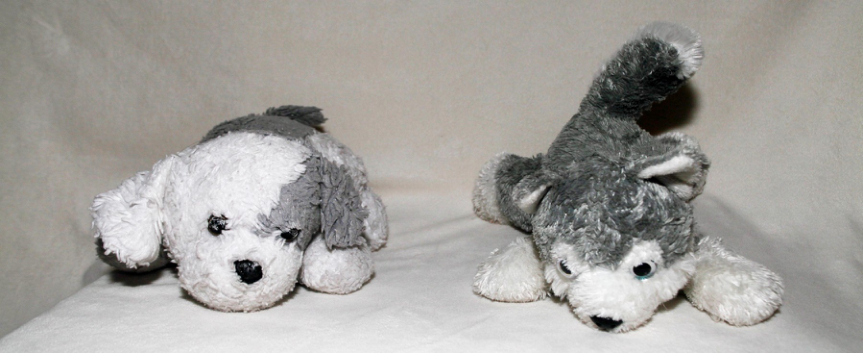
Figure 2. Stuffed Animal (Old: Left and New: Right)
A little girl used to carry a stuffed animal in age of 2 and refused to have another stuffed animal. The stuffed puppy was the one that she would carry and made her feel comfortable. However, she received a different stuffed puppy in age of 4 and accepted the puppy because the new stuffed puppy had very similar color scheme and size. (Figure 2)
WHY DO WE HAVE EMOTIONAL SAFETY NET Loss Aversion
Psychologists have long observed that repeated exposure to a stimuli results in an increase in positive affect. Emotional safety net can be explained by loss aversion, which was first demonstrated by Amos Tversky and Daniel Kahneman. Loss aversion is that a loss has more influence on choices than a gain of the same magnitude (Kahneman & Tversky, 1979). What it means that a loss is more painful than gain. People make a lot of efforts to prevent from losing and keep what they currently own and feel secure. Explanations for the endowment effect commonly draw on prospect theory and suggest that possession of a product causes consumers to become loss adverse (Kahneman, Knetsch, and Thaler, 1990) Emotion-Understanding Ability
Emotion-understanding ability is one of the core dimensions in Mayer and Salovey’s (1997) ability model of emotional intelligence. It pertains to the skill of analyzing the cause-and effect relations between “vents and emotions forward” (predicting future emotions based on current events) and “backward” (identifying which past events elicited current emotions; MacCann & Roberts, 2008; Mayer et al., 2008; Mayer & Salovey, 1997).
Zaltman, author of “How customers think”, stated in his book that a perfume’s fragrance - a product attribute - evoke a particular memory and an associated emotions in a potential buyer. If a painful memory triggers a painful emotion, then the person probably won’t buy the perfume, even if the fragrance, price, packaging, brand label, and other qualities meet her criteria (Zaltman G., 2003). Zaltman continues to state that decision making hinges on the simultaneous functioning of reason and emotions.
Because of skill of analyzing emotions forward in emotion-understanding ability, higher users’ confidence and familiarity will make stronger emotional safety net. The female buyer in Zaltman’s example would have bought a perfumes if she would have had a positive emotions triggered by a positive memory, which means that emotions backward would have to be positive.
Perceptual Familiarity Breeds Liking As Zajonc and Markus (1982) observe, “When objects are presented to the individual on repeated occasions, the mere exposure is capable of making the individual’s attitude toward these objects more positive”. This experiment has been done numerous times in advertising and marketing field. The positive effect could be interpreted various way and covered wide in daily life. Therefore, it is possible to influence users’ confidence and comfort. In advertising and marketing, the positive effect is eventually converted to action of purchase, which means that advertisers and marketers achieve their goal. However, it is more important for industrial designers to give more careful consideration after purchasing when the product and the user interact. While users interact with a product, the users gain users’ confidence, comfortability, and knowledge toward the product.
Familiarity Become Knowledge Familiarity and memory are significant elements for emotional safety net in design because familiarity has direct correlation to users’ confidence and is grounded in memory. Conover summarizes familiarity and permanent memory.
The information that a consumer gains from using or learning about a product is stored in a permanent memory which maintains that knowledge for future use. A basic characteristic of the consumer's permanent memory is that the information contained therein is highly organized for efficient retrieval. The structure of this organized product knowledge is subject to change as the consumer acquires new information to be integrated with the old. The effect of familiarity, then, is to modify the structure of the consumer's product knowledge. Marks and Olson (1981) reported evidence consistent with a "unitization" theory of knowledge development proposed by Hayes-Roth (1977). According to this theory, knowledge structures begin with the development and strengthening of lower-order knowledge units (concepts), each of which is activated in an all-or-none fashion. (Conover, 1982) For example, at the earliest stages of familiarity with a product, a consumer learns isolated pieces of information about it and information would carry various feelings toward information that the consumer obtained. The emotions can be generated by active or inactive way. In an active way, the feeling by active way tends to be first impression based on previous experience. Feeling by inactive way tends to generate by feedback from peers. As the consumer experiences with a product further, these isolated information with corresponding specific feeling become correlated and identify as overall feeling. However, the feeling can be changed depending on context. In terms of gathered isolated information, the whole information becomes a unit and Hayes-Roth called it “unitized”. An appropriate stimulus evokes both overall product information and feeling toward the product. Conover stated in the same article that after a period of increasing complexity of product knowledge (in the sense of comprising multiple separate concepts), further increments in familiarity lead to knowledge structures that are actually simpler (i.e., they contain relatively few, higher-order units, each of which comprises numerous related pieces of information) (Conover, 1982).
HOW DO WE ACHIEVE EMOTIONAL SAFETY NET IN DESIGN THROUGH DESIGN PROCESS Emotions have been a critical component in many disciplines – business, advertising, cognitive science, and design - trying to engage emotional aspects with customers in every possible way because emotions have been a vital aspect in decision making process. There are two components - validating users’ feeling and analyzing a metaphor - to achieve emotional safety net in design throughout design process.
Validating Users’ Feeling Emotions are intangible, but they derive tangible outcome. Also, emotions are invisible, but they are visible by reactions. There are three activities – story engagement, analyzing pain factor, and writing a break up letter - that can be applied in order to elicit users’ true emotions
Story Engagement Stories that feel meaningful will ultimately lead you to meaningful outcome (Simmons, 2006). We even find stories from TV commercial in 45 seconds. Grandfather reads fairy tale books to his granddaughters and grandsons and those books have lessons to learn. Stories are indirect communication, easy approaching and soft unfolding format. However, stories can deliver a lot of details, insights, and lifetime lessons. Literally, one inspired story can change people’s lives. Good stories are tremendously powerful and extremely delicate. Also, stories are contagious and epidemic. Something goes on in the world that infects people with certain memes and those memes eventually influence their hosts’ behavior in such a way that the something gets repeated and/or spread (Brodie, 2009). We all got connected by stories. Because the stories are tremendously powerful tool it must be created an experience that your audience will relate to but one that ultimately presents your ideas and your sincere intentions (Belsky, 2010). The psychic lever that opens us to the power of stories is the ability to form mental representations of our experience (Guber, 2011). More people in the story mean the bigger audiences. Washington University neuroscientist Jeffrey Zacks has found that vividly narrated stories activate the same brain areas that process the various component of real-life experience (Guber, 2011).
Listening to other’s stories is a way to find out your own story. Simmons said, “Genuine listening gives you permission to wonder aloud about your uncertainties. Influence is much easier when you gain access to the place where people hide their uncertainties” (Simmons, 2006) and suggested seven techniques for finding story (Simmons, 2006).
1. Look for patterns: How they tie together, what they mean to you, the moment of glory in your life
2. Look for consequences: Consider good or bad results that have influenced the way you develop relationships.
3. Look for lessons: Recall the biggest mistake you ever made, a turning point in your career and the lesson you learned
4. Look for utilities: Remember that story that changed you
5. Look for vulnerability: Tell me about your soft spot; the last time you cried, so happy, and touching family stories about those you love deeply
6. Look for the future experience: Develop your day-dreams of “how it could be” into a full story with real-life.
7. Look for story recollections: Find a story that stuck with you and mine it for meaning – favorite movie or book: there should be reasons for it.
Many people express that finding the stories are difficult and hard, and it is true if they don’t listen. As a matter of fact, these seven rules for finding story are how to listen to others.
Break-up Letter
Figure 3. Break up letter (Student’s Example)
In 2009, Smart Design created this method based on a familiar format in which to express thoughts and feelings about a product or service in an informal, accessible way. (Marin, B., Huntington, B. 2012) It is widely used in both product developments and marketing field. Also, break up letter can compensate the criticism of focus group interview (FGI). John R. Hauser, Kirin professor of Marketing at MIT’s Sloan School of Management, recently noted, “If you have two hours to cover five to ten topics with eight people, then you have about one or two minutes on each topic with each person. You can’t possibly get much beyond the surface given those constraints (Zaltman G., 2003).”
Although break up letter can take more time than conducting focus group interview, it can deliver deeper customers’ insights and identify pain factors. The biggest advantage of writing break up letter is that people who write break up letter don’t have to think about what other people’s opinions are and worry about not being a part of a majority. Each person only focuses on their own problems and feeling toward products (Figure 3.). Therefore, they only think about describing their problems and feelings, which can lead of higher chances of applying metaphor in their break up letter. This paper will cover with pain factor and metaphor.
Figure 4. Analysis of Break up letter (Student’s Example)
Figure available in the original PDF paper.
It is important to analyze the break up letter because the letter contains much valuable information such as metaphors and specific feeling toward specific problems (Figure 4.) It is hard for interviewers to identify problems and feelings because interviewees tend not to share their deep feeling toward a certain problem. Therefore, break up letter is an effective method to identify problem, which can lead to a possible solution.
Pain Factor Diagnosing users’ pain is an essential step to designing products. “Combining your expert knowledge with their own understanding of current situation and their desired outcome will lead to an accurate diagnostic of your customers’ pain (Renvoise, P & Morin, C 2007).” The role of interviewers is not just to ask a series of questions and record answers. They need to be proactive and involved as completely as possible in generating the questionnaires and researching in depth for the target buyers or users because the users’ pain won’t be unveiled by just recording the answers from the users. We can categorize the pain we usually have in three types – personal, financial, and strategy (Renvoise, P & Morin, C 2007) – and we often can’t recognize what they are.
1. Personal pain: composed of the feelings and emotions affecting those who are involved in deciding how and when to resolve the prospect’s primary pain.
2. Financial pain: covers your prospect’s economic performance or lack thereof.
3. Strategy pain: includes issues that affect the business process used to develop, manufacture, and sell products or services.
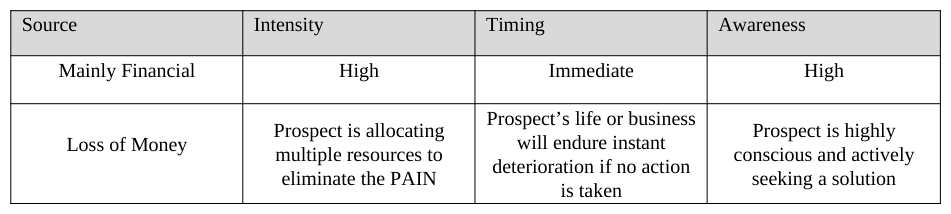
Personal and financial pain -- emotion, feeling, and money -- can be main issues from the users’ point of view. It seems to be little obvious that money is one of the main issues, however, feeling and emotions are something we need to look into further. One subtle problem – smell, texture, temperature, color, sound, physical weight, visual weight, tightness - can cause a major shift in decision making. Strategy pain tends to be in the business side and won’t go detail further in this article. Pain factor can be simplified as shown in table 2, which helps to visualize pain source, intensity, timing and awareness.
Table 2. Pain Factor in Product Development Source Intensity Timing Awareness
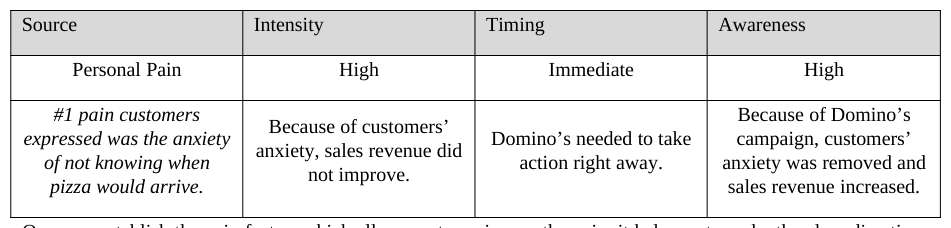
Now, we can establish the “Pain Factor” for the Domino’s Pizza’s case: “Actually, the number one pain customers expressed was the anxiety of not knowing when the pizza would arrive. Armed with this vital information, Domino’s pizza established a very successful slogan: Thirty minutes or less (or it’s free)” (Renvoise, P & Morin, C 2007)
Once we establish the pain factor, which allows us to easier see the pain, it helps us to make the clear direction and diagnose the pain accurately.
Analyzing Metaphor “Cognitive linguistics treats metaphor as a key to understanding the conceptual processes of the human mind.” (Nehaniv, 1998) Metaphors are powerful tools. Stemming from the biological, bodily aspect of the human existence, they underwrite most human thoughts. Metaphors are tools for meaning, representation, understanding, science and education (Louridas, 1999). Metaphors stimulate the workings of the human mind. By one estimate, we use almost six metaphors per minute of spoken language (Zaltman G. , 2003). The current theory, “The Contemporary Theory of Metaphor” by George Lakoff, must be addressed in order to valid of investigating metaphors in everyday language because metaphor was seen as a matter of language not thought in classical theories of language. (Lakoff G. , 1992). However, Lakoff argued traditional assumptions that “all everyday conventional language is literal, and none is metaphorical” and “All subject matter can be comprehended literally, without metaphor.” (Lakoff G. , 1992). However, Lakoff stated in his theory that the reason for the difference is that, in the intervening years, a huge system of everyday, conventional al, conceptual metaphors has been discovered and it is a system of metaphor that structures our everyday conceptual system, including most abstract concepts, and that lies behind much of everyday language. (Lakoff G. , 1992)
It indicates that we might not be able to communicate with other without having metaphors in their expression. Such metaphors are capable of giving us a new understanding of our experience (Lakoff M. J., 2003). As designers’ point of view, the metaphors can deliver valuable insight that would not be able to find out from conventional survey question. Analyzing the users’ metaphors in the design process should be included and be followed by the users’ interviews. Interview questions should be carefully and thoughtfully constructed before conducting the interview in order to derive the metaphors from the users. An interview question, “What is your experience when using a microwave oven?” seems to be appropriated. However, the question is failed to make the user think and use the deeper metaphors. The questions can be rephrased, “When you think about cooking in your kitchen, what thoughts and feelings come to mind?” or “Tell us about how you use your microwave oven when preparing meals.” Therefore, it is vital for designers to ask the right questions to have the right answers. Many designers tend to overlook the process of creating questionnaires and focusing more on answers and conclusions. The goal of generating questions is not just to find the numbers or trends. Then, what are the proper questions? The right questions can lead to answers that indicate some vital pain factors; pain source, intensity, timing, and awareness. Therefore, the designers must involve in the processes, from brainstorming questions to analyzing answers. How can the designers construct the legitimate questions for the interview? Zaltman (Zaltman G. Z., 2008) suggests eight guidelines for formulating the series of questions.
1. Determine the generic question you want to explore. Generic questions are not about users’ demographics. They are about users’ generic experiences. Designers should explore users’ attitudes and perceptions toward experience and environment.
2. Determine whether the basic question should be specific to brand, category, or problem. It is essential to have a clear direction whether the questions should be about the brand, the product category, or problem that users are facing. Depending on the characteristic of the project, the questions need to focus more on the situation.
3. Pose more general and more specific versions of the first question that occurs to you. Once designers establish the foundation of a questionnaire they tend to jump into specific questions they would like know directly —and thus miss vital cues from users.
4. Determine whether you need to know the direction, velocity, or both.
Sometimes, launching a new product is a high-risk project. It is like driving in busy downtown streets you have never visited before, without a GPS or even a printed map. Lately, the role of designers has expanded to include decision making about what to learn from the current market and consumers.
5. Allow for surprises. Designers need to be proactive while conducting surveys or focus group interviews. It means that users or consumers are motionless and receptive. They will only deliver the information that designers ask for. Furthermore, they will not even reveal their emotions and thoughts toward the products. That’s why designers need to stimulate users to get their inside stories.
6. Convert assumptions into questions. Assumptions are the worst enemy of questionnaires. Similarly, I always tell my students that the project will face a dead end the moment you assume the answer, users’ behavior, feelings, etc.
7. Employ a clairvoyant. No one can see the future. However, exercising and engaging imaginative thoughts will help to predict better. “Will this design succeed in the market?” Expand your imagination to seek specific answer for the products, “What do users dislike when they use this product?” or “What key emotions speak with other users when users think about the products and brand?” With those types of questions, designers can concentrate on the factors affecting users’ thinking and behavior. It will dramatically help to grasp not only the forest, but also the trees in the forest.
8. Employ a wizard. It is another stage in using our imaginations. “If there were a wizard, what would the first thing he would fix to correct this problem?” This question will lead designers to identify potential issues that can occur in the near future. In this case, designers should ask themselves, “Do we have enough information or resources to respond if problems occur?” and “Is it really likely to occur?” Establishing a strong “plan of attack” will solidify not only the design concept, but also sales revenue later.
Establishing insightful questionnaires is a solid foundation for the entire research process, and it is something we can control. Extensive preparation gives accurate and useful results to the designers. In other words, constructing the interview questions should be considered as design process and does need to have a brainstorming in order to formulate the valuable questions that would reveal the customers’ insight. As a matter of fact, these eight guidelines could initiate brainstorming stages, which plays a role for narrowing down a desired direction and composing critical interview questions.
CONCLUSIONS AND FURTHER RESEARCH Emotional safety net is a combination of strong feelings in order to stay in secure. It has been developed since babies have interacted with their parents. As babies grow, they tend to be attached a certain object such as blanket or stuffed animal. The security blanket or stuffed animal can provide emotional safety net for the kids because those simple objects can give peace of mind to the kids. Nowadays, there is the same phenomenon in among adults because they have been attached certain products and strong feeling toward those products. Therefore, it is important for design students to recognize that emotions have become an important design element and play a big role for decision making process. It is still ongoing research and there are more tasks to complete. Relevant literatures need to be revisited and hard data from interview and survey need to be collected in order to support relevant arguments and statements.
REFERENCES
Belsky, S. (2010), Making Ideas Happen. New York: Portfolio. Brodie, R. (2009), Virus of the Mind. London: Hay House, INC. Conover, N. J. (1982), Familiarity and the Structure of Product Knowledge", in NA - Advances in Consumer Research Volume 09, eds. Andrew Mitchell, Ann Arbor, MI : Association for Consumer Research, Pages: 494-498 Guber, P. (2011, March/April), The Inside Story. Psychology Today, p. 83. Conover, J. N. (1982),"Familiarity and the Structure of Product Knowledge", in NA - Advances in Consumer Research Volume
09, eds. Andrew Mitchell, Ann Arbor, MI : Association for Consumer Research, Pages: 494-498. Kahneman, D., & Tversky, A. (1979). Prospect theory: An analysis of decision under risk. Econometrica, 47, 263–291. Kahneman, D., Knetsch, J., & Thaler, R. (1990). Experimental tests of the endowment effect and the Coase theorem. Journal of Political Economy, 98, 1325–1348 Lakoff, G. (1992), Metaphor and Thought (2nd edition). Cambridge: Cambridge University Press. Lakoff, G. (1992). Multiple Selves: The Metaphorical Models of the Self Inherent In Our Conceptual System. A Conference of
the Mellon Colloquium on the Self at the Emory Cognition Project. Georgia: University of California at Berkeley. Lakoff, M. J. (2003), Metaphors We live By. Chicago: The University of Chicago Press. Louridas, P. (1999), Design as Bricolage: Anthropology Meets Design Thinking. Design Studies, Vol 20(No.6), 517. Marin, B., Huntington, B. (2012), Universal Methods of Design, p114, Beverly, MA: Rockford Publisher MacCann, C., & Roberts, R. D. (2008), New paradigms for assessing emotional intelligence: Theory and data. Emotion, 8, 540–551. Mayer, J. D., & Salovey, P. (1997), What is emotional intelligence? In P. Salovey & D. Sluyter (Eds.),
Emotional development andemotional intelligence (pp. 3–31), New York, NY: Basic Books. Mayer, J. D., Roberts, R. D., & Barsade, S. G. (2008), Human abilities: Emotional intelligence. Annual Review of Psychology, 59, 507–536. Nehaniv, C. L. (1998), Computation for Metaphors, Analogy, and Agents. Berlin: Springer. Renvoise, P & Morin, C (2007), Neuromarketing USA: Thomas Nelson p16, 20, 25, 26, 28, & 29 Salovey, P., Mayer, J. D. (1990), Emotional intelligence; Imagination, Cognition, and Personality, 9, 185–211 Simmons, A. (2006), The Story Factor. Cambridge, MA: Basic Books.
Zajonc, Robert B. and Helen Markus., (1982), “Affective and Cognitive Factors in Preference,” Journal of Consumer Research 9 (September), 123–131. Zaltman, G. (2003), How Customers Think. Boston: Harvard Business School Press. Zaltman, G. Z. (2008), Marketing Metaphoria. Boston: Harvard Business Press.
LISTED IN THE AHFE DIGITAL BOOKSTORE CATALOGUE
Explore the complete digital volume
Advances in Affective and Pleasurable Design
Read this individual research paper free through the original publisher, or explore the full digital proceedings book.
ISBN 978-1-4951-2109-8
Explore this ISBN in the AHFE Bookstore ↗Listed in the July 2026 bookstore catalogue; search by ISBN to confirm current availability · Digital book purchase optional