Sheridan Kromann, Chris Arnold (2026). A Practical, Operational Definition of “Intuitive” Industrial Design. In: Interdisciplinary Practice in Industrial Design. AHFE Open Access, vol. 222, pp. 219–228. https://doi.org/10.54941/ahfe1007761
Within the practice of Industrial Design, it is common for designers to put significant effort into making product interfaces ‘intuitive’; created in a way that a user may simply look at the interface and know how to use the product. To accomplish this, many designers adopt an intuitive approach: since both parties are human beings, if it makes sense to the designer, it will make sense to the user. While the notion of intuitive design is valuable, its implementation often runs into stumbling blocks that prevent it, leading to products with poor usability and avoidable user frustration.Often, these so-called ‘intuitive’ approaches are built upon an incomplete understanding of what the concept of ‘intuition’ entails. In addition, designers often hold a distorted view of what users will understand, in no small part because of their own immersion in the product development process.This paper will provide a brief overview of how cognitive processes, inputs, and constructs comprise human ‘intuition’ as it relates to interface design through the lens of Information Processing theory, and will highlight some of the most common problems that designers face as they attempt to design ’intuitive’ product interfaces.
In recent decades, the profession of Industrial Design has taken up the mantle of ‘user-centered design,’ an idea that describes how designers should prioritize the human aspects of a product, such as ergonomic comfort and intuitive use, as identified through user research, in the product design process rather than the application of brand aesthetics at all costs.
This design movement has resulted in arguably successful products; for example, the design of everyday functional objects, such as a hand drill, has seen marked ergonomic improvements, allowing their operators to use tools for much longer periods without discomfort or injury.
Beyond the most physical aspects, user-centered design routinely seeks to balance product form with how people perceive and use products. Intuitive Design, as defined by faculty of the Industrial Design program at North Carolina State University, is described as “the ability for users to pick up a product and know how to use it without instruction or training” (Blackler, Popovic, and Mahar, 2003, p. 492). Unfortunately, they do not appear to know much about what specifically makes a design ‘intuitive’. When interviewed, one recounted: “We have not done any deep research in this Received March 7, 2026; Revised April 8, 2026; Accepted April 26, 2026; Available online July 20, 2026
220 Kromann and Arnold area (intuition) …the concept (of intuitive use) makes so much sense to me, I never questioned it” (Blackler, Popovic, and Mahar, 2003, p.492). This is a common refrain that has led many in industrial design to mistakenly accept an abstract, artistic conception of intuition that does not reflect current research in fields of human cognition and perception.
This article aims to provide several things: first, it will show how the concept of Intuition is currently characterized in the practice of industrial design, and how that is misaligned with reality in several ways. Next, it will share a more accurate description of Intuition, built upon conceptual components rooted in cognitive psychology and information processing theory: Prototypicality; Jens Rasmussen’s Skills, Rules, Knowledge Framework; and Don Norman’s concepts of Affordances and Signifiers. With that as a foundation, a set of guidelines is offered as a starting point for industrial design practitioners to integrate this knowledge into their user-centered design practice.
‘INTUITIVE DESIGN’ IN INDUSTRIAL DESIGN AND ITS ISSUES There are three ways in which the current operational definition of ‘intuitive design’ within the practice of Industrial Design is erroneous: it is built on circular logic that equates it with aesthetics, and misappropriates the concept of ‘meaning’.
First, while there is no absolute definition, the operational description of ‘intuition’ in design practice is often described as follows: a design is intuitive if the person engaging with it can use the product, and the person engaging with the product can use it because the design is intuitive. This creates an often-ignored circular logic. This assumption may be checked during user testing as part of a comprehensive design process, but such testing may not be conducted due to practical constraints such as time, cost, and intellectual property restrictions, leaving the designer with little evidence for validation.
A second way the operational definition is inaccurate is that there often exists a common, unspoken assumption that intuition works the same way as aesthetics. This assumption treats designed ‘intuitiveness’ as a characteristic so self-evident that it requires no support other than its mere expression as part of the design to be correct. The implication is that Intuition incites users in the same way that a visceral response occurs when a viewer catches sight of an object with a pleasing or objectionable design aesthetic (Norman, 2013. p. 50). User cognition of aesthetics and intuition may occur in parallel, but they are not the same thing and do not function in the same way.
A third, and perhaps most significant, way that the current operational definition of intuition in design fails in its purpose is the unspoken assumption that meaning, and therefore intuition, is embodied within the designed object itself rather than in the user’s mind. The assumption continues: if only the designer is skilled enough, then enough meaning can be designed into the object that any user could be expected to use intuitively. Meaning applied to objects in this way was the aim of Product Semantics, an area of design study pioneered by Reinhardt Butter and Klaus Krippendorff (1985). More properly, meaning, where product design is concerned, does not exist outside
A Practical, Operational Definition of ‘Intuitive’ Industrial Design 221 of the minds of those people who interact with the object and imbue the object with said meaning. This claim is verifiable through a simple common- sense investigation. A worn-out teddy bear might be described as ‘trash’ by some, but to the young child who has owned it for as long as they can remember, the stuffed animal is priceless. Similarly, an electrician will look at a voltmeter and see a tool of their trade, useful for diagnosing and repairing electrical systems, while a layperson might see only a confusing device with no apparent function. Nor could enough ‘intuitive design’ embed enough information in the design of an automobile for a cave dweller to ‘intuitively’ operate it.
These examples demonstrate that the concept of Intuition, as applied to products, is predicated on pre-existing knowledge. Remove the pre-existing knowledge, and so is removed the capability for intuition.
Since intuition is not based on abstract, artistic ideals but on prior knowledge and behavioral patterns, designers must not rely on their aesthetic judgment to develop effective interfaces; instead, they should consult existing science. This is not to say that the artistic mind of the Industrial Designer is not useful; even within product categories that may be singularly focused on usability, such as is often the case for medical products, emergency equipment, and the like, there is certainly room, but also a desire for aesthetic beauty. Within the study of ‘usability’, there is significant evidence suggesting that ‘beautiful’ interfaces enhance usability (Norman, 2013). Whether a product’s design emphasizes function or aesthetic appeal, its interface should not be designed solely with either in mind. They should be designed with a comprehensive understanding of how the human mind processes information through interaction with products and systems.
A MORE ACCURATE CHARACTERIZATION To fully understand why the predominant ‘artistic’ approach to creating intuition-focused interfaces is ineffective, and to improve industrial design practice, it’s important to understand four key concepts. These concepts describe how a user moves from seeing an object to interacting with it effectively in the shortest possible time, which, phrased differently, was the core goal of the ‘Intuitive Design’ movement. These ideas are : Prototypicality, Rasmussen’s Skills, Rules, Knowledge Framework, Affordances, and Signifiers. This forms a chain of thought in the user’s mind, which is significantly more complex than is commonly understood. Combining these ideas, use perceptions develop something like this: a user recognizes a Prototypical (normal) object, which then activates the user’s Mental Model (understanding) of that object, which activates Rules (standard operating procedures and rules of thumb) and Skills (rote motor functions) related to that Mental Model, subsequently forming the user’s Expectations as they search for Affordances (things to act upon) and Signifiers (signs that point to Affordances) associated with the product interface. A breakdown in any of these processes will lead to user confusion and poor usability outcomes. To better understand how these elements work in concert, we will first look at them individually.
PROTOTYPICALITY Prototypicality is the first concept in this chain of thought to be considered here. This term refers to how closely a product resembles or is recognized as a member of its product category, such as ‘automobile’ or a ‘drill’ (Berghman and Hekkert, 2017). A product that exhibits a satisfactory degree of Prototypicality allows the user to place it in an appropriate category in their mind. This process of categorization is often the first thing a person does as they view an object (Krippendorff, 2006, p. 92).
Categorization, however, is not a simple in/out split. As Klaus Krippendorff explains (Krippendorff, 2006, p. 95), there are two ways that products may remain members of a category, though they are not strictly aligned with other members of the same class: Dimensions and Features. Dimensions are variations within what is normally expected for a given product category. For instance, a pack used for alpine hiking might be a large, comfortable, and expensive backpack. All attributes, cargo capacity, comfort, and cost, are characteristic of what every backpack must be or do, while backpacks for specific uses may vary in one Dimension or another.
Features are variations in a product’s capability beyond what is expected within a product category. For instance, a tow truck is an ‘automobile’ but one with added Dimension; the ability to collect and transport other automobiles. This is something only tow trucks can do, but it still falls within the product category of ‘automobile’ (Krippendorff, 2006, p.95). An object that does not immediately fit within an existing category in the user’s mind, even as a Variation of the archetype for that category, registers as unfamiliar and triggers a mismatch signal within the user’s mind. Such mismatches require higher-level cognitive processing to identify and interact effectively with the unfamiliar product (Rasmussen, 1986, p.80).
This is not to say that Prototypicality should be the sole priority for industrial design; under certain circumstances, Prototypicality will take a back seat to the pursuit of novelty, especially in fashion-forward products like footwear, apparel, and fashion accessories. Where seamless and effective human interaction is the focus, Prototypicality should be emphasized during the development of the primary ‘design gestures’ defining the product. At a surface level, this may seem basic; however, if a user does not understand what the product is, the high-speed, ‘intuitive’ information processing chain collapses. When an object embodies proper Prototypicality, it activates the proper Mental Model, which aligns with the highest stage of Rasmussen’s Skills, Rules, Knowledge Framework, the next component to be introduced here.
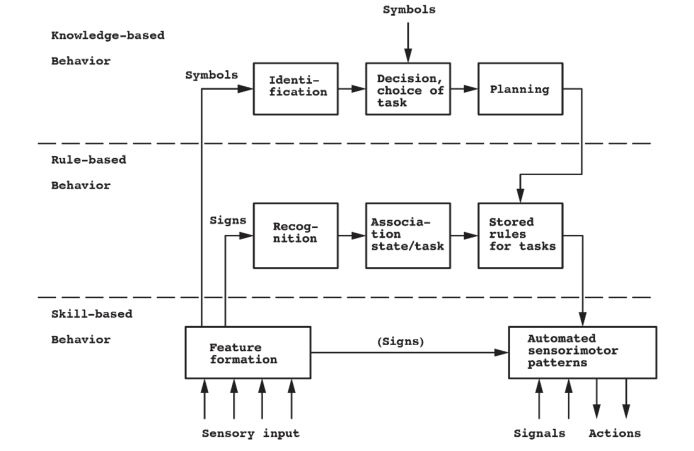
THE SKILLS, RULES, KNOWLEDGE (S.R.K.) FRAMEWORK The second, and pivotal concept of this thought chain is the Skills, Rules, Knowledge (S.R.K.) Framework, created by Human Factors Psychologist Jens Rasmussen (Rasmussen, 1986). S.R.K. is a standalone Information Processing framework widely used within Human Factors Engineering (Wickens, Gordon, and Liu, 1997) consisting of three elements: Skills, Rules, and Knowledge, all three interact in the following model:
Figure 1: The S.R.K. framework (Rasmussen, 1984, p.101).
The model’s Skills, Rules, and Knowledge represent different levels of cognition at which humans process information. A user will always utilize the lowest, or most direct level of behavior required to address the situation at hand. Higher levels of cognition require more time and mental resources to activate and use.
Skill-based Behavior, the model’s core form of behavior, involves well- learned actions that do not require conscious thought and are activated automatically. Walking, climbing stairs, or typing a password, having done so numerous times before, are examples of Skill-based behavior. The key here is that they take little or no conscious thought to activate and run.
Rule-based behavior is more colloquially called ‘rules of thumb’. These behaviors are activated when the user encounters something unexpected, but not unprecedented. Consider, for example, a user who finds their computer is not working properly and might decide to reboot it to fix the problem. The user might have no specific system knowledge to indicate that rebooting is the correct course of action; they merely know that it is a pattern of behavior that tends to solve problems like this. This level of processing requires a little conscious thought.
In Knowledge-based processing (alternatively called Model-based processing), the user does not understand what is going on and must think, using a large amount of cognitive resources, relying on their Mental Model to interact with the product, running simulations and predictions in their mind about what things might happen within the machine if the user takes certain actions. In the field of information processing, a Mental Model represents a user’s understanding of a product or system. A Mental Model may not accurately describe every working component of the product or system, but it provides enough understanding for the user to predict outcomes and respond to feedback appropriately.
224 Kromann and Arnold Mental Models should be thought of as the foundations from which Rules and Skills flow. Again, consider the concept of ‘automobile’. A person who understands what an ‘automobile’ is and its use need not concern themselves with identifying ‘what is that thing with four wheels?’ Rather, since the user immediately recognizes it as an ‘automobile’, they understand a litany of adjacent ideas related to the object that are implied in the idea of ‘automobile’. This is provided by the Mental Model-level ideas which include characteristics such as it has four wheels, it is self-propelled by a motor or engine, it carries a small number of passengers, it requires occasional maintenance, and it travels on roads; to Rule-level characteristics like: there is a hood release somewhere under the driver-side dashboard, if the door handle will not activate the door latch one must try unlocking the door again, if the car will not start check the battery; to Skill-level information which may include: turning the steering wheel will translate to a certain rate of directional change, and pressing the brake pedal with a certain amount of force will lead to a proportional reduction in speed. These Models, Rules, and Skills make up a user’s Expectations about a product. Indeed, expectations mirror each component of the S.R.K. Framework; users will test Mental Models, Rules, and Skills against their Expectations through action as they navigate their world. The Expectation of what one thinks will happen reflects our understanding of what has happened before when those behaviors were implemented. If the behavior produces an effect in the world that does not match the expected outcome, the validity of that behavior is called into question and will be reassessed (Kromann, 2025, p. 115). Expectations extend to all remembered parts of the product, from control inputs to component feedback, such as lights or haptics, to forcing functions like lock-outs or lock-ins, as well as more direct predictions, such as the location of a power button. These are examples of Affordances.
AFFORDANCES AND SIGNIFIERS The most concrete way that the Skills, Rules, Knowledge Framework is applicable is for the proper design and positioning of Affordances and Signifiers related to the product’s interface.
Affordances, a term popularized by Don Norman (Norman, 2013), refers to the specific part of an interface that is acted upon to cause some change in the product state, whether it be a knob, switch, touch screen, projection, or visual prompt. Affordances are the elements we expect to be present to facilitate interactions with a product (Norman, 2013, p.10). Having Affordances in a place that do not match Expectations, or having an Affordance that does not match expectations, is a gateway for confusion and human error. Consider a user who comes upon an automobile that appears to have no door handles at hand level; this observation conflicts with the handle-location-rule, stemming from the Mental Model of an ‘automobile’, into question. Perhaps this automobile has no door handles, or is it merely a concept model that has no actual functionality? This breaks the expected ‘Intuitive’ thought chain, leading to confusion.
This is not to say that everything the user interacts with must follow the Rules associated with a specific Mental Model for that Prototypical
A Practical, Operational Definition of ‘Intuitive’ Industrial Design 225 artifact, though it is preferable from a usability perspective. Users can select alternative Rules and, depending on the resolution and completeness of their Mental Model, troubleshoot on their own. If, however, an interaction must be outside the scope of a given Mental Model to provide additional Features or support manufacturability, the Affordance should align with some aspect of the Rule or Expectation that the User is most likely to identify through interaction with the product. If there is any doubt about whether the User will select the proper Rule, a clear and present Signifier must be used. If the Affordance to enable the performance of a certain function is expected to be in one location, but must be in another, it is beneficial to introduce a Signifier not only in the new location of the Affordance, but also in the location where one might expect the Affordance to be found. If not, a user will be forced to seek such controls without cues to guide them.
A Signifier, another concept highlighted by Don Norman (Norman, 2013, p.13), is an attribute that ‘points’ to an Affordance. Signifiers can be anything that guides attention, such as a light, a graphic element, an on-screen highlight, or a text prompt. Often, Affordances and Signifiers are combined; for example, a prominent door handle is an object that serves as both Signifier and Affordance. Other Affordances, such as wireless charging features on mobile devices, often go unnoticed unless Signifiers are introduced to indicate their presence. Signifiers are most useful when Rules or Skills do not correspond to the action the user needs to take. The purpose of a Signifier is, to put it in Rasmussen’s terms, to throw a harmless mismatch signal in front of the user as a notification to break from their current Rule or Skill behavior pattern and to perform a different action than would normally be expected.
Through Signifiers, a user can be empowered to cope with unfamiliarity with Rule- and Skill-based actions without becoming overly confused, provided their actions are grounded in an appropriate Mental Model. This explanation shows the full thought chain: Prototypicality activates Mental Models, which activate Skill and Rule, which activate Expectations and direct the user to search for Affordances and Signifiers in expected locations. Through this process, the intuitiveness of a product interface is far more about predictability, user familiarity, and learned skills than about artistry or aesthetics, and is a task not well-suited to the artistic side of a designer’s mind.
Applying the Framework to Design Now that a framework for ‘intuition’ has been introduced, we may explain how this framework might be used appropriately in industrial design practice. This will be done by highlighting several key considerations related to the concepts presented here and by providing practical guidelines for developing intuition-focused products.
Meshing With the Realities of User-Centered Design The aim of this framework is not only to create a human-centered approach but also to force the designer to recognize that every individual is unique.
226 Kromann and Arnold This highlights the most important consideration for this framework: every person’s Mental Models, Rules, Skills, and, therefore, Expectations are based on their experience and memories and are not ubiquitous. For instance, an automobile mechanic will have a vastly different Mental Model regarding an ‘automobile’ than someone who has never seen under the hood of a car. Likewise, a person who uses a personal computer regularly will have a different understanding of the Rules of operation for a computer than someone who does not.
It is possible to examine existing behavior patterns within user groups to identify similar Mental Models, Rules, and Skills, along with the Expectations associated with each. This can be done by looking at similar and adjacent products that users in that group already use and are familiar with. This is especially true for professions, such as nursing, aviation, and electrical work, because of factors like existing institutional knowledge, standardized education, and standard operating procedures. Those professional users exhibit a high degree of normalization across the Mental Models, Rules, and Skills available to them for processing their interactions with products related to their profession.
Variability should be expected whenever there is a difference in product expectations between groups; it can also occur across age groups, such as when older adults are less tech-savvy than their younger counterparts. It is the designer’s job to consider other products and experiences upon which the user, not just any user, has built their Mental Models, Rules, Skills, and expectations, extracting them from existing products for application in the product being designed.
Another point to note is that the S.R.K. Framework, a widely accepted theory that addresses how humans process and interact cognitively with machines, assumes that users understand the concepts and rules of the systems they interact with. It is theoretically possible for a user to evaluate a non-prototypical object by considering its Affordances and, in turn, infer the overall function from the product’s component parts. Doing this is known as bottom-up information processing, which is more difficult and prone to errors in evaluation. A more appropriate approach would be for the product to activate users’ existing Mental Models, Rules, and Skills to process information from the top down (Rasmussen, 1986).
Another concern here is the design process itself. A designer involved in the development of a product no doubt possesses a well-developed Mental Model of the product due to their familiarity with it, but as acknowledged earlier, that is a personal perspective and should not be applied universally. This often makes it extremely difficult for the designer to isolate their own expectations and biases regarding the product (Nielsen, 1994), creating a conflict that must be addressed.
Guidelines for Design Practice For designers, these cognitive tools can be summarized in a simple guideline for designing intuitive objects and interfaces.
A Practical, Operational Definition of ‘Intuitive’ Industrial Design 227 First, when designing a product, it is important for the designer to familiarize themselves with and document the Mental Model the intended user has of the Prototypical product they are designing before addressing the product’s components. This will allow the Designer to have a reference point for the ‘user’s point of view’ against which to validate interface and formal design decisions.
Second, where possible, products should visually present to the user as Prototypical objects for their product category, so they will be inclined to recognize the correct Mental Model on which to base the proper interaction.
Third, when determining the form, steps in the sequence of use, and locations for Affordances and Signifiers involving Features that fall outside the Prototypical form of the product category, designers should speaking with Users while also evaluating forms and controls associated with products that the intended User routinely interacts with, on which to build interface decisions, not only those everyday products that we might assume ‘everyone knows how to use.’ Doing so will ensure that the designer uses a Prototypical form, pre-learned Rules and Skills, Affordances, and Signifiers expected by the intended user, not by the designer.
Finally, Affordances should be designed and positioned in such a way that they can be found with no other direction than from the expectations derived from learned Rules and Skills flowing from a user’s correctly chosen Mental Model. If they cannot be identified in this manner, a clear and present Signifier(s) should be placed to direct the user to the proper Affordance.
There are considerations beyond these simplified guidelines such considerations toward the understanding of unfamiliar Affordances, the optimization of Signifiers, guiding Mental Model recognition related to novel products, and Rule selection for Features beyond Prototypical product function, but those provided above are those which should be focused on first for any project where a goal for the product in question is that it be ‘simple’ and ‘intuitive’ use (Kromann, 2025, p.105).
CONCLUSION
The goals of ‘simple’ and ‘intuitive use’ will remain a priority for user- centered designers, especially those practicing within the field of industrial design. This article presents an overview of a more accurate, research-based framework and a guideline for designing ‘intuitive use’ within the context of user-centered product design. This framework shows that the current understanding of intuition in industrial design is flawed and offers a starting point for updating the design process to improve design outcomes in an ever- more complex world of interaction.
ACKNOWLEDGMENT
The authors would like to acknowledge Shea Tillman and Tin-Man Lau for their contributions as committee members for the thesis on which this paper was based, and Dr. John Schmidt for his research recommendations.
REFERENCES
Berghman, M. and Hekkert, P. (2017). Towards a unified model of aesthetic pleasure in design. New Ideas in Psychology, 47, pp.136–144. doi:https://doi.org/10.1016/j. newideapsych.2017.03.004. Blackler, A., Popovic, V., and Mahar, D. (2003). The nature of intuitive use of
products: an experimental approach [Article]. Design Studies, 24(6), 491. https:// doi.org/10.1016/S0142-694X(03)00038-3 Krippendorff, K. (2005). The Semantic Turn A New Foundation for Design. Crc Press. Krippendorff, K., & Butter, R. (1984). ‘Product Semantics: Exploring the Symbolic
Qualities of Form.’ Innovation Magazine, Vol 3 (Issue 2). Kromann, S. (2025) An Approach to applying Information Processing, Semiotics, and Product Semantics to the Design of Novel Medical Devices with Complex Physical Interfaces. Master’s Thesis. Auburn University. Available at: https://etd. auburn.edu/handle/10415/10093 Nielsen, J. (1994). Usability Engineering. Amsterdam: Morgan Kaufmann. Norman, D.A. (2013). The design of everyday things. New York, New York: Basic
Books. Rasmussen, J. (1986). Information Processing and Human-machine Interaction an Approach to Cognitive Engineering. North Holland. Wickens, C. D., Gordon, S. E., and Liu, Y. (1997). An Introduction to Human Factors
Engineering (P. McGeehon, Ed.). Addison-Wesley Educational Publishers Inc.
LISTED IN THE AHFE DIGITAL BOOKSTORE CATALOGUE
Explore the complete digital volume
Interdisciplinary Practice in Industrial Design
Read this individual research paper free through the original publisher, or explore the full digital proceedings book.
ISBN 978-1-964867-98-4
Explore this ISBN in the AHFE Bookstore ↗Listed in the July 2026 bookstore catalogue; search by ISBN to confirm current availability · Digital book purchase optional