Xavier Rétauxa, Gaetan Bourmaud (2022). The Contribution of Ergonomics to Accessibility. In: Advances in Ergonomics In Design, Usability & Special Populations: Part III. AHFE Open Access, vol. 20. https://doi.org/10.54941/ahfe1001325
Physical accessibility can be defined as what is possible in terms of movements in the environment, and of knowledge (spatial orientation and communication) and the use of equipment. An examination of the different professional practices currently used in relation to accessibility shows that several approaches seem to co-exist. Some of these are highly fallible and even constitute obstacles that need to be overcome. Therefore, this paper proposes a constructive approach to accessibility, which considers space as a resource for the subject who uses it, before making several proposals, which are simultaneously theoretical and methodological..
At the 18th World Congress on Ergonomics IEA in Recife (Brazil) in February 2012 , accessibility has emerged as a very present theme , representing nearly 30 papers , 1 symposium and 1 working group. Although , as pointed Retaux & Bourmaud (2012) , these communications showed a variety in the treatment of the subject, both in terms of objectives ( accessibility of objects or products, such as accessibility of places or spaces) and evaluation methods ( normative evaluations , experimental observations or on the basis of scenarios , implication or not people with and without disabilities , etc. . ) It is important to note the attachment of ergonomics today is the issue of accessibility.
In France the report of the General Council for Sustainable Development and Environment, the General Inspectorate of Social Affairs and General Economic and Financial Control (Bellurot et al. , 2011) describes a " lack of competence of the experts ," whom he is blamed " an insufficient mastery of this specific subject" and a tendency to make "too exclusively control the application of rules." The normative approach appears poor. The same report invites to avoid derogatory approach to accessibility regulations for the benefit of research of alternatives..
Some French ergonomists have on several occasions stressed the importance to seize this important societal issue (Asty & Maillot, 2011; Bourmaud & Retaux, 2011; Folcher & Lompré, 2012).
So, we think ergonomics can make a valuable contribution, in particular by means of the method of clinical analysis of the activity (interviews, observations, simulations etc.). Also, this paper proposes a constructive approach of ergonomics to physical accessibility to open the way for new practices and new methods for design.
ACCESSIBILITY AND ITS APPROACHES Accessibility is a right emanating from the principle of non-discrimination. We need here to examine French legislation, as this sets out the framework for making physical spaces accessible.
Presentation of the concept of accessibility French legislation therefore defines accessibility to the built environment, the road network and transport: “The accessibility of the built environment, the natural environment, the road network and public or private transport, ensures they can be used independently by any person who, at one time or another, is subject to constraints due to a permanent incapacity (sensory, physical or cognitive disability, old age etc.) or a temporary incapacity (pregnancy, accident, etc.) or is subject to external circumstances (young children, pushchairs, etc.)”. The legal definition of accessibility is therefore a very broad one which recognizes many types of disability: physical, visual, hearing, mental, cognitive, psychological and dwarfism. It even applies to situations where people encounter constraints not linked to ill health. It also defines the principle of an accessible mobility chain: “The mobility chain, which includes the built environment, road transport, the layout of public spaces, transport systems and intermodal networks, is organized in order to ensure total accessibility for all persons with disabilities or reduced mobility”. Finally, it sets out the principle of accessibility to facilities and services in addition to accessibility to physical spaces.
Expert approaches to the concept of accessibility The different professional practices concerning accessibility seem to adopt the same methodological stance based on the “expert approach”, i.e. “analysis first”. The expert carries out a (usually non-comprehensive) diagnosis, based on the regulations in place. This is composed of specialist texts, detailing various principles and/or metric values.
We believe that two types of expert approach are used, sometimes concurrently. A good grasp of regulation is the shared basis on which both are built:
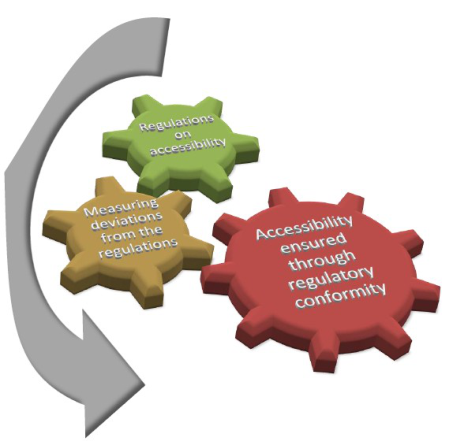
The first approach, which we have named the prescriptive or “measurement” approach, consists in measuring deviations from the regulations, highlighting them and suggesting that corrective action is taken.
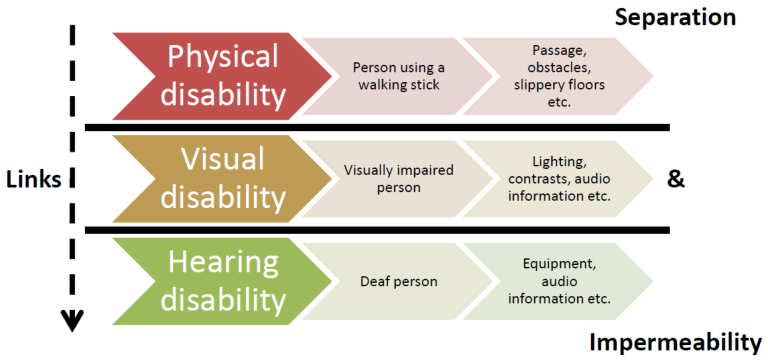
The second, “the impairment approach”, consists in identifying and compensating for the multiple constraints imposed by the environment, in relation to the specific needs of the individual according to their disability.
A third approach then emerges, that brings together the first two.
These different approaches seem to be highly fallible and open to criticism.
The first criticism put forth applies to all these approaches and deals with the motivation for requesting an accessibility diagnosis. These requests often relate to a desire to ensure conformity with legislation, rather than to provide genuine accessibility.
Other specific criticisms can be leveled at each approach:
Under the prescriptive or (“measurement”) approach, accessibility is considered as the result of a logical and unquestioned process as represented in Figure 1. It is therefore necessary for regulations to be sufficiently detailed and comprehensive to ensure that all deviations are identified. However, reading the reports produced using this type of approach reveals serious shortcomings.
Figure 1: Accessibility guaranteed by conformity
The second “impairment approach” is implemented through a series of successive analyses focusing on the various types of disabilities and the gap between people's needs and environmental constraints. It would seem that in numerous cases, the difficulties encountered by people with specific types of disability are compensated with solutions that currently pose serious problems for people with other types of disability. It would seem that accessibility cannot be ensured unless a systemic approach is adopted (see Figure 2).
Figure 2: Accessibility guaranteed by successive compensations
Our third criticism also pertains to all the different approaches and strikes at the heart of the expert analysis method. The total absence of the actual activity of the persons in question –the stakeholders using the spaces – affects the quality of the results obtained.
Finally, one last criticism – and, we feel, the most important one – is this: we believe that the model of Man used in these various approaches is insufficient and unsatisfactory, as it points both to a subject that is completely passive with respect to his environment – that is, with respect to the obstacles he encounters in a concrete sense – and to a deficient subject, characterized only by his deficiency, not accounting for his history and experience with this deficiency.
This is why we feel these different approaches are fallible and need to be replaced. It is to this purpose that we feel ergonomics, which are notable by their absence in France on the issue of accessibility, can make a valuable contribution, in particular by means of the method of clinical analysis of the activity (interviews, observations, simulations etc.).
“Space as a resource”: a constructive approach to accessibility We have been approached on several occasions by different companies to carry out accessibility interventions. These requests are made for two reasons:
Either to further the transformation of a workstation, notably to improve the accessibility of a given space,
Or to carry out an accessibility diagnosis for a whole (or several) building(s).
This understanding of the real work activity, the result of the clinical analysis of the activity made possible by the psycho-ergonomic approach, allowed us to question the bijective relationship between the person and the environment. We therefore have several proposals that are simultaneously theoretical, methodological and practical. This section is devoted to the specific approach which we support, in which the space is considered to be a resource for the subject who uses it, not just a set of constraints to be overcome and impairments which need to be compensated for (Bourmaud & Rétaux 2012). Notably, this approach aims to go beyond the models of man that underpin the approaches behind the different professional practices employed in the field of accessibility. We use three types of theories in conjunction which, in our opinion, all consider the environment as a resource for people’s activity: activity theories, and Rabardel’s concept of the capable subject and Falzon’s concept of the enabling environment.
Activity theories make it possible to consider accessibility in a wider sense. Accessibility can only be understood by looking at the purpose of the activity in which the subject is engaged. “Benefitting from personal resources, Man is able to construct a relationship with the world, and, in this process, to undergo development”. The stake of this process is to solve the “contradiction between ambitions and personal abilities on the one hand, and the requirements and conditions of activity on the other” (Nosulenko and Rabardel 2007, our translations). People do not move through an environment for no particular reason or with no purpose in mind. Indeed, the activity always focuses on a purpose: It is not only directed towards a given aspect of reality but is also stimulated by this and subject to its properties.
The capable subject (Rabardel) The active person is “a subject who acts, transforms the real and transforms themselves, and who will use all their resources to better ground and adjust their activity" (Rabardel and Pastré 2005). This capable subject “organizes their resources into general systems, linked to their fields of activity, their worlds and their overall development”.
The enabling environment concept (Falzon) Falzon (Falzon 2005; 2006; Falzon and Mollo 2009) has proposed the creation of an enabling environment as a tangible objective for constructive ergonomics, this environment is defined from these three perspectives:
From a preventative perspective: an enabling environment is one with no harmful impact on the individual and which maintains their future capacity to take action. This does not only concern the detection and prevention of risks, but also the preservation of the person’s physical and cognitive capacities.
From a universal perspective: an enabling environment is one which takes into account inter-individual differences (in terms of anthropometric characteristics, but also age, gender and culture) and which compensates for individual impairments (relating to ageing, illness and incapacity).
From a developmental perspective: an enabling environment is one that allows people to develop their capacities. An enabling environment contributes to the cognitive development of people, teams and organizations.
Therefore, in contrast with an assistive environment in which the objective is to overcome a set of constraints and compensate for impairments, this concept is based on an appreciation of the environment as a resource for human activity.
METHODOLOGY AND FIRST RESULTS Methodological contribution
Our methodology is an adaptation of the Barcellini, Van Bellgehem & Daniellou's work There's three steps :
1. Analyze: the goal of this step is to know the real activity of the operators. It is based on interviews and observations. We need to describe the activity of the operators and all its variations. This will be a guide to propose adapted solutions not only to the situation of operators with disabilities but also to their work.
2. Simulation: the goal of this step is to multiply the observations et to permit a generalization of our results (Leplat, 2008)..The “accompanied walks” methodology (Dischinger 2000) is particularly adapted to this goal. It was applied to the research of accessibility in historical sites in Brazil (Andrade & Bins Ely, 2012).
3. Formalization: As part of a previous research project, we developed an analysis methodology that, in our opinion, constitutes a powerful tool for the systematic and comprehensive exploration of the characteristics of resources systems (Bourmaud 2006; Rabardel and Bourmaud 2003). It is the purpose of the next chapter.
Formalization This methodology has notably made it possible to draw out the relationships between the different resources used by
the subject, both those used when carrying out their activity and those used as back up when the resources initially called on are found to be deficient: the concepts of repetition and complementarity make it possible to highlight the flexibility and robustness of the resources system. The subject organizes the situations that he must deal with professionally into classes of situations. These classes bring together situations with characteristics that are similar enough (e.g. the tasks to be performed and situations to be taken into consideration) to give rise to activity modalities that are both relatively stable for the same class of situations and differentiated from one class to another. Classes of situations are sufficiently explicit to be named as such by the operators themselves. Here, we need to add a level of intermediary organization between classes of situations and domains of activity: families of activities.
Based on observations of people’s activity and the discourse of their own activity, like the “accompanied walks” methods (Dischinger 2000; Andrade 2012 ), we have modified this methodology, in particular the analysis grid, in order to produce a tool for analyzing accessibility. This grid is presented below along with some examples of the data produced (see table 1).
Table 1: Example of a grid for analyzing the environment as a resource for the active subject (subject with hemiplegia. Does not require a technical aid, but moves with difficulty)
Table available in the original PDF paper.
Following our early applications of this methodology for analysing the activity of Man as a subject mobilizing a system of resources, we feel that the data it has produced has been particularly rich. Indeed, each of the expert approaches presented at the beginning of the paper would have concluded that the situation was satisfactory, considering that a person in the same state as our subject would have benefitted from the presence of the elevator to compensate for the inability to use the stairs. Our work suggests that the conditions that are internal, as well as external to the subject are involved in his relationship with the environment.
CONCLUSION
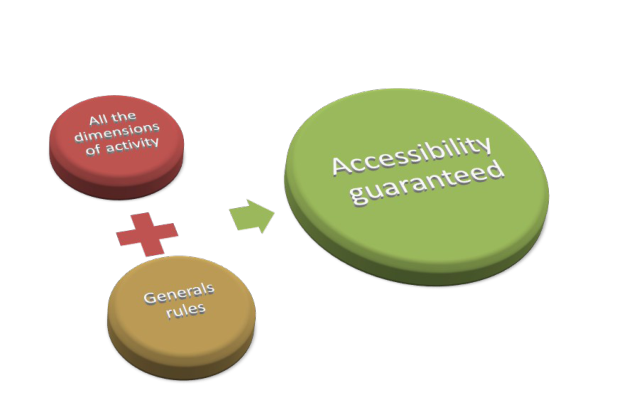
In conclusion, our aim is not to disregard the general rules on accessibility, but to associate them with a systemic analysis, and from a constructive perspective, with the different aspects of the persons’ activity (purpose of the activity, constraints encountered, resources used and their impact on persons) in their environment (Cf. Figure 3).
Figure 3: Accessibility guaranteed by combination of all the dimensions of activity and generals rules Regulation therefore constitutes both a framework and a driving force for taking action. It is certainly not the sole
objective by any means, as it is often insufficient given the complexity of the activity.
REFERENCES
Andrade, I., & Bins ELY, V. (2012). “Assessment method of accessibility conditions: how to make public buildings accessible?”
Journal Work: A Journal of Prevention, and Rehabilitation. Issue Volume 41, Supplement 1/ 2012. Asty, J. & Maillot, S. (2011). “Maintien dans l’emploi et accessibilité, des démarches complémentaires". 48ème Congrès de la SELF, Paris. Barcellini, F., Van Bellgehem, L. & Daniellou, D. (à paraître). “La conception comme occasion de développement des activités”. Bellurot, N., Debiesse, G., Raymond, M., Chain, P. & Renaudin, N. (2011). “Sur les modalités d’applications des règles
d’accessibilité du cadre bâti pour les personnes handicapées". Rapport du Conseil Général du Développement Durable et de l’Environnement, de l’Inspection Générale des Affaires Sociales et du Contrôle Général Economique et Financier. Bourmaud, G. & Rétaux, X. (2011). “Approche critique de l’accessibilité : propositions théoriques, méthodologiques et pratiques". Conférence au séminaire d'ergonomie du handicap, Université d’Orléans. Bourmaud, G. & Rétaux, X. (2012). “A critical approach to accessibility with theoretical, methodological, and practical
proposals”. Congress of Nordics Ergonomics Society (NES 2012). Stockholm, Suède. Bourmaud G., Rétaux X. (2012). “Review of practices for keeping people with disabilities in employment: moving beyond the concept of compensation to implement a developmental approach”. Work: A Journal of Prevention, Assessment and Rehabilitation. Issue Volume 41, Supplement 1/ 2012. Bourmaud, G., Rétaux, X. & Roux, C. (2012). “L'accessibilité au service de l'amélioration des conditions de travail". Les
Rencontres de l'accessibilité. Accès à l’emploi. Maisons de Victor Hugo. 12 novembre 2012, Paris. Costa, A. L., Coura, P. V., Gomes, M. M. A., Peregrino, Y. R., Sarmento, B. R. & Sousa, R. A. (2012). “Ergonomics issues in conceiving an accessible project”. Journal Work: A Journal of Prevention, and Rehabilitation. Issue Volume 41, Supplement 1/ 2012. Dischinger, M. (2000). “Designing for all senses: accessible spaces for visually impaired citizens”. Göteborg. Department of
Space and Process, School of Architecture, Chalmers University of Technology. Falzon P. (2005). “Ergonomics, knowledge development and the design of enabling environments”. Proceedings of the Humanizing Work and Work Environment HWWE’2005 Conference, December 10-12, Guwahati, India, 1-8. Falzon P. (2006). “Enabling environments and reflective practices”. ABERGO’2006, 14th ABERGO Congress, Curitiba, Brésil,
29 octobre-2 novembre, 2006. Falzon P., MOLLO V. (2009). “Para uma ergonomia construtiva: as condições para um trabalho capacitante". Laboreal 1 (2009), 61-69. Folcher, V. & Lompre, N. (2012). “Accessibilité pour et dans l’usage : concevoir des situations d’activités adaptées à tous et à
chacun". Le Travail Humain, 2012/1 Vol. 75, P. 89-120. Leplat, J. (2008) . “Repères pour l’analyse de l’acitvité en ergonomie”. Paris : PUF. Maillot, S. & Asty, J. (2012). “Les tests utilisateurs : un exemple pour intégrer l'usage dans une démarche d'accessibilité ».
Journée thématique du G.E.D.E.R. Lorsque l’ergonomie interroge l’accessibilité… 8 juin 2012, Paris. Nosulenko V., Rabardel P. (2007). “Rubinstein aujourd'hui. Nouvelles figures de l’activité humaine”. Octarès. Rabardel P., Bourmaud G. (2003). “From computer to instrument system: a developmental perspective”. Interacting with Computers, 15(5), 665-691. Rabardel P., Pastre P. (2005). “Modèles du sujet pour la conception. Dialectiques activités développement”, Toulouse, Octarès. Rétaux, X. & Bourmaud, G. (2012). “Comment l’ergonomie approche l’accessibilité aujourd’hui dans le monde”. Journée
thématique du G.E.D.E.R. Lorsque l’ergonomie interroge l’accessibilité… 8 juin 2012, Paris.
LISTED IN THE AHFE DIGITAL BOOKSTORE CATALOGUE
Explore the complete digital volume
Advances in Ergonomics In Design, Usability & Special Populations: Part III
Read this individual research paper free through the original publisher, or explore the full digital proceedings book.
ISBN 978-1-4951-2108-1
Explore this ISBN in the AHFE Bookstore ↗Listed in the July 2026 bookstore catalogue; search by ISBN to confirm current availability · Digital book purchase optional