Angélica Aciolya, Marcelo Soaresb, Phillipe Burgosc (2022). Usability Evaluation of Products - A Survey on Methods and Techniques Used In Analysis of Consumer Packaging. In: Advances in Ergonomics In Design, Usability & Special Populations: Part III. AHFE Open Access, vol. 20. https://doi.org/10.54941/ahfe1001313
Usability studies are concerned with identifying the level of interaction between the product or system and its user,in order to achieve their efficiency, effectiveness and satisfaction in a specified context of use, as defined by ISO9241-11 (1998). When referring to packaging we find that are common occurrences of various problems regarding use. The packaging is a product of regular or daily use, which, in most cases, a single model can be targeted to various kinds of procedures: age, sex, level of experience and different needs. As regards the analysis of the usability of packaging, there are a number of issues that require constant research, namely: “What methods are used and how the tests are conducted?”, “Which are the effectiveness/efficiency of existing methods, their limitations and difficulties of application?”, “Which technology trends for this type of analysis?”, among others. Therefore, the aim of this article is to present a survey on methods, techniques and tools (whether physical or virtual) used in academic research to evaluate the usability of packaging. Therefore, the survey was conducted in journals and scientific events related to ergonomics, design and usability. For the survey, were primarily selected articles published between 2009 and 2013.
The packages are increasingly representing a differential in today's society on production and marketing of products. Its importance goes beyond aesthetics, functionality, safety and security, involving intangible issues to the user very often - the allure, charm, identification with the product and the brand. Besides the classic functions of packaging, Poças & Moreira (2003) added as one of the functions of packaging - the service - that is, in general terms, from the perspective to the end of use and consumption of the product, in other words, the package must also contributes to product safety should be considered not to be a hazard to the consumer. However, this premise Ergonomics In Design, Usability & Special Populations III has not always been respected in the design of consumer packaging. There are several problems caused during the use of a packaging for different types of users, such as cuts, punctures, lack of information on the use or how to dispose of the packaging, explosion , improper opening or without lock at dangerous product. (PRO TEST; AMB, 2005) Such difficulties and
Ergonomics In Design, Usability & Special Populations III consequences can be revealed in public as children, the elderly, people with reduced mobility in th e upper and left- handed members. Some systems, for example, are created to ensure the safety of children, but can also encumber the access by adults, especially the elderly. According to Zunkic (2011), a failure in the design of a package may have fatal consequences for consumers, as drug packaging case.
To subsidize usage analysis of a particular product, in this case packaging, and understand the reason of the problems about its use, it is important to understand the principles of usability as a point of paramount importance for the design of products. Is meant by usability in products such as "the practice of engineering of products, where users can perform the required use, operation, service and support tasks with minimal stress and maximal efficiency". (Woodson apud Ferres, p.16, 2007) According to Falcao & Soares (2013, p.2),
usability starts with a philosophy, a belief in designing to meet user needs, by focusing on creating an excellent experience for it. A usability process begins by looking at who uses the product, understanding their needs and objectives, selecting the right techniques to answer t he following question: This product meets the requirements of use by users?
Many of the problems of current packaging comes from inadequacies of usability and, in general terms, it is perceived that usability issues in packages are not simple to be evaluated and materialized mainly by the heterogeneity of its customers, a wide range of shapes, templates and volume of materials and products designed. Brazil is the second country that more launches new packaging per year, just behind the United States, thus being the second most innovative country in packaging. (REMADE, 2009) In the realization of analyzes of products, in general, and this would not be different in relation to aspects of usability, it is necessary to adopted adequate methods and tools to the user, the product category to be analyzed and its context. According to Merino et al (2012) many methodologies have been developed within the design with a view to implementation of usability requirements in projects.
Freire & Soares (2006) assert that the definitions of usability suggest the researcher to reflect on ways of evaluation of usability. Since, in general, some of the methods and heuristic evaluation have an indication for use somewhat " generalist". The challenge therefore is to understand the best method/dimensions/metrics/heuristics must be adopted in analyzes of such products - the packaging.
Therefore, this paper presents a survey on methods, techniques and tools (physical or virtual) used in academic research to evaluate the usability of packaging. It is hoped that the results of this research can contribute to the expansion of theoretical and practical knowledge about the usability of packaging, contributing to a better performance, safety and comfort of the user of these products.
THEORIC REFERENCIAL Product Usability
According to Falcão & Soares (2012) the concept of usability with a focus on product design was first envisaged in the early 1990s by companies such as Thomson Consumer Electronics, Apple Computer and Northern Telecom. Patrick Jordan (1998) puts the focus on issues related to usability and advancement of publications and conference area from that period. He mentions the importance of this, the growing number of professionals (specialists in human factors, interaction designers, product designers and programmers and software) concerned with the production of easy to use products, seeking to put the user at the center of the process project.
A classical concept of usability is proposed by ISO (International Organization for Standardization) 9241-11 (1998) conceptualizes usability as "the extent to which a product can be used by specified users to achieve specified goals with effectiveness, efficiency and satisfaction in a specific context of use". The ISO (NBR 9241-11 , 2002 , p.3) details the terms used in its classical definition of usability, as follows: Effectiveness: Accuracy and completeness with which users achieve specific goals. Efficiency: Resources expended in relation to the accuracy and completeness with which users achieve goals.
Ergonomics In Design, Usability & Special Populations III
Satisfaction: Absence of discomfort and the presence of positive attitudes towards the use of a product. Context of use: Users, tasks, equipment (hardware, software and materials), and the physical and social environment in which a product is used. Work system: system consisting of users, equipment, tasks and the physical and social environment, in order to achieve specific goals. (Note: the use context consists of those components of the work system that are established when the specification or Measuring usability). User: A person who interacts with the product. Objective: Desired outcome. Task: Set of actions (the physical cognitive) necessary to achieve a goal. Product: Part of the equipment (hardware, software and materials) for which usability is specified or evaluated. Measure (noun): the resulting measurement value and the process used to obtain that value.
Moraes apud Tanure and Okimoto (2008) introduced the term as related to usability and its scope: ease of learning, effectiveness, attitude, flexibility, perceived usefulness of the product; suitability to task, task characteristics and characteristics of users.
Regarding to the process of product developing Catecati el al (2011, p.565) provides a definition of product usability Usability Professionals Association (UPA) - "an approach to product development that incorporates direct way, user feedback throughout its development cycle in order to reduce costs and create products and tools that meet the needs of users".
Regarding the analysis of products and softwares Jordan e Han et al (apud Falcao & Soares, 2013) argue it is necessary to consider a less performance-oriented approach when considering the usability of consumer products as a consequence of their voluntary use. Therefore, a consumable product is not a tool in which develops only a task, but is also a three-dimensional artifact, used for decoration in an environment which can represent a lifestyle of the user. This means that physical interfaces need to be included in a review, and that they should not only be efficient and easy to use, but at the same time need to look good.
To measure the result of usage, the NBR 9241-11 (2002) based on ISO ISO 9241-11 (1998) presents an example of some shapes to get measures of usability:
- Measures of overall usability: Effectiveness (Percentage of goals achieved; Percentage of users completing the task successfully; Average accuracy of completed tasks), efficiency (time to complete a task; tasks completed per unit time, monetary cost of carrying out the task) and satisfaction (satisfaction scale, frequency of use, frequency of complaints) can be specified for global objectives (eg produce a letter) or smaller goals (eg perform search and replace). When selecting usability measures for the most important user goals may be ignoring many functions, but probably this is the most practical approach. - Measures to desirable product properties: additional measures to particular desired product properties that contribute to usability can be: As an example for Effectiveness (number of important tasks performed, percentage of words read correctly in a normal viewing distance, number of learned functions, among others), Efficiency (time to learn to criterion, time spent correcting errors, time to correctly read a specific number of characters, among others) and satisfaction (frequency reuse; Scale for error handling, Scale for visual discomfort, among others).
Regarding more geared dimensions for evaluation of products some authors add more dimensions to those described previously. However, in general terms, there is a consensus among authors about the objectives attributes: efficiency, effectiveness, and subjective: satisfaction.
Rebelo et al (2011) present some objective attributes to evaluate the usability of consumer products: learnability, efficiency, flexibility, comprehensibility, storage, and reliability, and subjective attributes refer, for example, th e attractiveness of the product, which affects the positive attitude toward the product.
Kim & Han (apud Falcão & Soares, 2013) have eighteen dimensions of usability for consumer electronic products: simplicity, consistency, modeling, locus of control, direction, feedback, helpfulness, forgiveness, error prevention, adaptability, accessibility, learning ability, memory, familiarity, predictability, informative, effectiveness and Ergonomics In Design, Usability & Special Populations III efficiency.
Jordan (1998) states that the user experience is individual, i.e., a person can have a positive user experience while another does not. And so it points to some user characteristics that must be considered in relation to the usability of a given product, the prior user experience with the product and the knowledge that it has on the independent task of used product, cultural background, limitations, age and gender.
On the usability evaluation, Macedo et al (2012) states that this can occur in several ways, which may result in a huge range of results. In general terms, for the analysis of usability some elements are important - know your product user, both physical and behavioral/cultural aspect, looking also know their previous experience of using the product, the product features (components, tasks, scaling, among others) and the context in which it is used (physical factors/environmental/psychological, etc.), and the definition of what kind of methods, tools and evaluation that will be adopted in the analysis environment.
To Catecati et al (2011) another aspect to be considered in choosing the method of assessing the usability of a product is the stage of development that it is. For example, in the conceptual stage based expert user and methods may be used, different informational which is mainly based on experts. Karat (apud Catecati el al, 2011) presents another issue that can influence the process of choosing a method - also consider the time required to conduct the evaluation, the cost of achievement, confidence in obtaining data, among other topics.
Roepke et al (2012) reported that, the selection of assessment methods also depends on the context in which the product is being used. With respect to the type of product to be evaluated, those whose practical function (or technique) predominates. The authors suggest methods that provide more quantitative results, such as tests and experiments with the user with products such as a drill or cash machine, for example, and more subjective methods: interviews, focus groups, among others, for products that lead to a greater experience of use - cell phones or even cars, for example.
According to Catecati et al (2011) review methods usability of products can be divided into two classes: Methods based on observations and measurements about users, where typical users (actual or potential ) methods perform everyday tasks with the software product or system (or its prototype) and the evaluators use the test results to analyze how the interface supports these users in performing their tasks; Methods based on the knowledge of experts - where experts analyze the usability aspects of user - product or system interface. There are two main methods of evaluation of usability that are based on experts: Footsteps Cognitive (Cognitive Walkthrough) and Heuristic Evaluation (Heuristic Evaluation).
Usability tests can be applied at various stages of product development, including aftermarket launch. To Cybis et al (2010) usability testing has focused evaluation the quality of interactions that take place between users and the system. And as objective to notice the problems, measure its negative impact on the interactions and identify their causes. The tests may involve real users or representative of the target population of the system.
Falcão & Soares (2012) present a classification of the types of usability testing in accordance with the development phase of the product: 1. Formative tests - while the product is under development, aiming to diagnose and fix problems, usually based on small studies, repeated during development, 2. summative tests - after the product is finished, in order to establish a baseline metric or validation that the product meets the requirements, generally requires a larger number of statistical validity.
Packaging The packaging is a product that involves the life of people of different ages, genders, social classes and in many situations, very early, through a variety of types, shapes and functions. Brazilian packaging industries produce over seven thousand different items (Negrao & Camargo, 2008).
About its functions, in general terms, Etzel et al (2001) present purposes as a container: protect the product on its way to the consumer; provide protection after the product has been purchased; help to gain acceptance of the product by intermediaries and persuade the consumer to buy the product. As regards the protection directed to Ergonomics In Design, Usability & Special Populations III the product, sometimes it is not applied to its user. The packaging itself can promote inappropriate use, or mislead when manipulated, or even with proper use, cause discomfort and/or even accidents.
To Roncarelli and Ellicott (2010 , p.12) "ideally, a model of packaging contributes to a positive interaction between a product and the consumer". However, it is noticed that the application of this assumption is not always considered in the design of various products, including packaging design. Or, the performance goals established for the product and for the user, not cater to the target audience as a whole, being privileged just part of it. Ie, are several interface problems, which can present a package. Usability issues related to the cognitive and physical aspects - understanding of textual and pictorial information labels , difficulties in understanding and manipulation of opening and closing, handling difficulties related to inadequate way, dimensional, surface and material of packaging systems, among others.
Regarding the use of packages for different audiences, mostly elderly and children, some difficulties are commonly experienced as open or close, hold, understand the information on the label, among others. Some packaging clearly present difficulties to be manipulated. Usability problems related to opening/closing a packaging system can be an example (Figure 1). Other packaging components also are difficult to use for all its users, such as handles and seals that burst in his hand, or the need for assistance from some sharp instrument. According to the IDEC (2011, p.23) "the packages are responsible for 7.5% of consumer accidents recorded by INMETRO" (Institute of Metrology, Standardization and Industrial Quality - Brazil).
Figure 1 - Opening devices of some packaging
Zunkic (2011) presents as a cause of recurrence of the problems faced in ergonomic incompatibility of packaging, the fact that manufacturers are often not aware of the dimensions of the problems consumers have when interacting with the packaging. However, even when they are aware of the problem, often do not know how to solve them.
METHODOLOGY
The survey presented here was conducted to identify papers that address directly the usability applied to packaging in one or more aspects related to it. The research was structured as follows:
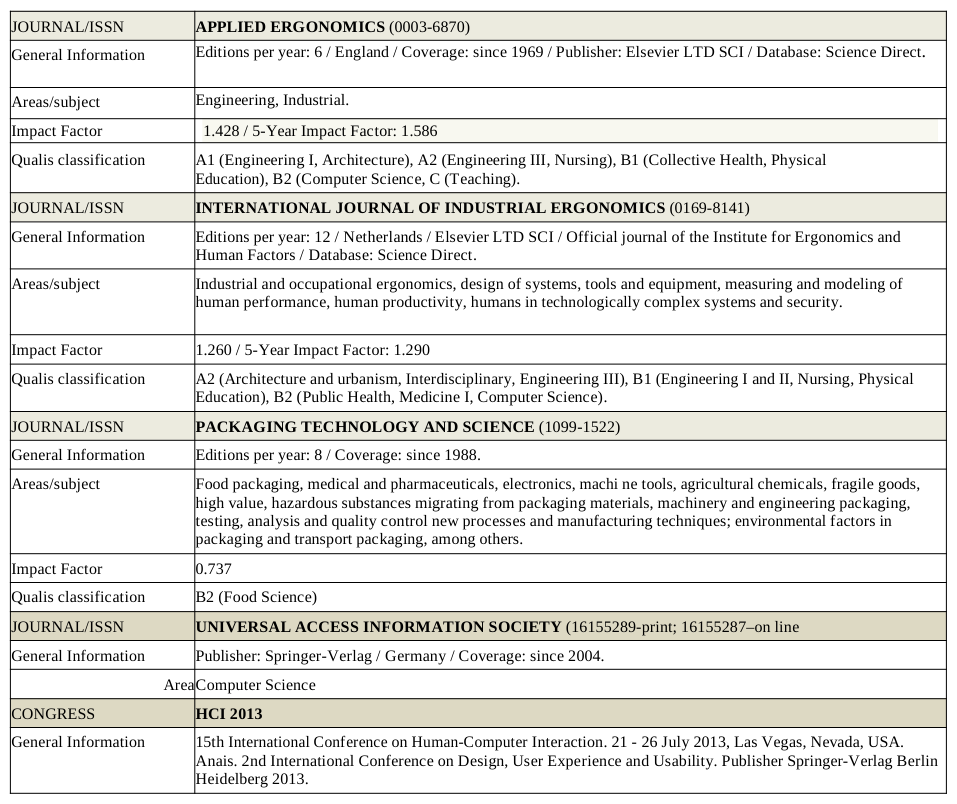
Articles of specialized journals about several issues related to ergonomics, design, usability and related areas. Data on periodicals, such as the impact factor, qualis, editor, and others were presented. According to Thompson (2005) the impact factor (Factor Impact) identifies the frequency with which the average article in a journal is cited in a particular year. Some information from each paper was presented: title, author(s), journal, goal(s), analysis methods and techniques adopted;
For the realization of this survey were used as means of search: the journal portal of CAPES (Coordination of Improvement of Higher Education Personnel, Brazil), websites of journals, proceedings of scientific conference HCI and printed editions of the Journal Ergonomics. Primarily with articles published between the years 2009 to 2013 were selected. Were used as keywords to identify the papers: analysis/evaluation/testing usability/in packs.
The following journals were searched: Applied Ergonomics (ISSN: 0003-6870); Ergonomics [(0014-0139 (printed), 1366-5847 (online)]; International Journal of Industrial Ergonomics (0169-8141); Human Factors (0018- Ergonomics In Design, Usability & Special Populations III
7208); Human Factors and Ergonomics in Manufacturing & Service Industries [1090-8471/ 1520-6564 (on line)]; Design Studies (0142-694x); Computer-aided design (0010-4485); Computers & Graphics (0097-8493); Engineering Design (0954-4828-printed; 1466-1837-on line); Packaging Technology and Science (1099-1522); Universal Access Information Society (16155289-printed; 16155287–on line). The congress HCI 2013 was added by owning a publication directly connected with the subject in question.
Table 1 presents the general information of journals of which were selected some of the article(s) described in this paper.
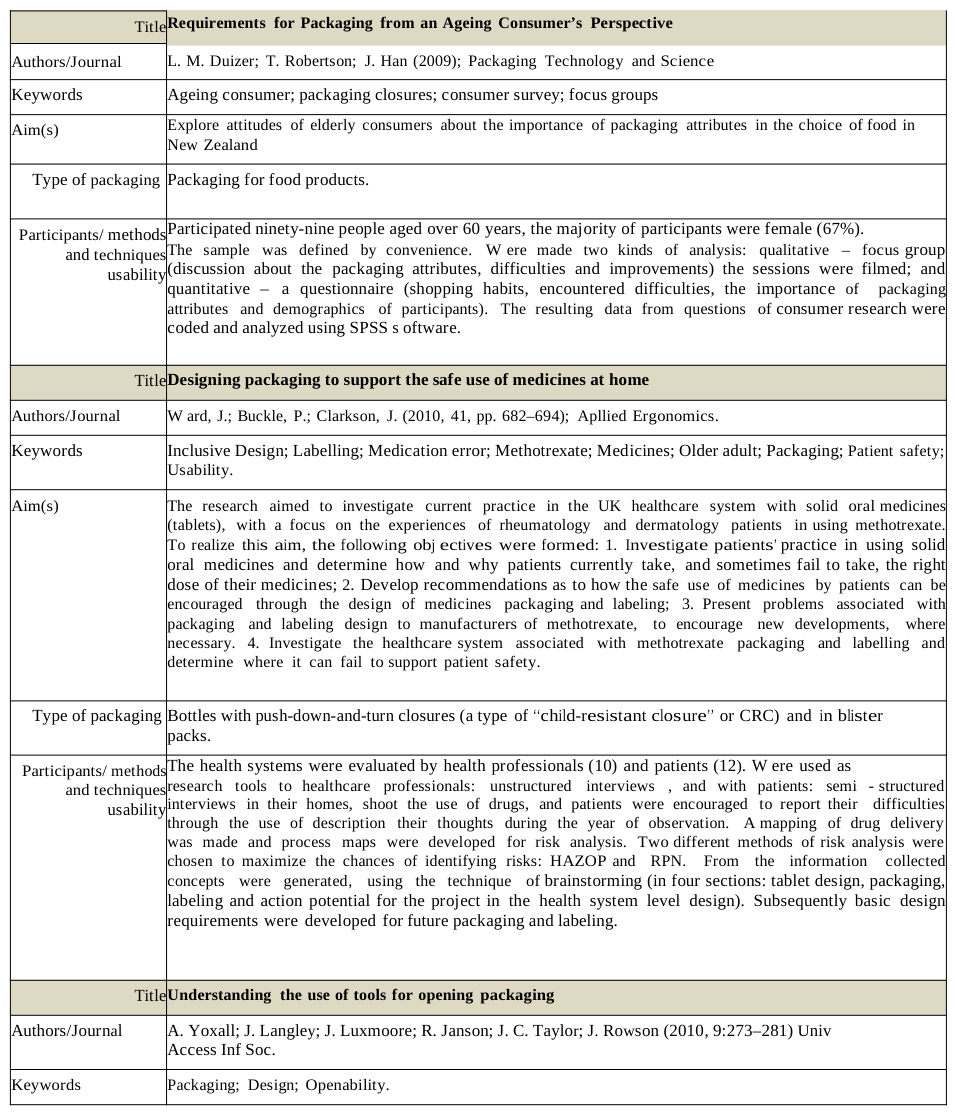
SURVEY From the survey were selected according to criteria established nine articles of journals and an article of Congress. In general, items that had some kind of test users, whether quantitative and/or qualitative nature, were selected. Table 2 describes the articles presenting the following information: title, authors, journal, goal(s), analysis methods and techniques adopted in usability analysis.
Ergonomics In Design, Usability & Special Populations III
Table 2: Description of articles researched TitleRequirements for Packaging from an Ageing Consumer’s Perspective
Ergonomics In Design, Usability & Special Populations III
Ergonomics In Design, Usability & Special Populations III
Ergonomics In Design, Usability & Special Populations III
CONCLUSIONS
Among the articles selected for this survey, it was observed that about 70% of the evaluated packages are drugs or dangerous products. Analysis packages which contents pose risks to consumer health has grown in recent years, especially with certain audiences, such as the elderly. The others studies described were about food packaging, packaging of transport and tools to open bottles. Half of the articles were targeted or involved the elderly public. Virtually all surveys, except one, used complementary quantitative and qualitative methods in order to measure efficiency, effectiveness and user satisfaction. Most tests were performed in laboratories or in public places. Only in one research the test was performed in the real environment of use.
Ergonomics In Design, Usability & Special Populations III
From the survey it is possible to identify the increase of publications on usability and packaging, and even the growth of new technologies both in quantitative and qualitative methods. As an example, one of the studies described the use of virtual reality tools for the analysis of risk perception of packaging.
It's also possible to signal, by the conclusions of the research analyzed, that further studies are needed, with a larger user population sample, behavioral studies across the new habits of life, on the use of new technologies for the tests besides the need to conduct usability testing in the product development process, not just when it is already on the market, among other open questions.
This research subsidizes a doctoral thesis on methods of assessment and guidance for the use of consumer packaging, and therefore the items described were selected under the criterion approach the topic of the thesis in question. And even assuming that the usability of a package can be evaluated by severa l aspects (physical/ cognitive/behavioral) and different areas of knowledge, this survey is not designed to exhaust the possibilities of research, i.e., the instruments researched and selected items do not constitute the totality of the theme "usability packaging". Some articles were not described, as presented analyzes, review methods and/or instruments very similar to the others.
REFERENCES
Ayanoğlu, H.; Rebelo, F.; Duarte, E.; Norieg, P.; Teixeira, L. “Using Virtual Reality to Examine Hazard Perception in Package Design”. In: HCI International 2013. Design, User Experience, and Usability - User Experience in Novel Technological Environments. 2013. Ed. Aaron Marcus. Volume 11. Parte III. Páginas 30-39. Las Vegas, NV, USA. Associação Brasileira de Normas Técnicas. (2002) “NBR 9241-11 - Requisitos Ergonômicos para Trabalho de Escritórios
com Computadores. Parte 11 – Orientações sobre Usabilidade”. Rio de Janeiro, Brasil. CAPES. Portal de Periódicos. Disponível em:http://www.periodicos. capes.gov.br. Catecati, T.; Faust, F. G.; Roepke, G. A. L.; Aráujo, F. S.; Albertazzi, D.; Rammirez, A. R. G.; Ferreira, M. G. G. (ago.2010/
jul.2011) “Métodos para a avaliação da usabilidade no design de produtos”. DAPesquisa: Revista de Investigação em Artes, Florianópolis , v.8, n.8, p. 564-581, Disponível em: <http://www.ceart.udesc.br/dapesquisa/edicoes_anteriores/8/ files/04DESIGN_Fernanda_Gom es_ Faust.pdf>. Cybis, W.; Betiol, A. H.; Faust, R. (2010) “Ergonomia e Usabilidade: conhecimentos, métodos e aplicações”. São Paulo; Novatec. Etzel, Michael J; Walker, Bruce J; Stanton, William J. (2001) Marketing. 11 ed. São Paulo: Makron Books. Falcão, C. F., Soares, M. M. (2012). “Ergonomics, Usability and virtual reality: a review applied to consumer
product”.Advances in Usability Evaluation – part II. Edited by Rebelo, F.; Soares, M. M. USA: CRC Press - Taylor & Francis Group. pp.297-306. Falcão, C. F., Soares, M. M. (2013). “Usabilidade de Produtos de Consumo: uma análise dos conceitos, métodos e aplicações”.Estudos em Design. Revista (online). Rio de Janeiro: v. 21, n. 2, pp. 01 – 26. ISSN 1983-196X Ferrés, Magdalena Sofia Pérez. “Desenvolvimento de uma Ferramenta de Avaliação de Usabilidade para Produtos e
Inclusão Social”. Dissertação de Mestrado. Programa de Pós Graduação da Faculdade de Engenharia Mecânica. Universidade Estadual de campinas. São Paulo. 2007 Freire, L. L.; Soares, M. M. (2006) “Avaliação de usabilidade: uma contribuição da ergonomia para pesquisadores que buscam métodos mais direcionados para seus usuários”. In: ABERGO. Curitiba, PA, Brasil. HCI International 2013. Proceedings.Springer. Las Vegas, NV, USA, Idec. Instituto Brasileiro de Defesa do Consumidor. (2011) “Abra-me se for capaz”. Revista IDEC. Maio. pp.23-25.
Disponível em http://www.idec.org.br/uploads/revistas_materias/pdfs/2011-05-ed154-teste-embalagem.pdf. International Standartization Organization. (1998) “ISO 9241-11: Ergonomic requirements for office work with visual display terminals, Part 11: guidance on usability”. Jordan, Patrick W. “An introduction to usability”. Taylor & Francis: USA. 1998 Journal Citations Report. “Citation Analysis and Impact Factor Trends in the Ergonomics Journal List, 1975–2007”.
Disponível em: http://http://admin-apps.webofknowledge.com.ez15.periodicos.capes. gov.br/ JCR/JCR?RQ=HOME Acesso em 2012. Macelo, V. D.; Oliveira, S. T.; Okimoto, M. L. L. R. (2012) “Estudos sobre métricas de usabilidade: parâmetros para avaliação de produtos e experiência do usuário”. In: 10° P&D Design – Congresso Brasileiro de Pesquisa e Desenvolvimento em Design. Marnhão, Brazil. Merino, E. A. D.; Merino, G. S. D.; Gobb, A. G.; Silva, D. (2012) “Design e usabilidade: técnicas e ferramentas de apoio ao projeto de produto”. In: II Conferência Internacional de Design, Engenharia e Gestão para a inovação. Florianópolis, SC, Brasil. Negrão, C.; Camargo, E. (2008) “Design de Embalagem – do marketing à produção”. São Paulo: Novatec. Poças, Maria de Fátima Filipe; Moreira, Raquel. (2003) “Segurança Alimentar e Embalagem”. ESB/UCP - Porto
2003. Disponível em http://www2.esb.ucp.pt/twt/embalagem/ MyFiles/biblioteca/publicacoes/a.pdf. Acesso em 2012. PRO TESTE - Associação Brasileira de Defesa do Consumidor; AMB - Associação Médica Brasileira (AMB).
(2005) “Acidentes de Consumo”. (Cartilha).
Ergonomics In Design, Usability & Special Populations III
Rebelo, F.; Duarte, E.; Noriega, P.; Soares, M. (2011) “Virtual Reality in Consumer Product Design: Methods and Applications”. In: Edited by Karwoski, W.; Soares, M. M.; Stanton, N. A. Human Factors and Ergonomics in Consumer Product Design: Methods and Techniques. USA: CRC Press - Taylor & Francis Group. pp.381-402. Remade. (2009). Disponível em: http://www.remade.com.br. Acesso em 2012 Roepkei, G. A. L.; Faust, F. G.; Catecati, T.; Araujo, F. S.; Ramirez, A. R. G.; Silveira Neto, W. D.; Ferreira, M. G. G. (2012)
“A importância da ambientação na avaliação da usabilidade de produtos”. II Conferência Internacional de Integração do Design, Engenharia e Gestão para a inovação Florianópolis, SC, Brasil. Roncarelli, S.; Ellicott, Candace. (2010) “Design de Embalagem - 100 fundamentos de projeto e aplicação”. São Paulo: Blucher. SICAPES. “WEBQUALIS”. Disponível em http://qualis.capes.gov.br/webqualis/publico/ pesquisaPublicaClassificacao. seam?conversationPropagation=begin. Acesso em 2012 Tanure, Raffaela Leane Zenni; Okimoto, Maria Lúcia L. R. “Vinculando a Usabilidade ao Processo de Design de Produtos”.
In: 8. Congresso de Pesquisa e Desenvolvimento em Design, 2008, São Paulo. 8. P&D Design 2008. v. 1. p. 82-93. Thomson. “Journal Citation Reports – Cartão de Referência Rápida”. Disponível em: http://www.lib.hiroshimau.ac.jp/online_tu/ JCR/JCR_ Quick_Ref_Card_v4_ Portuguese.pdf. Acesso em Nov. 2012 Yoxall, A.; Langley, J.; Luxmoore, J.; Janson, R.; Taylor, J. C.; Rowson, J. (2010) “Understanding the use of tools for
opening packaging”. Univ Access Inf Soc. Volume 9. pp: 273–281 Zunjic, A. (2011) “Ergonomics of Packaging”. In: Human Factors and Ergonomics in Consumer Product Design: Methods and Techniques. Edited by Karwowski, W.; Soares, M. M.; Stanton, N. A. USA: CRC Press - Taylor & Francis Group. p.101-123.
Ergonomics In Design, Usability & Special Populations III
LISTED IN THE AHFE DIGITAL BOOKSTORE CATALOGUE
Explore the complete digital volume
Advances in Ergonomics In Design, Usability & Special Populations: Part III
Read this individual research paper free through the original publisher, or explore the full digital proceedings book.
ISBN 978-1-4951-2108-1
Explore this ISBN in the AHFE Bookstore ↗Listed in the July 2026 bookstore catalogue; search by ISBN to confirm current availability · Digital book purchase optional