John Smallwood (2022). Mass and Density of Materials: Quantity Surveying Students’ Knowledge and Perceptions. In: Advances in Ergonomics In Design, Usability & Special Populations: Part III. AHFE Open Access, vol. 20. https://doi.org/10.54941/ahfe1001290
The construction industry in South Africa and worldwide generates a disproportionate number of fatalities, injuries and is associated with disease, the direct and indirect cost of which contributes to the cumulative cost of construction. Many injuries are musculoskeletal related in the form of sprains and strains arising from the handling of materials, which process is managed by construction managers. The purpose of the paper is to present the results of a study conducted among quantity surveying students in a South African university, the objectives being to determine their knowledge and perceptions relative to the mass and density of materials and construction ergonomics. The study was conducted using a self-administered questionnaire circulated at the inception of the presentation of a special health and safety (H&S) lecture series at third year level, which effectively constituted a captive convenience sample. Descriptive statistics in the form of frequencies and a mean score, a measure of central tendency, were computed to enable an interpretation of the empirical findings. The following constitute the salient results: knowledge relative to the mass and density of materials is limited; students appreciate that the mass and density of materials impacts on construction ergonomics; students rate their knowledge of the mass and density of materials as limited as opposed to extensive, and students appreciate the potential of the consideration of the mass and density of materials to contribute to an improvement in construction ergonomics. Conclusions include that: students lack knowledge and awareness relative to the mass and density of materials; students are precluded from conducting optimum design hazard identification and risk assessments, and quantity surveying education must be reviewed in terms of addressing / referring to construction health and safety, and ergonomics in other subjects. Recommendations include that: tertiary quantity surveying education address / refer to construction health and safety and ergonomics; professional associations raise the level of awareness relative to construction ergonomics, and design practices should include a category mass and density of materials in their practice libraries.
According to Monk (2005) construction materials may be heavy and / or inconveniently sized and shaped, thus presenting manual materials handling problems (Monk, 2005). In terms of related injuries, pain in the back and joints is a major factor in forced retirement from construction, and workers seeking less demanding occupations in
Canada. Furthermore, 62% of back injuries are attributable to manual materials handling (Construction Safety Association of Ontario (CSAO), 1993). Then, one-third of all construction industry accidents reported to the HSE in the United Kingdom (UK) every year involve manual handling (Health & Safety Executive (HSE), 2000).
REVIEW OF THE LITERATURE Legislation
In terms of the definitions in the South African Construction Regulations (Republic of South Africa, 2014), designer means, inter alia, a surveyor specifying articles or drawing up specifications. Regulation 5 (1) (g) requires that clients ensure that potential principal contractors (PCs) have made provision for the cost of H&S in their tenders. Clearly quantity surveyors need to facilitate such provision. In terms of Structures 6 (1) designers of a structure must, inter alia, include in a report to the client before tender stage, all relevant H&S information about the design that may affect the pricing of the work, and the geotechnical-science aspects. Therefore, quantity surveyors in turn need to take cognisance and integrate the aforementioned in the bills of quantities. Furthermore, designers are required to modify the design or make use of substitute materials where the design necessitates the use of dangerous procedures or materials hazardous to H&S. Consequently designers, quantity surveyors included, need to conduct design hazard identification and risk assessments (HIRAs) before finalising designs, bills of quantities, and contract documentation. However, a pre-requisite for conducting of design HIRAs is knowledge of the mass and density of materials.
Materials handling Handling heavy materials achieved a mean ranking of third out of eighteen ergonomics problems in terms of the frequency they are encountered during three previous self-administered questionnaire based research studies conducted in South Africa (Smallwood, 1997; Smallwood et al., 2000; Smallwood, 2002). Handling heavy materials achieved an importance index (II) of 2.94 / 4.00 based upon percentage responses to a scale of never to daily, which is above the midpoint of the II range 0.00 to 4.00, which indicates that handling heavy materials can be deemed to be encountered frequently as opposed to infrequently.
Furthermore, 78.8% of management respondents and 76.3% of worker respondents identified materials handling as an ergonomic aspect requiring attention, resulting in materials handling being ranked first among nine ergonomic problems requiring attention during the study reported on in 1997 (Smallwood, 1997). During a subsequent study, 92.6% of workers indentified materials handling, resulting in it being ranked first out of nine ergonomic aspects requiring attention (Smallwood et al., 2000).
Barriers to and improving ergonomics A more recent study required respondents to indicate the extent to which aspects negatively affect construction ergonomics (Smallwood, 2006). Degree of contractor awareness relative to ergonomics and degree of contractor planning achieved mean scores (MSs) of 4.26 / 5.00 and 4.13 / 5.00 based upon percentage responses to a scale of minor to major, which are above the midpoint of the range 1.00 to 5.00. They achieved rankings of second and third out of a total of ten aspects. A further issue addressed was the extent to which aspects could contribute to an improvement in construction ergonomics. Contractor planning and SWPs both achieved MSs of 4.55 / 5.00 based upon percentage responses to a scale of minor to major, which are above the midpoint of the range 1.00 to 5.00, and were ranked joint first out of a total of thirteen aspects.
RESEARCH Objectives
Given the role of manual materials handling, and in particular, heavy materials, in the occurrence of injuries, the role of Quantity Surveyors in construction in terms of specifying materials, and preparing bills of quantities and related Ergonomics In Design, Usability & Special Populations III contract documentation, and the importance of knowledge of the mass and density of materials in terms of conducting risk assessments, a study was conducted to determine students’ knowledge of the mass and density of materials.
Method
The sample stratum consisted of BSc (Construction Economics) students registered for the Quantity Surveying programme at a comprehensive university in South Africa.
The questionnaire consisted of seven closed ended questions, two of which consisted of five and four sub-questions pertaining to the mass and density of materials respectively. The other five questions were five-point likert scale type questions. The study was conducted using a self-administered questionnaire circulated at the inception of the presentation of a special health and safety (H&S) lecture series at third year level in 2013, which effectively constituted a captive convenience sample. 32 Responses were included in the analysis of the data to produce descriptive statistics in the form of percentages, and given that five-point Likert scale type questions were presented, a measure of central tendency in the form of a mean score (MS). Results
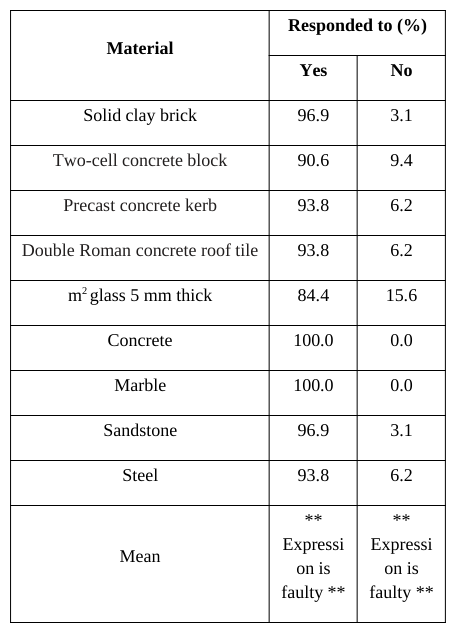
Table 1 provides a summary of the responses per question. The mean response was 94.5% and the non-response was 5.5%. The lowest response was relative to m2 glass 5 mm thick was 84.4%.
Table 1: Summary of mass and density of materials responses Responded to (%)
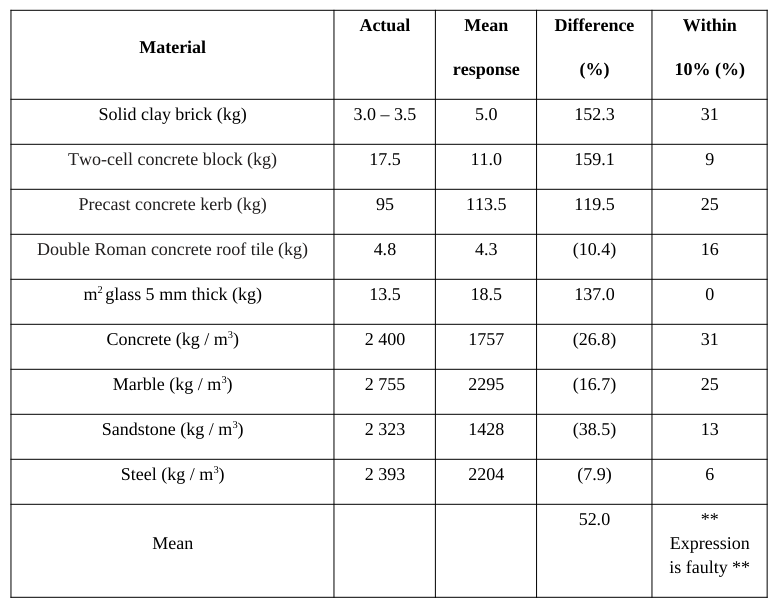
Table 2 presents the actual and mean response mass / density, percentage difference between the mean response and actual mass / density, and a summary of responses within a 10% range of the actual mass or density. The lowest percentage difference between the mean response and actual mass / density is relative to steel (-7.9%), followed by a double roman concrete roof tile (-10.4%). The highest difference is relative to a two-cell concrete block (159.1%), followed by a solid clay brick (152.3%). The mean percentage difference is 52%.
The mean of the percentage responses that were within 10% range of the actual mass / density is 17.3%, the lowest being 0% relative to m2 glass 5 mm thick, and the highest being 31% relative to both a solid clay brick and concrete. This is probably attributable to the fact that bricks and concrete are two common construction materials, and glass being a lesser known entity, which is also handled and installed by specialists.
Table 2: Actual and mean response mass / density, percentage difference, and summary of responses within a 10% range of the actual mass or density
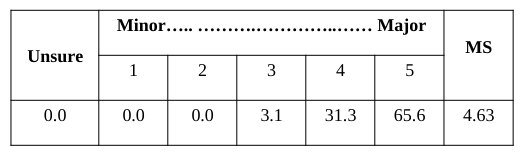
Table 3 indicates the extent to which the mass and density of materials impact on ergonomics according to respondents in terms of percentage responses to a five point scale ranging from 1 (minor) to 5 (major), and a MS ranging between 1.00 and 5.00. The MS of 4.63 (> 4.20 ≤ 5.00) indicates the impact is between near major to major / major.
Table 3: Extent to which the mass and density of materials impacts on ergonomics Minor….. ……….…………..…… Major
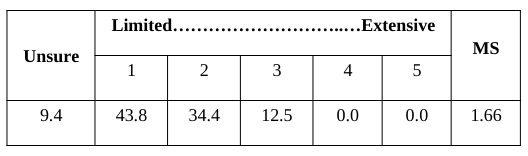
Table 4 indicates the respondents’ rating of their knowledge of the mass and density of materials in terms of percentage responses to a five point scale ranging from 1 (limited) to 5 (extensive), and a MS ranging between 1.00 and 5.00. The MS of 1.66 (≥ 1.00 ≤ 1.80) indicates the rating is between limited to below average. However, 1.66 is slightly below the upper range > 1.80 ≤ 2.60 – between limited to below average / below average. The 9.4 ‘unsure’ response is notable.
Table 4: Respondents’ rating of their knowledge of the mass and density of materials Limited………………………..…Extensive
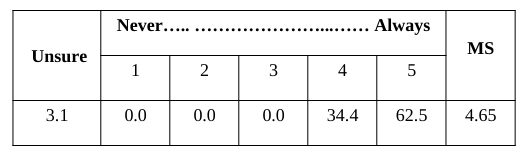
Table 5 indicates how frequently construction managers should consider the mass and density of materials when managing projects according to respondents in terms of percentage responses to a five point scale ranging from 1 (never) to 5 (always), and a mean score ranging between 1.00 and 5.00. The MS of 4.65 (> 4.20 ≤ 5.00) indicates the frequency is between often to always / always. The ‘always’ (62.5%) response is notable.
Table 5: Frequency at which construction managers should consider the mass and density of materials when managing projects
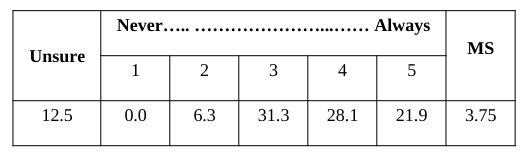
Table 6 indicates how frequently quantity surveyors should consider the mass and density of materials when preparing bills of quantities and other project documentation according to respondents in terms of percentage responses to a five point scale ranging from 1 (never) to 5 (always), and a mean score ranging between 1.00 and 5.00. The MS of 3.75 (> 3.40 ≤ 4.20) indicates the frequency is between sometimes to often / often. The ‘unsure’ (12.5%) response is notable.
Table 6: Frequency at which quantity surveyors should consider the mass and density of materials when preparing bills of quantities and other project documentation
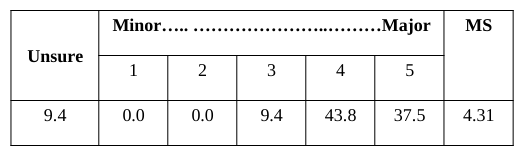
Table 7 indicates the potential of the consideration of the mass and density of materials to contribute to an improvement in construction ergonomics in terms of percentage responses to a five point scale ranging from 1 (minor) to 5 (major), and a MS ranging between 1.00 and 5.00. The MS of 4.31 (> 4.20 ≤ 5.00) indicates the potential is between near major to major / major. This is notable given the frequency the respondents recommended quantity surveyors should consider the mass and density of materials when preparing bills of quantities and other project documentation, and the respondents’ rating of their knowledge of the mass and density of materials is between limited to below average. The 12.5% ‘unsure’ response is notable.
Table 7: Potential of the consideration of the mass and density of materials to contributeto an improvement in construction ergonomics
CONCLUSIONS
Although on average 94.5% of respondents attempted to record a mass or density relative to the materials presented, on average only 17.3% were within a 10% range of the actual mass or density. Therefore, it can be concluded that the respondents are lacking in knowledge relative to the mass and density of materials. This conclusion is reinforced by the respondents’ rating of their knowledge of the mass and density of materials, namely 1.66 - between limited to below average / below average. However, as stated, 1.66 is slightly below the lower point of the upper MS range > 1.80 ≤ 2.60 – between limited to below average / below average.
However, it can be concluded that respondents appreciate, to a degree, the extent to which the mass and density of materials impact on construction ergonomics, as the MS indicates the appreciation to be between near major to major / major, and also: the frequency at which construction managers should consider the mass and density of materials when managing projects as the MS indicates the frequency to be between often to always / always; the frequency at which quantity surveyors should consider the mass and density of materials when preparing bills of quantities and other project documentation as the MS indicates the frequency to be between sometimes to often / often, and the potential of the consideration of the mass and density of materials to contribute to an improvement in construction ergonomics, which potential can be concluded to be between moderate to near major / near major.
RECOMMENDATIONS Given the conclusions relative to the empirical findings, and the findings of the survey of the literature, inter alia, manual materials handling contributes 62% of back injuries (CSAO, 1993), and every year, manual material handling is linked to one-third of all construction industry accidents reported to the HSE in the United Kingdom (HSE, 2000), it can be concluded that there is a link between manual materials handling, and more specifically, handling heavy materials and injuries. Therefore, tertiary built environment education, quantity surveying included, should optimise the level of awareness relative to construction ergonomics, and the role of the mass and density of materials, including engendering an awareness of mass and density of common construction materials. Furthermore, quantity surveyors in practice should deliberate the mass and density of materials when specifying materials while compiling bills of quantities and preparing contract documentation. Furthermore, they should facilitate adequate financial provision for H&S, ergonomics included, by contractors.
REFERENCES
Construction Safety Association of Ontario (CSAO) (1993) “Back Care and Manual Materials Handling in Construction”.
Etobicoke, Ontario: CSAO. Health & Safety Executive (HSE) (2000) “Backs for the future Safe manual handling in construction”. Norwich: HSE. Monk, V.A. (2005) “Ergonomics in Construction”, in: occupational health and safety in construction management, Lingard, H and Rowlinson, S (eds.), Spon Press: Oxon. Republic of South Africa (2014) “Government Gazette No. 37305. Construction Regulations”. Pretoria. Smallwood, J.J. (1997) “Ergonomics in construction”, ergonomicsSA, Volume 9 No. 1, pp. 6-23.
Smallwood, J.J., Deacon, C.H., and Venter, D.J.L. (2000) “Ergonomics in construction: Workers’ perceptions of strain”, ergonomicsSA, Volume 12 No. 1, pp. 2-12. Smallwood, J.J. (2002) “Construction Ergonomics: General Contractor (GC) Perceptions”, ergonomicsSA, Volume 14 No. 1, pp.
8-18. Smallwood, J.J. (2006) “Ergonomics in construction: South African perspectives”, in: Proceedings of CIB W107 Construction in Developing Countries International Symposium on Construction in Developing Economies: New Issues and Challenges, Santiago, Chile, 18-20 January 2005, D:\4.6.pdf
LISTED IN THE AHFE DIGITAL BOOKSTORE CATALOGUE
Explore the complete digital volume
Advances in Ergonomics In Design, Usability & Special Populations: Part III
Read this individual research paper free through the original publisher, or explore the full digital proceedings book.
ISBN 978-1-4951-2108-1
Explore this ISBN in the AHFE Bookstore ↗Listed in the July 2026 bookstore catalogue; search by ISBN to confirm current availability · Digital book purchase optional