Carlos Maurício Duque dos Santos, Pedro Luiz Oliveira Costa Neto, Rosangela Ferreira Santos (2022). Ergonomic Evaluation of Workstation Furniture for Wheelchair Users with reference to Brazilian Standards ABNT NBR-9050 and NR-17 on Ergonomics. In: Advances in Ergonomics In Design, Usability & Special Populations: Part II. AHFE Open Access, vol. 19. https://doi.org/10.54941/ahfe1001276
This paper presents a case study using ergonomics methodology to design workstations for wheelchair users in administrative offices. The case study was conducted for a large financial institution in Brazil with headquarters in São Paulo-SP. The design project seeks to meet two existing technical standards in Brazil , one of them is Brazilian standard ABNT NBR-9050: Accessibility of Buildings, Furniture, Urban Spaces and Equipment and the other is Ergonomics standard NR-17 which sets out the minimum comfort requirements for workstation furniture . The furniture in question will enable the financial institution (a Bank) to hire operators who have locomotor disabilities so that they can work in their premises at workstations that meet users’ needs and address their limitations, as well as complying with the Labor Legislation and the Accessibility Legislation (the Law on quotas), thereby demonstrating a real social contribution of Ergodesign and Ergonomics as a whole.
In November 1990, a regulatory Ergonomics standard was included in Brazilian labor legislation that obliges (public and private) companies to conduct an Ergonomic Analysis of Work, for which the acronym in Portuguese is AET. On doing so, this standard requires, among other items, that the workstation furniture is suitable for the worker and for the task. This standard established at that time (1990) that companies had a period of 5 (five) years in which to conduct an ergonomic analysis of workstations and to implement improvements so that operators could perform their tasks in conditions of comfort and safety. This standard became known as NR-17 on Ergonomics of the Ministry of Labor and Employment. Today, it is still one of the tools that companies use to manage Ergonomics in the workplace and this has brought about a significant change in the parameters of comfort and safety at work in Brazil (DUQUE dos SANTOS, C.M. 2010).
Law 8.213/91, known as the Law on Quotas, was created and promulgated on July 24, 1991. It deals with the obligation placed on legally established Brazilian and foreign companies to hire people with disabilities in the ratio laid down in Article 93 of that law. Ergonomics In Design, Usability & Special Populations II
"Art 93. A company with one hundred (100) or more employees is obliged to fill 2% (two percent) to 5% (five percent) of its posts with rehabilitated beneficiaries or people with disabilities, duly skilled, in the following proportions: " I - up to 200 employees .......................................... 2%;
II - from 201-500 ...................................................... 3%; III - from 501-1000 .................................................... 4%;
IV - from 1,001 onwards...............................................5%.”
As to these percentages, companies have found great difficulty in filling the number of vacancies needed to comply with the law, and when they have found staff qualified for the vacancy, the workstation was not suitable for an operator with a disability and even less comfortable and safe, as set out in NR-17 on Ergonomics. For this reason, apart from rare exceptions, almost no company has managed to fill vacancies in accordance with these requirements. Thus, the Law on Quotas in Brazil, the purpose of which is to include people with disabilities in the labor market has not been fulfilled for the reasons mentioned above.
Due to the personal commitment of a Congresswoman (Sra. Mara Gabrilli), who is physically disabled and a wheelchair user, the matter was again discussed and actions demanded from the government and its institutions (especially from the Ministry of Labor and Employment) at the various levels (federal, state and municipal) of government offices to see to it that the Law on Quotas is fulfilled and, hence, that accessibility to work environments and workstations is made adequate.
Due to the intensification of audit inspections by the Public Ministry of Labor in Brazil of this specific need, some companies have taken the initiative to make their premises suitably accessible to wheelchair users (employees and customers) and, consequently, have made workstations fit for use by wheelchair users.
SOCIAL RELEVANCE AND CONTRIBUTION OF ERGONOMIC DESIGN The study in question presents the results of a case study undertaken for a large financial institution in Brazil that has around 40,000 employees, 4,000 branches throughout Brazil, besides regional administrative centers and a head office. To fulfill the Law on Quotas, this company would need to hire at least 2,000 operators with physical disabilities (i.e. 5 % of its total workforce).
The hiring of operators who have a physical disability as determined by the Human Resources Department of the company should only be wheelchair users since operators with other types of disability or limitation would have difficulty performing tasks which have banking sector requirements due to computerized systems. Thus, the physical facilities of the various environments must allow access for wheelchair users, in addition to which the furniture used by these users should satisfy NR-17 on Ergonomics, i.e. the furniture should be ergonomically suited to the user and the task for which it is intended.
Having identified the demand as above, the application of the concepts and principles of ergonomic design (Ergodesign) is essential for drawing up a blueprint of workstation furniture, which in our view is a highly important social contribution, as this will enable wheelchair users to be included in the labor market and to use workstations with a computer terminal, and thus who will have furniture that matches their needs.
THE ERGONOMIC METHOD OF ASSESSING A PRODUCT Ergonomics In Design, Usability & Special Populations II
In view of the goal to be achieved, a method for assessing the Ergonomic Quality of Products, which is an integral part of the doctoral thesis "ERGODESIGN - Models for Assessing the Ergonomic Quality of Products, Workstations and Working Conditions" (SANTOS, C.M.D. 2010) was chosen which makes the due adaptations so as to satisfy NR-17 on Ergonomics of 1990 and NBR-9050 of 2004.
The Model for Assessing the Ergonomic Quality of a Product (a desk for a wheelchair user) was conducted over 4 steps: Step 1: A Virtual Anthropometric Assessment, in which "virtual anthropometric mannequins" were used in a sitting posture using a desk (for use with computer terminals) which was 70 cm high.
Step 2: A Virtual Anthropometric Assessment, in which "virtual anthropometric mannequins" were used in a sitting posture using a desk (for use with computer terminals) which was 75 cm high.
Step 3: A Real Anthropometric and Biomechanical Assessment, using a prototype 75 cm high desk and real users/ operators whose heights are 1.47 m, 1.66 m, 1.82 m and 1.91 m using a real wheelchair with a seat which is 50cm high.
Step 4: Evaluation of the Technical/ Construction Characteristics of the desk, taking account of the shape of the top, its dimensions and the finishing and materials on its surface that come in direct contact with the user's body.
Having obtained the assessments from the 4 steps as set out above, fit for purpose sizing of the furniture could be determined in addition to suggesting suitable positioning for operational equipment (monitor with height and tilt adjustment. a keyboard and separate mouse) as well as the complementary technical resources when necessary (ergonomic accessories: monitor stand with height adjustment, wrist support for keyboard and mouse) which should be provided to wheelchair users, so they can make any adjustments needed that stem from their limitations.
Development of the Assessments of the 4 Steps To conduct Anthropometric Virtual Assessments of Steps 1 and 2, "virtual anthropometric mannequins" of 3 heights, 2-dimensional wheelchairs and 2-dimensional desks were used, as shown below.
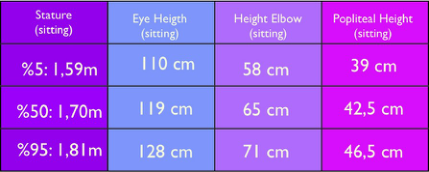
The "virtual anthropometric mannequins" were designed with reference to Anthropometric and Biomechanical Research of the INT, the National Institute of Technology of Rio de Janeiro using 3 heights, these being: 1.59 m - 5% percentile; 1.70 m - 50% percentile; and 1,81m - 95% percentile, which corresponds to 90% of the sample population studied, as shown in Figure 1 below:
Figure 1: Desk with anthropometric dimensions used in the study.
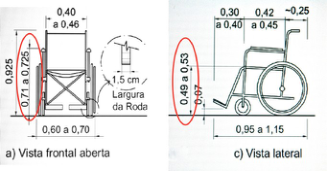
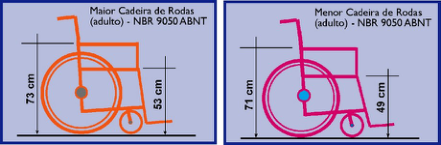
The minimum and maximum dimensions of wheelchairs set by the Brazilian regulatory Standard NBR-9050 was used, where the minimum height of the seat is 49 cm and its maximum height is 53 cm; the minimum height of the arm rest is 71 cm and its maximum height is 72.5 cm; and the footrest of the wheelchair is 7 cm from the floor.
Ergonomics In Design, Usability & Special Populations II
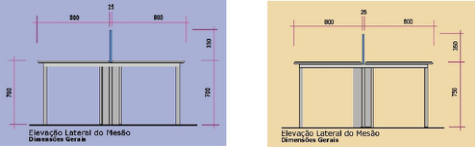
Figure 2: Dimensions of wheelchairs and the desk used in NBR-9050Figure 3: Drawing of the chairs used in the virtual anthropometric assessmentFigure 4: Desk 1 (height - 70cm) Figure 5: Desk 2 (height - 75cm)
Stage 1: Virtual Anthropometric Assessment with a 70 cm high desk This assessment consisted of analyzing the furniture using "anthropometric mannequins" with 3 heights corresponding to the percentiles of 5% (1.59 m), 50% (1.70 m) and 95% (1.81 cm) using 2 sizes of wheelchair and a 70 cm high desk.
Individual Anthropometric Study Percentile 5% with the smaller chair (seat height 49 cm), Figure 6:
Result: the operator can use the keyboard easily because of the height of the desk. However, the armrest of the chair "bumps" into the edge of the desk and may preclude the operator from moving nearer to the desk to use the keyboard and read the screen of the monitor.
Individual Anthropometric Study Percentile 5% with the higher chair (seat height 53 cm) Figure 7:
Ergonomics In Design, Usability & Special Populations II
Result: the operator find it difficult to use the keyboard which will be below the height of the chair arm and above his/her thigh, and may adversely affect his/her posture and arm movements.
Individual Anthropometric Study Percentile 50% with the smaller chair (seat height 49 cm) Figure 8:
Result: the operator will easily be able to use the keyboard because of the height of the desk. However, the armrest of the chair "bumps" into the edge of the desk and may preclude the operator moving closer to the desk to use the keyboard and read the monitor.
Individual Anthropometric Study Percentile 50% with the smaller chair (seat height 53 cm), Figure 9:
Result: the operator find it difficult to use the keyboard that will be well away from his/her body, which may adversely affect his/her posture and arm movements. The operator’s knee "bumps" into the edge of the desk and makes it impossible for him/her to move closer to the desk to use the keyboard and read the monitor.
Individual Anthropometric Study Percentile 95% with the smaller chair (seat height 49 cm), Figure 10:
Result: the operator will easily be able to use the keyboard because the height of the desk. However, the armrest of Ergonomics In Design, Usability & Special Populations II the chair "bumps" into the edge of the desk and may preclude the operator moving closer to the desk to use the keyboard and read the monitor.
Individual Anthropometric Study Percentile 95% with the smaller chair (seat height 53 cm), Figure 11:
Result: the operator find it difficult to use the keyboard that will be well away from his/her body, which may adversely affect his/her posture and arm movements. The operator’s knee "bumps" into the edge of the desk and this makes it impossible for the chair to be moved closer to the desk so he/she can use the keyboard and read the monitor.
Stage 2: Virtual Anthropometric Evaluation with a 75 cm high desk This review consisted of analyzing the furniture using "anthropometric mannequins" with 3 heights which correspond to the 5% (1.59 m), 50% (1.70 m) and 95% percentiles (1.81 cm) using 2 sizes of wheelchair and a 75cm high desk.
Individual Anthropometric Study Percentile 5% with the smaller chair (seat height 49 cm), Figure 12:
Result: the operator will find some difficulty in using the keyboard which is above the height of the armrest of the chair and which could adversely affect his/her posture and arm movements.
Individual Anthropometric Study Percentile 5% with the smaller chair (seat height 53 cm), Figure 13:
Result: The operator will find it easy to use the keyboard which is slightly above the height of the arm of the chair Ergonomics In Design, Usability & Special Populations II which may well facilitate his/her posture and arm movements.
. Individual Anthropometric Study Percentile 50% with the smaller chair (seat height 49 cm), Figure 14:
Result: The operator will find it easy to use the keyboard which is slightly above the height of the armrest of the chair which may facilitate his/her posture and arm movements.
Individual Anthropometric Study Percentile 50% with the smaller chair (seat height 53 cm), Figure 15:
Result: The operator will find it easy to use the keyboard which is slightly above height of the armrest of the chair which may facilitate his/her posture and arm movements.
Individual Anthropometric Study Percentile 95% with the smaller chair (seat height 49 cm), Figure 16:
Result: The operator will find it easy to use the keyboard which is above the height of the armrest of the chair which may facilitate his/her posture and arm movements.
Individual Anthropometric Study Percentile 95% with the smaller chair (seat height 53 cm), Figure 17:
Ergonomics In Design, Usability & Special Populations II
Result: The operator will find it easy to use the keyboard which is above the height of the armrest of the chair which may facilitate his/her posture and arm movements.
Summary of the Conclusion of Steps 1 and 2: Having made the anthropometric assessments in Steps 1 and 2, it can be stated that the desk height of 75cm (height of the work surface) is the one that best suits the users’ varying heights, when wheelchairs with the minimum and maximum dimensions suggested by ABNT 9050 are used.
Step 3: Real Anthropometric and Biomechanical Assessment This assessment consisted of analyzing the furniture for individuals of both sexes of 4 different heights that correspond to the percentiles of less than 1% (1.47 m), 25% (1.66 m) and 96% (1.82 cm) and the percentile above 99% using a single model of wheelchair (with a 50cm seat height) and desk height of 75cm.
Photograph of user who is 1.47 m tall (less than 1% percentile)
Result: the operator can take up a correct and appropriate posture and there is adequate space for the wheelchair under the desk posture. This allows the user to reach the operational equipment physically and visually, with his/her arms resting on the desk.
Photograph of user who is 1.66 m tall (25% percentile)
Result: the operator can take up a correct and appropriate posture and there is adequate space for the wheelchair under the desk. This allows the user to have the operational equipment within his/her physical and visual reach, with his/her arms resting on the desk and/or the armrest on the chair.
Ergonomics In Design, Usability & Special Populations II
Photograph of User who is 1.82 m tall (96% percentile)
Result: the operator can take up the correct and appropriate posture and there is adequate space for the wheelchair under the desk. This allows the user to have the operational equipment within his/her physical and visual reach, with his/her arms resting on the desk.
Photograph of User who is 1.91m tall (the 96% percentile)
Result: the operator can take up the correct and appropriate posture and there is adequate space for the wheelchair under the desk. This allows the user to have the operational equipment within his/her physical and visual reach, with his/her arms resting on the desk.
Summary of Conclusion of Step 3: Having conducted the anthropometric assessments in Steps 1 and 2, it can be stated that the desk height of 75cm (height of the work surface) is the one that best meets the varying heights of users, whose wheelchairs are within the minimum and maximum dimensions suggested by ABNT 9050.
Step 4: Evaluation of the Technical/ Construction Characteristics of the Furniture This review consisted of analyzing the technical construction characteristics of the furniture in use with a view to checking the items on the extent to which the furniture can be used easily and comfortably.
Photographs of Construction Details of the Furniture in Use:
Construction details of the height adjustment system of the support plan of the equipment (monitor and keyboard) used to adjust the height of the desk.
Photographs of the space under the desk in which the wheelchair can be moved: Ergonomics In Design, Usability & Special Populations II
Details showing the free space under the desk in which the wheelchair can be moved.
Summary of Conclusion of Step 4: It appears that the operators do not find it difficult to maneuver the wheelchair under the desk. However, the mechanisms for regulating the height of the surface supporting equipment should be improved in order to facilitate their use and to eliminate the "edges" and "sharp corners" of the support surface of the equipment, which can cause discomfort in a user’s arms or even the risk of accidents.
Overall conclusion The development of the project by applying the ergonomic methodology for designing furniture for a wheelchair user was found to satisfy suitably the two Brazilian standards in question i.e. NR-17 on Ergonomics and NBR-9050 on Accessibility.
The evaluation model made it possible to simulate how wheelchair users of different heights (virtual anthropometric measurements) would use the desk, for wheelchairs of the minimum and maximum dimensions laid down in Standard ABNT-9050.
It is noted that the virtual anthropometric assessment led to eliminating the construction of a prototype desk and testing it, since on making an anthropometric assessment of the 70 cm high desk, it was shown to be inadequate and/ or partially inadequate for the full range of the heights of the wheelchair users.
The anthropometric assessment and real biomechanics ratified the virtual anthropometric assessment for the 75cm high desk, since users whose heights range from 1.47m to 1.91m did not complain of discomfort or postural constraints when using the desk.
The evaluation of the technical/ construction characteristics showed its effectiveness at identifying some inadequacies and potential constraints and discomfort when using equipment, which should be subject to "redesign" of the surface that supports equipment and of the system for adjusting its height.
REFERENCES
Duque dos Santos, C. M. Ergodesign, Legislação e Normas – Uma Contribuição para a Melhoria da Qualidade Ergonômica de Produtos, Postos de Trabalho e Condições de Trabalho em Processo de Produção. Tese de Doutorado, UNIP-Universidade Paulista, 2011. NR-17 Norma Regulamentadora de Saúde e Segurança no Trabalho do Ministério do Trabalho e emprego do Brasil
(31/11/1990) accessed on 26/01/2013 Available at: http://www.guiatrabalhista.com.br/legislacao/nr/nr17.htm NBR-9050 Norma Regulamentadora Brasileira da ABNT-Associação Brasileira de Normas Técnicas – Acessibilidade a Edificações, Mobiliário, Espaços e Equipamentos Urbanos, 97 páginas, 2004.
Ergonomics In Design, Usability & Special Populations II
LISTED IN THE AHFE DIGITAL BOOKSTORE CATALOGUE
Explore the complete digital volume
Advances in Ergonomics In Design, Usability & Special Populations: Part II
Read this individual research paper free through the original publisher, or explore the full digital proceedings book.
ISBN 978-1-4951-2107-4
Explore this ISBN in the AHFE Bookstore ↗Listed in the July 2026 bookstore catalogue; search by ISBN to confirm current availability · Digital book purchase optional