Matthias Weippertab, Annika Riegera, Ricarda Lehmanna, Weiping Zhanga, Kerstin Thurowa, Regina Stollb (2022). Physiological Workload Response of Laboratory Staff during simulated Life Science Processes. In: Advances in Ergonomics In Design, Usability & Special Populations: Part II. AHFE Open Access, vol. 19. https://doi.org/10.54941/ahfe1001269
High demands for new drug development and advances in robotic technologies have led to automation of compound screening and biological culturing processes in life sciences. Nevertheless, not only cognitive skills during planning, programming, supervision, and evaluation are mandatory but also human manual skills are still essential for system performance in highly automated life science laboratories. Aim of this study was to assess the physiological workload response during simulated cell culturing tasks.20 healthy volunteers underwent a standardized test protocol including typical cell laboratory tasks. Cardio-respiratory parameters including heart rate (HR), breathing frequency, minute ventilation, oxygen uptake (VO2) and blood pressure (DBP, SBP) were measured and analyzed.There were strong effects of task condition on blood pressure (SBP: F(10,210)=30.8, p<0.001, η² = .618; DBP: F(10,210)=17.9, p=.000, η²= .485), HR (F(10,210)=34.5, p<0.001; η²= .793) and VO2 (F(10,210)=253.5, p<0.001; η²= .969). Especially during material transportation including static work components, SBP and DBP increased significantly, while HR and VO2 were significantly elevated during dynamic transportation tasks.We found significant increases of physiological activation during typical tasks in a modern life science laboratory. During transportation tasks including stepping stairs, average HR reached cut-offs for sustained effort (120 bpm), during all other tasks HR was well below these cut-offs. Episodes of static muscular work during charging and transportation where associated with blood pressure elevations. However, as these muscular loads occur only intermittent during a work shift these elevations seem to be uncritical. Nevertheless, individual assessment is advised for persons at risk.
High demands for new drug development and advances in robotic technologies have led to automation of compound screening and biological culturing processes in life sciences. Nevertheless, not only cognitive skills during planning, programming, supervision, and evaluation are mandatory but also human manual skills are still essential for system performance in highly automated life science laboratories. Especially before implementing automation to achieve high throughput and high quality standards, prototype processes are usually done manually by human staff. Further, a shift from manual to semi-automated production is not necessarily associated with a reduction in physical loads of the operator. The implementation of biotechnology on an industrial scale can increase physical demands as well because of larger volumes and weights that have to be moved by operators (Fig. 1a-c).
Figures 1a-c: Operator during material handling for a semi- automated cell culturing process Thus, sensory-motor and muscular demands are still common even in highly automated life science environments. Aim of this experimental study was to assess the physiological workload response during simulated cell culturing tasks.
METHODS
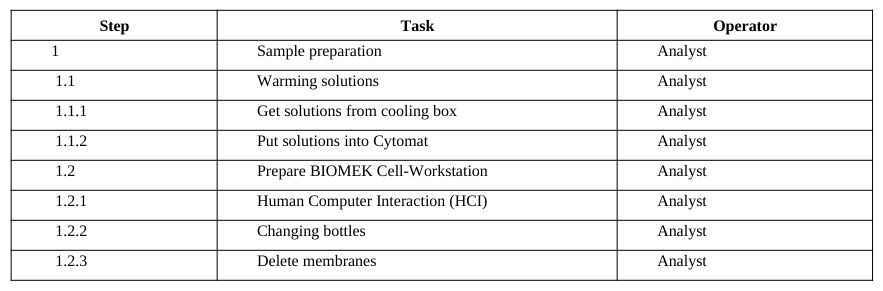
Before starting the experiment several observations during daily routine of a newly implemented semi-automated cell-culturing process were carried out. Table 1 shows the results of the observation study including about 50 work steps.
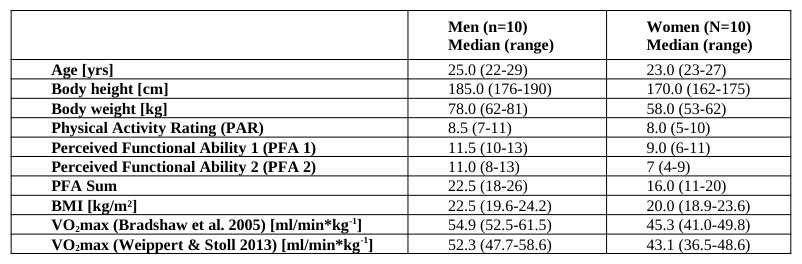
Table 1. Task analysis of a semi-automated cell-culturing process Step Task OperatorTable 2. Anthropometric and physical fitness data of the study participants Men (n=10) Median (range) Women (N=10) Median (range)
Figures 2 a-c. Participants during different protocol tasks wearing the mobile respiratory gas analyzer MetaMax 3B (a,b), subject
wearing the EQ-01 breast belt monitor
RESULTS
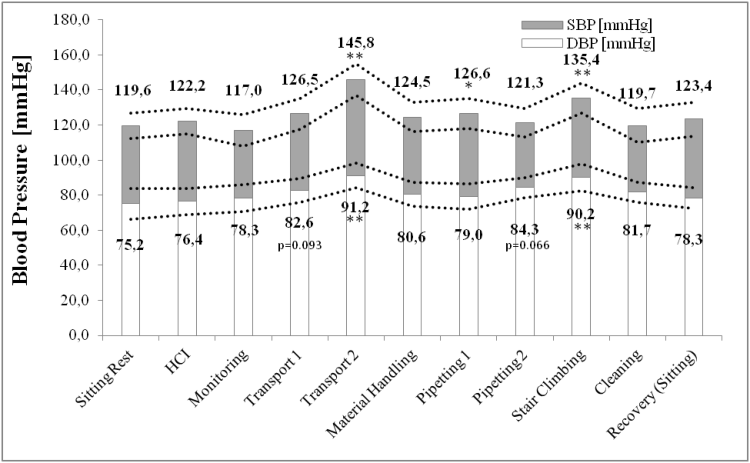
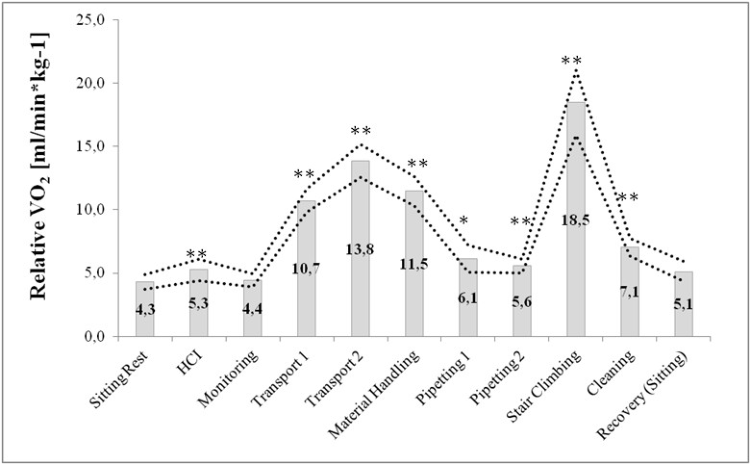
There were strong effects of task condition on blood pressure (SBP: F(10,210)=30.8, p<0.001, η² = .618; DBP: F(10,190)=17.9, p=.000, η²= .485), HR (F(10,210)=34.5, p<0.001; η²= .793) and VO2 (F(10,210)=253.5, p<0.001; η²= .969). Figures 3-5 show mean values and standard deviations across the different tasks and significance levels for the post hoc pair wise comparisons with sitting rest.
Figure 3. Diastolic and systolic blood pressure response of participants during rest, different laboratory tasks and recovery (N = 20), dotted lines represent Mean±SD; */** significantly different from Sitting Rest (p<0.05/ p<0.01)Figure 4. Heart rate response of participants during rest, different laboratory tasks and recovery (N = 20) dotted lines represent Mean±SD; */** significantly different from Sitting Rest (p<0.05/ p<0.01)
Figure available in the original PDF paper.
Figure 5: Average oxygen uptake of participants during rest, different laboratory tasks and recovery (N = 20), dotted lines represent Mean±SD; */** significantly different from Sitting Rest (p<0.05/ p<0.01)
CONCLUSIONS
Little is known about how typical demands in the field of life science affect blood pressure and other physiological parameters. This study aimed to assess blood pressure, respiratory and cardiac response to typical tasks in life science labs. Ambulatory blood pressure monitoring at regular intervals across a day or during an exercise test reveals only transient values of systemic blood pressure that might not be representative for occupational blood pressure responses. Thus, our experimental study adds physiological information to occupational research in the growing field of biotech workplaces.
Not surprisingly, we found that transportation tasks including larger isometric muscular actions elicited the strongest increase of blood pressure. It is known, that physical (isometric) workload can be associated with an increased risk of elevated blood pressure, which – in turn – is a risk factor for coronary heart disease (Clays et al., 2012; Virkkunen, Harma, Kauppinen, & Tenkanen, 2007). However, as the SBP values do not exceed 210 mmHg and muscular loads occur only intermittent during a work shift of a life science operator these elevations might be uncritical (Mancia et al., 2013). Nevertheless, individual assessment is advised for persons at risk (hypertension, musculoskeletal disorders) as our data mirror the average response of young and healthy volunteers. Further, conclusions have to be drawn cautiously, as there is no consensus on cut-off values for blood pressure during dynamic exercise testing or for intermittent work-related blood-pressure elevations (Mancia et al., 2013). Pipetting in the sitting position elicited a small but significant increase of SBP as well. Pipetting, cleaning and human- computer interaction tasks induced only minor but significant increases of VO2. Stair climbing elicited the strongest increase in oxygen uptake, followed by material transportation and handling. An 80% increase of heart rate was seen during stair climbing, which corresponded to the large increase in VO2 during this condition. Nevertheless this increase can be classified as moderate. Summarizing, based on the HR and VO2-measurements, the intensity of the analyzed tasks, especially when isometric muscular actions can be excluded, can be classified as light to moderate (Grandjean, 1991).
From a preventive perspective the inclusion of physical activity of light to moderate or even intense intensity (dynamic type) into the daily (work) routine can be recommended, especially when having/leading a rather sedentary job/life. Our task analysis and the subsequent experimental study implicate that 1st semi-automation of processes in the life science is not necessarily associated with a reduction in physical activity at work, 2nd the present physical tasks in life science labs can be well tolerated by healthy young operators and 3rd may help to limit the negative consequences of a sedentary life style when reaching sufficient duration and frequencies (Löllgen, Völker, Böckenhoff, & Löllgen, 2006).
ACKNOWLEDGEMENT
The authors wish to thank the Federal Ministry of Education and Research (BMBF Germany) for the financial support (FKZ: 03Z1KN11).
REFERENCES
Clays, E., De Bacquer, D., Van Herck, K., De Backer, G., Kittel, F., & Holtermann, A. (2012). Occupational and leisure time physical activity in contrasting relation to ambulatory blood pressure. Bmc Public Health, 12, 1002. doi: 10.1186/1471-2458-12-1002 Grandjean, E. (1991). Physiologische Arbeitsgestaltung - Leitfaden der Ergonomie. Landsberg: ecomed. Löllgen, H., Völker, K., Böckenhoff, A., & Löllgen, D. (2006). Physical activity and prevention of cardiovascular
diseases. Körperliche Aktivität und Primärprävention kardiovaskulärer Herzkrankungen. Herz, 31(6), 519- 523. Macfarlane, D. J., & Wong, P. (2012). Validity, reliability and stability of the portable Cortex Metamax 3B gas analysis system. European journal of applied physiology, 112(7), 2539-2547. doi: 10.1007/s00421-011- 2230-7 Mancia, G., Fagard, R., Narkiewicz, K., Redon, J., Zanchetti, A., Bohm, M., . . . Task Force, M. (2013). 2013
ESH/ESC Guidelines for the management of arterial hypertension: the Task Force for the management of arterial hypertension of the European Society of Hypertension (ESH) and of the European Society of Cardiology (ESC). Journal of hypertension, 31(7), 1281-1357. doi: 10.1097/01.hjh.0000431740.32696.cc Rieger, A., Neubert, S., Behrendt, S., Weippert, M., Kreuzfeld, S., & Stoll, R. (2012, 20-23 March). 24-Hour ambulatory monitoring of complex physiological parameters with a wireless health system: Feasibility, user compliance and application. Paper presented at the 9th International Multi-Conference on Systems, Signals and Devices (SSD), Dresden (Germany). Virkkunen, H., Harma, M., Kauppinen, T., & Tenkanen, L. (2007). Shift work, occupational noise and physical
workload with ensuing development of blood pressure and their joint effect on the risk of coronary heart disease. Scandinavian journal of work, environment & health, 33(6), 425-434. Weippert, M., Stielow, J., Kumar, M., Kreuzfeld, S., Rieger, A., & Stoll, R. (2013). Tri-axial high-resolution acceleration for oxygen uptake estimation: Validation of a multi-sensor device and a novel analysis method. Applied Physiology, Nutrition, and Metabolism, 38(3), 345-351.
LISTED IN THE AHFE DIGITAL BOOKSTORE CATALOGUE
Explore the complete digital volume
Advances in Ergonomics In Design, Usability & Special Populations: Part II
Read this individual research paper free through the original publisher, or explore the full digital proceedings book.
ISBN 978-1-4951-2107-4
Explore this ISBN in the AHFE Bookstore ↗Listed in the July 2026 bookstore catalogue; search by ISBN to confirm current availability · Digital book purchase optional