Belén Carballo-Leyenda, Sheila Vázquez-Vegas, Álvaro Regadío, Jose A Rodríguez-marroyo (2026). Ergonomic Assessment of Lower-Limb Exoskeleton on Physiological Responses in Wildland Firefighters. In: Cognitive Computing and Internet of Things. AHFE Open Access, vol. 205, pp. 33–40. https://doi.org/10.54941/ahfe1007359
Wildland firefighters are exposed to sustained physical demands that impose substantial physiological and perceptual strain. Lower-limb exoskeletons have been proposed as assistive devices to reduce internal workload. However, their effectiveness in this occupational context remains unclear. This study evaluated the effects of a hip-based lower-limb exoskeleton on physiological responses during a treadmill protocol simulating locomotor demands in wildland firefighting. Six wildland firefighters completed a 60-min walking protocol including level, uphill, and downhill stages while wearing full personal protective equipment and a 20 kg backpack. Two experimental conditions were compared in randomized crossover design: exoskeleton assistance activated (EXO) and exoskeleton worn without assistance (NO EXO). Oxygen uptake (VO2), heart rate (HR), and rating of perceived exertion (RPE) were recorded throughout the protocol. All variables changed significantly over time (p<0.001), confirming the physiological and perceptual demands of the task. However, no significant main effect of condition was found for VO2, HR or RPE, and no condition × time interactions were observed (p>0.05). Descriptive analyses suggested slightly lower VO2 (−5.6%) and HR (−2.5%) with exoskeleton assistance, alongside a marginally higher RPE (+4.7%). These findings indicate that, under the present experimental conditions, hip-based exoskeleton assistance did not produce clear reductions in physiological strain during simulated wildland firefighting locomotion. Further studies with larger samples, longer familiarization periods, and field-based protocols are needed to determine whether specific tasks or device configurations may improve effectiveness.
Wildland firefighting involves prolonged and physically demanding tasks performed under challenging environmental and operational conditions, including load carriage, uneven terrain, and sustained locomotion (Sol et al., 2018). These demands impose substantial physiological strain, typically reflected in elevated oxygen consumption, cardiovascular load, and
perceived exertion, which may negatively affect performance and increase fatigue-related risks (Rodríguez-Marroyo et al., 2012; Carballo-Leyenda et al., 2018).
Occupational exoskeletons have been proposed as an ergonomic intervention to reduce physical workload by providing mechanical assistance during movement. In particular, lower-limb exoskeletons are intended to support locomotion and improve movement efficiency, thereby potentially reducing the metabolic and cardiovascular demands associated with walking and load carriage. Sefton et al. (2025) investigated a bilateral active lower-limb exoskeleton at the ankle joint, specifically designed to assist locomotion, reporting improvements in metabolic efficiency and reduced cardiovascular strain in military population. Similarly, Ding et al. (2018) demonstrated that an active hip exoskeleton assisting hip flexion and extension can significantly reduce the metabolic cost of walking under controlled laboratory conditions.
Despite these promising findings, the available evidence remains heterogeneous, as the effectiveness of occupational exoskeletons varies according to task characteristics, assisted joint, and device design (Bär et al., 2021). Moreover, most studies have been conducted under controlled laboratory conditions with simplified tasks and non-specialized populations. Consequently, evidence from real occupational settings remains limited, particularly in wildland firefighters. In addition, the physiological effects of hip-based exoskeletons in this context remain largely unexplored, despite their potential relevance for load carriage and sustained walking tasks.
Therefore, this study aimed to evaluate the effects of a hip-based lower- limb exoskeleton on physiological responses during a controlled treadmill protocol designed to simulate the locomotor demands of wildland firefighters.
METHODS
Participants Six healthy wildland firefighters (1 female and 5 males; age: 40.5 ± 6.5 yr; height: 176.0 ± 9.4 cm; body mass: 79.2 ± 13.3 kg; BMI: 25.4 ± 3.2 kg·m−2; VO2max: 49.7 ± 8.3 mL·kg−1·min−1) participated in the study. All of them had previous experience as wildland firefighters ( > 5 yr). Written informed consent was obtained from all subjects before starting the study. The study was conducted in accordance with the Declaration of Helsinki, and the protocol was approved by the Ethics Committee of the University of León (Spain).
Equipment A commercial lower-limb exoskeleton (Hypershell Carbon X, Hypershell Tech, China) was used in this study. The device provides active assistance primarily at the hip joint during walking through a motorized system synchronized with the gait cycle. The total mass of the device, including the battery, was 2.5 kg. The system includes three assistance modes (Transparent, ECO, and Hyper), which differ in the magnitude of mechanical assistance
Ergonomic Assessment of Lower-Limb Exoskeleton 35 and energy consumption. For the purposes of the present study, the ECO mode was selected as a compromise between battery duration and assistance performance.
Experimental Design Each participant completed three trials across two testing sessions separated by at least 48 h. Participants were instructed to refrain from strenuous exercise and to avoid alcohol, caffeine, and tobacco consumption for 24 h prior to testing. A graded exercise test was performed during the first testing session to determine the subjects’ maximal aerobic capacity (VO2max). After the graded exercise test, and following a standardized recovery period of 30 min, participants performed one of the two experimental conditions, according to the randomized order. In the second session, participants completed the remaining condition.
Each participant completed the same protocol under two conditions: assisted (EXO) and unassisted (NO EXO). In both conditions, participants wore the exoskeleton, only the assistance setting differed, allowing the effect of the mechanical assistance to be isolated from the influence of device mass and structure. During all trials, participants wore the personal protective equipment currently used by Spanish wildland firefighters, which included thermal-resistant clothing (65% fire-retardant viscose, 30% Nomex, and 5% Kevlar; 1.5 kg), as well as additional protective elements such as a helmet, neck shroud, gloves, and low-calf hiking boots, resulting in a total additional mass of approximately 6.5 kg. Participants also carried a 20 kg backpack simulating the load carried during real wildland firefighting deployments (Rodríguez-Marroyo et al., 2012; Carballo-Leyenda et al., 2018).
Experimental Protocol The graded exercise test was conducted on a motorized treadmill (h/p Cosmos Pulsar, h/p Cosmos Sports & Medical GmbH, Nussdorf-Traunstein, Germany). Each test was preceded by a 10-min warm-up at approximately 60% of maximal heart rate (8–10 km·h−1), followed by 5 min of stretching. The protocol started at 4 km·h−¹ with a 10% incline. Speed was increased by 0.5 km·h−1 every minute until reaching 6.5 km·h−1, after which the slope was increased by 1% per minute until volitional exhaustion.
Prior to the experimental protocol, participants completed a 15 min familiarization period with the exoskeleton, which included walking and ascending and descending stairs to ensure adequate adaptation to the device. The experimental protocol consisted of 60 min of treadmill walking in a temperate environment (~22 ºC and 65% relative humidity). Participants performed a sequence of continuous and variable walking stages, including level walking (1% grade; 6 km·h−1), downhill walking (−15% grade; 4 km·h−1), and uphill walking (+15% grade; 5 km·h−1). The temporal structure was as follows: 0–10 min level walking, 10–15 min downhill, 15–20 min uphill, 20–50 min level walking, 50–55 min downhill, and 55–60 min uphill. The protocol was designed to simulate the locomotion demands representative of wildland firefighting tasks (Rodríguez-Marroyo et al., 2012).
Measurements Oxygen uptake (VO2) was measured using a breath-by-breath gas analysis system (Medisoft Ergocard, Medisoft Group, Sorinnes, Belgium). Data were averaged over 3-min periods at the end of each walking stage to obtain representative steady-state values. Perceived exertion was assessed using the Borg CR10 scale (Borg, 1982) at the end of each stage throughout the protocol. Heart rate (HR) was continuously monitored throughout the treadmill test using a heart rate monitor (H10, Polar Electro Oy, Kempele, Finland). Before each testing session body mass was measured using a calibrated scale (50K150, COBOS, Barcelona, Spain), and height was assessed using a stadiometer (Seca 213, Seca Gmbh & Co. KG, Hamburg, Germany).
Statistical Analysis Data are presented as mean ± standard deviation (SD). The effects of condition (EXO or NO EXO), time (0, 10, 15, 20, 35, 50, 55 and 60 min), and the condition × time interaction on relative VO2, HR, and RPE were assessed using a two-way repeated-measures analysis of variance (ANOVA). When the assumption of sphericity was violated, the Greenhouse-Geisser correction was applied. Pairwise comparisons were performed using Bonferroni-adjusted post hoc tests.
In addition, condition-specific overall means were calculated for each participant by averaging values across all time points, and these averages were used for between-condition comparisons. Percentage change (Δ%) between EXO and NO EXO conditions was calculated relative to the control condition. Effect sizes were estimated using paired Cohen’s d and interpreted as trivial ( < 0.20), small (0.20–0.49), moderate (0.50–0.79), and large (≥0.80) (Cohen 1988). All analyses were performed using IBM SPSS Statistics (version 29, IBM Corp., Armonk, NY, USA). Statistical significance was set at p < 0.05.
RESULTS
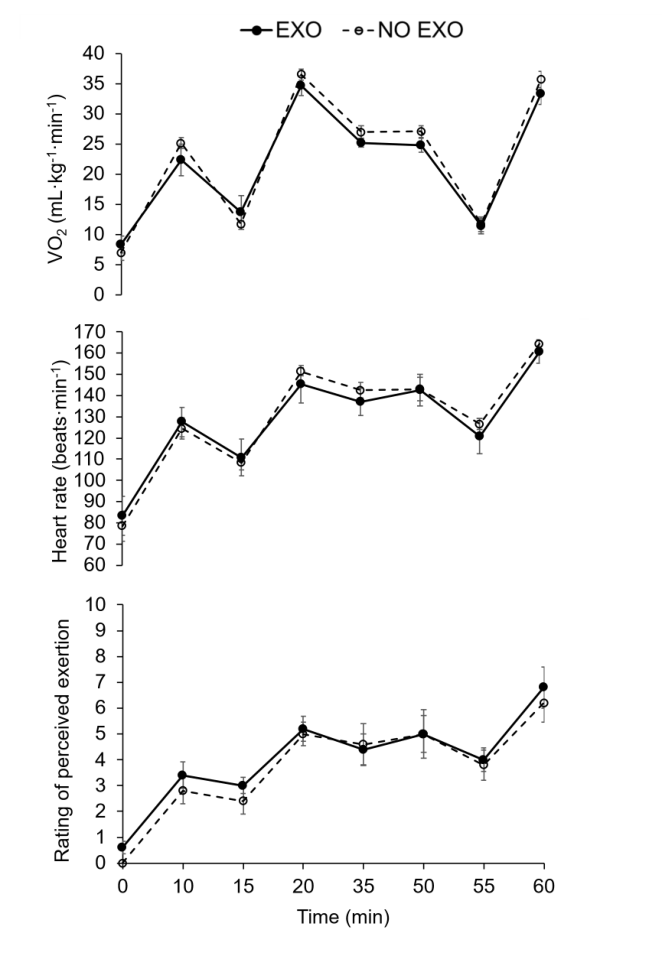
VO2, HR, and RPE changed significantly over time during the protocol (p < 0.001), reflecting the varying physiological and perceptual demands imposed by the different walking stages (Figure 1). No significant main effect of condition was observed for VO2, HR, or RPE (p > 0.05). Likewise, no significant condition × time interaction was found for any variable (p > 0.05), indicating that the temporal response patterns were similar between assisted and unassisted conditions.
When overall condition-specific means were compared, VO2 tended to be lower (−5.6%; d = −0.50) in the assisted condition (23.6 ± 2.5 mL·kg−1·min−1) than the unassisted condition (25.0 ± 1. 5 mL·kg−1·min−1). A similar pattern was observed for HR (−2.5%; d = −0.50; 134 ± 11 vs. 138 ± 19 beats·min−1). In contrast, RPE was slightly higher in the assisted condition (+4.7%; 4.5 ± 0.9 vs. 4.3 ± 1.1). Although this effect size (d = 0.38) was small in magnitude. None of the differences reached statistical significance.
Figure 1: Time-course of physiological and perceptual responses during the experimental protocol. Data are presented as mean ± standard deviation.
DISCUSSION
The present study aimed to evaluate the effects of a hip-based lower-limb exoskeleton on physiological responses during a treadmill protocol designed to simulate the locomotor demands of wildland firefighting. The main findings indicate that exoskeleton assistance did not produce statistically significant reductions in physiological load, as reflected by comparable values of VO2,
HR, and RPE between assisted and unassisted conditions. Taken together, these results suggest that, under the present experimental conditions, no clear physiological benefit of exoskeleton assistance was detected.
With regards to VO2, no significant improvements in metabolic efficiency were observed with the use of the exoskeleton. This finding contrasts with previous studies reporting reductions in the metabolic cost of walking when using lower-limb exoskeletons under controlled laboratory conditions. For example, Sefton et al. (2025) reported improved metabolic efficiency and reduced cardiovascular strain using a bilateral active ankle exoskeleton in a military population, while Ding et al. (2018) demonstrated significant reductions in metabolic cost with a hip exoskeleton assisting hip flexion and extension through human-in-the-loop optimization. Several factors may explain these discrepancies. In the study by Sefton et al. (2025), ankle exoskeletons directly assist the push-off phase of gait, which plays a key role in locomotor energetics, whereas hip assistance may have a more distributed or phase-dependent contribution. Additionally, Ding et al. (2018) applied a human-in-the-loop optimization approach to tailor assistance timing and magnitude to each individual, likely maximizing metabolic benefits, whereas the commercially available device used in the present study operates with predefined assistance patterns that may not be optimal for all users.
In line with the VO2 findings, HR responses were not significantly reduced with exoskeleton assistance, suggesting that cardiovascular strain remained largely unaffected. This observation is consistent with previous literature indicating that reductions in cardiovascular load are not always evident when using occupational exoskeletons, particularly during prolonged task involving load carriage and variable terrain (Bär et al., 2021). In such scenarios, overall physiological demand is likely determined by multiple interacting factors beyond locomotor mechanics alone, including external load, task duration, and environmental constraints.
Interestingly, a tendency toward higher RPE was observed in the assisted condition. Although these differences were not statistically significant, this pattern may be relevant from an applied perspective. One possible explanation is that interaction with the device introduced constraints on movement, such as altered gait mechanics or reduced movement naturalness, which could increase perceived effort despite similar metabolic demand. In addition, factors such as device weight, fit, or localized discomfort may have contributed to an increased perceptual load. These findings highlight the importance of considering perceptual responses alongside physiological variables when evaluating the usability and effectiveness of exoskeletons in occupational settings.
Overall, the present results support the notion that the effectiveness of lower-limb exoskeletons is context-dependent and influenced by the interaction between device design, assisted joint, and task characteristics. While clear benefits have been demonstrated under controlled laboratory conditions, particularly for ankle-based devices (Sefton et al., 2025) and optimized assistance strategies (Ding et al., 2018), these effects may not directly translate to more complex and ecologically valid scenarios such as
Ergonomic Assessment of Lower-Limb Exoskeleton 39 those encountered in wildland firefighting. This underscores the importance of evaluating exoskeleton performance under task-specific conditions that closely reflect real occupational demands.
Several limitations of this study should be acknowledged. First, the small sample size limits statistical power and may have reduced the ability to detect subtle effects. Second, although the protocol was designed to simulate occupational demands, it was conducted under controlled laboratory conditions and may not fully capture the environmental and operational complexity of real wildfire scenarios. Third, the familiarization period with the exoskeleton was relatively short, which may have influenced both physiological and perceptual responses. Finally, only one assistance mode (ECO) was evaluated, which may not reflect the full potential of the device under different configurations. Therefore, the present findings should be considered exploratory and interpreted with caution.
CONCLUSION
The hip-based lower-limb exoskeleton evaluated in this study did not produce statistically significant reductions in physiological load under the tested conditions, indicating no clear benefits in terms of metabolic or cardiovascular strain during simulated wildland firefighting locomotion. Given the exploratory nature of this study and the small sample size, further research is required to determine whether different assistance settings, longer familiarization periods, or task-specific applications may enhance the effectiveness of this device.
ACKNOWLEDGMENT
The authors gratefully acknowledge ITURRI S.A. for providing the exoskeleton used in this study.
REFERENCES
Bär, M., Rieger, M.A., Steinhilber, B. and Luger, T. (2021). “The influence of exoskeletons during occupational tasks on acute physical stress and strain: A systematic review” Applied Ergonomics, 94, 103385. https://doi.org/10.1016/j. apergo.2021.103385 Borg, G. A. (1982). “Psychophysical bases of perceived exertion”, Medicine and
science in sports and exercise, 14, 377–381. http://dx.doi.org/10.1249/00005768- 198205000-00012 Carballo-Leyenda, B., Villa, J.G., López-Satué, J., Collado, P.S. and Rodríguez- Marroyo, J.A. (2018). “Fractional contribution of wildland firefighters’ personal protective equipment on physiological strain”, Frontiers in Physiology, 9, 1139. https://doi.org/10.3389/fphys.2018.01139 Cohen, J. (1988). Statistical Power Analysis for the Behavioral Sciences. 2nd ed.
Hillsdale, NJ: Lawrence Erlbaum Associates. Ding, Y., Kim, M., Kuindersma, S. and Walsh, C.J. (2018). “Human-in-the-loop optimization of hip assistance with a soft exosuit during walking”, Science Robotics, 3(15), eaar5438. https://doi.org/10.1126/scirobotics.aar5438
Rodríguez-Marroyo, J.A., López-Satue, J., Pernía, R., Carballo, B., García-López, J., Foster, C. and Villa, J.G. (2012). “Physiological work demands of Spanish wildland firefighters during wildfire suppression”, International Archives of Occupational and Environmental Health, 85 (2), 221–228, https://doi.org/10.1007/s00420- 011-0661-4 Sefton, J.M., Neal, F.K., Agostinelli, P.J., Bordonie, N.C., Whitley, P.E., Pickle, N.T.
et al. (2025). “The impact of a commercial lower extremity exoskeleton on metabolic load, perceived exertion, and physiological response to a challenging military relevant task: A randomized cross-over design pilot study”, PLOS ONE, 20(1), e0314613. https://doi.org/10.1371/journal.pone.0314613 Sol, J.A., Ruby, B.C., Gaskill, S.E., Dumke, C.L. and Domitrovich, J.W. (2018), “Metabolic Demand of Hiking in Wildland Firefighting”, Wilderness and Environmental Medicine. 29(3), 304–314. https://doi.org/10.1016/j. wem.2018.03.006
LISTED IN THE AHFE DIGITAL BOOKSTORE CATALOGUE
Explore the complete digital volume
Cognitive Computing and Internet of Things
Read this individual research paper free through the original publisher, or explore the full digital proceedings book.
ISBN 978-1-964867-81-6
Explore this ISBN in the AHFE Bookstore ↗Listed in the July 2026 bookstore catalogue; search by ISBN to confirm current availability · Digital book purchase optional