Ahamed Altaboli, Raja Ahmida, Mustafa Elmgrab, Heba Immraga, Rabheen Othman (2022). Using Anthropometric Criteria to Evaluate the Design of School Furniture for Benghazi Primary Schools. In: Advances in Ergonomics In Design, Usability & Special Populations: Part I. AHFE Open Access, vol. 18. https://doi.org/10.54941/ahfe100829
The objective of this study is to evaluate the existing designs of school furniture used in the basic education stage in public schools in the city of Benghazi. Anthropometric data were gathered for a total of 360 students (183 females and 177 males) for the first three grades in the basic education stage (children of age 6 to 10 years old) from eight schools. Several body dimensions were measured for each student (popliteal height, popliteal-buttock length, shoulder height sitting, knee height, elbow height sitting, shoulder to elbow length, and hip breadth sitting). Dimensions of the existing design of the classroom desk were also obtained. The evaluation procedure involves the utilization of several equations relating body dimensions to furniture dimensions. Each equation computes an acceptable range for each desk dimension based on the associated body dimension. Each desk dimension is compared to the range computed for the related body dimension for each student and percentages of matches/mismatches are determined accordingly. Results of the evaluation revealed substantial percentages of mismatches between the desk dimensions and students anthropometry; all the evaluated desk dimensions are larger than the related students’ dimensions.
Schoolchildren spend large parts of their times sitting in the classroom and poorly designed furniture might force them to sit in awkward and constrained postures, in the long run this may result in musculoskeletal discomfort for the children that might even continue to their adulthood (Hedge & Lueder, 2008). Consequently, school furniture designs should follow the related ergonomic and human factors guidelines; the dimensions of school furniture should conform to the body dimensions of schoolchildren.
Recently, considerable number of studies has been conducted to evaluate designs of school furniture (see Hedge & Lueder (2008) for an extensive review of the related literature). Almost all indicated considerable mismatches be- tween schoolchildren anthropometrics and the dimensions of their classroom furniture (Agha, 2010; Castellucci et al, 2010; García-Acosta & Lange-Morales, 2007; Gouvali & Boudolos, 2006; Parcells et al, 1999; Sarrni et al., 2007; and Savanur & De, 2007).
Although various evaluating and designing procedures have been suggested and utilized in these studies; however, all are based on students’ anthropometry. For example, García-Acosta & Lange-Morales (2007) and Sarrni et al. (2007) directly compared furniture dimensions to the associated body dimensions of the students, e.g. comparing desk height to elbow height sitting. Savanur & De (2007) used a traditional ergonomic textbook methodology (Tay- yari and Smith, 1997) consisting of using students’ anthropometric dimensions to compute the expected furniture di- mensions that should fit 90% of the population and compare them to the existing furniture dimensions. A more thoroughly approach was developed and applied first by Parcells et al. (1999) and was further developed and applied later by Gouvali & Boudolos (2006) and Agha (2010). The procedure utilizes several equations relating body dimen- sion(s) to the furniture dimension to be evaluated. Each equation is used to individually compare body dimension(s) of each student to the furniture dimension; the furniture dimension is considered suitable for the student if the results of the comparison showed that it was compatible with the body dimension. A similar procedure was used in this cur- rent study as well.
This article reports the outcomes of the first step in a wider ongoing study. The overall objective of the ongoing study is to evaluate the existing design of the school furniture that currently being used in the Libyan public schools in the basic education stage and to propose potential improvements in the design accordingly. Related anthropomet- ric data for the students will be gathered and utilized to evaluate the existing and the potential designs with the ob- jective of developing the furniture design(s) that would best fit students' anthropometry. The work reported in this current study includes gathering the related anthropometric data for students in the three first grades in the basic ed- ucation stage, obtaining the specifications for the existing design of the school furniture, and setting and applying a procedure for evaluating the existing school furniture design utilizing the gathered anthropometric data.
METHODOLGY Participants
The school system in Libya consists of two stages: basic education and middle education. The basic stage consists of nine grades (first to ninth), the first six are usually referred to as "primary" stage, and the last three (seventh to ninth) are usually called "preparatory" stage. The school system has both public and private schools. Public schools are owned and run by the government (the ministry of education) and private schools are owned and run by private indi- viduals or entities with permission and under the supervision of the ministry of education.
The purpose of the current study is to evaluate the classroom furniture used in public schools for the first three grades of the basic education stage. Anthropometric data for students from these three grades was gathered and used to evaluate the current design of the classroom furniture. Anthropometric data were measured for a sample of a total size of 360 students (177 males and 183 females) aged between 6 to 10 years old. The sample was randomly se- lected from eight schools in Benghazi (seven public and one private) form the three grades covered in this study. Measurements were taken after getting permission from the officials and principles in each school and all students voluntarily participated in the study.
Measures of Classroom Desk Public schools in Libya use one design of classroom furniture (desk) with the same dimensions (one size) for all of the nine basic education grades. This desk consists of a fixed height bench seat connected to a fixed height desk, de- signed to accommodate two students sitting side by side.
One potential difficulty related to such a desk design with fixed seat and table heights is that the fixed height may not fit all the students with their different ages and grades. During these ages, children go through a continuous phase of growing and sizes of their bodies differ considerably even in the same grade and age group (Norris & Smith, 2008). Additionally, the fixed horizontal distance between the bench seat and the table used in this design may cause other difficulties include that for students with relatively small body sizes, if the student lean back in or- der to rest on the backrest he/she may not be able to put his/her elbows on the table surface to support his/her arms while writing or reading. Moreover, if the horizontal distance (clearance) between the seat and table edge decreased so smaller students can support their arms on the table, larger students may find the clearance too small for them to stand.
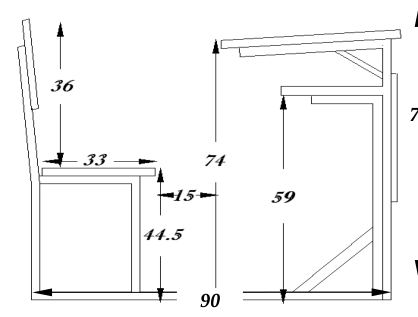
Six desk dimensions will be evaluated in this study to see if they are compatible with related student's dimensions. These six desk dimensions are seat height, seat depth, seat width, backrest height, desk height, and under desk height. The dimensions of the desk are shown in Figure 1 and Table 1.
110
76
90
Side view Back view
Figure 1. Dimensions of the classroom desk (in cm).
Table 1 Dimensions of the classroom desk.
Dimension Measurement (in cm) Seat height (SH) 44.5
Equation reproduced from the original PDF.
Backrest height (BH) 36 Desk height (DH) 74
Under desk height (UH) 59
* The total width of the bench seat is divided by two to obtain the width avail- able for one student.
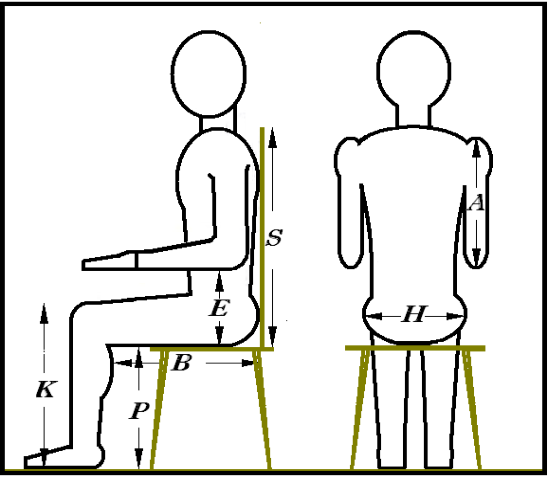
The Measured Body Dimensions Seven body dimensions plus body stature were measured for each student. Measurements were taken using measur- ing tapes while students were wearing light clothes. Measurements were taken in the classroom while students were sitting on the desks. The dimensions are shown in Figure 2 and defined below.
Figure 2. The measured body dimensions
Popliteal height (P): The vertical distance from the floor to the popliteal angle at the underside of the knee where knee flexion at 90°.
Popliteal-buttock length (B): The horizontal distance from the rear of the buttock to the back of the knee.
Shoulder height sitting (S): The vertical distance from the seat surface to the top of the shoulder.
Knee height (K): The vertical distance from the Floor to the upper surface of the knee with knee flexed at 90°.
Elbow–height sitting (E): The vertical distance from the seat surface to the underside of the elbow while the el- bow was flexed at 90° and shoulder was flexed at 0°.
Shoulder to elbow length (A): the vertical distance from the top of the shoulder to the underside of the elbow while the elbow was flexed at 90°.
Hip breadth sitting (H): Maximum horizontal distance across the hips in the sitting position.
Table 2 Summary of the measured dimensions (in cm).
The evaluation criteria and procedure used in this current study is similar to the procedure used in (Agha, 2010; Gouvali & Boudolos, 2006; and Parcells et al., 1999). The procedure uses several equations relating body dimen- sion(s) to furniture dimension to be evaluated. Each equation is used to individually compare body dimension(s) of each student to the desk dimension; the desk dimension in question is considered a match to the associated student dimension, if the results of the comparison showed that the desk dimension sets within the limits calculated by the related equation.
The following section gives the equations used to compare each dimension of the desks. All the equations were adopted from (Agha, 2010; Gouvali & Boudolos, 2006; and Parcells et al., 1999). Some few adjustments were made on few equations to fit requirements of the current case.
Seat height (P + 2 ) cos 30° ≤ SH ≤ )P + 2 ) cos 5° (1)
where SH is seat height and P is popliteal height.
Equation (1) (Agha, 2010 and Gouvali & Boudolos, 2006) shows that seat height should be lower than popliteal height so that the lower leg forms a 5–30° angle relative to the vertical and the shin–thigh angle is between 95 and 120°. A 2 cm correction for shoe height was added to popliteal height.
Seat depth For children, Parcells et al. (1999) suggested that, to be considered a match, seat depth should satisfy the relation- ship in Equation (2).
0.80 PB ≤ SD ≤ 0.95 PB (2) where SD is seat depth and PB is popliteal–buttock length.
Backrest height Backrest height is considered appropriate when it is below the scapula to facilitate mobility of the trunk and arms. Thus, it is recommended to keep the backrest lower than or at most on the upper edge of the scapula, complying with the relationship in Equation (3) (Agha, 2010 and Gouvali & Boudolos, 2006).
0.6 S ≤ BH ≤ 0.8 S (3)
where BH is backrest height and S is shoulder height.
Desk height
Several researchers have considered elbow height as the major determinant for desk height, due to the fact that a sig- nificant reduction of the load on the spine will be achieved when arms are supported on the desk (Agha, 2010 and Gouvali & Boudolos, 2006).
Parcells et al. (1999) suggested that desk height be adjusted to elbow–floor height, so that it would be minimal when arms are not flexed or abducted and maximal when upper arms are at 25° flexion and 20° abduction (elbow rest height× 0.8517 shoulder height × 0.1483). This is translated in the relationship in equation (4) (Gouvali & Boudo- los, 2006).
E + (P + 2 ) cos30° ≤ DH ≤ (P + 2 ( cos5° + 0.8517 E+ 0.1483 S (4) where DH is desk height, E is elbow–seat height, P is popliteal height and S is shoulder height.
Under-surface of desk height The under-surface of desk height should be such that there is space between the knee and the under-surface of the desk, this space should also allow for knee crossing (Gouvali & Boudolos, 2006). Parcells et al. (1999) proposed at least 2 cm between the knee and the under-surface of the desk. Based on that, the relationship in equation (5) was es- tablished (Gouvali & Boudolos, 2006).
(K + 2 ) + 2 ≤ UD ≤ (P + 2) cos5°+0.8517 E +0.1483 S - 4 (5) where UD is the under-surface of desk height and K is the knee height.
Seat width Equation (6) states that seat width should be at least 10% (to accommodate hip breadth) and at the most 30% larger than hip breadth (for space economy) as reported in (Gouvali & Boudolos, 2006).
1.1H ≤ SW < 1.30H (6) where H is hip breadth.
Equation (6) was developed for the case of separated chair and desk to be used by a single student. In the case of the current study where the furniture is a combined desk and bench designed to accommodate two students, this equa- tion is not suitable. Each student needs enough personal space to read, write, and to move and rotate arms and the trunk. A new equation was proposed to fit requirement of the current study. The equation proposed that the seat width will be considered fit if it is larger than hip breadth plus the full length of upper arm when extended horizon- tally (flexed and abducted at 90 degrees) plus five centimeters allowance, this relationship is shown in equation (7).
H + A + 5 < SW (7) where H is hip breadth, A is shoulder to elbow length, and SW is the seat width for a single student.
RESULTS
Results of Anthropometric Measurements
Table 2 summarizes the gathered anthropometric data. Minimum measurement, maximum measurement, mean, and standard deviation are summarized for each dimension, and are presented per gender for each grade.
The high variability between grades, within grades, and the overlap between grades and genders is very noticeable in all dimensions. This is the result of the fact that children at these ages are in a continuing growth and no one child is really fixed at an exact specific size.
Results of the Comparison Calculations of the acceptable upper and lower limits
The students’ anthropometric data gathered in this study were used to calculate the acceptable upper and lower lim- its for each desk dimension. The mean and standard deviation of the acceptable upper and lower limits for each desk dimension are given in Table 3. Comparing the values of the mean acceptable limits to the values of the dimensions of the existing design of the desk (also given in Table 3), one can see that in each grade, almost all desk dimensions, except seat width and backrest height, are larger than the mean acceptable limits. This gives evidence that the size of the existing desk is larger than the sizes of the students.
Table 3 Mean and standard deviation of the upper and lower acceptable limits (in cm).
Percentages of match/mismatch Using the procedure and equations described earlier, the desk dimensions were compared to the individual accept- able limits calculated for each student. The desk dimension in question is considered a match to the associated stu- dent dimension(s), if the results of the comparison showed that the desk dimension sets within the limits calculated by the related equation. If the desk dimension sets outside those limits, it is considered a mismatch; either above the upper limit or below the lower limit. Table 4 gives the results of comparison of the desk dimensions to the related acceptable ranges. The results are summarized as percentages of match or mismatch (above the upper acceptable limit and/or below the lower acceptable limit).
Table 4 Percentages (%) of match/mismatch in each grade.
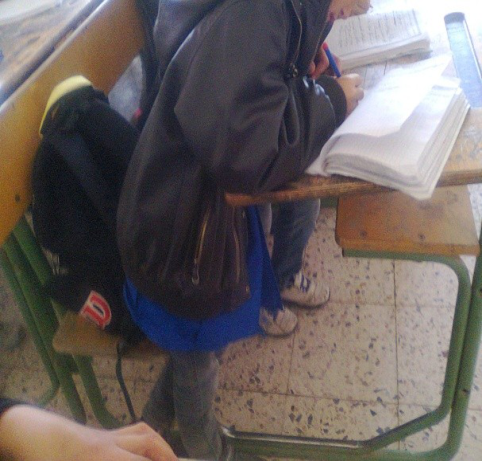
From the table it is clear that high percentages of mismatch are found for almost all desk dimensions in all grades. A 100 % mismatch was found with seat height, desk height and under desk height indicting that the size of the desk is larger than sizes of the students. Students are sitting on a desk with a seat too high for them and a desk surface too high for them as well. These mismatches make students slid forward or stand while writing as shown in the example in Figure 3.
Figure 3. A student standing while writing.
Above 91% mismatches in backrest height are found in all three grades. All mismatches are above the upper limits. A very high backrest would restrict the free movement of the trunk and arms.
The mismatches in seat depth decrease with increase in age and body size (grade) as the calculated percentages for each grade show (about: 87% in first grade, 55% in second grade and 29% in third grade). All mismatches are above students' anthropometrics, indicating again that the desk size is relatively large for these three grades. Seat depth mismatch with thigh length would create strong stresses on the thigh.
The mismatches in seat width are relatively lower compared to the other dimensions. The mismatches increase with increase in age and body size (grade); form about 5% in the first grade to about 18% in the second and to about 36% in the third grade. The desk was designed to accommodate two students and since the desk size is relatively large for body sizes of the students in these grades (as indicated by the above upper limits mismatches for almost all of the desk dimensions); thus, the space available to accommodate a single student will decrease as the sizes of the stu- dents increase with increase in age, resulting in increase in the percentages of mismatches. Figure 4 shows an exam- ple of two students sitting on the desk with limited space between them.
From these results it is clear that the existing desk size is incompatible with the anthropometrics of the students in the first three grades. Several design alternatives can be considered to eliminate or reduce this problem. These alter- natives can range from designs of completely adjustable separated chairs and desks for use by single students to at least adjusting the dimensions of the existing desk design to reduce the percentages of mismatch as much as possi- ble.
Figure 4. Two students sitting with limited space between them.
Figure available in the original PDF paper.
CONCLUSIONS
The evaluation of the existing desk design revealed substantial percentages of mismatches between desk dimensions and students' anthropometry, especially for seat height, desk height, and under desk height. The size of the existing desk design is larger than the body sizes of the students in the three grades included in the study. Students are sitting on desks with seats and tables that are too high for them. This could force students to sit in awkward and con- strained postures, and in the long run this may result in musculoskeletal discomfort for the children that might even continue to their adulthood.
To complete the study, the next step should extend the work to include all grades in the basic education stage and should propose and evaluate potential improved design alternatives; like designing several sizes of adjustable furni- ture to cover all ranges of students' anthropometrics. In addition, more measurements of students' anthropometrics should be gathered including all parts of the country and covering all possible varieties in the population. This will also help in building a database of anthropometric measurements for Libyan children that can be used for other de- sign and research purposes. Moreover, caretakers and teachers should be made aware of the importance of the chil- dren's sitting posture for the children's health as well as most probably their learning experience.
REFERENCES
Agha, S. (2010), "School furniture match to students' anthropometry in the Gaza Strip", Ergonomics, Volume 53 No. 3, pp 344-
354. Castellucci, I., Goncalves, M., Arezes, P. (2010), "Ergonomic Design of School Furniture: Challenges for the Portuguese Schools", in: Advances in Occupational, Social, and Organizational Ergonomics, Vink, P .and Kantola, J . (Ed.), CRC Press, pp 625–633. Hedge, A. and Lueder, R. (2008), "Classroom Furniture", in: Ergonomics for Children, Lueder, R. and Rice, J. (Ed.), CRC
press, Taylor & Francis Group, pp 721-751. García-Acosta, G. and Lange-Morales, K. (2007), "Definition of sizes for the design of school furniture for Bogotá schools based on anthropometric criteria", Ergonomics, Volume 50, No 10, pp1626-1642. Gouvali, M.K. and Boudolos, K. (2006), "Match between school furniture dimensions and children anthropometry", Applied Er-
gonomics, Volume 37 No. 6, pp 765–773. Norris, B., and Smith, S. (2008) "Child Anthropometry", in: Ergonomics for Children, Lueder, R. and Rice, J. (Ed.), CRC press, Taylor & Francis Group, pp 39-64. Parcells, C., Manfred, S. and Hubbard, R. (1999), "Mismatch of classroom furniture and body dimensions, empirical findings and
health implications", Journal of Adolescent Health, Volume 24 No. 4, pp 265–273. Saarni, L., Nygård, C., Kaukiainen, A., and Rimpelä, A. (2007), “Are the desks and chairs at school appropriate?”, Ergonomics, Volume 50 No 10, pp1561-1570. Savanur, C., Altekar, C., & De, A., (2007), "Lack of conformity between Indian classroom furniture and student dimensions: pro-
posed future seat/table dimensions", Ergonomics, Volume 50, No 10, pp1612-1625. Tayyari, F. and Smith, J. (1997), "Occupational ergonomics", Chapman & Hall.
LISTED IN THE AHFE DIGITAL BOOKSTORE CATALOGUE
Explore the complete digital volume
Advances in Ergonomics In Design, Usability & Special Populations: Part I
Read this individual research paper free through the original publisher, or explore the full digital proceedings book.
ISBN 978-1-4951-2106-7
Explore this ISBN in the AHFE Bookstore ↗Listed in the July 2026 bookstore catalogue; search by ISBN to confirm current availability · Digital book purchase optional