Maria Antónia Gonçalvesa, Pedro Arezesb (2022). Analysis of the Mismatch Between School Furniture and Children. In: Advances in Ergonomics In Design, Usability & Special Populations: Part I. AHFE Open Access, vol. 18. https://doi.org/10.54941/ahfe100792
The characteristics of school furniture are strongly associated with back and neck pain, referred by school-aged children. In Portugal, about 60% of the adolescents involved in a recent study reported having felt back pain at least once in the last three months. The aim of this study was to compare furniture sizes of the 2 types indicated for primary schools, within 9 schools, with the anthropometric characteristics of Portuguese students, in order to evaluate the mismatch between them. The sample consisted of 432 volunteer students. Regarding the methodology, 5 anthropometric measures were gathered, as well as 5 dimensions from the school furniture. For the evaluation of classroom furniture, a (mis)match criterion equation was defined. Results indicated that there is a significant mismatch between furniture dimensions and the anthropometric characteristics of the students.
The proposed activities in the classroom, such as reading, writing, observing, drawing and interpreting, are carried out with students kept on sitting position for extended periods of time, as several previous studies have found (Geldhof et al., 2007; Cardon et al., 2004; Murphy et al., 2002; Aagaard-Hansen & Storr-Paulsen, 1994). In Portugal, a study found that students of the 4th year are about 70% of the time in a sitting position (Froufe, 2002). If it is considered that the school-age children spend about 30% of their daily time in school (Linton, 1994), the time they spend seated is considerable.
Recent studies reported that there are a mismatch between school furniture dimensions and schoolchildren’s anthropometric measures (Castellucci et al., 2010; Gouvali and Boudolos, 2006; Panagiotopoulou et al., 2004; Parcells et al, 1999). This mismatch seems to be the main cause of the back, legs, arms, neck, shoulders and feet pain reported by students (Murphy et al., 2007; Parcells et al, 1999; Knight & Noyes, 1999; Mandal, 1994). In Portugal, about 60% of the adolescents involved in a recent study, reported having felt back pain at least once in the last three months (Assunção, 2011). Therefore, the school furniture seems to be primarily responsible for these constraints relating to sitting posture.
Ergonomics In Design, Usability & Special Populations I (2022) https://openaccess.cms-conferences.org/#/publications/book/978-1-4951-2106-7
In addition to posture, there are other studies that warn about the harmful effects of improper furniture, namely at a cognitive level, such as hyperactivity, lack of interest and consequent worst learning outputs (Reis et al., 2002; Moro et al., 1999; Mandal, 1994).
The aim of this study was to compare two furniture sizes indicated for primary schools, with the anthropometric characteristics of Portuguese students, in order to evaluate the potential mismatch between them.
METHODS
Sample and study design The variables for this study were the school furniture dimensions (seat and desk) and the students’ anthropometric dimensions. The sample for the anthropometric study included 432 volunteer students (216 male and 216 females) from 9 public schools belonging to the 1st cycle of the Portuguese educational system. The students aged 7 to 10 years old, with an average of 8.5 (±1.2) years old. This sample represents a confidence level of 87,6%. It should be noted that the sample was a sample of convenience and so far, the measurements were taken only in the Northern part of the country, near the city of Porto. The two types of furniture used in this study were those which are approved by the Portuguese government for primary schools.
Dimensions of desks and chairs The measures of school furniture considered for this study were those which, according to other studies (Garcia- Acosta & Lange-Morales, 2007; Gouvali & Boudolos, 2006; Panagiotopoulou et al., 2004; Parcells et al., 1999; Knight & Noyes, 1999; Molenbroek et al., 1996; Miller, 2000), are relevant for the comparison with the anthropometric measurements of children, namely: seat height, seat depth, seat width and desk height.
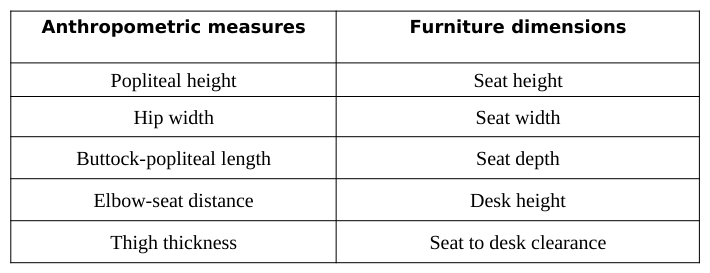
Anthropometric measurements According other studies analysed in the literature review (Garcia-Acosta Lange-Morales, 2007; Gouvali Boudolos, 2006; Panagiotopoulou et al., 2004; Molenbroek et al., 2003; Miller, 2000; Parcells et al., 1999; Knight and Noyes, 1999), the relevant anthropometric measures are shown in table 1.
The anthropometric measurements were collected using a validated anthropometric chair, developed by the first author.
To gauge the results provided by anthropometric chair, reproducibility tests were carried out in the laboratory, through a pilot study, using a portable anthropometer (Holtain) and a fixed or wall anthropometer (developed by the University of Minho). The reproducibility study has shown the degree of concordance between the results of measurements of the same variable anthropometric, where individual measurements are performed varying only the measuring instrument, since the study was carried out by a single evaluator.
The measures were taken by a single evaluator, eliminating the error that could be introduced by the consistency Ergonomics In Design, Usability & Special Populations I (2022) https://openaccess.cms-conferences.org/#/publications/book/978-1-4951-2106-7 factor measurements, i.e., the error that can be introduced when measurements are made by several evaluators. During the sessions, the evaluator was aided of one data-recording assistant.
All the anthropometric measurements were taken with the subject seated in erect position in the anthropometric chair, with the knees bent at an angle of 90°, and the feet resting on an adjustable footrest. The exception to this, was the stature, which was performed with the individuals standing upright and in a relaxed position, using the measuring tape attached to the anthropometric chair. During the measurement process, the individuals were barefoot and wearing shorts and t-shirts.
The measurements were collected in accordance with ISO 7250:1996, considering namely the following dimensions: Popliteal height: measured with 90º knee flexion, as the vertical distance from the foot resting surface and the popliteal space (posterior surface of the knee); Buttock-popliteal length: measured with 90º knee flexion, as the horizontal distance from the posterior surface of the buttock to the popliteal surface; Hip width: the horizontal distance measured in the widest point of the hip in the sitting position; Elbow-seat distance: taken with a 90º angle elbow flexion, as the vertical distance from the bottom of the tip of the elbow to the subject’s seated surface; Thigh thickness: the vertical distance from the highest uncompressed point of the thigh to the subject’s seated surface.
Application of the measures To evaluate the match/mismatch of school furniture, using the applied anthropometry and according to ergonomic principles, some compatibility criteria were defined. These criteria establish the minimum and maximum between each furniture dimension that is considered suitable or a match (two-way equations) or, for situations in which only a maximum or minimum value is required, equations one-way.
Popliteal height (PH) and seat height Considering the anthropometric assumptions, the seat height must be adjusted to the popliteal height (Molenbroek & Kroon-Ramaekers, 2003; Dul & Weerdmeester, 1998; Helander, 1997) so that the feet are perfectly laid on the floor. There is incompatibility if the seat height is greater than 95% (high mismatch) or less than 88% popliteal height (low mismatch) (Parcells et al., 1999). That is, the seat height must be in the range of values between 88% and popliteal height 95% (compatibility) (equation 1).
88% PH ≤ Seat height ≤ 95% PH (1) Hip width (HW) and seat width
In order that a subject is able to sit comfortably, the seat must be wide enough to accommodate subjects with wider hips (Pheasant & Haslegrave, 2006; Mondelo et al., 2000; Helander, 1997; Evans et al., 1988). Thus, the compatibility criterion is given by the equation 2.
In order that a subject is able to sit comfortably, the seat should allow the subject to seat with their legs flexed at 90° (or higher) without compressing the popliteal area and, at the same time, be able to support the lumbar support back on.
For this, the seat depth is must be lower than the buttock-popliteal length (Pheasant & Haslegrave, 2006; Milanese & Grimmer, 2004; Helander, 1997). However, if the depth of the seat is too small for the gluteus-popliteal length (CGP), the thighs will not have the proper support. So, the compatibility criteria is according to equation 3 (Parcells et al., 1999): Ergonomics In Design, Usability & Special Populations I (2022) https://openaccess.cms-conferences.org/#/publications/book/978-1-4951-2106-7
The desk height is strongly related to the seat height, since this dimension is considered to a sitting work and must be analyzed as an interconnected system. The desk height depends on the seat height. Thus, the desk height will be the sum of the elbow-seat distance with the seat height.
Desk height (from the seat) must be between the elbow-seat distance and 3 to 5 cm below this anthropometric dimension (Pheasant & Haslegrave, 2006; Poulakakis & Marmaras, 1998). Assuming the most extreme value of this last condition, the criteria for compatibility is translated by the equation 4.
ESD ≤ Seat to desk height ≤ ESD+5 (4) Thigh thickness (TT) and seat to desk clearance
The clearance required between the seat and the desk must to allow free movements of the legs and, for this, must be at least higher than the thigh thickness (Garcia-Acosta & Lange-Morales, 2007; Molenbroek & Kroon-Ramaekers, 2003). This clearance is considered comfortable if exceed the knee-height in 2 cm (Parcells et al., 1999).
Based on these considerations, the compatibility is defined in equation 5.
TT+ 2 ≤ Seat to desk clearance (5)
RESULTS AND DISCUSSION
From the previous equations, the dimensions of the existing classroom furniture and the children anthropometric dimensions, we can infer about the percentage of match or mismatch. For the case when the two-way equations are applicable, if the furniture dimension is below the minimum value it is considered that there is a “low mismatch”; if it is above the maximum value it is considered to be a “high mismatch”. Between the maximum and minimum values is the percentage of children for whom the seat is compatible (“match”).
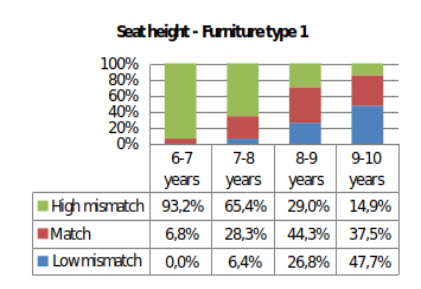
The seat height is considered by several authors as the starting point for the design of school furniture, being the "anchor" of the school set size (Garcia-Acosta & Lange-Morales, 2007; Molenbroek & Kroon-Ramaekers, 2003). The analysis of the charts in Figure 1, we can infer that the seat is too high for children between 6 and 7 years (with a share of more than 93% mismatch). The highest percentage of compatibility (44%) are observed in the 8-9 years children. For children belonging to the age group 9-10 years, it turns out that the mismatch is due essentially to the fact that the seat height is too low.
Figure 1: Percentages of match/mismatch of seat height
Ergonomics In Design, Usability & Special Populations I (2022) https://openaccess.cms-conferences.org/#/publications/book/978-1-4951-2106-7
According to the results presented in Figure 2, there is, in younger children (6-7 years), still a significant percentage (around 60%), for which the seat is too deep, i.e. the buttock-popliteal length of these children is less than the minimum value compatible with the seat depth, and so it is incompatible. In this situation, there is a pressure on popliteal area that causes constriction of the blood vessels, preventing blood circulation to the legs and feet (Pheasant & Haslegrave, 2006; Panero & Zeinik, 2002).
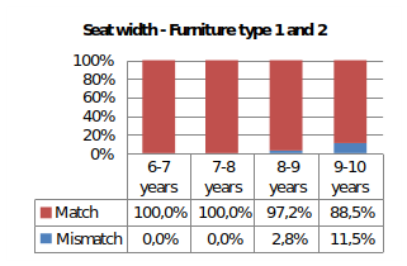
The seat width has a high percentage of compatibility with the width of the hips. The highest percentage of incompatibility is on the group ages 9-10 years, in which there are 11,5% of children that have a width of hips higher than the seat width. For these children, the use of a narrow seat will, most likely, result in discomfort and restrictions on their mobility (Helander, 1997; Evans et al., 1988).
Figure 2: Percentages of match/mismatch of seat width and depth
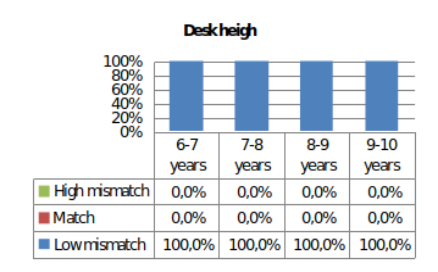
In this study it was found that the two types of desks used in Portuguese primary schools are too high for children who use them. Figure 3 shows the percentage of children whose elbow-seat distance is less than the minimum value required for the compatibility of this measure with seat-to-desk clearance.
Figure 3: Percentages of match/mismatch of desk height
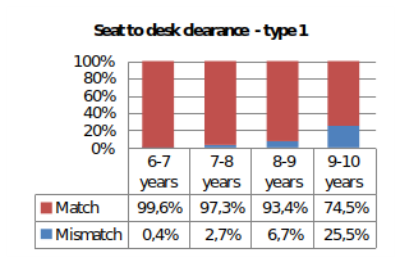
The clearance between the seat and the bottom of the table has more than 70% of compatibility with the seat and desk type 1, being greater than 98,9% in the case of the seat and desk type 2, in oldest children (figure 4).
Ergonomics In Design, Usability & Special Populations I (2022) https://openaccess.cms-conferences.org/#/publications/book/978-1-4951-2106-7
Figure 4: Percentages of match/mismatch of seat to desk clearance
CONCLUSIONS
With the anthropometric measurements, namely those that have an impact on sizing of school furniture, and using compatibility criteria used in similar studies between anthropometric measurements and dimensions of furniture, an analysis was made of two types of furniture used in the primary schools, whose models were previously approved by the Portuguese Ministry of Education. The obtained results reveal that in these schools, and particularly in schools considered in the sample, there is a significant percentage of incompatibility between the students’ body dimensions and the furniture that are used at the schools. It turns out that most of the children are seated on chairs whose seat is too high or too low, combined also with tables that are too high. From all the relevant furniture dimensions, only the seat width and the free space between the thigh and the lower part of the desk presented a high compatibility percentage. This finding is similar to that of other studies analysed in the carried out literature review. It is also important to highlight that, in all situations, the analyzed furniture had fixed dimensions and were not adjustable.
REFERENCES
Aagaard-Hansen, J., Storr-Paulsen, A. (1994), “The working positions of schoolchildren”, Technical Note. Applied Ergonomics, Vol. 25 No. 1, pp. 63-64, ISSN 0003-6870. Assunção, A. (2011) “Efeito do desajustamento das dimensões do mobiliário escolar em relação às características
morfológicas de adolescentes com diferentes níveis de maturação na prevalência de sintomas músculo- esqueléticos na coluna vertebral”, Master Thesis, FMH-UTL, Lisboa. Cardon, G., De Clercq, D., De Bourdeaudhuij, I., Breithecker, D. (2004), “Sitting habits in elementary schoolchildren: a traditional versus a “Moving school””. Patient Education and Counseling, Vol. 54, pp. 133– 142, ISSN 0738-3991. Castellucci, H.I., Arezes, P.M., Viviani, C.A. (2010) “Mismatch between classroom furniture and anthropometric
measures in Chilean schools”. Applied Ergonomics, Vol. 41 No.4, pp. 563-568, ISSN 0003-6870. Dul J., Weerdmeester, B. (1998) “Ergonomics for Beginners – A Reference Guide”. Taylor & Fancis, London, ISBN 0-7484-0825-8. Evans, W.A., Courtney, A.J., Fok, K.F. (1988). “The design of school furniture of Hong Kong school children: an
anthropometric case study”. Applied Ergonomics, Vol. 19 No. 2, pp. 122–134, ISSN 0003-6870. Evans, W.A., Courtney, A.J., Fok, K. F (1998) “The design of school furniture of Hong Kong school children: an anthropometric case study”. Applied Ergonomics, Vol. 19 No. 2, pp. 122–134, ISSN 0003-6870. Froufe, M.T.(2002) “Recomendação para a conceção de mobiliário para o primeiro ciclo de escolaridade”. Master
Thesis, FMH, UTL, Lisboa. Garcia-Acosta, G., Lange-Morales, K. (2007). “Definition of sizes for the design of school furniture for Bogotá schools based on anthropometric criteria”. Ergonomics, Vol. 50 No. 10, pp. 1626-1642, ISSN 0014-0139 Geldhof, E., De Clercq, D., De Bourdeaudhuij, I., Cardon, G. (2007) “Classroom postures of 8-12 year old
children”. Ergonomics, Vol. 50 No. 10, pp. 1571-1581, ISSN 0014-0139.
Ergonomics In Design, Usability & Special Populations I (2022) https://openaccess.cms-conferences.org/#/publications/book/978-1-4951-2106-7
Gouvali, M.K., Boudolos, K. (2006), “Match between school furniture dimensions and children’s anthropometry”.
Applied Ergonomics, Vol. 3 No. 7, pp. 765-773, ISSN 0003-6870. Helander, M. (1997). “A Guide to the Ergonomics of Manufacturing”. Taylor & Fancis, London.
ISBN: 9780748401222. ISO 7250: 1996 – Medidas básicas do corpo humano para o design tecnológico. Knight, G., Noyes, J. (1999) “Children’s behaviour and the design of school furniture” Ergonomics, Vol. 42 No. 5, pp. 747-760, ISSN 0014-0139. Linton, S.J., Hellsing, A.L., Halme, T., Akerstedt, K. (1994) “The effects of ergonomically designed furniture on
pupils’ attitudes, symptoms and behavior” Applied Ergonomics, Vol. 25 No. 5, pp. 299–304, ISSN 0003-6870. Mandal, A.C. (1994) “The prevention of back pain in school children” in: The Ergonomics of seating, Taylor & Fancis, London, pp. 269-277. Milanese, S., Grimmer, K. (2004), “School furniture and the user population: an anthropometric perspective”.
Ergonomics, Vol. 47 pp. 416-426, ISSN 0014-0139. Miller, H. (2000). Workplace research. Available from http://hermanmiller.com/ research/ Accessed: 2010/09/12. Molenbroek, J.F.M., Kroon-Ramaekers, Y.M.T, Snijders, C.J. (2003), “Revision of the design of a standard for the dimensions of school furniture”. Ergonomics, Vol. 46 No. 7, pp. 681-694, ISSN 0014-0139. Molenbroek, J.F.M., Kroon-Ramaekers, Y.M.T. (1996) “Anthropometric design of a size system for school
furniture”, Proceedings of Annual Conference of the Ergonomic Society: Contemporary Ergonomics, In: Robertson, S.A., (Ed.), Taylor & Fancis, pp. 130-135, London. Mondelo, P., Gregori E., Barrau, P. (2000) “Ergonomía: Fundamentos”, 3rd Edition, Alfaomega Grupo Editor – UPC, México. Moro, A.R.P., Ávila, A.O., Nunes, F. P. (1999) “O design da carteira escolar e suas implicações na postura das
crianças”, Proceedings of VIII Congresso Brasileiro de Biomecânica, Sociedade Brasileira de Biomecânica: Florianópolis-SC, pp. 125-130. Murphy, S., Buckle, P., Stubbs, D. (2007), “A cross-sectional study of self-reported back and neck pain among English schoolchildren and associated physical and psychological risk factors”. Applied Ergonomics, Vol. 38 No. 6, pp. 797-804, ISSN 0003-6870. Murphy, S., Buckle, P., Stubbs, D (2002) “The use of the ergonomic observation method (PEO) to monitor the
sitting posture of schoolchildren in the classroom”. Applied Ergonomics, Vol. 33 No. 4, pp. 365-370, ISSN 0003-6870. Panagiotopoulou, G., Christoulas K., Papanckolaou, A., Mandroukas, K. (2004) “Classroom furniture dimensions and anthropometric measures in primary school”. Applied Ergonomics, Vol. 35, pp. 121-128, ISSN 0003- 6870. Panero, J., Zeinik, M. (2002) “Dimensionamento humano para espaços interiores – Um livro de consulta e
referência para projetos”. Editora Gustavo Gili, S.A., Barcelona. Parcells, C., Stommel, M., Hubbard, R. (1999) “Mismatch of Classroom Furniture and Student Body Dimensions: Empirical Findings and Health Implications”. Journal of Adolescent Health, Vol. 24 pp. 265–273. Pheasant, S., Haslegrave, C. (2006) “Bodyspace: anthropometry, ergonomics and the design of work” 3rd Edition,
CRC Press, London, ISBN - 10: 0415285208. Poulakakis, G., Marmaras, N. (1998) “A model for the ergonomic design of office”, Proceedings of Ergonomics Conference, Scott, P.A., Bridger, R.S., Charteris, J. (Eds.), pp. 500–504, Cape Town Reis, P.F., Moro, A.R.P, Silva, O.J., Cruz, R.M., Souza, E.R.(2002) “O uso da média na construção do mobiliário
escolar e a ilusão do conforto e saúde”. Proceedings of VII Congresso Latino-Americano de Ergonomia, XII Congresso Brasileiro de Ergonomia, I Seminário Brasileiro de Acessibilidade Integral, Anais da Abergo – ABERGO, Recife.
Ergonomics In Design, Usability & Special Populations I (2022) https://openaccess.cms-conferences.org/#/publications/book/978-1-4951-2106-7
LISTED IN THE AHFE DIGITAL BOOKSTORE CATALOGUE
Explore the complete digital volume
Advances in Ergonomics In Design, Usability & Special Populations: Part I
Read this individual research paper free through the original publisher, or explore the full digital proceedings book.
ISBN 978-1-4951-2106-7
Explore this ISBN in the AHFE Bookstore ↗Listed in the July 2026 bookstore catalogue; search by ISBN to confirm current availability · Digital book purchase optional