Alexandra Cabral, Carlos Manuel Figueiredo (2022). Costume Design: Ergonomics in Performance Art. In: Advances in Ergonomics In Design, Usability & Special Populations: Part I. AHFE Open Access, vol. 18. https://doi.org/10.54941/ahfe100820
CIAUD - Research Centre for Architecture, Urban Planning and Design, Faculty of Architecture of the University of Lisbon, Rua Sá Nogueira, Pólo Universitário do Alto da Ajuda, 1349-055 Lisboa, Portugal ↗
The human body, in contemporary art, is used as a means, as it also is in fashion design practices applied to the art field, that explore the alteration of the anatomic perimeter in its impact on the user’s self-image, expression and transformation. Costumes that defy gesture bear a reflection on dress over body and we question how functionality (or the lack of it) can influence cognition – mostly when we expect a performer to feel and express the same way a character does and when the audience aims to feel the same way the character feels. Does the performer become a more reactive user towards dress under the realm of the action field of performance art, if interacting with a «non-user-friendly» costume? Since costume and body cannot be separated in performance art, we explore ergonomics, regarding both physical and psychological discomfort in improving the acting of a performer, namely when improvising or moving and in the contribution to a more proficient involvement with the audience. A noninterventionist methodology of qualitative basis is used, based on literary research and observation on the impact of different garments on a performer’s work, so as to obtain new indicators for costume design methodology.
Ergonomics and fashion have a direct relationship due to sharing the body as their common denominator. Nevertheless, fashion design has not always paid attention to how consumers respond to clothing, producing generally the same kind of garments for a wide range of people, attending mainly to market demands. Viggiani quotes Martins who enlightens that “the human body is the reference, therefore we should consider that all individuals are similar in shapes and sizes, but never the same” (Viggiani, 2011, p.2).
When addressing costumes, designed for performance art, we narrow the focus to a specific situation in the design field, which is particularly user-centered. Then, we see that both functional and cognitive questions arise, when what we expect from a performer’s action is directly linked to what we see on his body: a garment that reflects his intentions under a certain artistic conception, designed according to the scenery and an expected kind of communication with an audience. In this realm, discomfort is a variable that is put under the analysis of costume design while a co-adjuvant of the creative process, considering that it might enhance the ability to build and embody a character, facilitate acting and better instill reactions from the audience.
BODY AND COSTUME AS ONE The usage of the body in performance art, as a concept inherited from the 1970’s, is focused on the awareness of its own potentialities in communication. Since then, conceptual inputs towards altering the way the body moves, are centered on the notions of body motion or stillness, it’s language and poetry, so as to convey a certain point of view, being performance therefore considered a “state of mind”, according to Emmett Williams (as cited in Ruhrberg et.al, 2005, p.588). Performance practice has also been questioning the usage and reading of the body, and we focus on the imagined body as the starting point of the performer’s acting. This arises from the way body has been placed as a subject on the side of culture and not only on the side of biology (Ingold, 2000, p.170), being then used and shaped as we please, like the so valid means of expression it became, just like any other in the art field.
As performance is a chameleon-like artifice, “a highly reflexive, volatile form – one that artists use to articulate and respond to change” (Goldberg, 2011, p.249), we consider, when looking at recent achievements in technology, that the virtual world and computer aided design tools have influenced artists with a new sensation of freedom regarding transforming and reinterpreting the body. Besides digital technology, the desires of the mind in the projection of the mental body are now easier to achieve, when they can also (and actually) be put into practice with cosmetic surgery, like in the nine surgical operation-performances held between 1990 and 1993 by Orlan, in which the artist changed her body. We see that in those, “the body is mended after impairments or can be molded for new experiences. (…) It is about the bodily dimension of plasticity and about the plasticity of bodily experience.”, as De Preester (2007, p.359) underlines.
But changes in body can as well be done by fashion, being fashion also deeply related to the notion of the self, somehow linked to “a confirming consistency between appearance and manner” (Goffman, 1990, p.29), exposed in this article through costumes in performance art. We suddenly confuse body transformation with body customization with textiles, when fashion meets art and conceptual boundaries turn so difficult to delimit. Shall we focus on Pierre Cardin’s Men’s shoes (1986), for example, a pair of shoes resembling a pair of feet, once inspired in René Magritte’s The Red Model (1935), and we will certainly ask “is the object reflecting the mind, or the mind reflecting the object?” (Cabral, 2010, p.60). What would we express by wearing those shoes, which character would we represent, then?
Sally Dean explains how she understood a change in the way she saw costumes and her perception of the body as a tool, when she lived in Java in 2007-08 and had her movements constrained by the Javanese dance costume. She says that “the costume itself created a kinesthetic experience of ‘containment’ in the mid to lower body” and that the experience inspired her in new reflections on the role of costume – namely while allowing “people to find gestures and movement qualities that might otherwise be missing from their repertoire.” (Dean, 2012, p.3). She adds that “across different cultures, from ballet to Balinese dance, dance training is typically done in attire similar to that used in performance, and influences what kind of movement is possible” (Dean, 2012, p.2). This leads us to the core of our research, which is user-centered, although theory-focused, on concepts which imply experimental approaches to performance art that explore body perception through costumes’ plastic potentialities and even its constraints. We therefore acknowledge the definition of ergonomy by the International Ergonomics Association, as a discipline “concerned with the understanding of the interactions among humans and other elements of a system” (Falzon, 2005, p.2), when referring to clothing functionality and cognitive particularities of the performer, linked to self- expression and self-image during a performance. This self-image and self-expression tend to be read by spectators not only as an outer display, but also as an inner identity and emotion, since they blend together with the performer’s actions, thus connecting the artistic expression with the clear notion of the selfness of the performer. In this process, communication is obviously involved.
WEARING AND INHABITING SPACE Rey Kawakubo, for Comme des Garçons, with Body Meets Dress, Dress Meets Body (1997), a fashion collection with padded components suggesting deformed body extremities, explores the boundaries between subject and object by altering the anatomical perimeter, consequently confusing our perception of body boundaries. This artifice, that has been a way of many authors stating fashion as an art, crystallizes fashion as the mirror of the soul – and not only as a body shell – thus reinforcing its immateriality. The theatre director António Lagarto adds that since beauty becomes a highly subversive value, altering the body shape and proportion is something he explores in acting (Santa
Clara, 2009, p.148). We can therefore say that the most consensual statement one can find, and that has unified the conceptual attempts of turning fashion into an art form, is the usage of the body as a means of expression, which is a shared approach among other contemporary arts. Apparently, “one of the most fundamental experiences was the discovery of the body as a means, (…) the interaction between the physical and spatial perceptions” (Ruhrberg et al., 2005, p.548).
When referring to dress over body in performance art, we need to discuss body in space, because besides clothing, space can be a symbolic extender of the body, as they contextualize one another – being the body involved in an ergonomic relationship with space. Stephens (2011, p.165) describes Baskt’s designs from 1915 for allowing interactions between the human figure and costumes, in the sense that various appendages, such as feathers or jewelry, prolonged and emphasized a dancer’s gestures and movements. Moreover, Rebecca Horn explores body in space, in how body can occupy it so as to understand it, and uses this as a tool to also discover and express herself. Her Finger Gloves (1972), resembling prosthetic gloves with long pipe-like fingers, represented an artistic assumption while providing an alluring tactile sensation, by allowing her to feel the empty space as a completely reachable and physically filled one.
In the 1920’s, we also find examples of experiments on the performance space towards its occupying body and vice- versa. Goldberg describes a lecture by Schlemmer that consisted of exploring the cubic dimension of the space in different stages, through moving the body inside a room divided by a web of wires, and refers the usage of costumes in that setting: “Phase two added costumes emphasizing various parts of the body, leading to gestures, characterization, and abstract color harmonies provided by the coloured attire” (Goldberg, 2011, p.104). This means that besides understanding space, human gestures and spirit were confronted with shapes, textures and colors that were meant to define one’s personality – or should we say character? Schlemmer also explored the idea of unity between body and space in his Slat Dance (1927). He wrapped up lath strips to his limbs, torso and head, so as to constrain the body and delineate a relationship between himself and the surrounding space, as Warr (2013) enlightens: “Speed’s work depicts the body moving about in the midst of space, defining, and being defined”.
The idea of transferring ourselves physically to objects turns out to be plausible, as apparently we are “able to change our mapping of a sense of ownership and agency onto altered bodies” (De Preester, 2007, p.363). Schlemmer’s experiments resemble the ones by Rebecca Horn in Finger Gloves (1972), which De Preester (2007, p.359) describes as follows: “The gloves both enable and disable her, and it seems as if she is looking for the possibilities and impossibilities of the extension of her body schema and of her sensitive, sensory body.”. This leads us to Grotowski when professing the «poor theatre» concept, defending that “In the actor, in his body, there is the entire theatre (…) that is, the total theatre through the total actor” (Grotowski, 1969). Although he did not consent the usage of elaborate costumes or props, an actor had to use space in order to involve the audience in the theatre play, but he also had to wear specific attires for that effect, even though they were minimal – it should be an actor capable of conveying the entire theatre through his ability.
Both space and garments become fictional projections of body limits, as they are conceptual interventions and physical extensions of a performer. Body and mind, garments and space form an action unit along with the audience, under the particular contextualization of the art performance. Therefore, social interaction is called to this discussion, in the sense that fashion’s codes are interpreted along with the performer’s gestures being depicted, during the acting. Body in space and dress over body become, simultaneously, personal and social notions, and that means that towards a reading of inhabiting space by wearing costumes, we need to consider the act of wearing in the impact on others, as a decoded language. Hence, a performer (or a costume designer), by deliberately choosing a signifying object for his performance is alluding to a certain social interpretative dimension.
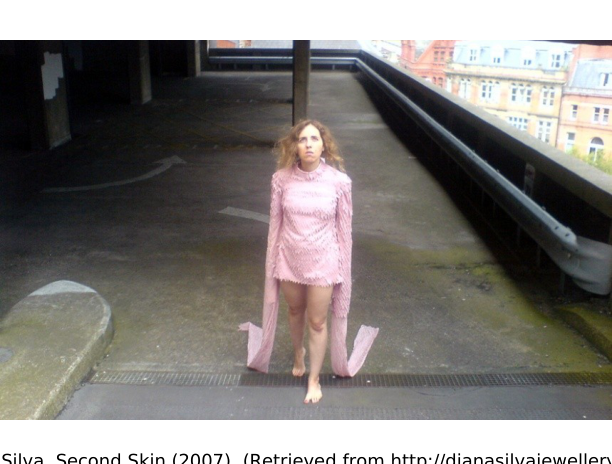
This is present in Diana Silva’s Second Skin (2007) (see Figure 1), a garment made of pink latex. Its scale texture represents a snake’s skin and, for that reason, it looks like she is leaving the past behind when wearing it: “The main idea was to protect myself from the outside. The shirt (…) looks like an armour (…). But since the material is similar to human skin, it’s like my metamorphosis into a serpent. The long sleeves (…) symbolize memories I haven’t let go” (Cabral, 2010, p.253). We realize that the act of wearing this outfit is intimately linked to the socially constructed symbolism over its characteristics, which is the connotation of a snake’s skin change. But in this work we can also grasp significance in the relationship the artist establishes with the surrounding space, because she is wearing it in a performance. Diana Silva choses to be filmed while walking in an empty space, like she were acting an introspective catharsis, far from the presence of others. This does not imply that she didn’t form a relationship with space, otherwise we couldn’t do this specific reading of her acting; or that she did not establish a relationship with others, as she wanted to be watched via the video she recorded. With this example, we can summarize two simultaneous qualities in costumes, which are wearing and inhabiting, and we could say, following the opinion of Merleau-Ponti
(as cited in Battcok & Nikas, 2010, p.5): “Our body is not in space like things; it inhabits or haunts space. It applies itself to space like a hand to an instrument; and when we wish to move about we do not move the body as we move an object. We transport it without instruments as if by magic, since it is ours and because through it we have direct access to space.”
Figure 1. Diana Silva, Second Skin (2007). (Retrieved from http://dianasilvajewellery.blogspot.pt/, 1
February 2014)
SHARING THE PERFORMANCE EXPERIENCE Both the action of the performer and the response from the audience, regarding the usage of textiles, have become tacit, if we take into account that we use textiles since we were born and that our construction and understanding of fashion’s codes is linked to our social contexts of interaction. In performance art, the communication of textiles is unveiled under combined premises; for example, if the body moves or stands still, if the set is linked to the costume itself, if a lightening effect changes the reading of a costume, if a costume is made of technological textiles, and so on.
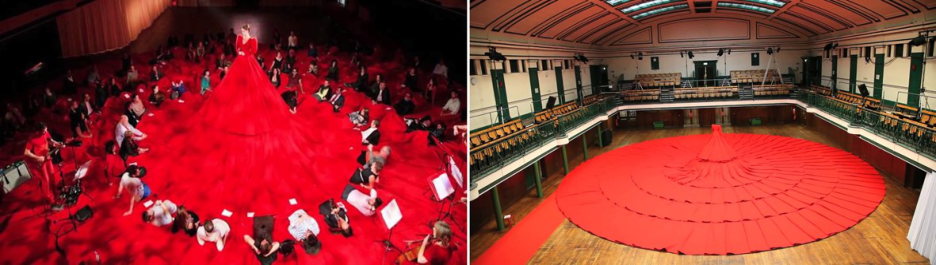
In Reddress (2004) (see Figure 2), Aamu Song places 238 people under the skirt layers of a 20 meter diameter dress installation, and she describes the dress not as a garment but as “space or furniture, where people can stay and share time” (Crane.tv, 2011). The audience is lying down covered by the red cloth while attending to a concert: there is a singer inside the bodice and upper skirt of the red dress. Consequently, an emotional bondage and a physical relationship between performer and audience is created by the fabric that connects them. The spectator almost feels the same physical sensation provided by the weight, texture and warmth of the fabric the singer does – a tactile sensation that also harmonizes the emotional charge of the music piece. The fabric is red, and Aamu Song explains the choice: “I wanted to symbolize a strong but warm woman, like my grandmother who is very beautiful and strong, like the dress” (Crane.tv, 2011).
Figure 2. Aamu Song, Reddress (2004), video by Crane.tv in collaboration with the London Design Festival 2011. (Retrieved from https://www.youtube.com/watch?v=YrApHtZda7Q, 27 February 2014)
Suddenly, the physical contact with the interactive installation becomes the simulacrum of wearing and feeling like the person flaunting dress; plus, it allows a spectator to «become» the singer. Besides this, the dress turns to be the set, since it changes the scale perception of the theatre room, delineating the perception field of the audience. The spectator thus wears the setting as he wears the dress installation, he becomes part of the performance space. In addition, he gets a sense of collective sharing of emotions by wearing the same attire the other spectators do. He also feels a sense of unity, due to a collective sharing and belonging of space among the other spectators.
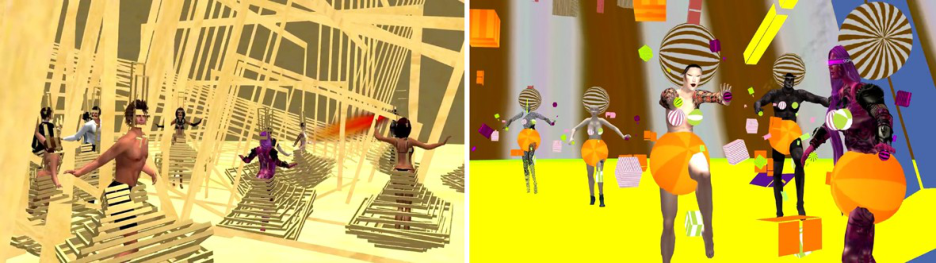
This spectator-wearer dimension is virtually explored by Oscar Wagenmans, by means of an alter-ego character called Save Me Oh, mainly in the video by Nina Camplin, called Wear to Move (2014) (see Figure 3). The character is a virtual female performer who invites others to collectively interact with her, in different virtual spaces, asking them to wear costumes that were designed for each setting. Save Me Oh gets volunteer avatars in Second Life to do it. By participating in the call, participants are able to both project themselves in an imagined space and perceive their presence in a dream-like reality. At the same time, they are able to observe themselves through a computer monitor, so they become performers and spectators of the same play they are acting in – and the distinction between what is real and what is virtual becomes blurred, in their level of perception. It’s then created a unity of performing and perceiving, as well as an inherent weirdness in re-creating both space and self, through a virtual conception.
This recreation became facilitated by the usage of costumes, since the experiment shows different conceptions of the self in each particular setting, and while the experiment could have been done with naked characters, the usage of particular costumes was, instead, mandatory. This self-awareness of each avatar performer resulted also from the awareness of the collective self, since the drive for acting of each individual was a response to the acting of others, as well as a consequence of what each costume allowed him/them to do (especially when all had to wear the same attire at the same time).
Figure 3. Oscar Wagenmans, Wear to Move (2014), Kraftje and Stripe scenes. Live performance from the 9th March 2014, held at Second Life. Video by Nina Camplin [Fuschia Nightfire]. (Retrieved from https://vimeo.com/88809335, 15 March 2014)
We witness that costumes pervade the environment and lead performers, by “creating new limitations and requiring them to move in new ways” (Dean, 2012, p.16), and also that “wearing the same costume often seemed to create a sense, among participants, of togetherness or alikeness” (Dean, 2012, p.15). It was this collectiveness of performer avatars that has also graphically delimited the boundaries of a non-existing (virtual) space in Wear to Move (2014), which was aesthetically and symbolically characterized by fashion imageries that were suggestive enough to involve the spectator. Plus, by being moving entities, the avatars triggered the spectator’s reflection on the flexibility they seemed to have, so different from the real body, thus reminding us of somatic costumes, as they “can allow both the performer and audience to experience visually, in space, reflections of the kinesthetic experiences a performer is working with” (Dean, 2012, p.20).
BODY PERCEPTION AND SOMATIC MOVEMENT In a performer’s perspective, life and performance tend to merge, considering that the performer finds his resources for acting among his life experiences and memories. Somatic approaches need to be considered due to the emphasis on one’s inner search for emotional states according to the plot´s requirements, both physically and psychologically speaking, centered on a total consciousness of the self being explored by the body’s physical activity and expression. Martha Eddy defines the usage of “a variety of skills and tools, including diverse qualities of touch, empathic verbal exchange, and (…) movement experiences” that are needed to achieve so (Eddy, 2009, pp.1-2). Linden refers somatic education, defining it as “the educational field which examines the structure and function of the body as processes of lived experience, perception and consciousness” (Linden, 1994, pp.1-2). Thomas Hanna, alluding to the meaning of soma, Greek word to describe body, says that “a soma isn’t a body and it isn’t a mind; it’s the living process”, since “the soma is a process of unified movement” (Hanna, 1991) that expresses the process of that same way of living. Hence, being and performing are alike, when acting relies on the performer’s capability to understand his body in complete tuning with his soul.
Sally Dean analyses her experience of wearing high heels and concludes that it implies a cognitive process of understanding what the gesture means to our body language and awareness of the self, as much it means to others, regarding the cognitive acquisition they make of it. She might indeed be a performer in everyday life, as Goffman (1990, p.29) defends and she notices. She says: “If I wear high heels, for example, I walk in an entirely different way that if I wear boots. My experience of my feet, and indeed of my whole body, is different; I create a quite different ‘character’, and the basis for my interactions with my environment and with others around me also changes” (Dean, 2012, p.2). The analysis of Sally Dean makes us ponder about men who wear high heels in demonstrations about domestic violence. Apparently, they become closer to women just by wearing an accessory exclusively made for them. In that moment, they seem not to be uncomfortable neither in the sense of being susceptible to social stigma, nor physically speaking due to tightness or pain. Instead, those factors seem to impel them to protest, more than to restrain them from doing so. These simple examples demonstrate that the frontiers between reality and performance art are, indeed, fragile.
Performance allows performers to enter a new reality and experiment sensations or even desires that can be motivated by several kinds of stimuli, being some of those, costumes. Alluding to Sally Dean’s practical projects, we focus on the workshop she gave during the Dance & Somatic Practices Conference on 2011, where participants
had to try several costumes on (see Figure 4). Topics such as awareness of the body, awareness of the body in space and awareness of the space between body and costume were explored (Dean, 2012, p.6). We turn our attention to a particular costume, the Bin Bag Skirt, composed of twelve to fifteen large inflated bin bags attached to the pelvis and hips. Instructions were given to participants, such as “walking while feeling their pubic bone, tail bone, iliac crests, sit bones through touch, and noticing how these shifts of awareness affected the movement of the body” (Dean, 2012, p.8). Testimonials were given by the participants around their experience, and one said: “I thought I was flying for some instants” (Dean, 2012, p.8). Curiously, by looking at the Bin Bag Skirt we could imagine clouds – or a clouded sky if considering a group of them –, presuming that they were light. But what if the volume, color and amount of bags would interfere in the reading of the costume, and therefore in the participant’s experience? That’s what must have happened with the participant who said: “I felt like a strange animal coming out of darkness to hunt” (Dean, 2012, p.17).
Figure 4. Sally E. Dean, Somatic Movement and Costume Project, Dance and Somatic Practices Conference 2011.
Figure available in the original PDF paper.
Costumes by Sandra Arroniz Lacunza and Carolina Reickhof, photography by Christian Kipp.
It seems that we can change the perception of what we are trough what we wear in performance – every time attire, interpretation and staging are tuned in order to establish a certain communication level with the audience. Schlemmer showed having a rational approach to costumes, as we can see in the silhouettes for the Triadic Ballet show, designed to be one element in three, in order to be perceived in a unit of both tangible and intangible elements, being those dance, costumes and music (Goldberg 2011, p.111). Those outfits resembled sectioned geometric shapes, combined and set on top of each other, thus amplifying the titration of the body. Comfortable or not, the costumes still remain unique nowadays, and they are mainly characterized per not defining nor showing much of the human body. The garments, that somehow remind us of the above mentioned Kawakubo’s body distortion, not only distort the body shape, but also influence one’s body awareness and possible movements – by restraining them due to the exaggerated volume. Mulato and Queiroz (2012, p.163) describe the movements they allow as being more robotic than human, showing us that attire and movements go hand-in-hand.
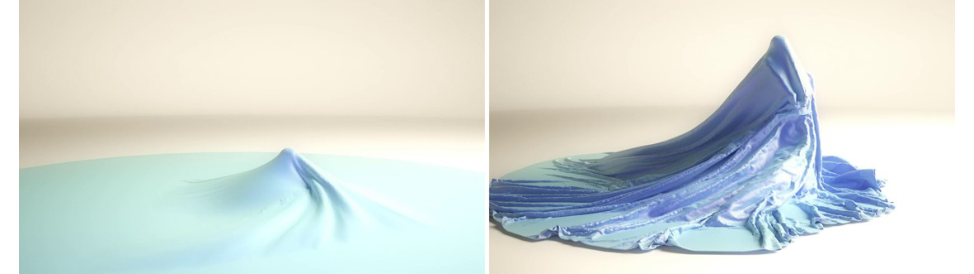
In Cloth Dance (2012) (see Figure 5), Vahid Tehrani shows us a video that explores the connection between body and cloth, giving us underlying messages on that same ergonomic relationship. First of all, the fabric resembles a water surface, due to being blue and oval shaped. Suddenly, a figure, which we identify as a human body, rises underneath the fabric (water) surface without emerging it. Despite the conflicting readings of the event, our first interpretation of the underlying message is of a unification of flesh and water, because the person we see never gets free from the fabric on the one hand, and on the other, we can interpret the body movement as being also the one of the water. Another reading could be the struggle of a performer to control the fabric as an extension of the body, since living surrounded and covered in textiles is almost a human condition. Although what is shown to us is a realistic animation video, the performance it shows could indeed be real.
Figure 5. Vahid Tehrani [Vahid 3D], Cloth Dance, 2012, video. (Retrieved from https://vimeo.com/36279283, 24 February 2014)
With the purpose of defining a narrative during the duration of the video, Vahid Tehrani uses the constraint of the body as a theme. If it were real, the fabric covering the body from head to toe would make us wonder about the performer’s comfort and discomfort sensations. While seeming not to be see through, the fabric would possibly leave the wearer lost in the notion of space; yet, its length, weight and body-hugging features would permit a precise perception and control of body movements.
DISCOMFORT AND EMOTIONAL OUTCOME The primary conceptual stage of costume design may rely on a keyword personification of garments, based on the interpretation of the character’s personality and hierarchy in the plot. Therefore, costumes play an important role in performance on account of embodying the character’s self. But it’s the performer’s drive that leads the audience to truly perceive its characteristics. Being correlated to the costume’s shape, weight, tightness, size, texture or color, tactile and kinesthetic sensations can either be faked or truly felt by the performer, to so better be interpreted by the viewers. In addition, “people seem to transfer the perceived tactual qualities directly to the product personality: a cold object expresses a cold personality and a flexible product may be experienced as a flexible personality” (Sonneveld & Schifferstein, 2008, pp.56-57), which suggests that the acting should be accordingly, since, as António Lagarto explains, costumes aren’t the actor’s skin, but the character’s one (Santa Clara, 2009, p.111).
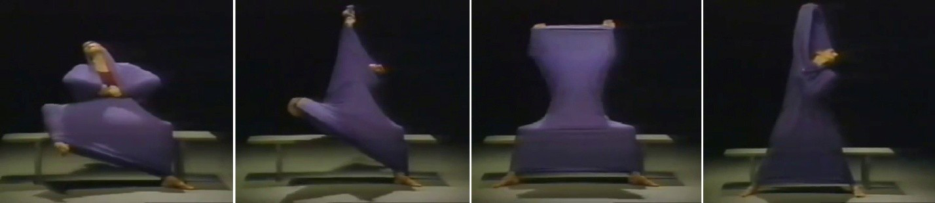
Lagarto reflects on the importance of considering instilling discomfort (or even immobility) through costumes, both physical and visually speaking, mentioning that by that way they can positively contribute to the construction of characters (Santa Clara, 2009, p.111). That’s present in Martha Graham’s work, as the example of Lamentation (1930) indicates (see Figure 6). The choreographer explains: “Lamentation (…) is the tragedy that obsesses the body; and the garment that is worn is just a tube of material, but it’s though you were stretching inside your own skin.” (Marques, 2007). A dancer explores her grief through moving on a bench while remaining sited, lifting her arms and legs and turning her torso around in order to follow the piano music piece by Zoltan Kodaly. We can only see the naked feet, hands and face, and even when she stands up, she never undresses the tube, rather stretches it along with the body movement, a movement that is restrained. By watching this, a spectator, mourning for her son, told Martha Graham that “the grief was honorable, that it was universal and that she did not be ashamed to cry” (Marques, 2007). The tension felt by this spectator was also due to the costume’s restraint, leading us to assume discomfort as a tool, as it can be explored to enrich the perceived emotional outcome.
Figure 6. Martha Graham, Lamentation (1930). Performed by Peggy Lyman in 1976. A Thirteen/WNET and Martha Graham Dance Company production, 1976. (Retrieved from https://www.youtube.com/watch?v=xgf3xgbKYko, 24 February 2014)
We need to define discomfort, so as to distinguish somatic costumes from uncomfortable ones, although these last ones can allow a somatic experience. Vinik and Looze (2008, p.441) mention that there is no such thing as a general notion of comfort and discomfort, and Li gives us an overall definition that we associate to the fruition in performance art, saying that “comfort depends on subjective perceptions of visual, thermal and tactile sensations, psychological processes, body-apparel interaction and external environmental effects” (as cited in Roy Choudhury, Majumdar & Datta, 2011, p.2), and we could say: so does discomfort. We allude to sadomasochistic attire, for example, which contributes to explore the limits of the unbearable, towards a pleasurable fruition, to conclude that sometimes the more realistic a tactile feeling or a psychological distress is inflicted, the more convincing an interpretation might be. Textiles promote a sense of renewal in the performer, inducing sensorial responses during acting. Therefore, a user-centered design approach to costume design seems to be increasingly significant in the realm of performance art, having in mind the subjective notions that Li describes when referring to comfort/discomfort.
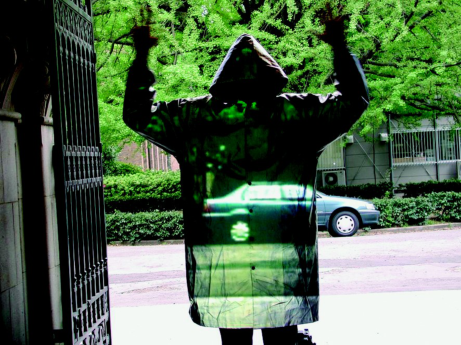
Wondering about the potentialities of technological textiles in this respect, we analyze Atsuko Tanaka’s Electric Dress (1956). Although it wasn’t made of textiles, it could be, namely with embedded leds, if designed nowadays. The artist appears dressed in both round and elongated light bulbs that cover all her body, with their power wires hanging to the floor. Obviously, the attire couldn’t be comfortable for the weight and mess, not to mention the heat caused by the lightening. The communicative aspect was therefore reinforced by the choice of materials and what they might have represented at the time, captivating the minds of the observers, who must have wondered which kind of character she was embodying. Another attire, that, in turn, stimulates the enquiring on the perception of the performer’s spatiality, is the Invisibility Cloak (2003) (see Figure 7). In 2003, the Tachi Laboratory creates a garment resembling a movie screen, made of retro-reflective material in which a projection of the background of the wearer turns him «invisible». Susumo Tachi explains how it works: “microscopic beads on the surface of the coat have the function of retro-reflection” and that “since the cloak the subject is wearing (…) reflects back the incident light just the same direction it comes from, an observer looking through a half mirror sees a very bright image of the scenery so that he is virtually” (Tachi, 2003, pp.6-7).
Figure 7. Tachi Laboratory, Keio University & The University of Tokyo, The Invisibility Cloak (2003).
We therefore question how such outfit, under the realm of a performance – and by removing the performer’s image from its setting, through merging it with the background – would affect the audience’s interpretation. Would it confuse the audience due to an augment reality that influenced the unpredictable presence or absence of the performer? How would he then play with the inconstancy of the audiences’ reaction? Would he feel exposed or protected – comfortable or uncomfortable – by wearing a garment that would place him between two perceptive dimensions? To him, during this product-user interaction, “the inputs from the various senses should be integrated in order to give rise to a unified multisensory product experience” (Shifferstein & Spence, 2008, p.151), which would be a quite fulfilling experience, though complex. With this prototype, we realize that technological textiles, such the ones that change their shape or react to stimuli, can more easily make us imagine and convey other realities by their dynamic features than the traditional ones. Nonetheless, they might bear new approaches to ergonomics due to their novelty, new relationships with the human body and environment, and consequent symbolic discourses they might promote, either in fashion or costume design – and we wonder what kind of surprises performance art holds for us, with their inclusion, for the years to come.
CONCLUSIONS
The exploration between body, costume and fashion design, and of the character’s inner and boundary space, in the realm of performance art expression and acting, leads to countless meanings in terms of communication to viewers, as it also does to the performer in conceptual terms. The relationship between garments and artistic expression seems to be a never ending quest.
Functionality and cognition go hand-in-hand, since costumes and body relate to each other in gesture, being constrictive garments a valid contribution to convey a more convincing emotional interpretation. Gesture, body and costume interaction and related constraints create an artistic expression able to communicate to the audience inner emotional and symbolic feelings as they share kinesthetic and somatic experiences and perceptions. Costumes behave as triggers for an enhanced acting, since shape, weight, tightness, size, texture or color are a range of tactile and kinesthetic sensations that can either be faked or truly felt by the performer, so contributing to a better interpretation of the plot and acting by the viewers.
Regarding the usage of the attire by the performer, friendly and «non-user-friendly» costumes can undertake different metaphors and interpretations, the same way they can convey different comfort or discomfort perception levels to the audience, either physical or psychological. Shapes, materials, fashion and clothing concepts, meanings and symbolisms have a main role and effect on the performer self-image and self-expression, leading to different character’s embodiments that he represents and conveys. Ergonomics and fashion have a direct relationship in the performer’s actions as they are directly linked to what he - and the audience - feels and sees on his body. Body and costume become one and only.
Finally, virtual costumes cannot be physically comfortable nor uncomfortable. Nevertheless, the way we perceive them is as actually being so – we do not need to wear them so as to feel them. The sensation of inhabiting the same space of a virtual character also contributes to that feeling. In fact, wearing a costume is also inhabiting a set, since we are able to transfer ourselves physicality to objects. Both space and garments become fictional projections of body limits, and can generate meanings to be conveyed, while being conceptual interventions and physical extensions of a performer.
REFERENCES
Battcok, G., Nikas, R. (2010). The Art of Performance: A Critical Anthology. UbuWeb Edition. Retrieved from http://anticlimacus.files.wordpress.com/2013/03/battcock_the-art-of-performance_19841.pdf Cabral, A. (2010). Fashion and Contemporary Work of Art: Approaches, Practices and Cross-Contaminations in the Work of
Joana Vasconcelos. Master of Arts. Lisbon: College of Architecture of the Technical University of Lisbon. Crane.tv (Producer), (2011). Aamu song, REDDRES [video file]. Retrieved from https://www.youtube.com/watch?v=YrApHtZda 7Q Dean, S.E. (2012). ‘Somatic Movement and Costume: a Practical, Investigative Project’. Retrieved from http://www.sallyedean.
com/wp-content/uploads/Somatic-Movement-and-Costume.pdf De Preester, H. (2007). ‘To Perform the Layered Body – A Short Exploration of the Body in Performance’. Janus Head, 9 (2), 349-383. Amherst, New York: Trivium Publications. Eddy, M. (2009). ‘A Brief History of Somatic Practices and Dance: Historical Development of the Field of Somatic Education
and its Relationship to Dance’. Journal of Dance and Somatic Practices, 1 (1), pp.5-27, Intelect Ltd, DOI: 10.1386/jdsp.1.1.5/1. Falzon, P. (2005). ‘Developing Ergonomics, Developing People’. Proceedings of the 8th South East Asian Ergonomics Society Conference SEAES-IPS International Conference Bridging the Gap, May 23-25 2005. Denpasar, Bali, Indonesia, 1-10. Goffman, E. (1990). The Presentation of the Self in Everyday Life [1959], London: Penguin Books. Goldberg, R. (2011). Performance Art, 3rd ed. London and New York: Thames & Hudson. Grotowski, J. (1969, November 27). Jerzy Grotowski on the Notion of Poor Theatre (JM Drot) [Video file]. Retrieved from
http://fresques.ina.fr/europe-des-cultures-en/fiche-media/Europe00064/jerzy-grotowski-on-the-notion-of-poor-theatre. Hanna, T. (1991). A Conversation with Thomas Hanna, Ph.D. by Helmut Milz, M.D.. Somatics: Magazine-Journal of the Bodily Arts and Sciences. Spr/Sum 1991, III (2), pp.50-56. Retrieved from http://somatics.org/library/mh-hannaconversation.html Ingold, T. (2000). The Perception of the Environment: Essays on Livelihood, Dwelling and Skill. London and New York:
Routledge. Linden, P. (1994). ‘Somatic Literacy: Bringing Somatic Education into Physical Education’, Columbus Center for Movement Studies, 12p. Retrieved from http://www.being-in-movement.com/content/somatic-literacy-bringing-somatic-education- physical-education Marques, A. [Arthur Marques] (2007, December 12). Martha Graham – Lamentation 1930 [video file]. Retrieved from
https://www.youtube.com/watch?v=xgf3xgbKYko Mulato, A. & Queiroz, J. (2012). ‘Estudos Aplicados Sobre o Ballet Triádico’. Anais do 7º Congresso de Iniciação Científica, Tecnológica e Artística, pp.160-162. Senac. ISSN 2176-4468. Retrieved from http://www3.sp.senac.br/hotsites/campus _santoamaro/cd/arquivos/pesquisa/2013/anais_vii_cicta.pdf Roy Choudhury, A.K., Majumdar, P.K. & Datta, C. (2011). ‘Factors Affecting Comfort: Human Physiology and The Role of
Clothing”, in Guowen Song (ed.), Improving Comfort in Clothing, The Textile Institute and Woodhead Publishing, Cambridge, pp.1-60. Ruhrberg, K. [et al.] (2005). Arte do Século XX, vol.I, Köln: Taschen GmbH. Santa Clara, G.M. (2009). O Desenho de Figurino e a Formação Académica. Mestrado. Lisboa: Faculdade de Belas Artes da Universidade de Lisboa. Shifferstein, H. & Spence, C. (2008). ‘Multisensory Product Experience”, in Schifferstein Hekkert (ed.), Product Experience,
Elsevier, pp.133-161. Sonneveld, M. & Schifferstein, H. (2008). ‘The Tactual Experience of Objects’, in Schifferstein Hekkert (ed.), Product Experience, Elsevier, pp.41-77. Stephens, J.G. (2011). Modern Art and Modern Movement: Images of Dance in American Art, c.1900-1950. PhD Thesis.
Lawrence: Faculty of the Graduate School of the University of Kansas. Tachi, S. (2003). ‘Telexistence and Retro-reflective Projection Technology (RPT). Proceedings of the 5th Virtual Reality Internationl Conference (VRIC2003), pp.69/1-69/9, Laval Virtual, France (2003.5). Viggiani, M.F. (2011). ‘Utilizando a Ergonomia na modelagem da Lingerie’. Anais do VII Colóquio de Moda, 10p. Retrieved
from http://coloquiomoda.com.br/anais/anais/7-Coloquio-de-Moda_2011/GT13/Comunicacao-Oral/CO_88564Utilizando _a_ergonomia_na_modelagem_da_lingerie_.pdf Vinik, P. & De Looze M.P. (2008). ‘Crucial Elements of Designing for comfort’, in Schifferstein Hekkert (ed.), Product Experience, Elsevier, pp.441-460. Warr, T. (2013). 'The Practice of Space: Hayley Newman & Emily Speed'. Retrieved from http://www.castlefieldgallery.co.uk/
Advances in Ergonomics In Design, Usability & Special Populations: Part I
Read this individual research paper free through the original publisher, or explore the full digital proceedings book.
ISBN 978-1-4951-2106-7
Explore this ISBN in the AHFE Bookstore ↗Listed in the July 2026 bookstore catalogue; search by ISBN to confirm current availability · Digital book purchase optional