Christianne Falcão, Marcelo M. Soares (2022). Applications of Haptic Devices & Virtual Reality in Consumer Products Usability Evaluation. In: Advances in Ergonomics In Design, Usability & Special Populations: Part I. AHFE Open Access, vol. 18. https://doi.org/10.54941/ahfe100804
Usability has come to play an important role in interface design. Product usability focus on product ease of use first and foremost with consideration to users demographics, experience level and user requirements to serve the population efficiently. Virtual reality technologies provide novel and enhanced modes of human computer interaction that can be used as a potential tool to support product usability testing in far more efficient way starting from early project stage. The interaction component of this high-end user interface involves multiple sensory channels, such as the visual, auditory, haptic, olfactory, and taste inputs. Significant research has been done in this area but researchers have not yet provided an assessment on the relative impacts on VR systems development. Haptic devices allow users to touch, feel and manipulate three-dimensional objects in virtual environments and this technology started to get worldwide recognition and use in manipulation-intensive applications. Although the applications of haptic devices have several advantages over other methods for the development of consumer products, the VR systems also have some limitations; this is partly due to the complexity of interaction devices and haptic feedback processing. This paper presents a conceptual approach to haptic feedback for product design and consumer products usability evaluation.
Haptics is the science of touch. The word derives from the Greek ' haptesthai' (or touch) and is related to “being able to come into contact with” (Aziz & Mousavi, 2009). The study of haptics emerged from recent advances in virtual reality. Virtual reality (VR) is a high quality computer-user interface that involves simulation in real-time and interactions through multiple sensory channels with feedback in virtual environments. These sensory modalities are visual, hearing, tactile, and olfactory and taste (Burdea & Coiffet, 2003).
Visual and auditory feedbacks are relatively well developed and attract a great deal of research. In contrast, the feedback associated with touch (or haptic) remains a challenging research problem. Several researchers referred to the unavailability of devices with the full capability to support haptic systems due to complicated structure of the Ergonomics In Design, Usability & Special Populations I (2022) underlying physiology of these processes, expense hardware and software, complexity and limited workspace (Boud, Baber & Steiner, 2000; Lecuyer et al., 2000; Srinivasan & Basdogan, 1997).
In product design, VR can be considered as a "communication channel " (Reich et al., 1996) among designers and users, since a virtual environment enables designer to simulate, analyze and test the product, combining field and laboratory studies, allowing the user to interact with the product in a similar context to the real situation. At the same time, allowing researchers to control the variables and safety conditions (Bruno & Muzzupappa, 2010; Reich et al., 1996). VR can be applied in almost all stages of product design and development; however greatest benefits can be achieved in the prototyping (Bordegoni, Ferrise & Lizaranzu, 2011). Virtual Prototyping is based on the simulation in a realistic three-dimensional Virtual Environment of the functionality expected from the new product. Virtual prototyping technologies can reduce the time and costs associated with the development and construction of new products and bridge the disciplinary and distance gaps among different collaborators working on the same project (Lu, Shpitalni & Gadh, 1999).
The sense of touch appears to be fundamental to assess the properties of a product. This need becomes evident as a result knowing that vision and / or hearing senses are not sufficient to permit the recognition of objects. In this case, it is necessary to use devices linked to haptic VR systems for identifying objects. Haptic devices allow enhancement to virtual environments by enabling users to 'touch' and feel the simulated objects they interact with. This sensory channel complements the visual and sound feedback modalities used in current VR simulations (Burdea, 2000).
This study outlines several haptic devices and demonstrates the potential benefits of application this technology on consumer product usability evaluation. This theme has been developed by the Research Group on Design and Ergonomics of the Postgraduate Program in Design at Federal University of Pernambuco in Brazil. This paper intends to investigate the suitability of using VR in the evaluation of usability of consumer products. The research investigates the potential of Virtual Reality Technology, such as haptic interaction in usability evaluation of consumer products during the prototyping stage.
USABILITY AND VIRTUAL REALITY Usability was first introduced by Shackel (1986), and well-defined as to the approach of Human-Computer Interaction (HCI). Many studies in HCI seek to apply this concept to support usability in consumer products (Han et al., 2001; Jordan, 1998; Kwahk & Han, 2002). The objective is to develop transparent interfaces, capable of enabling an interaction easy, pleasant, effectively and efficiently, allowing the user to fully control of the environment without becoming an obstacle during the interaction (Nielsen, 1993).
The definition of usability is sometimes shortened to 'ease of use', but this offers poor information about the user interface. From a better known concept, usability is defined as the ability of a product or system to be used in an effective, efficient and enjoyable way by a specific range of users for tasks that need specific tools within a given environment (Falcão e Soares, 2012).
In order to measure the level of user satisfaction, as well as effectiveness and efficiency of the product, usability testing is a required process. Usability evaluation allows designers to see what users actually do when they use the product, what works best for them and their preferences. Usability testing refers to activity that focuses on observing users using a product, performing tasks that are real and meaningful to them (Bamum, 2011).
During usability testing, the virtual prototype should be viewed and interacted with by all the actors involved in its design, including the potential users, as if it was a real physical product. This is where VR can play a significant role since it can allow evaluating various alternative solutions and compared in quite a realistic and dynamic way, not only visually but also considering other interaction aspects such as sound and force feedback. From stereoscopic visualization and haptic feedback, VR simulation provides a more realistic interaction with the prototypes than possible with Computer Aided Design (CAD) prototypes (Park, Son & Lee, 2008). Chen et al. (2005) e Lian et al. (2005) suggested that haptic could be used in nearly all the phases of product design. Gao et al. (2006; 2012) has been developed haptic function evaluation of products methods.
Ergonomics In Design, Usability & Special Populations I (2022)
For interactions with virtual prototypes, the motion and behavior of virtual objects should be realistically simulated besides realistic visual feedback. That involves the human hand, as in the case of performing operations in the real physical world. Data-glove provides the possibility of tracking the user's hand and finger motions in 3D space (Han & Wan, 2010; Jimeno & Puerta, 2007). This type of device allows users to interact in a virtual environment. Interaction is connected with communication between user and VR system. It is defined for the capacity of detecting user motions and actions (user inputs) and refreshing virtual environment.
Besides interaction, there are important factors for experience in VR from the physical and psychological user point of view. Burdea & Coiffet (2003) suggest that VR is the integration of three vertices (I³) - immersion, interaction and imagination.
Immersion is a key issue in VR systems, because it is fundamental for the paradigm where the user becomes part of the simulated world instead of the simulated world being a characteristic of the real world (Thalmann, 1997). Gutiérrez et al. (2008) classified the types of immersion on the basis of the physical configuration of a VR user interface: fully immersive (head-mounted displays - HMDs), semi immersive (large projection screens), and no immersive (desktop – based VR). The level of immersion is measured by the ability of users to interact and communicate with the object in virtual reality in a way similar to how he/she interacts and communicates with objects in the real world. Thus, the less the perception (see, hear, touch) of the real world, the greater the classification of immersion in VR will be (Gutiérrez et al., 2008). Imagination is related to the user’s capacity to perceive nonexistent things and the will to believe that he/ she is in the VE, even while knowing he/she is physically situated in another environment (Burdea & Coiffet, 2003).
The applied researches has been focusing on integrating haptic devices into the design system (Dachille, Qin & Kaufman, 2001; Han & Wan, 2010; Liu et al., 2004; Sener et al., 2003; Zhu & Lee, 2004), since haptic modeling provides an intuitive and natural interaction between the designer and computer. These works mainly focused on the shape modeling by the tools and does not include the interaction between user and product. However, other researches with products already have being developed (Gao et al., 2012; Wang & Lu, 2009). Such systems is believed to provide solutions and design can be made interactively and easily than if the object were physical, which means more prototypes alternatives can be tested, which would be financially viable (Park, Son & Lee, 2008; Volkov & Vance, 2000).
HAPTIC DEVICES Haptic devices (or haptic interfaces) are mechanical devices that mediate communication between the user and the computer system. Haptic devices allow users to touch, feel and manipulate three-dimensional objects in virtual environments (Han & Wan, 2010; Tideman, van der Voort & Houten, 2006). The haptic system consists of the entire sensory, motor and cognitive components of the body-brain system, which is most often described as “proprioceptive” (Oakley et al., 2000).
The perception of touch is related to three components: tactile, cutaneous and kinesthetic. In humans, these sensations cannot be separated, but the same does not happen with the equipment developed to simulate these ones, for this reason there are devices that provide both or only one of them (Aziz & Mousavi, 2009; Oakley et al., 2000).
For interactions with 3D objects, the motion and behavior with virtual objects should be simulated with a realistic touch feedback. Burdea (2000) divides the haptic feedback modality in two groups: tactile feedback and force feedback. Tactile feedback allows users to feel the rugosity of virtual surfaces, their edges, temperature, or slippage. Force feedback reproduces the weight of grasped virtual objects, their mechanical compliance, inertia, as well as motion constraints. The Table 1 shows the definitions of each term related to haptic sensation. According Oakley et al. (2000), using these definitions, devices can be categorized and understood by the sensory system that they primarily affect.
Ergonomics In Design, Usability & Special Populations I (2022)
Table 1: Definitions of Haptic Terminology (Oakley et al., 2000).
Term Definition Haptic Relating to the sense of touch
Vestibular Pertaining to the perception of head position, acceleration, and deceleration.
Cutaneous
Pertaining to the skin itself or the skin as a sense organ. Includes sensation of pressure, temperature, and pain.
Force Feedback Relating to the mechanical production of information sensed by the human kinesthetic system.
Some haptic devices have been developed with the aim of offering new way to recognize and handle objects in VR environments. This can be as simple as joysticks with limited force feedback interactivity, as indicated in the research study by Bruno & Muzzupappa (2010). Bruno & Muzzupappa (2010), used a 3D joystick for virtual objects selection with usability testing in virtual reality. Meanwhile, a haptic device with a higher level of sophistication provides greater level of interaction and allows higher degrees of freedom in translation and rotation movement. Research literature indicates that haptic devices are divided into three main categories, according to their use: for hands, arms or legs, and body.
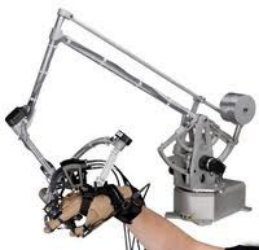
Hands Motion Capture The hands motion capture devices usually provide touch sensations to the fingers or hands of the user, such as pressure, heat or vibrations. The gloves are mentioned as the devices with the greatest natural interaction with objects. This kind of device is made up of sensors that measure the movement of each finger. Some of them also have sensors that measure the angles of some or all of the fingers and work with 3D trackers to find the position of the user’s hand. The glove CyberGrasp, for example, is the glove CyberTouch (Fig. 1.a) added with an exoskeleton (Fig. 1.b) (Fisher et al., 2003).
Ergonomics In Design, Usability & Special Populations I (2022)
a) CyberTouch glove b) CyberGrasp glove c) CyberForce
Figure 1. Three models of cyberglove. (images.google.com)
Maciel et al. (2004) investigated the potential of Cybergrasp to improve perception in Virtual Reality worlds. The success of most of the tests allows the authors to conclude positively on the use of this device for many applications in Virtual Reality. However, they also identified a set of drawbacks that require improvements to be done on the device. Maciel et al (2004) mentioned the lack of force smoothing procedures implemented in hardware, and the direction of applied forces that is limited to the hand opening direction. In addition, other factors, like tactile and visual feedback, seem to play an important role besides the force-feedback. According the authors, many applications are not possible, especially all which require very high frequencies like vibrations or contact with very irregular and very hard deformable objects. For those, the device known as PHANToMTM is more indicated.
Arms and Legs capture The devices for arms and legs motion capture aim to offer force-feedback. One of the reasons these are not focused on the sensation of touch is that the hands are more sensitive and used for this activity. Thus, although some offer touch and force feedback, its main function is to restrict the user's actions, according to their actions when used. One category of devices available on the market uses a kind of mechanical arm to provide sensations of touch and force feedback. One of the advantages of such devices is to allow movements with 6 degrees of freedom (DOF), well suited to applications with stereoscopic display. The PHANToMTM - Personal Haptic Interface Mechanism, from SensAble Company, is one of them. This device comprises a base which is linked to the mechanical arm and the end of which resembles a pen. When equipped with some sort of point of support, devices for hands can provide force feedback. Figure 1.c shows the glove CyberGrasp, mentioned in the previous section, added to a mechanical arm that provides force feedback. The CyberForce (fig. 1.c) also corresponds to an arm device.
Wang & Lu (2009) developed a real-time modeling and simulation system incorporating with PHANToM haptic for handheld design and evaluation. The product could be evaluated in the early stage of design and all the modeling, interaction and evaluation was carried out with the virtual model that could save both the cost and time.
Observing the examples of cybergrasp and cyberForce can be noticed the possibility of the user hold and manipulate virtual objects from multi-fingered haptic interfaces, that help to enhance realism and haptic perception. However, as pointed out by Maciel et al (2004), some applications are not compatible and adding the high price, these gloves have not been widely used as the PHANToM devices (Gao et al., 2012).
Other studies have pointed out to the combination of devices as means of improving the performance of the haptic interface. Nikolakis et al. (2004), proposed a combination of the PHANToM and the CyberGrasp devices in order to provide an enhanced of haptic feedback. Gao et al. (2012) used a dual PHANToM interface to generate internal force output and allow the feel of the elasticity of the products.
Thus, the decision of which device to use and how they should be applied must take into account the complexity of the 3D environment and the task the user is asked to perform. However, the application of these devices still has Ergonomics In Design, Usability & Special Populations I (2022) many limitations. Despite that haptic devices provide a significant kinesthetic feedback, the lack of tactile sensations reduces the realism of the simulation. As pointed by Ferrise, Bordegoni & Graziosi (2013), the representation fidelity of haptic control behavior is high, but interaction tests with product is limited to pressing buttons while other gestures in the product global use hasn’t been considered.
Body Motion Capture The haptic devices capturing the body movement are actually platforms designed to provide vibration or interactions with the user sense of balance. In some cases they are treated as haptic devices which do not allow perceive objects but fumbling with the balance of the body, they are commonly known as mobile platforms and are widely used by the entertainment industry in making videogames. Civil aviation and the automobile industry, in turn, make use of these platforms for a long time to build flight simulators (Guerlesquin et al., 2012; Jimeno & Puerta, 2007; Moreau, Fuchs & Stergiopoulos, 2004).
CONCLUSIONS
This research paper intends to illustrate and present the state of art in haptic devices in order to improve user interactions and the potential application of the tool applied in the evaluation of product design. Due to the necessity of working closer with user's domain in usability test, 3D tasks have been suggested as tools and applications which allow the user to work as in a realistic environment. Researches pointed out and claimed the need to provide feedback by manipulating physical input devices that represent the virtual objects. The development of haptic devices and adapting the technology to the needs of research design is an important step to fill the gap between knowing what we want to do and how to achieve product intended use or goals.
Despite the enthusiasm surrounding haptic, much work has been done to advance the technology and to create useful haptic systems. However, major innovations are still required to achieve the intended VR implementation for consumer product design. Progress in haptic interfaces research is much slower than that in visual (i.e. displays and image generation), however the current state of hardware to manipulation of product prototype in virtual environment is not satisfactory in most of the cases. Among them researchers highlight the need for more sophisticated devices that provide more realistic tactile and force feedback, as well produce lighter, simpler and easy to use shapes. Researchers believe that this problem can be solved in the future with innovation in VR and technological advances.
ACKOWLEDGMENTS This research has been sponsored by Brazilian Federal Agency for Support and Evaluation of Graduate Education - CAPES and the National Council of Scientific and Technologic Development – CNPq.
REFERENCES
Aziz, F. & Mousavi, M. (2009). A Review of Haptic Feedback in Virtual Reality for Manufacturing Industry. Journal of Mechanical Engineering, Vol. ME 40 (1). Barnum, Carol. (2011). Usability testing essentials: ready, set … test! . Burlington: Elsevier. Bordegoni, M.; Ferrise, F.; Lizaranzu, J. (2011). The use of interactive Virtual Prototypes for products specification in the
concept design phase. Virtual Reality Conference (VR) Proceedings IEEE, pp.197-198. Boud, A.; Baber, C. and Steiner, S. (2000). Virtual Reality: A Tool for Assembly?. Presence, 9(5), pp. 486-496. Bruno, Fabio; Muzzupappa, Maurizio. (2010). Product interface design: A participatory approach based on virtual reality.
International Journal of Human-Computer Studies 68 (2010) 254 – 269. Burdea, G., & Coiffet, P. (2003). Virtual reality technology (2nd ed.). New Brunswick, NJ: Wiley/IEEE Press. Burdea, Grigore. (2000) Haptics Issues in Virtual Environment. Proceedings of Computer Graphics International. p. 295-302. Chen, Y.H., Yang, Z.Y., and Lian, L.L. (2005). On the development of a haptic system for rapid product development. Ergonomics In Design, Usability & Special Populations I (2022)
Computer-Aided Design, 37, 559-569. Dachille, F.; Qin, H. and Kaufman, A. (2001). A Novel Haptics-based Interface and Sculpting System for Physicsbased Geometric Design. Computer-Aided Design, Vol. 33(5), pp. 403-420. Falcão, Christianne S. & Soares, Marcelo M. (2012). Ergonomics, usability and virtual reality: a review applied to consumer
product. In: Rebelo, F. e Soares, M.M. Advances in usability evaluation. Part II. CRC Press, Boca Raton, USA, p. 297-306. Ferrise, F.; Bordegoni, M & Graziosi, S. (2013). A method for Designing Users' Experience with Industrial Products based on a Multimodal Environment and Mixed Prototypes. Computer-Aided Design & Applications 10 (3): 461-474. Fisher, A.; Mavroidis, C.; Bar-Cohen, Y. and Melli-Huber, J. (2003). Haptic Devices for Virtual Reality, Telepresence and
Human-Assistive Robotics. In Bar-Cohen, Y. & Breazeal, C. Biologically inspired intelligent robots. Washington, SPIE. Gao, Z.; Chen, Y.; Lian, L. (2006). Haptic aided soft-touch multi-material product design. Proceedings of Virtual Environments, Human-Computer Interfaces and Measurement System, July, Coma - Spain. Gao, Z.; Wang, Jiehua; Jiang, Z. (2012). Haptic perception evaluation for the virtual prototyping of elastic hand-held product
designs. Virtual and Physical Prototyping, 7:2, 117-128. Avaliabel at <http://dx.doi.org/10.1080/17452759.2012.688491> [Accessed February 2013]. Guerlesquin, G.; Mahdjoub, M.; Bazzaro, F.; Sagot, J. (2012). Virtual reality as a multidisciplinary convergence tool in the product design process. The Open Cybernetics & Systemics Journal. Available at: http://www.iiisci.org/journal/CV$/sci/pdfs/HFA101DF.pdf. Gutiérrez, M. A.; Vexo, F. e Thalmann, D. (2008). Stepping Into Virtual Reality. Lausanne: Springer. Han, Sung; Yun, Myung; Kwahk, Jiyoung, Hong, Sang. (2001). Usability of consumer electronic products. International Journal
of Industrial Ergonomics 28: 143-151. Han, X. & Wan, H. (2010). A Framework for Virtual Hand Haptic Interaction. In Z. Pan et al. (Eds.): Transactions on Edutainment IV, LNCS 6250. Springer-Verlag Berlin Heidelberg. P. 229-240.
Jimeno, A. & Puerta, A. (2007). State of the art of the virtual reality applied to design and manufacturing processes. The International Journal of Advanced Manufacturing Technology. Vol. 33: 866-874. DOI 10.1007/s00170-006-0534-2. Jordan, P.W. (1998). An introduction to usability. London: Taylor & Francis. Kwahk, J.; Han, S. H. (2002). A methodology for evaluating the usability of audiovisual consumer electronic products. Applied
Ergonomics 33: 419-431. Lecuyer, A.; Coquillart, S.; Kheddar, A.; Richard, P. and Coiffet, P. (2000). Pseudo-haptic feedback: can isometric input devices simulate force feedback? IEEE International Conference on Virtual Reality, New Brunswick, NJ, USA, pp. 83-90. Lian, L.L., Chen, Y.H., and Yang, Z.Y. (2005). Haptic rendering: an approach to tactile property perception in early product
design. Proceedings of the Institution of Mechanical Engineers Part B-Journal of Engineering Manufacture, 219. p. 891- 902. Liu, X.; Dodds, G.; McCartney, J. and Hinds, B. K. (2004). Virtual Design Works – Designing 3D CAD Models via Haptic Interaction. Computer-Aided Design, Vol. 36(12), pp. 1129-1140. Lu, S. C-Y.; Shpitalni, M; Gadh, R. (1999) Virtual and Augmented Reality Technologies for Product Realization. Annals of
CIRP Vol. 48. Available at < http://wireless.ucla.edu/gadh/pdf/99k.pdf > [Accessed March 2013]. Maciel, A.; Sarni, S.; Buchwalder, O.; Boulic, R. and Thalmann, D. (2004). Multi-finger haptic rendering of deformable objects.
Proceedings of Eurographics Symposium on Virtual Environments, 8-9 June 2004, Grenoble, France. Moreau, G.; Fuchs, P.; Stergiopoulos. (2004). Applications of Virtual Reality in the manufacturing industry: from design review to ergonomic studies. Mecanique & Industries, 5, 171-179. DOI: 10.1051/meca:2004018. Nielsen, Jakob. (1993). Usability Engineering. Boston: Academic Press. Nikolakis, G.; Tzovaras, D.; Moustakidis, S.; Strintzis, M. (2004). CyberGrasp and PHANTOM Integration: Enhanced Haptic
Acess for Visually Impaired Users. Proceedings of the SPECOM 2004 9th Conference Speech and Computer. St. Petersburg, Russia. Oakley, I.; McGee, M.; Brewster, S. and Gray, P. (2000). Putting the Feel in 'Look and Feel'. In Press, A. (ed). Proceeding of the SIGCHI Conference on Human Factors in Computer System. The netherlands, pp. 415-422. Park, H.; Son, J.; Lee, K. (2008). Design evaluation of digital consumer products using virtual reality-based functional behavior
simulation. Journal of Engineering Design, 19(4), 359-375. DOI:10.1080/09544820701474129. Reich, Y.; Konda, S.; Monarch, I.; Levy, S and Subrahmanian, E. (1996).Varieties and issues of participation and design. Design Studies 17(2): 165-180. Sener, B.; Pedgley, O.; Wormald, P. and Campbell, I. (2003). Incorporating the FreeForm Haptic Modelling System into New
Product Development. Proceeding of EuroHaptics 2003, Dublin, Ireland, July 6-9. pp. 26-38. Shackel, B. (1986). Ergonomics in design for usability. In People and computers: Designing for usability. Proceedings of the Second Conference of the BCS HCI specialist group, eds. M. D. Harrison and A. F. Monk, 23-26, 44-64. Cambridge: Cambridge University Press. Srinivasan, M. A. and Basdogan, C., (1997). Haptics in Virtual Environments: Taxonomy, Reasearch Status, and Challenges.
Computers & Graphics, Vol. 21(4), pp. 393-404. Thalmann, Daniel. (1997). Introduction to Virtual Environments. Proceedings of The International Conference on Multimedia Modeling. Available at <http://vrlab.epfl.ch/~thalmann/VR/Intro.pdf.>[Accessed January, 2010]. Tideman, M; van der Voort, M.C & van Houten, F. (2006). Haptic virtual prototyping for design and assessment of gear-shifts.
In: ElMaraghy, H. A.; ElMaraghy, W. H. (eds.) Advances in Design. Springer: Berlin. p. 461-472. Volkov, S. and Vance, J. M.. (2000). Effectiveness of Haptic Sensation for the Evaluation of Virtual Prototypes. Journal of Ergonomics In Design, Usability & Special Populations I (2022)
Computing and Information Science in Engineering, Vol. 1(2), pp. 123-128. Wang, J. & Lu, W. F. (2009). Development of a Haptic Modeling and Simulation System for Handheld Product Design and Evaluation. Proceedings of the ASME 2009 International Design Engineering Technical Conferences & Computer and Information in Engineering Conference. San Diego. Zhu, W. and Lee, Y.-S. (2004). Five-axis Pencil-cut Planning and Virtual Prototyping with 5-DOF Haptic Interface. Computer-
Aided Design, Vol. 36(13), pp.1295-1307.
Ergonomics In Design, Usability & Special Populations I (2022)
LISTED IN THE AHFE DIGITAL BOOKSTORE CATALOGUE
Explore the complete digital volume
Advances in Ergonomics In Design, Usability & Special Populations: Part I
Read this individual research paper free through the original publisher, or explore the full digital proceedings book.
ISBN 978-1-4951-2106-7
Explore this ISBN in the AHFE Bookstore ↗Listed in the July 2026 bookstore catalogue; search by ISBN to confirm current availability · Digital book purchase optional