Tomáš Kozík, Ivana Tureková, Róbert Bulla, Terézia Bagalová (2018). System of Lifelong Learning in Occupational Safety and Health in the Slovak Republic. In: Advances in Physical Ergonomics and Human Factors: Part I. AHFE Open Access, vol. 1. https://doi.org/10.54941/1005
Department of Technology and Information Technologies, Constantine the Philosopher University in Nitra, Nitra, Drazovska 4, 949 74, Slovakia b Labour inspectorate Nitra, Nitra, Jelenecká 49, 950 38, Slovakia ↗
The area of OSH is currently widely debated issue in the European Union and also in other countries of the world. It is a given fact that the level of development of OSH standards and their application in daily life of a human is directly related to the quality of life and economic development of society. In that connection there must be interest in the educational system that perform the task of preparing the public perception of the importance of OSH in the lives of individuals and the acquisition of respect the OHS rules in work and non-work activities.Legal norms and OSH measures are very precisely elaborated. However daily experience of real life shows the low level of perception, understanding and respect for the principles of safe work and human health protection at the workplace and during free time.Authors of the report analyzes the state educational program and the curriculum framework to answer the question, whether the current education system in the Slovak Republic in relation to current legal standards and rules adequately prepares graduates of particular types of schools, to show an interest for safe conditions of work and life in healthy environment.
Education is one of the means which contribute to increasing and maintaining a high standard of living of people across EU. To achieve this goal, it is necessary that the education and training in the field of health and safety be systematically implemented at all education levels from pre-schools to universities. It is therefore essential, as regards to lifelong learning of OSH, to create a system which provides a proper education and training for people performing work-activities related to health and safety or technical equipment safety on a commercial level as well as the level of civil servants, who provide attendance upon compliance with the regulations governing health and safety.
Advisory services, particularly technical and safety services, that is, safety technicians and certified safety technicians, play an important role in enterprise subjects in the area of employee and manager education. The expertise of these services along with the ability to educate and provide proper guidance highly affects the quality of the organization management.
1 EDUCATION AND TRAINING OF PROFESSIONALS IN THE FIELD OF OSH
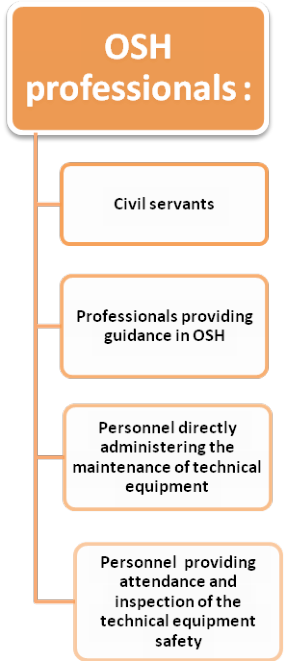
The roles of OSH professionals are highly differentiated. Division is explained in figure 1.
Figure 1. Division of professional workers in the field of OSH
1.1 Education and training of civil servants (labour inspectors)
Education and training of civil servants administering practical tasks in the field of labour inspection can be divided into two target categories: a) Training of the candidates for the appointment of a labour inspector
the point and the purpose of educating (training) these candidates , followed by passing the examination is to provide them with knowledge and skills necessary for being able to completely apply the legal and other standards regarding OSH.
b) Vocational Training and improvement of qualification of labour inspectors themselves The strategic objective of the concept is a permanent and continuous improvement of work performance and ethical behaviour, with the aim to develop a culture of service to citizens. Continuous education of civil servants is essential for the improvement of their performance and steam-lining the activities of those bodies of state administration, which grant professional growth and career evolution of civil servants.
1.2 Education and training of safety technicians
Safety technicians and certified safety technicians perform tasks like security service either as internal staff, or supplier form at a commercial level when these services are ordered by employers for employees. The professional contribution of safety technicians (ST) and certified safety technicians (CST) most often regards professional, methodological, organizational, inspection and coordination and educational tasks as well as other tasks regarding a higher level of safety and health. The conditions for earning a safety technician certificate or certified safety technician certificate are strictly defined by the law regarding OSH. The procedure of gaining the certificate is described in figure 2.
Part 1 – General requirements Part 1 – General requirements (basic OSH standards) (basic OSH standards)
Extent: at least 30 lessons Extent: at least 30 lessons
Completing the proffesional training in OSH under qualified
Completing the proffesional training in OSH under qualified
Part 2 – Special requirements
attendence
Part 2 – Special requirements
attendence
(MOP, hazard, technical safety
(extent 176 lessons)
(MOP, hazard, technical safety
(extent 176 lessons)
etc.)
etc.)
Examination Examination
Extent: at least 30 lessons Part 3 – Special requirements
Extent: at least 30 lessons Part 3 – Special requirements
12 hours of knowladge adjustment and consultation
12 hours of knowladge adjustment and consultation
(workplace factors, ergonomy) (workplace factors, ergonomy) Extent : at least 36 lessons Extent : at least 36 lessons
Part 4 – Special requirements Part 4 – Special requirements (faktory pracovného prostredia, (faktory pracovného prostredia,
Safety technician
Safety technician
ergonómia) ergonómia)
certificate certificate
Rozsah: najmenej 36 hodín / to Rozsah: najmenej 36 hodín / to isté??
isté??
2 year practice
2 year practice
appeal and documents appeal and documents
Secondary school or university examination with the content and the extent of OSH studies established after consulting with the state labor inspectorate
Secondary school or university examination with the content and the extent of OSH studies established after consulting with the state labor inspectorate
Oral and written examination Oral and written examination
Demostrable knowladge of legal and other regulations regardinbg OSH and ability
Demostrable knowladge of legal and other regulations regardinbg OSH and ability
before the examination committee appointed by
to practically apply them
before the examination committee appointed by
to practically apply them
the national labor
the national labor inspectorate inspectorate
Certified safety technician certificate
Figure 2. The procedure of gaining the certificate https://openaccess.cms-conferences.org/#/publications/book/978-1-4951-2104-3
Figure available in the original PDF paper.
Physical Ergonomics I (2018)
Professional duties and advisory services to ensure the safety and health at work are provided by a safety technician and certified safety technician especially under these employers´ obligations:
- Improve work conditions and adapt them - Identify a hazard in all actions carried out by employees - Assess risk and make a written document on risk assessment for all activities carried out by employees - Ensure that work place, communication, work equipment , materials, manufacturing process, organization of work and work places do not endanger safety and health of employees - Provide safety checks on technical equipment and a proper maintenance and adjustment of workplaces, tools and technical equipment. - Ensure that work environment factors (chemical, physical , biological), psychological factors regarding mental workload and social factors do not endanger safety and health of employees - Eliminate hazard and if to scientific and technical knowledge not possible, take measures to reduce it and prepare measures for elimination. - Replace strenuous and monotonous work and work under difficult, unsafe or hazardous working conditions with proper equipment, operating procedures, production processes and improvement of work organization. - Establish safe working practices. - Identify and provide protective measures to be taken and, if necessary, identify and provide protective equipment to be used. - Prepare in writing, regularly evaluate and update if necessary the policy concept of health and safety at work. - Issue internal regulations, rules on safety and health at work, give instructions on safety and health at work, and more.
Professional tasks in the field of safety and health at work for an employer who carries out tasks of a higher risk, which can while performing cause serious damage to the health of employees or which arise frequently health damage, are independently carried out by a certified safety technician. In the event of a serious accident at work, participation of an authorized safety technician in identifying the causes of this accident is essential.
Safety technicians and certified safety technicians certificate is issued for an indefinite period. ST and CST are obliged at least every five years after the certification to undergo an upgrade training in the extent of 16 hours under the attendance of a person eligible for education and training and who is a legal entity. Without an acknowledgement of completion of the update training, certificate is invalid.
1.3 Personnel eligible for assigned tasks and work equipment handling
To perform certain work tasks (e.g. maintenance, reconstruction, technical equipment installation) and being able to handle certain technical equipment (e.g. electrical, compression, lifting, gas) competence is essential. When using these particular machines, one must identify oneself with a valid ID or written document granting one´s professional training executed by inspection technician. Maintenance IDs are executed by a person eligible for education and training regarding the competent equipment category or a qualified entity.
1.4 Competent legal entity
Verifies that equipment safety requirements are met, under the authorization issued by the National Labour Inspectorate. The verification of equipment safety requirement comprises: a) Verification of professional competence of employer regarding professional inspection, professional examinations and maintenance of particular technical equipment.
b) Carrying out inspections, management, evaluation or execution of examinations.
c) Verification of knowledge of personal entities for examination execution, professional inspection and maintenance of particular technical equipment.
d) Assessing whether technical equipment, materials, building design documentation along with technical equipment documentation, and its changes meet the requirements regarding safety and health at work, and lastly, technical expertise execution.
Professional training and education of employees (compression, lifting, electrical and gas equipment inspectors as well as documentation and construction inspectors) who carry out verifications of meeting the requirements regarding technical equipment safety includes a job training period followed by qualification examination before the commission, consisting of two parts: oral and practical.
2 PILOT PROJECT
To find out the current status of quality and safety of advisory and technical services from the perspective of the audited entity - labour inspectors, the authors put together the pilot project. To obtain the necessary evidence base anonymous and voluntary questionnaire was used with the application of Internet communication with labour inspectors.
The aim of the pilot project was to determine how labour inspectors who work professionally at the Labour Inspectorate perceive the activities of the safety technicians in terms of educational achievement, quality of work and experience. There is a direct communication between many of the inspectors and safety technicians during inspection executions, advisory services provisions, or during various educational activities. The results of the survey conducted in the pilot project will be implemented by the authors into the design of the study program for future safety technicians.
The survey was conducted on a group of 35 respondents, 8 of which were women, representing 23 %. All respondents work as labour inspectors. The questionnaire was divided into 4 parts in terms of focus issues: 7 questions of a general nature were aimed at gathering the views of labour inspectors on the perception and evaluation of the quality of educational institutions, organization of various courses, availability and diversity among OSH literature.
4 questions were aimed at learning the opinions of experts on the content and quality of education, where the safety technician certificate is gained in higher education.
13 questions were based on an assessment of subject composition and content of the study program of OSH 3 of the questions, last of which has 7 sub-questions aim at learning what kind of skills and knowledge is expected from fresh graduates who have completed a bachelor´s degree in OSH before entering their first job.
Labour inspectors had the option to comment on asked questions with: yes, rather yes, I cannot judge, rather no and no.
The survey results The results of the questionnaire are shown in Table 1
Table 1 Results of the questionnaire survey of selected respondents demonstration:
Expected outcomes
Questions of general nature
OSH study program requirements
Requirements on school-leavers beginning their OSH studies
DISCUSSION
According to the first two questions, labour inspectors think that education and training of safety technicians ought to be carried out at university level. 77% of the respondents find this way of gaining competencies valid. None of the respondents answered with „rather no” or „no“ . Only 6% (2 of the respondents) cannot seem to assess the validity of university education for safety technicians.
A similar result was reached in the 5th issue. The aim of laying this question was to find out whether safety technician trainings carried out at educational institutions holding rights to this kind of education, in the extent of 176 lessons, is comparable and equally valid to university education in the field. It is essential to mention that these educational institutions executing the discussed trainings have gained their competencies from the National Labour Inspectorate and have met all the legal and other requirements as well. In its 176 lesson training executed due to well-defined time table established by accredited project, the training prepares the future safety technicians and proper documentation and certification is carried out. In contrast to these institutions, universities provide a better technical and biological basis, which is an important contribution for a future safety technician. Respondent attitude also shows the requirement to only accept those candidates who have successfully completed the entrance exams, that is, are interested in the studies and have met the requirements set by the university.
Question number four regarded quality of the knowledge. The study shows that 63% of the respondents feel, that knowledge quality of current safety technicians is insufficient, which is a rather poor state and an alarming signal in relation to preparation of executive safety technicians for practice.
The aim of another question was to find out what respondents – labour inspectors think of the amount of scientific literature and scientific works published in Slovak journals in the field of OSH. The survey confirmed that public is very poorly informed about the publishing activities of publishers and that the number of scientific publications on Slovak market is very low.
In the last issue of the first question group respondents prove that cooperation with universities on scientific project is very low. Only 5 of the respondents actually participate in joint research projects with universities. One of the ways to achieve higher cooperation of educational institutions and universities with scientific practice is the way of participation in joint research projects.
Second question group sought to obtain relevant information on the knowledge level and awareness of safety and health in secondary schools. The survey clearly showed that pupils in secondary schools receive insufficient information on OSH. The survey also indicated a better preparation of technical school graduates compared to students from the humanities. Answers to the questions in this group confirmed that students enter the university with insufficient knowledge on health and safety. It is important to note that not all graduates of secondary schools continue to further study at university, but many move on to execute their profession into real life where they are assumed to know the basic rules and have the proper knowledge on safety at work. One of the causes could be that not all of the secondary school teachers are fit to consign information on present day OSH issues. This might be, because of the long-time absence of an obligatory subject dealing with OSH in the educational system of future teachers (this has been confirmed by 77% of the respondents). According to the survey results, such an object should not be absent in the system of lifelong learning.
Another group of questions in the questionnaire was focused on the quality of education and the content of the OSH study program. Respondents confirmed that the training of specialists in the field of OSH should be participated by professionals. Student in their study of the OSH program should graduate from scientific practice or internships. Respondents find the 2 week long practice gained during bachelor studies insufficient or rather insufficient. The gained results also show that respondents do not find the practice at the Labour Inspectorate necessary, 30% of them were unable to comment on the matter. From this, we predict the conclusion that job candidates should gain professionalism, skills and experience in real-world practice conditions.
Additional requirements on the content of the study program OSH arising from questionnaire responses were as follows: [Equation or mathematical symbol available in the original paper PDF] Include the acquisition of lecturing skills that graduates apply for training in organizations into curriculum
• Part of curricula should be subjected to ergonomics, health and safety management, risk management and civil protection ,
• Lead the students of OSH to analyze problems and to be able to design realistic measures with concrete application outputs in the bachelor thesis.
• Include practical exercises designed to learn the methods of measurement and evaluation of working environment factors.
The conducted survey shows that most respondents agree that OSH is an applied scientific discipline with lots of topics to be investigated. University is the place providing proper conditions for scientific research on the matter and achievement of scientific outputs for practical application.
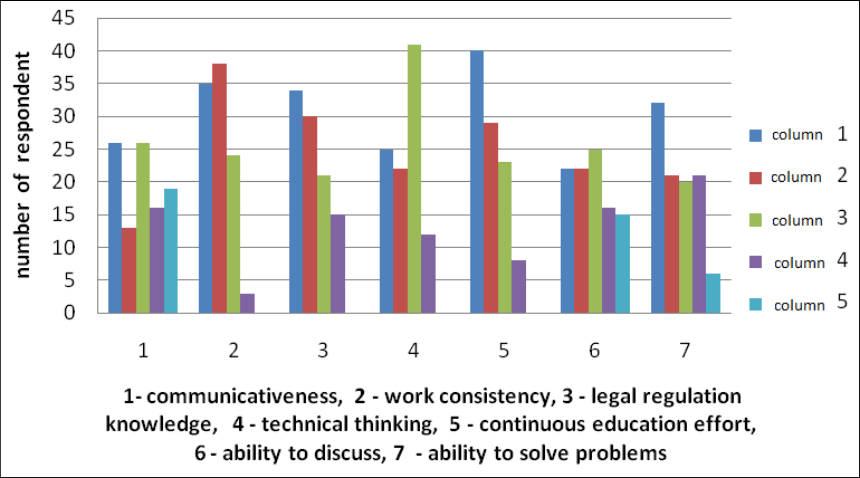
The last group of questions was put together in order for the inspectors to define which competencies and skills are considered most important for safety technicians. The study shows that the basic and most important skill for a safety technician is the legal regulation knowledge and definition. Most of the respondents agreed that safety technician job execution requires the knowledge of at least one foreign language. The last question was aimed to discover which of these skills: communicativeness, work consistency, legal regulation knowledge, technical thinking, continuous education effort, ability to discuss, ability to solve problems current safety technicians lack in the most. The result analyses are shown in figure 3.
Figure 3. Comparison of the skills current safety technicians lack in The figure shows that inspectors find lack of continuous education effort, work consistency, legal regulation knowledge and inability to solve problems the most serious issues in terms of the work of safety technicians. 41% of the respondents indicated “cannot judge” regarding the question whether OSH employees lack technical thinking. It is important to consider and stress that inspectors do not care for or inspect the knowledge of the person, but the outcome of their work.
Conclusion
Practical knowledge confirmed by the research indicates a not ideal level of OSH education on all education levels. It is therefore desirable to create proper conditions for a qualitative change in OSH education on all levels including universities and consider the education in the field of OSH an important factor of life.
The aim of the pilot project was to determine how labour inspectors in their experience perceive the role of safety technicians. Based on the pilot project the authors plan to carry out a research project with the participation of all labour inspectorates in Slovakia, the results of which will serve as one of the bases of creation the study programme OSH.
To implement the pilot project, 35 labour inspectors from Nitra region were involved. The outcome indicates these conclusions for the formation of the study programme:
- University education has its merits in training experts providing safety and technical services
- Study programme must highly reflect on practice
- In education and training not only knowledgeable teachers but also field professionals should be involved.
- It is necessary to enforce inclusion of a subject dealing with OSH into teacher study programmes.
- Students, while studying, should gain some lecturer skills to become a qualified person whose competencies may include introducing employers and employees to the development and changes regarding the safety and health at work.
Education and training is indirectly related to the quality of services to employers carried out by safety technicians and certified safety technicians. Only a quality curriculum can contribute to qualitative improvement of competent personnel.
It is important to pay attention to the forms and content of OSH education on all educational levels with the aim to provide the school-leavers entering the working process with proper awareness, knowledge and skills which they can efficiently develop in various forms of lifelong learning.
REFERENCES
Law n. 124/2006 Z.z. (2006), “Zákon o bezpečnosti a ochrane zdravia pri práci a o zmene a doplnení niektorých zákonov”, as amended by later regulations, National Council of the Slovak Republic Law n. 125/2006 Z.z. (2006), “Zákon o inšpekcii práce a o zmene a doplnení zákona č. 82/2005 Z. z. o nelegálnej práci a
nelegálnom zamestnávaní a o zmene a doplnení niektorých zákonov”, as amended by later regulations, National Council of the Slovak Republic Law n. 311/2001 Z.z. (2001), “Zákonník práce”, as amended by later regulations, National Council of the Slovak Republic National Labour Inspectorate (2013), “Správa o stave ochrany práce a o činnosti orgánov štátnej správy v oblasti inšpekcie práce za rok 2012” National Labour Inspectorate Website: www.safework.gov.sk/?id_fa=467&ins=nip Regulation n. 356/2007 Z.z. (2007), “Vyhláška, ktorou sa ustanovujú podrobnosti o požiadavkách a rozsahu výchovnej a
vzdelávacej činnosti, o projekte výchovy a vzdelávania, vedení predpísanej dokumentácie a overovaní vedomostí účastníkov výchovnej a vzdelávacej činnosti”, as amended by later regulations, Ministry of Labour, Social affairs and Family of the Slovak Republic Regulation n. 508/2009 Z.z. (2009), “Vyhláška, ktorou sa ustanovujú podrobnosti na zaistenie bezpečnosti a ochrany zdravia pri práci s technickými zariadeniami tlakovými, zdvíhacími, elektrickými a plynovými a ktorou sa ustanovujú technické zariadenia, ktoré sa považujú za vyhradené technické zariadenia”, as amended by later regulations, Ministry of Labour, Social affairs and Family of the Slovak Republic
LISTED IN THE AHFE DIGITAL BOOKSTORE CATALOGUE
Explore the complete digital volume
Advances in Physical Ergonomics and Human Factors: Part I
Read this individual research paper free through the original publisher, or explore the full digital proceedings book.
ISBN 978-1-4951-2104-3
Explore this ISBN in the AHFE Bookstore ↗Listed in the July 2026 bookstore catalogue; search by ISBN to confirm current availability · Digital book purchase optional