Nikos Frangakis, Vassilis Stratis, Vaggelis Papakonstantinou, Eric Caughi (2020). Vessel Information - Rich Meta-file to Increase the Life Cycle of Small Craft Passenger Boats. In: Advances in Social and Organizational Factors. AHFE Open Access, vol. 9. https://doi.org/10.54941/ahfe100314
Institute of Communication and Computer Systems, Athens, GREECE b OCEAN Shipyard, Koropi, Attiki, GREECE c International Naval Surveys Bureau, Athens, GREECE d Seability, Piraeus, GREECE ↗
The aim of this paper is to present a methodology that will focus on the increase of the life cycle of small craft passenger boats made of composite materials (Glass Reinforced Plastic, GRP). Passenger boats (small craft, with length overall up to 30m), are sea-going vessels which carry passengers for recreational purposes, such as small charter cruises, for the purposes of scheduled routes or transportation of professional personnel or ship crews. The goal is to develop a user-friendly, dynamic information-rich vessel's technical metafile will include all aspects of the vessel from initial customer specifications and required regulations, to shipyard designs, final sea-trial data to post-delivery surveys and inspections. Using the meta-file as the main knowledgebase, a number of applications will be developed to allow the collaborative building of the vessel with synchronous update of the current rules and regulations, allowing this way all the interested parties to be up-to-date and fully aware.
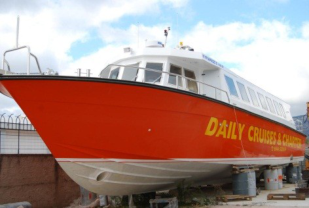
Passenger boats (small craft, with length overall up to 30m, Figure 1), are sea-going vessels which carry passengers for recreational purposes, such as small charter cruises, for the purposes of scheduled routes or transportation of professional personnel or ship crews. Typical distance between starting port and final shore for small passenger vessels is up to thirty (30) nautical miles, carrying on average a hundred (100) passengers, extending the limits also to (80) nautical miles and 300 passengers. Operating small-craft passenger vessels counts for approximately five hundred (500) units across Greek sea- waters.
Figure 1: Daily Cruiser Boat
Our application will decrease the cost of designing, building, maintaining and modifying vessels, and consequently increasing the product's life span by t. A user-friendly, dynamic information-rich vessel's technical metafile will be designed and developed which will include all aspects of the vessel; from initial customer specifications and required regulations, to shipyard designs, final sea-trial data to post-delivery surveys and inspections. This dynamic data-set will be integrated into visual depictions of the vessel (i.e. three-dimensional drawings). Visual representations will effectively connect design aesthetics and design elements (e.g. number of passengers and scale of comfort) with installed parts, equipment, and their properties (supply vendors, cost of purchasing/servicing, technical characteristics etc.). Furthermore, all aspects of this technical file would be dynamically connected with customer requirements, regulations and required specifications by the Classification Society (ex. Structural properties, safety regulations, required equipment etc).
As a result, any decision made in any stage of the product's life-cycle, from initial design to post- delivery modifications, would be based on updated information provided by all parties involved. The boatyard could forecast costs regarding different decisions, and offer different solutions (different equipment, environmentally friendly or more durable materials, layouts, etc), and Classification Society would be well informed about the effectiveness of such changes, ensuring that they would be according to its Rules and Guides or setting new applicable rules/regulations/recommendations and surveys to be carried out. Moreover, the customer could visualise different solutions based on the Boatyard's and Classification Society's recommendations and intervene in the entire business process, while keeping a better and more information rich access to the boat lifecycle details.
Any interested party and authorities, will have access to the dynamic technical metafile, easily reviewing construction, operating and surveying data, information regarding updates on on-board equipment, systems and regulations applying on the vessel. The vessel's technical file follows its life- cycle and is less dependent on ownership. New owners will be provided with information on the history of the vessel from initial design to the latest survey.
CURRENT SITUATION Life-cycle model of the vessel
Local transportation needs and tourism set business demand for building passenger vessels. Usual requirements include operating speed, capacity and maintenance cost. Small passenger boats are usually made of composite materials, built by boatyards (boat manufacturing yards). There are three (3) major parties involved in the process of boat manufacturing: the customer, the boatyard and the Certification Body. Customers can be either companies, individuals or boat owners unions.
Customers are typically represented by one or more technical consultants during the building period and many time can act on behalf of large naval firms in purchasing or modifying boat transactions.
The Boatyard is usually a company with all the necessary means of production (facilities, specialized personnel, etc) but subcontractors are also employed for various parts installed on vessels. The Boatyard incorporates as business partners, industry vendors (manufacturers or importers) for materials, and equipment (ex. Propulsion engines, generators, navigation systems, etc).
The Certification Body, is either a public (Administration Surveying Body) or private organization (Classification Societies) with the responsibility of setting the applicable rules/regulations/ recommendations for the construction of boats/ships. Moreover, surveys are carried out in the construction and post-delivery stages of boat's life-cycle in order for the boat/ship to be certified as sea-worthy according to Society's standards.
The process of building, delivering and operating a passenger boat consists of different stages, which can be summarized as follows: − Configuring customer requirements based on business demands
− Setting boatyard's specifications and forming an initial design proposal based on customer requirements and yard's production standards, accompanied by economic offer − Approving a final design by all parties: customer, technical consultant, Classification Society and boatyard followed by shipbuilding contract
− Boat manufacturing and equipment installation according to specifications and national regulations. Frequent surveys conducted by the Classification society − Performing final survey, sea trials and delivery of boat. The vessel is operated by the final user.
− Conducting annual boat surveys by the Classification Society to ensure that the vessel is operated and maintained in accordance to Society's guides and National regulations. As a result, a maintenance schedule is followed which is implemented by the boatyard (maintenance regarding the boat structure), industry vendors (for example annual engines service) or other business units specialized in boat maintenance.
Besides the annual commonly scheduled maintenance, the final user (customer) communicates frequently with the boatyard for various technical issues regarding usage and maintenance (parts replacement, servicing procedures and guides). In addition, due to the fact that customer requirements may change in accordance to service demand (business environment) or alterations to regulations may take place, there are frequent inquiries for modifications to the initial design, in order to meet newly formed business demands. Implementing those modifications will increase product life and economic return of investment. These changes on initial design can vary in terms of cost, depending on the scale of modifications. Economic gain can be met either by reducing operating cost (e.g. less fuel consumption or reducing maintenance cost of propulsion engines), by meeting new business demand requirements (e.g. adding passenger seats) or by improving services and being more competitive (e.g. adding services on-board, reducing arrival time, etc).
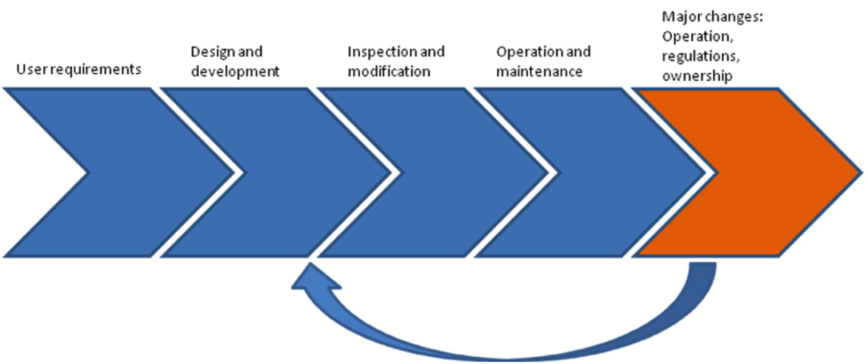
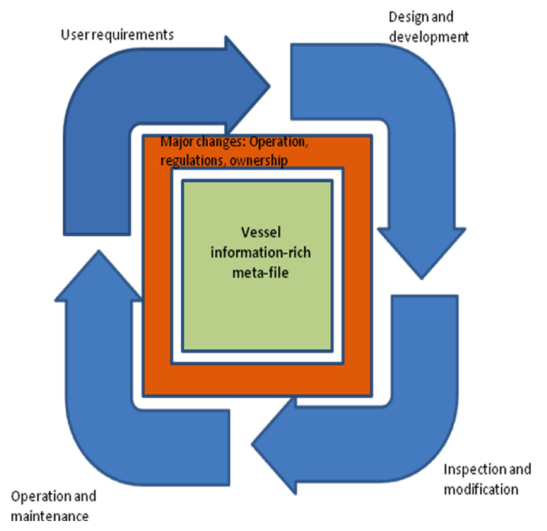
From the aforementioned it is obvious that the entire life-cycle of the vessel is following a rather linear value chain with sparse or insufficient interlinks. Our plan, is using UIW approach to transform the entire business process into a recursive loop with one common point of reference, the vessel meta-file.
Figure 2: Current value chain in ship design and operation
VISION FOR THE FUTURE Our cluster concentrates in the development of an application, which aims in aiding the increase of the life cycle of small craft passenger boats made of composite materials (Glass Reinforced Plastic or GRP). Passenger boats (small craft, with length overall up to 30m), are sea-going vessels which carry passengers for recreational purposes, such as small charter cruises, for the purposes of scheduled routes or transportation of professional personnel or ship crews. Typical distance between starting port and final shore for small passenger vessels is up to thirty (30) nautical miles, carrying on average a hundred (100) passengers, extending the limits also to (80) nautical miles and 300 passengers. Operating small-craft passenger vessels count for approximately five hundred (500) units across Greek sea-waters.
Our application will decrease the cost of designing, building, maintaining and modifying vessels, and consequently increasing the product's life span by t. A user-friendly, dynamic information-rich vessel's technical metafile will be designed and developed which will include all aspects of the vessel; from initial customer specifications and required regulations, to shipyard designs, final sea-trial data to post-delivery surveys and inspections. This dynamic data-set will be integrated into visual depictions of the vessel (i.e three-dimensional drawings). Visual representations will effectively connect design aesthetics and design elements (e.g. number of passengers and scale of comfort) with installed parts, equipment, and their properties (supply vendors, cost of purchasing/servicing, technical characteristics etc.). Furthermore, all aspects of this technical file would be dynamically connected with customer requirements, regulations and required specifications by the Classification Society (ex. Structural properties, safety regulations, required equipment etc).
As a result, any decision made in any stage of the product's life-cycle, from initial design to post-delivery modifications, would be based on updated information provided by all parties involved. The boatyard could forecast costs regarding different decisions, and offer different solutions (different equipment, environmentally friendly or more durable materials, layouts, etc), and Classification Society would be well informed about the effectiveness of such changes, ensuring that they could be according to its Rules and Guides or setting new applicable rules/regulations/recommendations and surveys to be carried out. Moreover, the customer could visualise different solutions based on Boatyard's and Classification Society's recommendations and intervene in the entire business process, while keeping a better and more information rich access to the boat lifecycle details.
Any interested party and authorities, will have access to the dynamic technical metafile, easily reviewing construction, operating and surveying data, information regarding updates on on-board equipment, systems and regulations applying on vessel. Vessel's technical file follows its life-cycle and is less dependable on ownership. New owners will be provided with information on history of the vessel from initial design to the latest survey.
Figure 3: Value Chain process concept
As a result the system will enable the owner: − to effectively organise the maintenance of the vessel by accessing all relevant information and reducing overall time and costs by 30% due to the availability of the vessel technical information;
− to be informed on equipment and systems updates thus following market dynamics while expanding the life-cycle of the vessel; − to be early informed about costs involved in necessary modifications to meet new business demands, decreasing lead time in product modifications by at least 20%;
− to forecast total costs and prepare an elaborate financial plan about the vessel's use, putting the emphasis also on environment-friendly materials that could expand the life cycle of the product while decreasing the overall environmental footprint; − to transform the vessel into a Meta-Product that is accompanied by an information-rich environment.
Moreover, the system will enable the Boatyard: − to provide customers with a complete dynamic system of recorded vessel's technical information, used for initial design, construction, operation and future modification thus decreasing the overall process implementation time by at least 30%;
− visualize various technical solutions based on all aspects of building (financial and regulative) and enabling the use of advanced and environmentally friendly materials throughout the process; − use enhanced visualizations as a communication and promotion strategy
− effectively communicate required specifications with vendors and the Classification Society decreasing the communication overhead while maintaining effectivecommunication; − reduce costs of design and implement modifications by at least 20%.
In Addition, the system will enable the Classification Society to: − effectively communicate required specifications to both the Boatyard and the Customer facilitating the entire process;
− reduce surveying costs by at least 20%, regarding the continuously monitoring of the vessel which will be visible to the end-user − provide information to any interested party (ex. Future owners) with no previous involvement, details and current status of the vessel;
− effectively evaluate the purchasing price of the vessel and make decisions regarding modifications; − plan the required inspection for renewal of vessel's Class and statutory certificates;
− associate all information to the vessel transforming it to a Meta product whose information is accessible by all stakeholders involved
CONCLUSIONS
As a conclusion, the flow of information on the system between all involved parties will reduce the cost of maintenance and modifications, and will effectively reduce time of on decisions regarding design of those modifications and consequently will promote the expansion of the vessel's life cycle.
AKNOWLEDGEMENTS The research leading to these results has received funding from the European Community's Seventh Framework Programme under grant agreement No. 609027 (Project Use-it-wisely).
REFERENCES
Use It Wisely Project (2013), “Cluster 5 core work”: http://www.use-it-wisely.eu
LISTED IN THE AHFE DIGITAL BOOKSTORE CATALOGUE
Explore the complete digital volume
Advances in Social and Organizational Factors
Read this individual research paper free through the original publisher, or explore the full digital proceedings book.
ISBN 978-1-4951-2102-9
Explore this ISBN in the AHFE Bookstore ↗Listed in the July 2026 bookstore catalogue; search by ISBN to confirm current availability · Digital book purchase optional