Atsuo MURATA, Kousuke GOTOH (2020). Effects of Pen Holding Posture on Handwriting Motion. In: Advances in Social and Organizational Factors. AHFE Open Access, vol. 9. https://doi.org/10.54941/ahfe100359
Exploring the nature of skill is useful to understand the specific feature of handwriting or calligraphy. Although we learn the holding posture in handwriting at elementary school, and we notice that the holding posture must be one of the important factors to improve skills in handwriting or calligraphy, it has not been explored how the holding posture of pen or brush affects the handwriting efficiency or performance. In this study, we categorized the holding posture of a pen into three types according to the angle of the joints of the fingers; weak grip which is generally recognized correct as holding style and recommended at elementary school education in Japan, strong grip under which fingers are strongly bent, and others (types I and II). The motion of fingers, the writing pressure and the holding posture of a pen, and the gripping pressure during handwriting were measured to verify the rationality of the weak grip type which is in general recommended at elementary schools in Japan.
In order to understand the skill in calligraphy and make use of this for the proposal of an effective instruction method, the investigation of hand-eye coordination must be essential. Although there seem to be many approaches that made an attempt to develop an effective calligraphy instruction method, few studies paid attention to a hand-eye coordination skill. In calligraphy, we are much interested in how we gaze at paper and draw characters on paper. Murata et al. (2009), Murata et. al. (2011) and Murata et. al. (2012) made an attempt to simultaneously measure the brush tip movement and the eye gaze position during calligraphy. Exploring the nature of skill is useful to understand the specific feature of handwriting or calligraphy. Although we learn the holding posture in handwriting at elementary school, and we notice that the holding posture must be one of the important factors to improve skills in handwriting or calligraphy, it has not been explored how the holding posture of pen or brush affects the handwriting efficiency or performance.
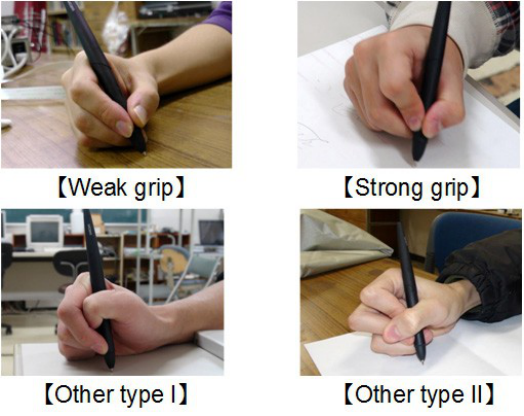
In this study, we categorized the holding posture of a pen into three types according to the angle of the joints of the fingers (see Figure 2); weak grip which is generally recognized correct as holding style and recommended at elementary school education in Japan, strong grip under which fingers are strongly bent, and others (types I and II). The motion of fingers, the writing pressure and the holding posture of a pen, and the gripping pressure during handwriting were measured to verify the rationality of the weak grip type which is in general recommended at elementary schools in Japan.
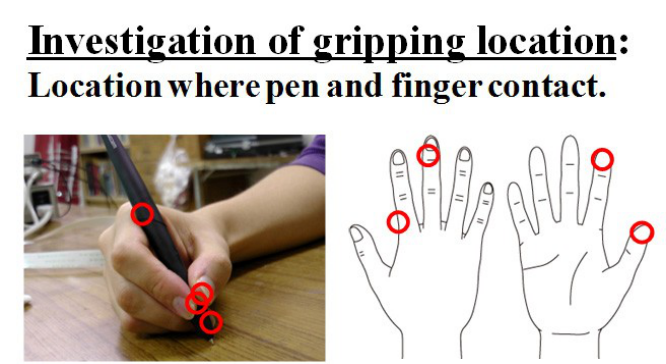
Figure 1. Investigation of grip locations for classification of holding posture (style) of a pen.Figure 2. Classification of holding postures used in the experiment.
METHOD
Participants Eight right-handed undergraduate students participated in the experiment. They were all healthy and had no orthopedic disease. All signed the document on informed consent after receiving a brief explanation of the aim and the contents of the experiment.
Acquisition of basic information As a first stage of the experiment, basic information such as the gripping location of a pen, the tilt (slope) of a pen, and the moveable area of thumb, index finger, and middle finger was acquired. In short, the investigation of gripping location was carried out before the experimental task according to Figure 1. Consequently, the holding posture of a pen was into three types according to the angle of the joints of the fingers; weak grip, strong grip, and others (types I and II) (see Figure 2).
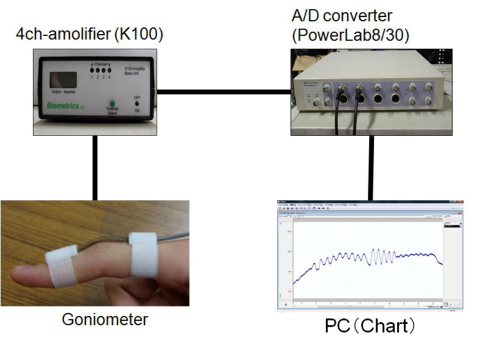
Figure 3. Measurement system of finger joint angle.
Measurement of moveable range of finger
Writing cross on
Attachment of goniometer (Biometrics, Inc.)
Figure 4. Procedure for measurement of moveable range of finger.
Figure available in the original PDF paper.
Measurement of pen holding posture when pen tip contacts paper OceanServer (OceanServer Technology, Inc )
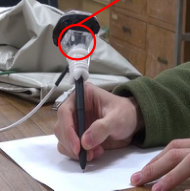
Figure 5. Measurement system for pen holding posture.
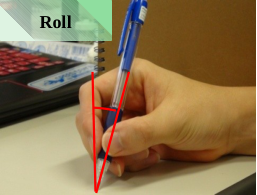
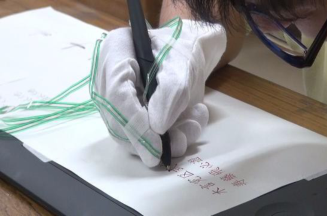
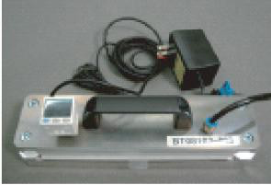
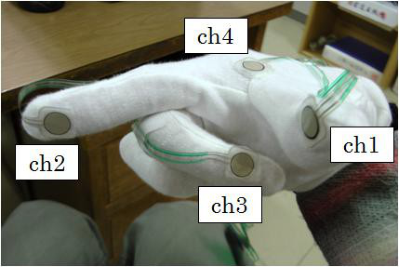
Apparatus The moveable ranges of each finger while holding a pen was measured using a goniometer (F35, Biometrics Inc) (see Figure 3 and Figure 4). The tilt (slope) of a pen was measured using OceanServer (OceanServer Technology, Inc) (see Figure 5. and Figure 6). The writing pressure was measured using Intuos5 touch small (Wacom) (see Figure 7). The gripping pressure during handwriting was measured using OctSense (Nitta) (see Figure 8 and Figure 9).
Pitch Roll
Measurement of pen holding posture
Figure 6. Definition of pitch and roll angles.
Measurement of writing pressure
Figure 7. Measurement system of writing pressure.
Calibration unit Sensor sheet Sensor connector
Figure 8. Apparatus for measuring gripping pressure.
Output of gripping pressure
ch1 ch2 ch3 ch4 ch5
Thumb Index finger Middle finger Fulcrum Others I:Thumb 2 Others II:Ring finger
Figure 9. Attachment of sensors for measuring gripping pressure and an example of actual
measurement of gripping pressure.
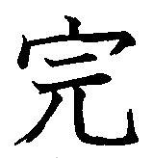
Japanese meaning (Complete)
Using image processing technique, the following measures were calculated:
Before trace (model)
Deviation area from the model =(area after tracing)
- (area before tracing) Rate of deviation from the model
=(deviation area)/(area after tracing)
After trace The smaller this rate is, the more dexterity the participant has.
Figure 10. Calculation procedure of deviation from the model.
Procedure In Japan especially in elementary school education, generally accepted and recommended correct holding style (posture) of a pen is regarded to have the following advantages:
(1) less fatigued. (2) easily movable finger joint. (3) make use of the weight of a pen in writing. (4) fast writing.
On the other hand, the disadvantages induce the following outcome: (1) more fatigued and long duration of writing is impossible. (2) aesthetic writing is impossible. (3) slow writing speed.
Taking the advantages and the disadvantages above into account, the following measures for identifying the correct holding style (posture) of a pen: (A) tilt (slope) of a pen (see Figure 5 and Figure 6). (B) moveable area of finger joint (see Figure 3 and Figure 4). (C) gripping pressure during writing (see Figure 8 and Figure 9). (D) dexterity (measured by the tracing deviation from the model) (see Figure 10). (E) writing pressure (see Figure 7).
The moveable ranges of three fingers (thumb, index finger, and middle finger) while holding a pen, the tilt (posture) of a pen, the holding position, the gripping pressure during handwriting, the holding posture and the writing pressure during handwriting (tracing) were measured. The dexterity in handwriting was evaluated by means of the performance of the tracing task (the difference of area of the model (example) shapes or characters and the area of actual writing) (in more detail, see Figure 10). These areas were calculated in pixel unit by inputting each image to a computer and processing each image.
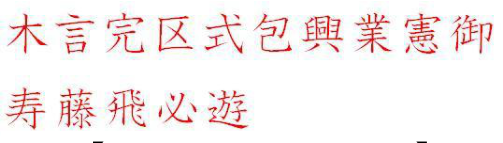
The experimental procedure is summarized in Figure 11. On the first stage, basic information mentioned in 2.2 were collected. On the third stage, the participants carried out a handwriting task of 1,200 Japanese characters. On the second and the fourth stages, the participants were instructed to trace printed shapes and kanji characters shown in Figure 12 with a pen.
(First Stage) Acquisition of basic information
(First Stage) Acquisition of basic information
(Second Stage) Tracing pre-specified characters or figures
(Second Stage) Tracing pre-specified characters or figures
(Third Stage) Dictation of 1,200 characters
(Third Stage) Dictation of 1,200 characters
(Fourth Stage) Tracing pre-specified characters or figures
(Fourth Stage) Tracing pre-specified characters or figures
Figure 11. Experimental procedure.
Figure available in the original PDF paper.
【shape】
【Japanese characters】
Figure 12. Shape and Japanese character used in the experiment.
120
100
Thumb Index finger Middle finger
80
60
40
20
Moveable range deg.
0
A B C D E F G H Weak grip Strong grip Others Participants
Figure 13. Moveable range of fingers as a function of type of holding posture (thumb, middle finger, and index finger).
Figure available in the original PDF paper.
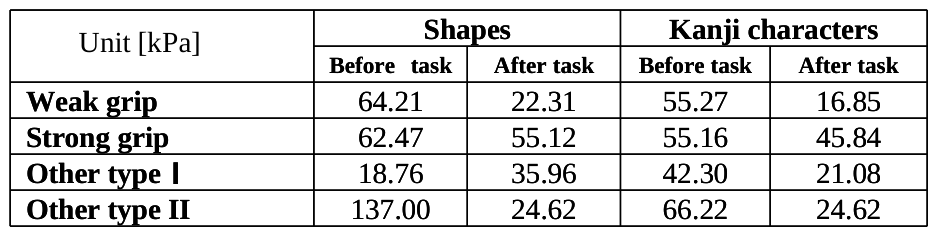
Table 1. Gripping pressure compared among holding postures of a pen.
RESULTS
The experimental results showed that the range of motion of fingers was larger in weak grip than in strong grip (see Figure 13). Holding pressure was different among the holding postures (weak grip, strong grip and other types (I and II)) (see Table 1). No differences of tracing performance, and the tilt angle (pitch and roll) were detected among the holding postures.
For all participants, the pitch angle was significantly larger than the roll angle. The pitch and roll angles ranged from 24 to 40 deg (Figure 14). As for characters, the rate of tracing deviation from model for figures was significantly different among holding styles (postures) (see Figure 15). On the other hand, no significant difference of this measure was detected among holding styles (postures). As shown in Figure 16, the writing pressure of Weak grip type was apparently smaller (Figure 16). The gripping pressure is compared among three fingers and between weak and strong holding postures in Figure 17.
DISCUSSION
Moveable range of finger of weak grip is regarded to be wider than that of strong grip, and lead to superiority in writing. The results in this study corresponded with this prediction (see Figure 13). This might be effective when writing characters or figures of large size.
As for the tilt (slope) of a pen, no significant differences were detected among holding posture conditions of a pen, and he pitch and roll angles ranged from 24 to 40 deg (see Figure 14). Although such a tendency was observed in
60
Pitch Roll
50
40
30
20
10
0
Slope (tilt) of pen deg.
-10 A B C D E F G H Weak grip Strong grip Others
Participants
Figure 14. Slope (tilt) (pitch and roll angles) of a pen as a function of type of holding style (posture).
Figure available in the original PDF paper.
Weak grip Strong grip Others
0.25
0.2
0.15
0.1
0.05
0
Rate od deviation from model Before task After task Dictation of characters
Figure 15. Rate of deviation before and after task as a function of holding (gripping) style of a pen.
Figure available in the original PDF paper.
Weak grip Weak grip
Strong grip Strong grip
Others I Others I
Others II Others II
Figure 16. Examples of traced characters for weak holding type, strong holding type, and other types I and II.
Figure available in the original PDF paper.
Before dictation task
35
30
25
20
15
10
5
Gripping pressure kPa
Weak grip Strong grip
0
Thumb Index finger Middle finger
After dictation task
35
30
Weak grip Strong grip
25
20
15
10
5
Gripping pressure kPa
0
Thumb Index finger Middle finger
Figure 17. Gripping pressure for thumb, index finger, and middle finger compared between weak and strong grip (holding) types.
Figure available in the original PDF paper.
this study, the tilt angle of a pen must be one determinant factor that specifies the writing performance. Therefore, the effects of tilt angle of a pen when writing on writing performance or comfort should be explored more systematically. As the obtained measurement characteristics might differ by the type of a pen used, the proper holding posture must be explored for a variety of pens.
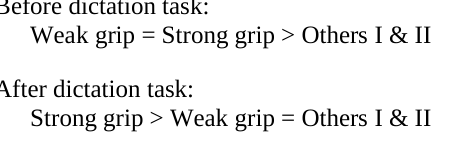
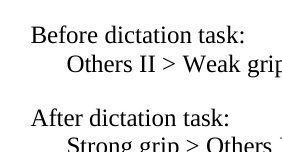
Concerning the rate of deviation from the model for figures, no significant difference of this measure was detected among holding postures. The reason might be inferred as follows. When tracing a figure shown in Figure 12, the trace is carried out with one stroke without intermission. This must lead to the dispersion among the participants. Interpretation of the results for characters in Figure 15 might lead to the following conclusions from the viewpoint of the rate of deviation from the model: Before dictation task:
Equation reproduced from the original PDF.
In general, the holding posture of a pen which enables one to write characters or figures with smaller gripping pressure induces less muscle workload and eventually less fatigue. Therefore, the weak grip is more practical than the strong grip. Interpreting the results on the gripping pressure, the following conclusions might be reasonable from the perspective of gripping pressure.
Equation reproduced from the original PDF.
As mentioned above, only for characters, significant difference of rate of trace deviation was detected among holding postures (weak grip, strong grip, and others). Moreover, only for figures, significant differences of gripping pressure were observed among holding postures. The trace of figures might require one to maintain dexterity, while the spontaneous dexterity might be necessary for the trace of characters. This viewpoint must be verified in future research.
Each measurement items (A) tilt (slope) of a pen, (B) moveable area of finger joint, (C) gripping pressure during writing, (D) dexterity (measured by the tracing deviation from the model), and (E) writing pressure were separately evaluated. In order to deepen the understanding on how the proper holding posture of a pen should be and identify the desirable holding posture of a pen, the relevance of these measurement items should be clarified in more detail.
CONCLUSIONS
It was explored how the holding posture (style) of a pen affected the writing performance such as the tilt (slope) of a pen, the moveable area of finger joint, the gripping pressure during writing, dexterity (measured by the tracing deviation from the model), and the writing pressure. While there were no significant differences of moveable range of fingers among three types of holding postures (styles), it was indicated that the weak grip and the strong grip types excels other types before the dictation task, and the strong grip type was superior to other types after the dictation task. Each holding posture, as a whole, has advantages (merits) and disadvantages (demerits). Thus, in the range of this experiment, we cannot judge which holding posture is recommended like Japanese elementary school education generally recommends weak grip as a basic and standard holding posture (style).
In the range of this experiment, we could not reach a definite conclusion (find specific rationale) that weak grip is superior to other holding postures as generally believed to be proper and taught at elementary school, because no remarkable differences of tracing performance, and the tilt angle (pitch and roll) between holding styles (postures) were observed. Future research should increase the sample number, verify and confirm the results in this study, and approach to the ultimate solution on what the ideal holding posture of a pen should be.
REFERENCES
Murata, A., Inoue, K., Hayami, T. and Moriwaka, M. (2012), “Real-time Measuring System of Eye-gaze Location and Writing Pressure in Calligraphy”, Proceedings of AHFE2012, pp.8290-8299 Murata, A., Inoue, K. and Moriwaka, M. (2011), “Real-time Measurement System of Eye-Hand Coordination in Calligraphy”,
Proceedings of SICE Annual Conference 2011, pp.2696-2701 Murata, A. and Moriwaka, M. (2009), “Skill of Eye-Hand Coordination in Calligraphy -Difference of Skill of Hand-Eye Coordination between Expert and Novice-”, Proceedings of Fifth International Workshop on Computational Intelligence & Applications, pp.316-319
LISTED IN THE AHFE DIGITAL BOOKSTORE CATALOGUE
Explore the complete digital volume
Advances in Social and Organizational Factors
Read this individual research paper free through the original publisher, or explore the full digital proceedings book.
ISBN 978-1-4951-2102-9
Explore this ISBN in the AHFE Bookstore ↗Listed in the July 2026 bookstore catalogue; search by ISBN to confirm current availability · Digital book purchase optional