Małgorzata Spychała (2020). Analysis and Development of Occupational Competencies of 21st Century Managers of Municipal Sector. In: Advances in Social and Organizational Factors. AHFE Open Access, vol. 9. https://doi.org/10.54941/ahfe100351
In the article the implementation stages of 21st century manager’s competency profile in municipal sector were presented. The main managers’ occupational competencies were described: communication skills, organizational skills, ethics management skills, team management skills and creative thinking skills. In the practical part of this paper examination of managers’ professional competencies in selected enterprises of Wielkopolska municipal sector was performed. At the same time methods of occupational skills development were assessed. Current managers’ knowledge and skills level were taken into account during planning of their development.
“Modern organizations find that only the ability, experience, knowledge, skills and other characteristics that employees have, may lead the company to implement its strategy, meet customer needs and the conditions dictated by the competition” (Rostkowski, 2004, s.38). However, to manage the professional competencies of employees, it is necessary to explore them and evaluate what competencies are necessary for the proper functioning of the given organization in the future (Boyatzis, 2008, Czapla, 2011, Filipowicz, 2004, Rakowska, 2007, Walkowiak, 2004). Such task is carried out within the project: "Model of validation of competencies for employees of MSME of Wielkopolska’s municipal sector." The project is co-financed by the European Union under the European Social Fund. Implementation timeframe is from September 2011 to August 2013. The main implementers of the project are practitioners - executives and managers of municipal sector companies and a specialist in the field of designing competency profiles.
The purpose of this article is to present the main steps in the designing competencies profile for the 21st century manager of the Wielkopolska’s municipal sector and to show the results of research of the managers’ professional competencies (Spychała 2012, 2013).
Personal profile based on competencies has been created for managerial positions and concerns the required technical competencies as well as social competencies in the workplace in the future. This profile can be used during the various stages of human resource management (including the selection of managers to project tasks, creating career paths, training and development and evaluation of managers) (Dubois, Rothwell, 2004, Whiddett, Hollyforde, 2003).
Knowledge about the quantity and quality of occupational competencies of municipal sector managers will be gathered during the actual test of professional competencies of managerial personnel in mentioned sector. It will allow to determine the competency gap as well as a surplus of knowledge and skills of managers compared to the competency requirements in the future.
To develop the municipal sector organizations, human resources management should be based on employees’ competencies, which can be already developed among future managers. Therefore knowing competencies matrixes, that will be required in the future, the management staff can be improved much earlier.
THE CURRENT KNOWLEDGE IN THE FIELD OF RESEARCH TOPIC Enterprises of municipal sector do not have designed and implemented catalogue of competencies consistent with Polish and European Qualifications Framework for executive and managerial personnel (Babiak 2012, Krawczykowski 2012). There is also no developed system of validation and certification of competencies acquired in non-formal education (Babiak, 2012, Krawczykowski, 2012). Therefore, a team of experts undertook the task to determine the current status of the competencies of human resources in the municipal sector of Wielkopolska. Examination, identification and assessment of professional competencies of managers (ie, the development of methods and tools) are necessary steps for the strategic management of company’s community (Babiak, 2012, Spychała 2012).
Thus for effective management of professional competencies of municipal sector managers it is necessary to acquire the relevant knowledge, and then organize, analyze, disseminate and apply it to achieve the desired result.
IMPLEMENTATION STAGES OF 21ST CENTURY MANAGER’S COMPETENCY PROFILE IN MUNICIPAL SECTOR “Competency comprises the specification of knowledge and skills. The application of knowledge and skills to the
standard of performance requires completing a task.” (Jui-Lan Wu, 2013). Thereforethe first stage of the project was to analyze the tasks performed in the workplace by managers of the municipal sector. The aim of the project team was to develop a detailed list of tasks and activities that they do working on their positions. Brainstorming method was used and the analysis of documentation of municipal companies (Spychała 2012).
The next stage of the project was to design the position description for the municipal sector manager. During position description creation, the methods of interview with managers has been used and directors have made self- assessment about range of the tasks on given positions. Documents of studied municipal enterprises were also examined.
However, the project does not concern the tasks of managers performed at workplace, so the project team developed a twenty-first century manager’s position model. Involvement of management staff in the development of managerial competency profile allowed to become familiar with it before realization and a better understanding of the purpose of its implementation (Spychała 2012).
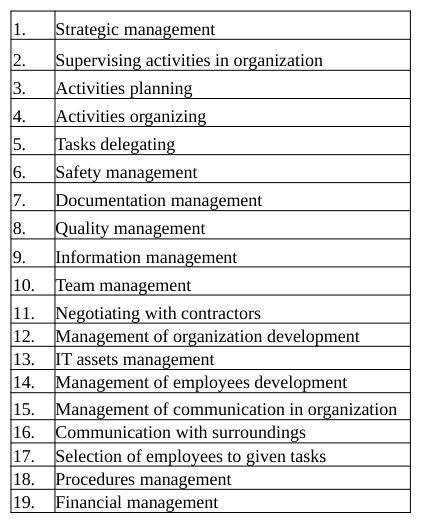
During creation of the position description for the manager of twenty-first century in municipal sector brainstorming method has been used, where a team of experts defined the tasks, which will be implemented by managerial personnel in the future. The results are presented in Table 1. Analyzing these data, as well as interviews with managers of the municipal sector, a list of future tasks of twenty-first century manager was developed.
Table 1. Range the tasks of the twenty-first century manager in the municipal sector - the results of tests on 08.02.2012. (Source: own study based on data from the conducted research)
“Competency models offer the possibility of creating an integrated and consistent framework for the selection, appraisal, training and development of HR practitioners, as well as a mechanism for linking HR strategy and business performance (Boyatzis, 1982, 1993; Ulrich et al., 1995; Baill, 1999; Ulrich et al., 2008, Caldwell, 2010).
Having analyzed the literature in the field of managerial competences it turned out communication skills are the most important. Therefore, they have been discussed in detail in the practical part of the article. (Cameron., Whetten, 1983, Dickson, Hargie, 2004, Platonoff, 2001, Rakowska 2008, Smółka 2008).
A set of related examples of behaviors and actions determines the specific competency (Filipowicz 2004, Jurek 2008, Walkowiak 2008). To be sure that those will be understood in the same way by all employees of the municipal sector, it is necessary to describe every occupational competency of manager.
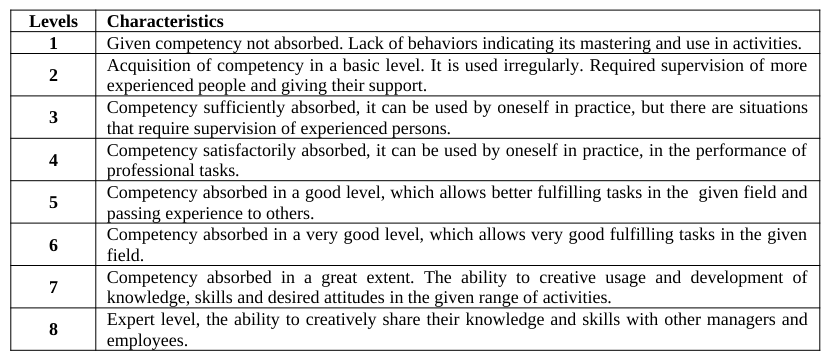
Figure 1 . Competency profile of XXI century manager of municipal sector. (Spychała 2012) Competency profile is a basic tool for planning of self-development of every manager. Allows for clear definition of the objectives of development, the implementation of which will be the basis for the realization of all pre-planned activities. It is a document that contains 8 levels of professional competencies developed by the project team. Each level has been characterized in table 2.
Table 2. Characteristics of particular levels of professional competencies of the municipal sector managers, (Source: own study within the project: “Model of validation of competencies for employees of MSME of Wielkopolska’s municipal sector”) Levels Characteristics 1 Given competency not absorbed. Lack of behaviors indicating its mastering and use in activities.
Presented levels of competencies relate to the requirements for the twenty-first century managers. Therefore during assessment of the actual competencies of the municipal sector managers there will often situation occur where the level of competencies of the manager will be lower than required. The work of the municipal sector organizations will be taking actions to place a person on a particular position in the future, whose level of competencies will be as close as possible to those specified in the profile. Manager that has insufficient competencies will perform his work poorly, while one whose knowledge and skills far exceed the requirements of the position will not be fully utilized.
Competency profile of twenty-first century manager enables to raise the quality of human resources management (Boyatzis, 2008, Dubois, Rothwell, (2004). However, it will play its role only if it is consistent with the strategy and culture of the organization. Because it must take into account not only the current situation of the organization, but also a vision of the future, it allows to prepare managers for the changes in the organization. (Bratton, Gold, 2007).
EXAMINATION OF PROFESSIONAL COMPETENCIES OF MANAGERS IN SELECTED ENTERPRISES OF WIELKOPOLSKA MUNICIPAL SECTOR The main objective of the research was to recognize the professional competencies of the municipal sector managers and identify needs to acquire new skills and knowledge useful in performing tasks in the future. The study was conducted in selected small and medium-sized enterprises of municipal sector in the region of Wielkopolska (38% - small enterprises, 62% - medium-sized enterprises). 125 managers were surveyed: 73 men and 49 women (3 persons did not reveal their gender). The research was conducted in the period of March - April 2012.
54% of tested were the middle level managers, who have superiors and are managing subordinates. 30% of respondents are the lowest level managers who are direct superiors of subordinates and are subject to the mid-level manager. Using a 360-degree approach to study professional competencies of managers in these groups one can obtain more reliable and objective results as superior and subordinates will assess the knowledge and skills of the manager. Another group of 14% are executives, who are not subject of supervision and are superiors for other directors. The smallest group is the only-level managers who have no superiors, but subordinates only.
74% of managers are aged 31 - 50 years old, 22% of managers are people over 51 years old, a very small group consists of people younger than 30 years - 3%.
74% of respondents have University level education, 18% high school education, and 5 managers have a vocational education.
The questionnaire addressed to the managers of the municipal sector contained 18 questions: 9 closed and 9 open. Field of research, which managers were subject to, concerned the actual technical and social competencies, used on existing positions as well as an excess of competencies, which they do not use at work. Another question concerned the tasks they have problems with, or lack of competencies, and how to improve and develop skills. The professional competencies of municipal sector managers required currently on given position and competencies necessary for the implementation of future tasks were analyzed.
47% of respondents believe that the position occupied by them corresponds to their qualifications in a good degree. A large part of respondents, as many as 34% think that their competencies are matched to their position in a very good extent. This result is very satisfactory, but attention should be paid to a group of managers who feel that they are not matched to the position in terms of qualifications - 6 managers, and that they are prepared only in sufficient extent. Analysis of the knowledge and skills of those managers should be done and identification of the areas which they have problems with. The nature and level of competency gaps should be examined as soon as possible and be developed and improved.
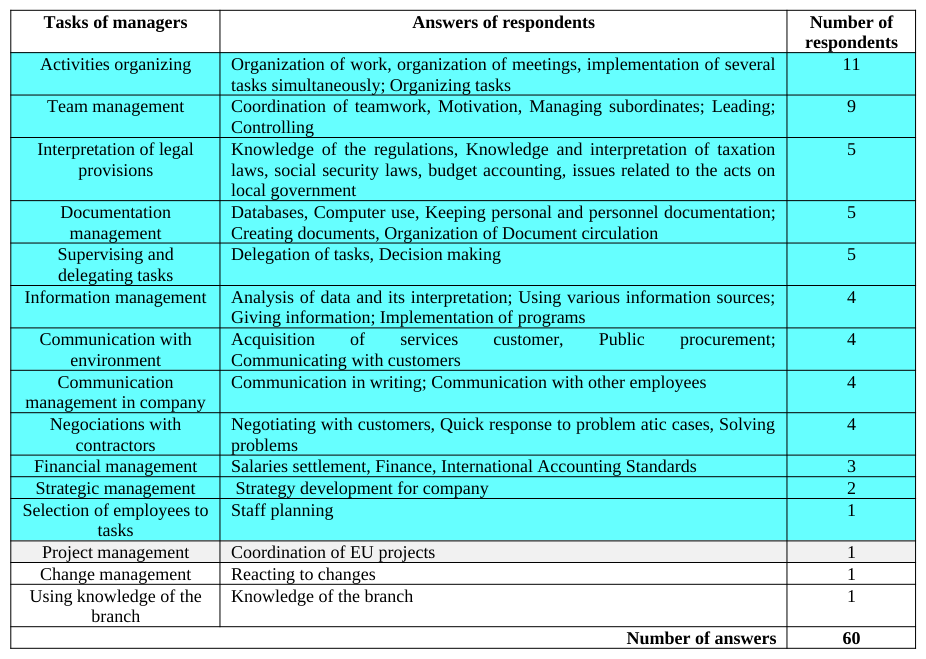
Next question concerned the tasks that the manager performs better than his colleagues. 69% of respondents answered positively. Table 3 presents the tasks which managers perform better than their colleagues.
Table 3. Tasks which are performed by managers better than by their colleagues.( Source: own study based on data from the conducted research within the project of Polish Chamber of Commerce)
In table 1, tasks highlighted in blue are the ones which appeared first on the list of tasks carried out by the municipal sector managers as well as on the list of tasks that may be implemented in the future by the managers of the twenty-first century. The color gray marks tasks to be implemented in the future and not included in the list of tasks carried out at present. The research shows that managers handle the best organizing activities -11 respondents.
They feel that they cope better with organizing and executing several tasks at the same time, than their colleagues. The next tasks are related with the team management. 9 respondents believe that they motivate, coordinate and mostly lead a team of employees better than their co-workers. This is a very good result, because it is essential task for the manager's future. 5 respondents believe that they can interpret the law much better than their colleagues. This ability is used in many tasks, for example, during negotiations, managing a team, managing projects and communicating with others.
Another task, with which 5 managers do not find problem with is document management in the organization. It is the task of the future, which will be realized in every company oriented on development. Organization of documentation circulation, creation of databases and personal records facilitate performance of tasks and help in the analysis of enterprises indicators.
Another group of managers surveyed (5 people) think that they can supervise and delegate tasks better than their colleagues. It is the basic responsibility of every manager, which will be carried out in the future.
Although 69% of respondents declared themselves that they can perform tasks better than others in the team, only 48% of managers were able to name the task. This can result from high self-esteem, or lack of ability to name tasks.
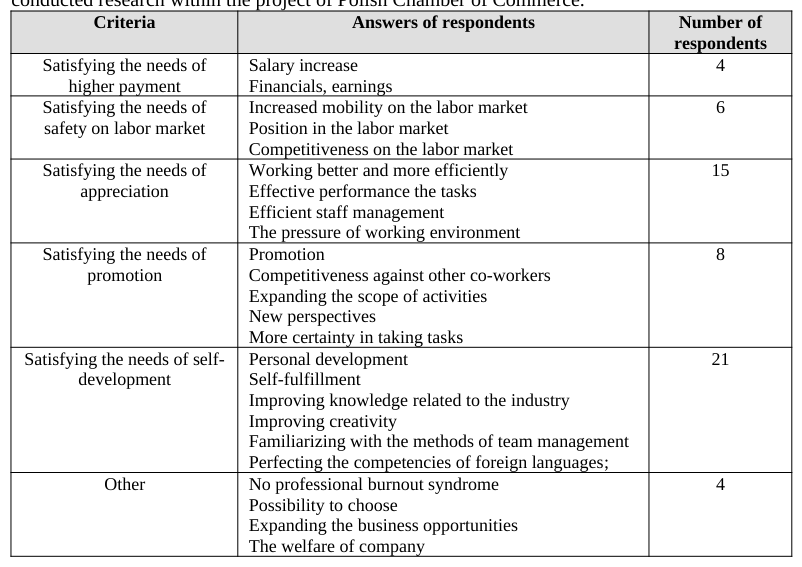
Respondents were also asked about the reasons for the development and improvement of their professional competencies. Table 4 shows the results of the research. The criteria represent the levels of needs in Maslow's pyramid, starting with the lowest level (salary) to the highest (self-improvement and development). The main reason respondents indicated was willingness to self-development (17%), followed by meeting the needs of appreciation
(12%) and promotion (7%). In the last place managers positioned salary. For managers surveyed, money is not the main reason for improvement and development of own competencies. Analyzing these reasons it can be concluded that the needs of the respondents are of the highest level of Maslow's pyramid, they are ready for continuous development and improvement of their competencies.
Table 4. Why do employees want to improve and develop their competencies? Source: own study based on data from the conducted research within the project of Polish Chamber of Commerce.
It should be noted that managers primarily use informal methods of improvement (professional literature, the experience of others, industry meetings) and non-formal (e-learning, training, specialist courses). Only two people use formal methods for improving themselves, which are higher and postgraduate education.
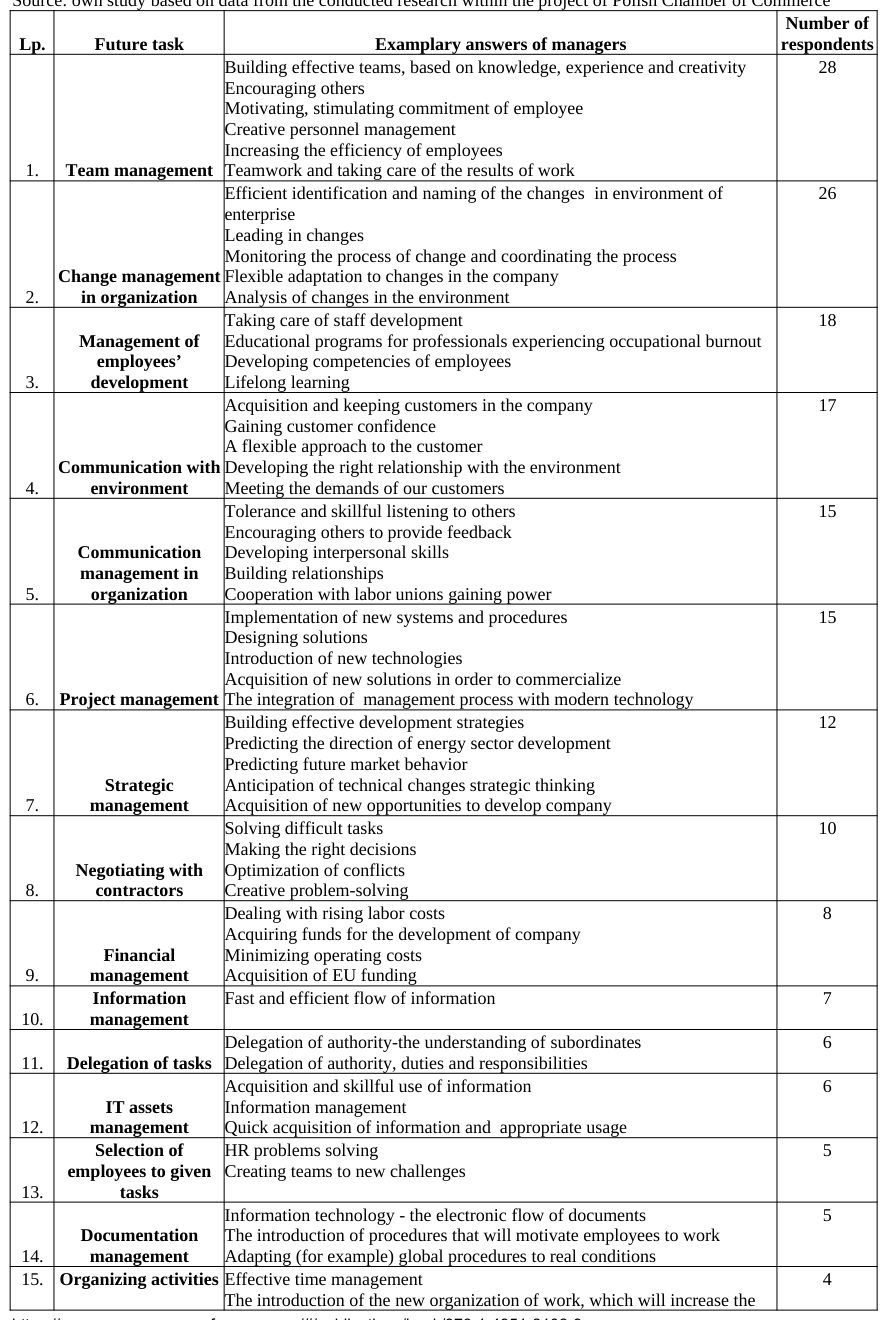
Last part of the survey involved future tasks and professional competencies. Responses are shown in Table 6 and 7. Due to the fact that each of the managers could include several sentences, only selected responses will be presented (Table 5).
Table 5. List of future tasks Source: own study based on data from the conducted research within the project of Polish Chamber of Commerce Lp. Future task Examplary answers of managers Number of respondents
Managers think that the most important task is to manage a team of employees (28 respondents) and the management of change in organizations (26 answers). Building effective teams, based on knowledge, experience and creativity, as well as creative management of those teams are the tasks of the future, which are challenge for manager of municipal enterprise. Respondents are aware that changes in the test sector are inevitable. Hence it is vital to flexibly adapt to changes taking place in the company, to monitor and coordinate the process. Managers also point out that their main task will be to adapt the professional competencies to changing economical, social and legal conditions. They need to develop own skills but also ensure that employees improve their competencies. Some respondents (5 people) believe that municipal companies should base their actions on the continuous training of human resources across the organization. Which means that enterprises should become learning organizations.
Another future task is to communicate with the external environment (17 managers) and internal environment (15 people). Respondents believe that their main task will be the developing of an appropriate image of the company and establishing appropriate relations with the environment. Thrust of customers and meeting their requirements should be achieved. 8th position is assigned to the task of negotiating with contractors (10 people). Managers think that this is a very important task, which is why they distinguish this task separately from communication with environment, which of course should be included within external communication group. In addition to communicating with customers, managers will also communicate with their employees. Thus they think that interpersonal skills should be developed, such as tolerance and skillful listening to others, to build positive relationships and work together.
15 managers selected project management as a major task in the future in the municipal sector. Tasks will consist not only of standard and repetitive activities, will be largely separate and very complicated: Implementing new systems and procedures, modernization of economical facilities, introduction of new technologies, are just few examples of challenges to be faced by managers of municipal companies in the future.
Another task that is in the top ten, is strategic management. It was listed up by 12 respondents. Managers think that the prediction of future behavior of the market and then building effective development strategy is essential to succeed.
None of the 125 managers chosed quality management and safety management as an important task in the future. Nevertheless these are fundamental tasks for the operation of any organization. Organizations must ensure quality of service, and must meet the demands of customers. In such situation effective quality management is a necessity.
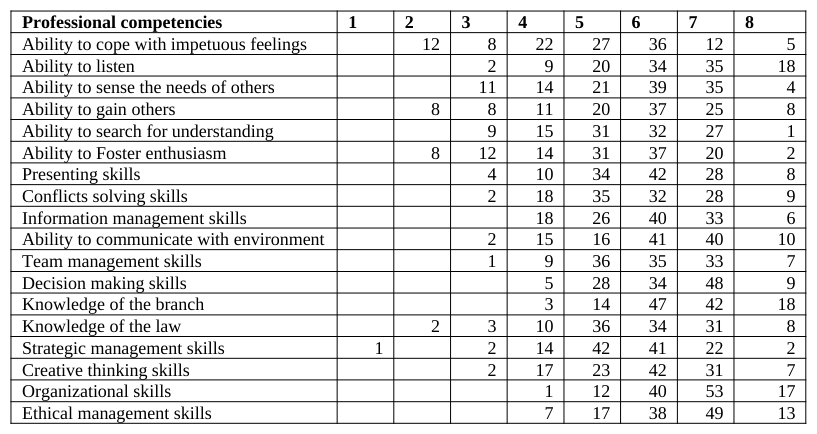
The last point of the study was self-assessment of professional competencies of managers necessary to perform the tasks in the future. The results are presented in Table 6. Managers previously acquainted with the competency levels of 1-8. Each of them has been precisely characterized. Examined competencies were described in details as well. Skills from the first to the seventh line are included as communication competencies. Due to a fact those play an important role on managerial position, they have been examined in detail. Subsequent competencies are a set of future competencies that have been proposed by a group of experts.
Table 6. Self-assessment of occupational competencies required to realize future tasks. Source: own study based on data from the conducted research within the project of Polish Chamber of Commerce.
The research shows that the majority of respondents have a problem with strategic management (one manager rated his abilities at level 1, which means no competencies in this area), only 2 people have stated that they are experts. Respondents think that they have the deficiencies when it comes to creative thinking skills, knowledge of the law and the ability of fostering enthusiasm in others.
Only 8% of questioned, responded that they can adequately manage a team of employees, the remaining part, which is 92% rated their skills in this area good (29%), very good (28%), excellent (26%) and at the level of an expert (5%) . Managers said they are ready for management of the project team in the future.
Self-assessment of competencies is an important source of information, but should be verified. Therefore, the next stage of research will be examination of occupational competencies of managers and assessment of their skills and knowledge through Assessment Center and 360 degrees methods. Only after this evaluation objective assessment of the competency level of the respondents can be done.
CONCLUSIONS
The main conclusions of the research include the following statements:
1) 69% of the surveyed managers distinguished group of tasks, which they perform better than co-workers. These are the tasks related with the organization of activities, managing a team of employees, interpretation of regulations and documentation management. According to above list those are the future tasks of managers. This means that some of the respondents already have professional competencies that will be essential to manage the company in the future.
2) 17% of respondents have difficulty with the current tasks on their positions. These are tasks such as personnel management, document management, supervision and delegation of tasks, management of communication in the organization, financial management and change management.
3) 24% of the examined managers of the municipal sector have competencies not used at work. These are competencies such as the ability to communicate with others, team management skills, knowledge of the law, financial management skills and skills related with their interests. Diagnosis of competencies excess will allow assigning them new tasks and increase the motivation to act.
4) 82% of respondents want to broaden their competencies. As the main reason for improvement, surveyed managers indicate willingness to self-development (17%), followed by meeting the needs of appreciation (12%) and promotion (7%). The least important were answers related to the salary.
5) 44% of managers currently gain additional competencies in the field of performed tasks through training, courses, postgraduate studies, literature, and e-learning. Managers mainly broaden their knowledge and skills in informal and formal manner. Formal way (postgraduate studies) is a small percentage (2%) of the respondents.
6) 77% of managers want to participate in the nearest future in training and courses perfecting their skills. Looking for training they are mostly guided by its topic, quality of training, skills of the coach and the possibility to use gained knowledge on given position.
7) As the main tasks of the future managers, surveyed persons have selected: - Creative team management; - The management of change in organizations; - Management of employees’ development - Effective communication with internal and external environment; - Continuous development and improvement of their skills;
8) Analyzing the self-assessment of professional competencies of municipal sector managers it is concluded that about 70% of respondents rate their competencies at good, very good and excellent level. Most respondents have a problem with the strategic management, creative thinking skills, knowledge of the law, and skills to foster the enthusiasm in others.
Analysis of the knowledge and skills of managers of municipal sector enables to recognize competency gaps and the excess of competencies, and thus affects the rational design of specific development programs for managers. Conducted research of competencies is a first part of study that will cover whole Poland. This action will allow to diagnose real knowledge and skills of managers of the municipal sector, and thus allow to create plans for the development and improvement of their professional competences required in the future.
REFERENCES
Aiken, L. (2003), “Psychological testing and assessment”, Boston: Pearson Education Group. Babiak, J., (2012), expert opinion about the project "Partnership and strategy for economic change Wielkopolska sector" Baill, B., (1999). The changing requirements of the HR professional: Implications for the development of HR professionals.
Human Resource Management, 38(2), 171-175 Boyatzis, R., (1982), The competent manager: a model for effective performance, Wiley, New York. Boyatzis, R., (2008), Competencies in the 21st century, Case Western Reserve University, Cleveland, Ohio, USA, Journal of Management Development, Vol. 27 No. 1, pp. 5-12 Bratton, J., Gold, J. (2007), Human Resource Management, theory and practice, 4th edition, Palgrave Macmillan, New York.
Caldwell, R., (2010), Are HR Business Partner Competency Models Effective?, Applied H.R.M. Research, Volume 12, Number 1, pages 40-58 Cameron, K., Whetten, D., (1983), A model for teaching management skills, The Organizational Behaviour Teaching Jurnal, , nr
8 Czapla, T.P., (2011), Modelowanie kompetencji pracowniczych w organizacji, Wyd. Uniwersytetu Łódzkiego, Łódź. Dickson, D., Hargie, O., (2004), Skilled interpersonal communication: research, theory and practice. Routledge, London. Dubois, D., & Rothwell, W., (2004), Competency-Based Human Resource Management, Davies-Black Publishing. Filipowicz, G., (2004), Zarządzanie kompetencjami zawodowymi, PWE, Warszawa. Filipowicz, G., (2008), Rozwój organizacji poprzez rozwój efektywności pracowników, Wolters Kluwer Polska, Kraków. Grudzewski, W.M., Hajduk, I.K., Sankowska, A., Wańtuchowicz, M., (2010), Sustainability w biznesie, czyli przedsiębiorstwo przyszłości – zmiany paradygmatów i koncepcji zarządzania, Polktext, Warszawa. Janowska, Z., (2010), Zarządzania zasobami ludzkimi, PWE, Warszawa. Jurek, P., (2008), Analiza wybranych metod oceny kompetencji zawodowych, [w] Kompetencje a sukces zarządzania
organizacją (red.) A. Witkowski, T. Listwan, Difin, Warszawa. Key Competences for Lifelong Learning, (2007), European Reference Framework, Education and Culture DG, European Communities, Belgia. Klink, M., (2007), Competences and vocational higher education: Now and in future, European journal of vocational training ,
No 40 – 2007/1. Krawczykowski, T., (2012), expert opinion about the project "Partnership and strategy for economic change Wielkopolska sector", Markiewicz, I., Profile kompetencyjne – jak zarządzać różnorodnością w firmie?, http://www.kadry.abc.com.pl/czytaj/-/artykul/profile-kompetencyjne-jak-zarzadzac-roznorodnoscia-w-firmie-1 (15.07. 2013) McEvoy, G., Hayton, J., Wrnick, A., Mumford, T., Hanks, S., & Blahna, (2005), M. A competency-based model for developing
human resource professionals. Journal of Management Education, 29, 383- 402 Morawski, M., (2009), Zarządzanie profesjonalistami, PWE, Warszawa. Perrini F., (2005), Building a European Portrait of Corporate Social Responsibility Reporting, European Management Journal Vol.23, No. 6, pp. 611-627. Platonoff A.L., (2011), Czas na rozwój. Człowiek, społeczność, organizacja; Master of Business Administration (116) 1/2011 Rakowska A., (2007), Kompetencje menedżerskie kadry kierowniczej we współczesnych organizacjach, UMCS, Lublin. Rakowska A., (2008), Samoocena kompetencji menedżerskich kadry kierowniczej współczesnych organizacji – wyniki badań, w:
S. Witkowski , T. Listwan, Kompetencje a sukces zarzadzania organizacją, Centrum Doradztwa i Informacji, Difin, Warszawa. Rausch, E., Sherman, H., & Washbush, J. B., (2002). Defining and assessing competencies for competency-based, outcomefocused management development. The Journal of Management Development, 21, 184-200 Rostkowski, T., (2004), Nowoczesne metody zarządzania zasobami ludzkimi, Difin, Warszawa. Smółka, P., (2008), Kompetencje społeczne, metody pomiaru i doskonalenia umiejętności interpersonalnych, Oficyna, Kraków. Spychała, M.,(2011), An analysis of methods of monitoring and evaluation of workers’ occupational competencies in a modern
enterprise; w: Workers’ occupational competencies in a modern enterprise, Publishing House of Poznan University of Technology, Poznan. Spychała, M., (2012), Zarządzanie kompetencjami zawodowymi menedżera XXI wieku wielkopolskiego sektora komunalnego, w: A. Branowska, P. Siemieniak, M. Spychała, Zarządzanie kompetencjami w tradycyjnych i nowoczesnych organizacjach, Wydawnictwo Politechniki Poznańskiej, Poznań. Spychała, M., (2013), Kompetencje zawodowe menedżera przyszłości w wielkopolskim sektorze komunalnym, Acta universitatis
lodziensis, Folia oeconomica, Łódź. Szczęsna, A., Rostkowski, T., (2004), Zarządzanie kompetencjami, w: T. Rostkowski (red.), Nowoczesne metody zarządzania zasobami ludzkimi, Difin, Warszawa. Thorton, G.C., Rupp, D.E., (2004), Simulations and assessment centers. w: J.C. Thomas (red.), Comprehensive handbook of
psychological assessment (vol. 4, 319-344). Industrial and organizational assessment, John Wiley and Sons, Inc., New Jersey. Ulrich, D., Brockbank, W., Yeung, A., & Lake, D. (1995). Human resource competencies: An empirical assessment. Human Resource Management, 34(4), 473-496. Ulrich, D., Brockbank, W., & Johnson, D. (2008). HR Competencies: Mastery at the Intersection of People and Business,
Alexandria, VA: Society of Human Resource Management. Walkowiak, R., (2008), Problemy metodologiczne pomiaru i raportowania kompetencji, [w] (red.) A. Witkowski, T. Listwan, Kompetencje a sukces zarządzania organizacją, Difin, Warszawa. Whiddett, S., Hollyforde, S., (2003), Modele kompetencyjne w zarządzaniu zasobami ludzkimi, Oficyna Ekonomiczna, Kraków. Wu, J.L., (2013), The Study of Competency-Based Training and Strategies in the Public Sector: Experience From Taiwan, Public
Personnel Management 42/2, pp 259-271
LISTED IN THE AHFE DIGITAL BOOKSTORE CATALOGUE
Explore the complete digital volume
Advances in Social and Organizational Factors
Read this individual research paper free through the original publisher, or explore the full digital proceedings book.
ISBN 978-1-4951-2102-9
Explore this ISBN in the AHFE Bookstore ↗Listed in the July 2026 bookstore catalogue; search by ISBN to confirm current availability · Digital book purchase optional