Adriana Angelica Gómez-Carrillo, Elvia Luz González-Muñoz (2020). Evaluation of Working Postures in Mexican Rural Workers and Their Effect on Musculoskeletal Discomfort. In: Advances in Social and Organizational Factors. AHFE Open Access, vol. 9. https://doi.org/10.54941/ahfe100324
The study population consisted of workers who live in areas considered rural (less than 2, 500 people and have no regular water service, electric light, street paving, according to INEGI, 2010), distributed in the municipalities of Poncitlán and Ocotlan, Jalisco. Its economy depends to be workers or peasants in small family plots. Objective: To relate the positions taken and musculoskeletal discomfort in workers of a furniture industry in Ciénega region of Mexico, in 2011. Methods: Cross-sectional prospective analytical component. 258 workers participated. The instruments used were socio-demographic survey, Standardized Nordic Questionnaire (CNE) and OWAS method. The data were analyzed using basic statistics and correlation, organizing data in tables and graphs. Results: The greatest inconvenience positions were presented in sewing, upholstery, assembly and shipping. Variables in the correlation of the anatomical region of the back and expressed seniority factor had the highest risk, followed by positions with action category 3 and 4 OWAS and age. Conclusions: These are the positions derived from the task which causes musculoskeletal discomfort and not the activity itself. Reengineering posts, ergonomic education intervention, and automation of high-risk areas is proposed.
Since late last century is considered that novel occupational health problems are composed of two emerging diseases, job stress and ergonomic injury to the musculo-skeletal system, according to the Workers' Commissions of Castilla and Leon (2008), one of every four workers referred complaints regarding their musculoskeletal system. The European OSHA reports that musculoskeletal disorders are the most common work-related health problems, with non-neutral postures as the cause for cumulative trauma disorders.
The purpose of ergonomics is to adapt the work to the man, and one of the ways to do this is to study the risks of labor in a physical environment. This paper aims to contribute to understanding the positions and their effect on the presence of musculoskeletal discomfort in male and female workers in the furniture industry. This has not been studied in Mexico, and reported studies focus on male workers in heavy industry, as expressed by nurses and dentists treating the patients.
This research proposes improvements to ergonomic working conditions and contributes to the knowledge of the characteristics of rural labor populations for further study of causality. The lack of information on this subject and its impact on the local population is reflected in the ambiguity with which employers implement appropriate ergonomic adjustments. Due to insufficient training, workers are unaware of the ergonomic risk factor. Also in scientific, medical and business areas in the writer's country, needs are unknown regarding the use of ergonomics as an instrument of satisfaction, wellness and prevention.
The Cienega region, in the state of Jalisco is located on 2 major corridors for commercial activities: the runner Tepic-Guadalajara-Morelia-Mexico and Manzanillo-Guadalajara-Lagos corridor Moreno-Lion-San Luis Potosi leading to U.S. border. Industrial production reached 4. 3% of the industrial production of the State focuses on the area of Ocotlán and its area of influence, emphasizing the furniture industry that has national importance (National Development Plan, 2007-2009).
Despite being a thriving industrial area, some have studied the processes that occur in the area, in the literature only focused on studies of social conditions and the economy that generates the furniture industry are reported. Results indicate precarious and far from the quality standards, risk factors for work-related pathologies working conditions. Most employers recognize that within the main risks to damage the health and safety of its employees associated with physical fatigue or stress positions (40.5%) is found, and that, in fact, what causes these risks are primarily tools, machinery, and equipment (46.6%) (Cuellar, García, & Hernandez, 2008).
A high percentage of the furniture industry in the area is not eligible for export or inserted competitively in the domestic market which is reflected in lower incentives to modernize machinery; the 73.3% do not acquire, modify or replace equipment individually or collectively protection provide poor training of workers, generated few change in its organization, minimum adjustments aimed at the health and safety of workers; the 88.5% of employers do not consider jobs modification to improve their ergonomics aspects, plus an undercount accident and occupational disease (Cuellar et al., 2008).
The continuous development of science and technology seeking to satisfy human needs makes the world economic order subject in a significant percentage to the industrial sector. In 2007, according to a report of the total world population, 48% are employed, of which 17% are female, and 31% are male. In Mexico, the rate of total labor force in 2008 is 68%. The state of Jalisco, one of the most industrialized countries, had the sum of 1.9 million people paid workers in 2009 according to the Economic Census, which covers manufacturing 35.1% of workers. In June 2010, provides for the processing industry 3'885, 280 workers and specifically in the manufacture of furniture 81, 590 workers (INEGI, 2010).
The interrelation of media production and the worker presents risk conditions capable of producing disorders related to the work (Piedrahita, 2004). Physical strength man development for survival in the early days was lost for the sake of the bipedal position, designed to walk on two legs. The requirements in job performance may cause damage to health when tasks exceed the capacity of man, injuring him (Kumar, 2001).
Precarious conditions of the work environment in México, more pronounced in rural areas bring disease and accidents. Employers do not have the financial means or the intention of providing a healthy work environment and if any worker not immersed in a culture of prevention does his best to avoid them, creating a vicious circle suitable for risk factors lead to damages for worker health.
The transition from livelihood industrialized and highly skilled jobs has led to an increase in the presence of psychosocial factors, biological, physical, chemical and ergonomic risks related to accidents and illnesses. The study of human biomechanical performance against requirements demanding jobs to the economically active population is studied by ergonomics (Gutiérrez, 2009).
The World Health Organization (WHO) encompasses musculoskeletal discomfort in a group of conditions defined as "work-related disorders, which may be caused, aggravated, accelerated or exacerbated by exposure at the place of work and they may be associated with work conditions. Personal characteristics and other socio-cultural factors play a role as a risk factor in triggering these conditions." (Piedrahita, 2004). The International Labour Organization (ILO) included musculoskeletal disorders (MSDs) in their list of occupational diseases in 2002.
Viikari-Juntura, Rauas, Martikainen, Kuosma, Riihimäki, Takala, & Saarenmaa, K. (1996) refers to the proportion of musculoskeletal diseases attributable to work is about 30%. Luttmann (2004) for his part, points out that in industrialized countries, one third of sick leave for health reasons are due to musculoskeletal ailments, including cumulative trauma disorders. OSALAN (2008) reports in its 2007 report that the health damage found 47.8% are risks of muscle-skeletal injuries. In 2007, in Mexico, 2.6 per 10 000 workers have occupational diseases (3,681 cases), of which 56 were reported as back pain, since musculoskeletal disorders are not classified as such (IMSS, 2008).
In this absence of classification by both medical and legal in México and because of the economic conditions in which the industry develops in Mexico, Small and Medium Enterprises (PyMES) are a good source of job creation but also the origin occupational diseases, including musculoskeletal. Within this area, the position that the employee takes in carrying out their work fits working conditions. The imposed load, working hours, job demands, in clear contrast to what gives the definition of the ILO Occupational health. The work must be adapted to the worker and not the reverse, creating the conditions sufficient for an occupational disease develops. The effects of good or bad fit between the object and the user used in each of the activities will have very different consequences, from mild to severe and disabling (Prado, 2006).
The need to study working postures in an industrial environment is usually based on three premises: a) inadequate postures alter the way to work or cause pain or fatigue, b) inadequate postures are associated with workplace accidents, and c) poor posture are harmful to health (Prado, 2006). The postures that are adopted in the workplace have a goal, a purpose outside themselves. This is because the positions are related to external conditions (Kuorinka, 2004). So the posture analysis should include the working environment and the task itself.
The posture is closely related with balance and stability. In fact, the posture is controlled by a number of nervous reflexes, in which the arrival of tactile and visual sensations from the environment has an important role. It is defined as the organization of the trunk, head and extremities (position) that takes a person to perform an activity, in this case the performance of their work. Posture is the basis of the precise movements and the visual observation, as well as being a source of information about events taking place at work (Kuorinka, 2004).
The neutral position is the most appropriate because the anatomical regions maintain the natural position of the body. The posture is intended to facilitate the work, and therefore has a purpose that influences their nature, their temporal relationship and its cost (physiological or otherwise) to the person. Posture is the source of musculoskeletal load. Except when we are relaxed, whether standing, sitting or lying down, the muscles have to exert force to balance our position or control movements.
Kuorinka (2004) points out that, in reality, it was observed that a "typical" or "optimal" position, e.g. manual handling, is a thing of fiction. For each personand each work situation, there are a number of "best" alternatives from the point of view of different criteria postures. Awkward postures are positions of work involving one or more anatomical regions longer in a natural comfort position to move to a position that generates forced hyperextension, hyper-bending or musculoskeletal rotations and can cause overuse injuries. They include a) fixed positions or restricted body, b) the positions that overload the muscles and tendons, c) the positions loaded joints asymmetrically, and d) positions that produce static charge on the musculature (Cilveti, & Idoate, 2001).
Aaras (1998), Burdoff (1991), Keyserling (1988), Reyes (2000), and Ryan (1989) have shown that non-neutral postures are the leading cause of musculoskeletal disorders industry. Some musculoskeletal problems can be considered ergonomic diseases that can result from simple episodes of overexertion, overuse, or both cumulative (Pheasant, 1991).
The PyMES are the mainstay of Mexican industry, a large percentage came from family businesses; their expansion is in relation to market demand, so do not go hand in hand with a vision-mission competitive and globalized which include protection of worker health. López (2007), in a study conducted ergonomic practices in PyMES in Ensenada, concluded that little attention to the ergonomic design of the workplace is provided, and therefore, the care of the safety, health, and quality of life workers.
STAGE I. DETECTION OF MUSCULOSKELETAL DISCOMFORT Population
The study was conducted in a furniture company in the municipality of Ocotlán, located in the Cienega region. Census with the entire working population was performed.
Type of study and procedure The study is prospective with cross-sectional analytical component. From the results and observations made during the pilot study, it was decided to proceed with the application of both questionnaires in the form of an interview to all workers. From this post and distribution work area, presence or absence of musculoskeletal discomfort and background to apply the exclusion criteria was obtained. Ten interviews were scheduled per day, individually, in an office.
Instruments Questionnaire for demographic, anthropometric and labour variables.
A questionnaire was used for collecting information which included data such as gender, age, weight and size, marital status, education, sport, work at home, care of children, a history of accidents or prior injuries, as well as general musculoskeletal disease. Labour variables were a history of similar jobs, seniority in the job, seniority in the company, work and working hours, area and job, as well as if you have another job in another company.
Standardized Nordic questionnaires for the analysis of musculoskeletal symptoms Musculoskeletal-related work, symptoms were identified with the Nordic Questionnaire Standardized (Kuorinka, Jonsson, Kilbom, Vinterberg, Biering-Sorensen, Andersson, & Jordensen, 1987) which was created for the analysis of musculoskeletal symptoms ergonomic origin in the context of occupational health. It consists of two parts; one is general, and the other is specific for the shoulder and neck. The limitations of the questionnaire are related to the person completing the questionnaire, including the length of time that he/she has submitted a questionnaire. The hassle and appreciation of the intensity are subjective to the person.
Results
The results of Table 1 describe the socio-demographic characteristics of the subject; it finds that most are male and with one whose age is less than 30 years.
.
Table 1 Socio-demographic characteristics of the subject, Variable Characteristics Percentage
Sex Male 60% Female 40%
Age 17 to 30 age 61%
More than 30 age 39% Education Level Elementary 38%
Middle or more 62%
Laboral characteristics Regarding the distribution of job characteristics of the sample, it was found that workers were divided into 2 areas: rooms (79%) and bedrooms-kitchens (21%). There are 15 jobs that cover the processes for preparing the wood, furniture assembly, finishing, packaging and distribution. The average length in the company is 5 years (± 4) and in the position of 4 years (± 3). The 75% have up to 5 years in the company and 25% over 5 years. 84% have up to 5 years in the job and 16% over 5 years.
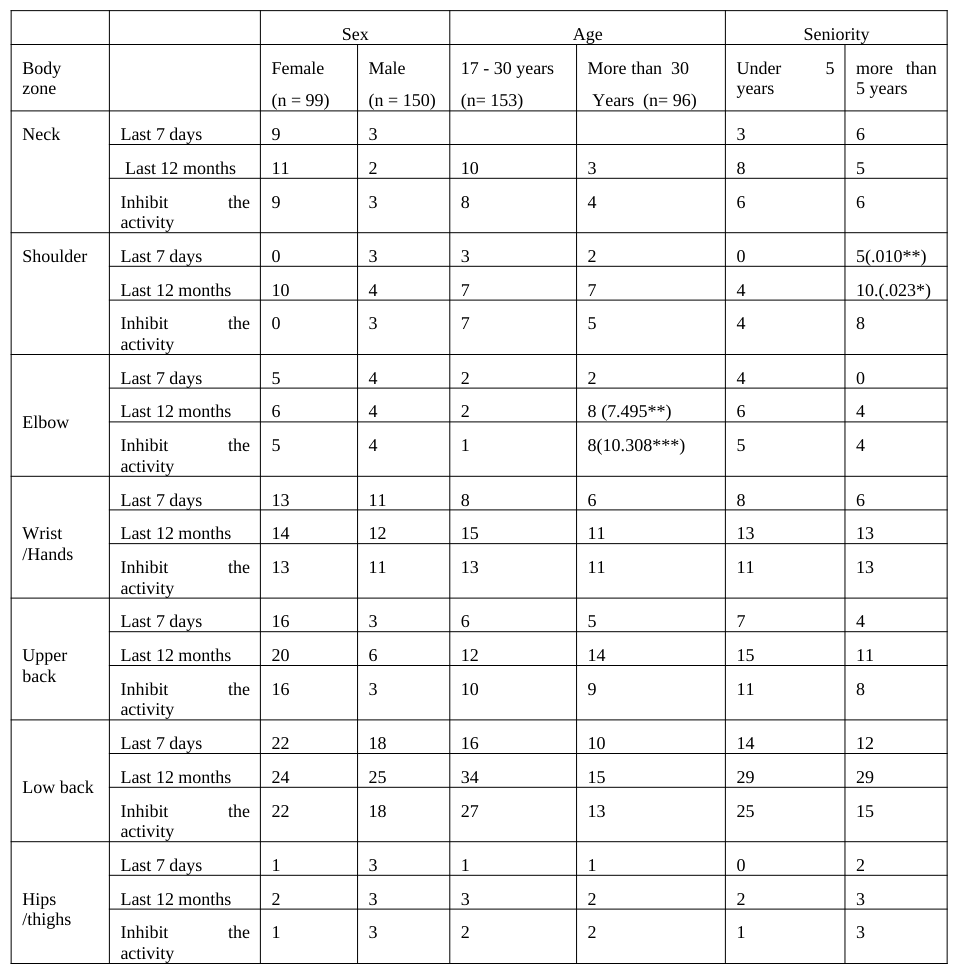
Detection of musculoskeletal discomfort The results of detection of musculoskeletal discomfort referred through the Standardized Nordic Questionnaire, and their relationship to gender, age, education level, length of service and work area are presented below. In addition to the classification that gives the instrument on the presence of discomfort, the last 12 months which related to chronicity and the mention of discomfort in the last seven days is considered an expression of the actual presence of the disease and whether these have limited performance in their workplaces and non-work activities.
Areas with the highest percentage of musculoskeletal discomfort in the past 12 months were upper back (10.4%), and hand and finger (10.2%). The lower back was the area with the greatest discomfort in the last twelve months (19.7), past 7 days (10.4%) and is the largest impediment to the activity (16.1%).
Relationship of musculoskeletal discomfort with other variables The female has a greater percentage musculoskeletal discomfort in both recent and chronic forms and prevent their activities. In terms of age, no statistically significant differences as subjects older than 30 years had more discomfort in the elbow and knee in the last 12 months (chronic symptoms), and discomfort in the elbow that prevents activities.
The presence of musculoskeletal discomfort relating to schooling was statistically significant on the neck for the last 12 months and impedes activities of the neck and ankle in the group of middle and high school. For ankle discomfort in the past twelve months and hip in last seven days (acute discomfort), the significance was in the group of elementary school.
The presence of musculoskeletal discomfort regarding seniority was statistically significant for shoulder and ankle in the last 12 months and ankle in the last 7 days for the group with more than five years of seniority.
Also, musculoskeletal discomfort that had a statistically significant relationship with length of service was shoulder in last 12 months in the group with less than five years old in the post. Ankle discomfort in the last 12 months was significantly lower in both groups but was more prevalent among subjects with more than five years in office activities than subjects with five or fewer years in office. Most workers have less than five years working in the position. In the case of musculoskeletal discomfort in the upper back, subjects employed in the area of rooms were found to have the most developed symptoms.
The jobs that were significantly associated with musculoskeletal pain in the past 12 months in order of the decreasing number of cases were sewing and polishing, upholstering, carpentry, pre-assembly, padding, and packaging.
Jobs shown to have a significant impact on the neck muscles included sewing, assembling, polishing and shipping, whereas for upper back areas they included sewing, polishing, rubber, foam, shipping and assembly (Table 2).
Table 2. Distribution of discomfort musculoskeletal according to sex, age and seniority in the post Sex Age Seniority
STAGE II. RELATIONSHIP BETWEEN MUSCULOSKELETAL DISCOMFORT AND INADEQUATE POSTURES.
Sample The sample was made up of subjects who has answered the musculoskeletal questionnaire, selected per job that had major musculoskeletal discomfort, and were of age, with at least one year in the job position.
Removal and exclusion criteria: Temporary workers, workers with physical scars from accidents, workers heavily pregnant from the second quarter onwards, workers who had other medical conditions involving musculoskeletal symptoms of general work-related origin such as diabetes, rheumatoid arthritis drop leukemia, thyroid disease and aplastic anemia, were all excluded from the study. Workers with less than one year in the company were also excluded. Those workers who answered less than 85% of the items were eliminated.
Instruments Postures Data Collection by Using Video Recorder
Subject Working postures will be recorded by a video recorder (Kivi & Mattila, 1991; Saurin & Guimaraes, 2006). Observations should be made at 30 second intervals. The observer maintains a recording distance of approximately two meters from the subject so as to ensure a full view of the body. The advantage of using a video recorder is that the observer has sufficient time to look at the observed postures.
OWAS Method The OWAS method is collects observation information on worker postures on back, arms and legs. It has 252 posture, which are combination of four back postures, three arm postures and seven leg postures with three estimate loads. Each posture of the OWAS is determined by the four digit code in which the numbers indicates the postures of the back, the arms and the load needed. Observer need to identify OWAS posture code of each selected posture from the video image for each work task.
Each OWAS posture code will then be analysed using individual OWAS classified posture combinations in order to get the action category for each work phase. The classification for individual posture combination indicates the level of risk or injury for the musculoskeletal system. If the risk for musculoskeletal disorder is high, then the action category indicates the need and urgency for corrective actions. The action categories for each individual postures are presented in Figure 2 and explanation about OWAS action categories for prevention shown at Table 2. Prolong time spent in one particular posture may cause musculoskeletal injury. Therefore, the next analysis is identifying the
OWAS action category by calculating the total time spent in different postures for each body part for one complete work task. WinOWAS software will be used to identify the OWAS action category.
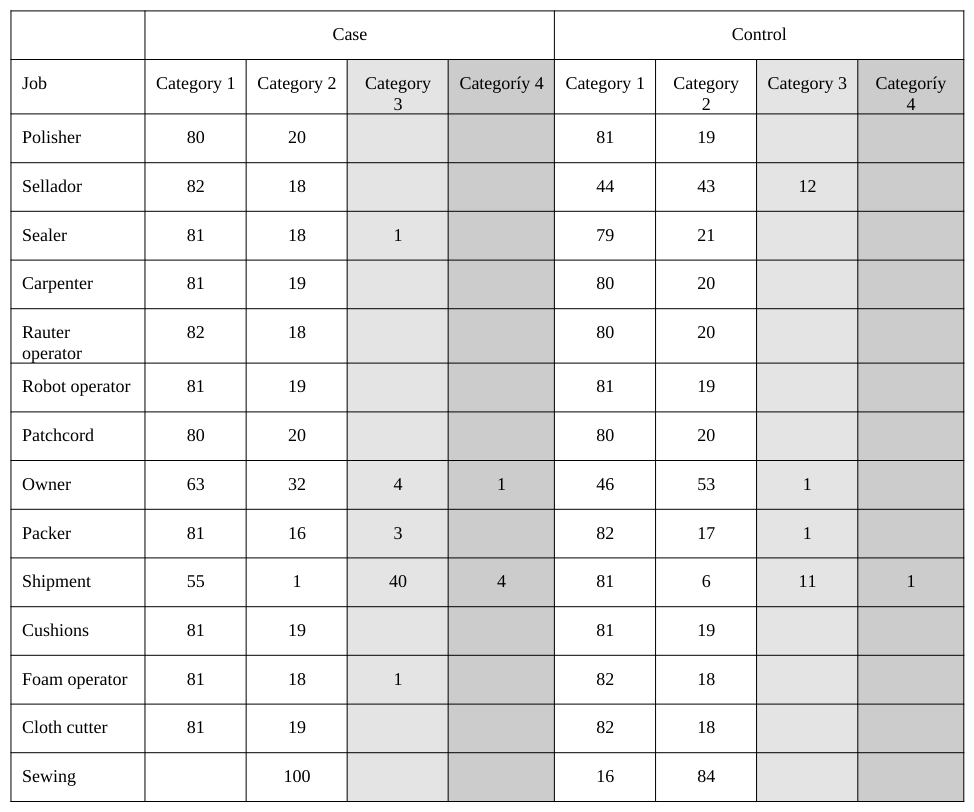
Results Postures adopted in the work Based on the results of employment data obtained from the questionnaire and applying the selection criteria specifically the presence of musculoskeletal discomfort, a total of 208 workers was obtained. From this selection workers were matched by job, sex, age and education. Was designated as a case worker with the maximum score of musculoskeletal discomfort as a case and was appointed as its torque control a worker without musculoskeletal discomfort.
Both cases and controls were filmed in their area of work for a period of 30 minutes during which a total of 80 observations in that period was obtained. Of all the places filmed, six workers were female, and 9 were male.
Table 3. Percentage of postures by category method OWAS.
Upholsterer 80 2 18 80 12 8
Logistic regression analysis for the musculoskeletal discomfort.
The variables age, seniority, and categories three and four in action in OWAS in risk analysis (odds ratio) for the presence of musculoskeletal discomfort (Table 4) were considered.
The variables that were significant with crude risk were adjusted to each other. After this process, three variables remained significant, two increased their significance: seniority in the company (OR 5.9) and back (OR 4.2). Category Three remained with an equal OR (1.3). The variables age and Category Four lost the stastistics' significance, and were adjustable with other variables (Table 5).
The age and Category Four variables lost significance when adjusted with the other variables (OR 1 and 1.4, respectively).
Table 4. Crude estimate of odds ratio.
Table available in the original PDF paper.
Odds ratio estimate OR IC 95%
Age 17 - 30 years 1.7 0.346-8.038 More than 30 years
Seniority Under 5 years 5.3 1.079-26.429 More than 5 years
No gender difference was found. No relationship of musculoskeletal discomfort was indicated by gender because the morphology and physiology of the musculoskeletal system are not different between the sexes. In addition, the scope of the study did not show these data, but the reference of musculoskeletal aches percentage was higher in women. Even if you can mention that the jobs are not designed from the variable anthropometry and gender are not able to adjust to this feature.
All jobs studied were positive for the presence of non-neutral postures, although not all workers reported musculoskeletal discomfort, as an expression of anti-ergonomic industrial design areas. The work area was statistically significant for inconvenience rooms.
The group in middle school and high school was the statistically most significant, as the majority of them were workers in jobs with more manual handling of loads are the largest schools, highlighting that during the development of research observed.
In the investigation of musculoskeletal discomfort the Standardized Nordic Questionnaire divides the body into seven anatomic regions, the results of this study in the furniture industry craft was found that the back is the one that showed statistical significance and scored highest category level the method of observation (OWAS) at level three.
It was found that back problems are directly related to the position adopted, age greater than 30 years and the oldest in the post, including damage caused by degeneration of the very conditions of the person together with cumulative damage by wear due to the workload and not neutral postures I am subject to the same exposure time, in line with the theory of Biomechanics Musculoskeletal disorders. Prado (2006) mentions that although there are degenerative changes due to aging that normally occur over time due to biological and biochemical changes resulting from the burdens lumbar joints, it has also been shown that if the loads or compressive forces exceed a degree that would be considered appropriate to the physical and biological capacity of the functional unit, the degeneracy will be greater and at an earlier age. Pheasan (1991) classifies musculoskeletal damage cumulative and instantaneous, entering the first lumbar discomfort considered from the ergonomic approach.
Therefore it is concluded that they are not neutral postures that produce musculoskeletal discomfort and no job, ie required by the task and by the physical conditions of the post positions.
REFERENCES
Chapanis, A. (1996), “Human factors in systems engineering”. Wiley Series in Systems Engineering and Management. Andrew Sage, series editor. Hoboken, NJ: Wiley. Comisiones Obreras de Castilla y León. (2008). Manual de trastornos músculo-esqueléticos. España: Secretaria de salud laboral. Cuellar, H., García, A. & Hernández, E. (2008). Estudio descriptivo de las condiciones y medio ambiente de trabajo. El caso de
las MIPYMES de la Industria Mueblera de Ocotlán, Jalisco, México: Estudios de la Ciénega, Gutiérrez, A. (2009).Guía Técnica para el análisis de la exposición a factores de riesgo ocupacional. Bogotá: ISTAS. Website: http:/www.fonforiesgosprofesionales.gov.co INEGI (2010). Censos económicos y poblacionales. México. Kumar S. (2001). Theories of musculoskeletal injury causation. Ergonomics, 44. 17-47. Kuorinka, I., Jonsson, B., Kilbom, A., Vinterberg, H., Biering-Sorensen, H, H., Andersson, Andersson, G., Jordensen, K. (1987).
Standarised Nordic Questionnaires Nordic for Questionnaires for the analysis of musculoskeletal symptoms. Applied Ergonomics, 18(3), 233-237. Luttmann A. Jager M, Griefahn, B. (2004). Prevención de trastornos musculoesqueleticos en el lugar de trabajo. SUIZA: OMS. Pheasant, S. (1991). Ergonomics, Work and Health. Aspen Publisher Inc. Piedrahita, H. (2004). Evidencias epidemiológicas entre factores de riesgo en el trabajo y los desórdenes musculo-esqueleticos.
Mapfre medicina, 15(3), 212-221. Prado, L. (2006). Ergonomía y Lumbalgias Ocupacionales. (2da. Ed.). México: Ediciones CUAAD.
Viikari-Juntura, E., Rauas, S., Martikainen, R., Kuosma, E., Riihimäki, H., Takala, E. P., & Saarenmaa, K. (1996). Validity of self-reported physical work load in epidemiologic studies on musculoskeletal disorders. Scandinavian Journal of Work Environment and Health, 22(4), 251-259.
LISTED IN THE AHFE DIGITAL BOOKSTORE CATALOGUE
Explore the complete digital volume
Advances in Social and Organizational Factors
Read this individual research paper free through the original publisher, or explore the full digital proceedings book.
ISBN 978-1-4951-2102-9
Explore this ISBN in the AHFE Bookstore ↗Listed in the July 2026 bookstore catalogue; search by ISBN to confirm current availability · Digital book purchase optional