Fuel-Efficient Driving (2022). Climbing Decision Ladders To Analyse Ecodriving: The First Rung on the Way to. In: Advances in Human Aspects of Transportation: Part III. AHFE Open Access, vol. 17. https://doi.org/10.54941/ahfe100727
This paper presents the initial stage of the design of an in-vehicle ecodriving support tool, namely the analysis phase. In order to understand the types of behaviours that characterise fuel-efficient driving a review was conducted, covering both the academic literature and more publicly available web resources, such as advice provided by governmental websites, car manufacturers’ websites, and specific ecodriving organisations. The review resulted in the identification of four distinct driving activities, each related to the use of the accelerator pedal, that play a crucial role in the use of fuel in the private road vehicle. A preliminary attempt at modelling these activities using Jens Rasmussen’s Decision Ladder approach was made, with the resulting models being discussed in a focus group. Then followed a series of four interviews with ecodriving experts; these served to validate, supplement, and further specify the models into five activities. One of these models is discussed in detail, drawing on theory from the Skills, Rules and Knowledge taxonomy and the Direct Manipulation Interface approach. Finally, some suggestions are offered as to how this analysis may go on to inform an in-vehicle, ecodriving support system.
Many modern vehicles, both those with internal combustion engines (ICEs) and those with less conventional drive trains (e.g. hybrids and electrics), come with a means for providing feedback and advice to the driver about fuel efficiency. Given the backdrop of sustainability and the over-usage of resources, and the established finding that the way in which a car is driven can have a significant effect on the amount of fuel used - from around 15% in ICE vehicles (Evans, 1979; Waters & Laker, 1980) to as much as 30% in electric vehicles (Bingham, Walsh, & Carroll, 2012) – the increasing trend in supporting ‘ecodriving’ through in-vehicle information is unsurprising. There is, however, great variance in the way different vehicle manufacturers present ecodriving information to the driver, in terms of the actual type of information presented, and in the way it is presented. For example, though a number of modern vehicles show to the driver a real-time miles-per-gallon metric (MPG; or MPG equivalent for hybrid and electric vehicles) to indicate the current fuel-efficiency of the vehicle, with the aim of encouraging lower energy use (e.g. Barkenbus, 2010) it has been suggested that this may be “an inappropriate and misleading metric for instantaneous feedback in vehicles” (Stillwater, 2011, p. 7).
The current paper therefore presents the first step towards the design of a fuel-efficiency support system that does not aim to provide feedback about current efficiency levels, but rather to support the very behaviours that characterise fuel-efficient driving. In order to develop such a system it is first necessary to understand those behaviours; only then will it be possible to support them in the vehicle. The focus of the current research is, therefore, the analysis of the decision-making processes made when driving in an economical fashion. Following a review of both the academic literature and of publicly available web-based ecodriving resources, four specific driving activities that can have significant effects on fuel-efficiency were identified (see below). These activities were modelled using Rasmussen's Decision Ladders (Rasmussen, 1974), an analysis technique that models activities in decision-making terms. Then followed a number of interviews with experienced 'ecodrivers' (i.e. subject matter experts) with the resulting information serving to amend, supplement, and validate these Decision Ladder models. For reasons of brevity, only one of the completed models is discussed; this is done so in terms of its contribution to the design of a new, in-vehicle information system aiming to support ecodriving behaviours. The discussion is grounded in the Skills, Rules and Knowledge (SRK; Rasmussen, 1983) theoretical framework.
Before describing the specific activities that were modelled, and the process by which these activities were identified, a brief explanation of the theoretical basis of this research is offered, alongside a description of the Decision Ladder (Rasmussen, 1974) modelling technique.
SKILLS, RULES, KNOWLEDGE AND DECISION LADDERS The SRK Taxonomy
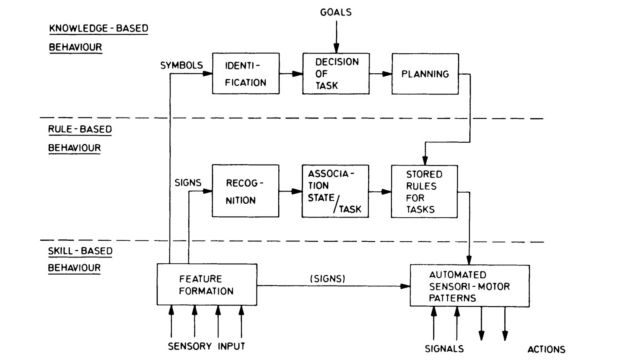
The Skills, Rules and Knowledge taxonomy is a theoretical framework that describes the three different levels of cognitive control with which actors interact with their environment (Rasmussen, 1983). Skill-based behaviour (SBB) involves automatic, direct interaction with the environment; rule-based behaviour (RBB) involves associating familiar perceptual cues in the environment with stored rules for action and intent; knowledge-based behaviour (KBB) involves analytical problem solving based on symbolic reasoning and stored mental models (Vicente, 2002). Typically, novice interaction, and interaction in unfamiliar or unanticipated events will proceed using KBB, whereas expert interaction, and interaction in highly routine and familiar situations will proceed with SBB. The theory also provides a description of learning, in that an individual, starting as a novice, will initially interact with a task at the KBB level. As experience grows, behaviour will progress through RBB to SBB, whereby actions become routine and automatic. In this sense the theoretical framework bears resemblance to earlier descriptions of learning from the field of psychology, one of the earliest being that of Ryle’s (1949) distinction of knowing that and knowing how, and the later, but closely related differentiation of declarative and procedural knowledge (Anderson, 1976, 1983).
Declarative knowledge (knowing that) refers to information in individual fragments that are stored separately, for example knowledge of facts, events and relationships, while procedural knowledge (knowing how) represents knowledge of how to do things, for example complex motor skills and cognitive skills and strategies. Where behaviour based on declarative knowledge requires effortful and time-consuming integration of knowledge fragments (Anderson, 1993), with procedural knowledge the retrieval of information required to guide behaviour is said to be fast and automatic (Pirolli & Recker, 1994). As Anderson (1993) explains, it is the conversion of declarative knowledge to procedural knowledge, through the amalgamation (or aggregation, in Rasmussen’s words) of individual pieces of information into coherent concepts, or higher-level chunks that guide action, that characterises skill development, i.e. learning. These distinctions clearly resonate with the SRK philosophy; where knowledge-based behaviour requires the operator to perform complex reasoning, reflecting on and interpreting information displayed in the interface (using declarative knowledge), perceptual-motor reasoning (skill- and rule- based) needs only recognition of familiar aspects of the task or problem to guide behaviour (Glaser, 1984). Such similarities between the SRK and earlier descriptions of human cognition are by no means accidental; Rasmussen, Pejtersen and Schmidt (1990) expressly state that the SRK taxonomy “is compatible with the main-line of conceptualization within cognitive science and psychology (declarative vs. procedural knowledge…)” (Rasmussen et al., 1990, p. 106).
Though Figure 1 shows a visualisation of the SRK taxonomy as provided by Rasmussen (Rasmussen, 1983), Decision Ladder models can also be used to depict the kinds of behaviours that characterise the three different levels of cognitive control.
Figure 1. Graphical representation of the SRK taxonomy, from Rasmussen (1983) Decision Ladders
The Decision Ladder was first described in detail by Jens Rasmussen in 1974 with the aim of providing a model of human data-processing that could be used “to facilitate the matching of the formatting and encoding of data displays to the different modes of perception and processing used by human process controllers” (Rasmussen, 1974, p. 26). The diagrams are used to represent activity in decision-making terms; they depict the decisions that actors are required to make at different stages of a particular decision-making process (see Figure 2). The diagram contains two different types of nodes: the rectangular boxes represent information processing activities, while the circles represent the resultant state of knowledge. For example, the information processing activity labelled as diagnose state leads to knowledge of the current system state. The left portion of the diagram is concerned with an analysis of the situation and diagnosis of the current state of affairs, while the right side deals with the definition, planning and execution of an action. The top of the diagram represents the evaluation of options and the consideration of specific goals pertaining to the task at hand.
The sequential arrangement of the rectangles (information processing activities) and circles (states of knowledge) characterises both the process of decision-making through which a novice operator would progress, and the decision-making steps required during unanticipated and novel situations (i.e. at the knowledge-based level of cognitive control). In these situations, and with novice actors, the top part of the diagram maybe circulated around more than once. In these instances the decision maker may have to consider the various options available to him or her, and what affect each of these options will have on the chosen goal of the activity. Furthermore, there may be multiple, conflicting goals present in the decision-making task; each will require consideration.
In familiar situations, and in experienced actors, the linear sequence depicted in the decision ladder is rarely followed, rather shortcuts can be, and often are taken. There are two types of shortcuts defined in the literature (Jenkins et al., 2009; Vicente, 1999); shunts and leaps. Shunts connect data processing activities to non-sequential states of knowledge while leaps connect two states of knowledge. The arrows in the centre of the figure 1 represent these shortcuts. For example, in certain situations the process of diagnosing the system state may lead directly to the knowledge that a set procedure is required; such a shortcut is an example of a shunt. An example of a leap would be the association of knowledge of the current system state with a knowledge of a task that needs to be performed in order to, for example, get the system back to normal system operations. These shortcuts are often driven by rules and heuristics, learned through, for example, formal training and informal experience. Experienced actors may also enter the decision ladder at different nodes; they do not necessarily have to enter at activation and exit at execute. In accommodating various start and end points, the decision ladder is sufficiently flexible to represent the kind of opportunistic decision-making often seen in complex and, in particular, dynamic environments (Rasmussen, 1974). For example, an experienced actor may enter the decision ladder with an understanding of the current system state. From this they may infer, from past experience, the action required to achieve his or her given goal. Similarly, the activity may not necessarily flow from left to right, but can occur from right to left. For example, knowledge of the desired target state may lead an actor to observe for more information and cues to understand how this state may be achieved.
The aforementioned shortcuts represented in the decision ladder are indicative of rule-based behaviours; they represent instances in which familiar perceptual cues in the environment are associated with stored rules for action and intent. Skill-based behaviour, the fast, automatic response to stimuli in the environment, is represented on the decision ladder by the arrow connecting activation with execute. Here, upon activation of the decision making process, a pre-set response is released, resulting in the execution of a particular activity. As described above, this form of responding is fast and automatic, and is said to be unavailable for introspection (Pirolli & Recker, 1994).
As previously described, the full decision ladder, when annotated for a given decision-making process, will represent the way in which an actor analyses the situation, evaluates and selects goals, and plans and executes a task when using knowledge-based reasoning (i.e. follows the sequential path in its entirety), with all possible information inputs and options; this represents a prototypical model of activity (Jenkins, Stanton, Salmon, Walker, & Rafferty, 2010). Rather than representing any one particular instance of an activity and the decisions therein (this would be a typical model of activity), the prototypical model aims to capture all possible elements that may affect the decision- making process (though not all will be used in any given situation). For example, Jenkins et al. (2010) describe the process of developing a decision ladder by means of asking a subject mater expert about a specific instance in which the activity of interest was performed. This supported development of a model of typical activity, i.e. a particular example of an event that, in the case of Jenkins et al. (2010) has happened in the past. This typical model was then supplemented with all the additional and alternative information that may have been used, and the information that could be used in similar situations. This converts the typical model into the prototypical model.
According to Elix and Naikar (2008) the decision-ladder approach can be used to inform the design of an interface; they do not, however, go into great detail on how this is to be achieved. Jenkins et al. (2010) go further in explaining how the generated prototypical models support an understanding of the relationships between the elements in the decision-making process. It is suggested that understanding the decisions to be made and the information sources that guide these decisions will help a designer to design an interface that more fully supports the operator on their task. Rasmussen, Pejtersen and Goodstein (1994) also make this point, stating that a designer must have a satisfactory understanding of the decision-making process of the potential user if they are to provide the correct information in the correct volumes in the interface. The process of developing the decision-ladder supports such an understanding.
MODELLING FUEL EFFICIENT DRIVING For the analysis of the decision-making processes when driving in an economical fashion it is necessary to first select specific situations, and in turn decision-making events, that have the most significant effect on fuel economy. This selection process serves to constrain, and give focus to the analysis. Hence a review of the available information on ecodriving was undertaken.
Activity Identification Information on ecodriving, that is to say the driving styles that characterise a more economical use of fuel in the road vehicle, is widely available, both in the academic literature, and across a plethora of more publicly available websites. Hooker (1988) offered one of the first descriptions of the specific driving styles that characterise economical driving. His research revealed that it is the style of acceleration and the timings of gear selections that have the greatest effect on fuel use in the vehicle. This is still the case in modern vehicles; Barkenbus (2010) states that ecodriving is characterised by (among other things) smooth acceleration, shifting up to the highest gear possible as early as possible (within the boundaries of safety), and anticipating the traffic flow and road layout ahead so as to avoid sudden starts and stops (i.e. to drive as smoothly as possible).
The concept of anticipation for ecodriving also features heavily across a multitude of publicly available internet resources, including specific ecodriving websites, (e.g. ecodrive.org, 2013; Travelfootprint.org, 2013), motoring organisations (e.g. The AA, 2013), car manufacturers (e.g. Ford, 2013; Renault, 2013), local government (e.g. Devon County Council, 2013), and from national and international non-governmental organisations (e.g. energy saving trust, 2013; United Nations, 2013). These resources offer advice not only on the style of driving that characterises lower fuel consumption, but on the general maintenance of the vehicle as well. For example, removing unnecessary weight from the vehicle (e.g. not keeping the golf clubs in the car when they are not to be used), avoiding the use of air conditioning, and maintaining the recommended tyre pressures, will all have a beneficial effect on fuel economy. This research is, however, only concerned with the types of driving styles and behaviours that characterise fuel-efficient use of the vehicle, i.e. the driving task itself, hence these maintenance and peripheral use related considerations were not included in the current study.
This leaves us with two primary classes of driving behaviour that significantly affect fuel-economy. Behaviours related to use of the vehicle's gears, and behaviours related to use of the vehicle's accelerator and brakes. The second point can be further simplified to only use of the accelerator pedal; to minimise use of the vehicle's hydraulic brakes the driver must anticipate the road scene ahead in order to remove their foot from the accelerator pedal such that coasting down to a required speed can be achieved. This allows for smoother driving and, over the course of a route, reduces the amount of accelerator pedal usage (and therefore fuel usage).
Though the issue of gear choice behaviours is an important one in terms of the use of fuel in a manual transmission, internal-combustion engine vehicle, this class of behaviour was not included as part of the current study for two main reasons; firstly, the aim is to develop a system that is equally useful in both ICE vehicles and electric vehicles (which do not have gears in the same way ICE vehicles do); secondly, to reduce complexity and maintain focus. Hence only those behaviours associated with use of the accelerator pedal were considered.
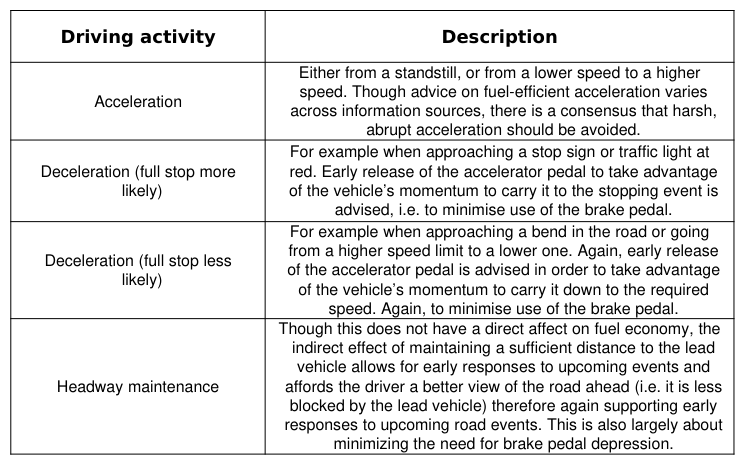
Based on the information provided in the academic and public literature, and on the aforementioned criteria, four specific activities were identified for modelling; these are presented in Table 1 alongside a brief description of why each is important in terms of fuel efficiency.
Table 1: Ecodriving activities selected for analysis Driving activity Description
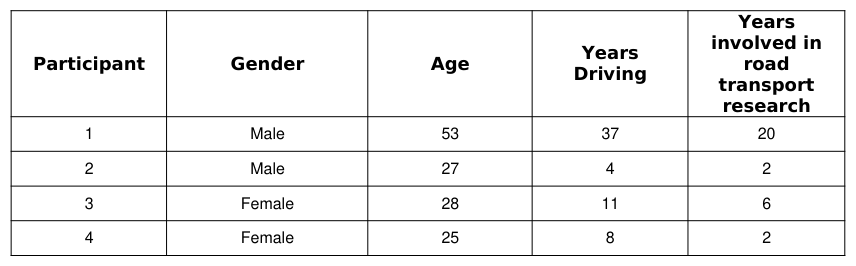
Ecodriving Decision Ladder validation A Decision Ladder model was developed for each of the four activities listed in Table 1. The first iteration of the analysis was based on information gathered from online ecodriving information, on information from the academic literature on ecodriving, and on the first author’s knowledge of the driving domain. A focus group was held at the University of Southampton’s Transportation Research Group, the participants of which were four researchers, including the two current authors, each of whom possessed a working knowledge of human factors in road transport. Note, however, that none of the members of the focus group was an expert in ecodriving specifically. The group served both to validate the choice of activities, and to discuss the resultant models. It provided a platform for the discussion of the first iteration of the analysis. Table 2 provides a summary of the four participants’ relevant information.
Table 2: Focus group participant information
Though the focus group discussions were useful for an initial attempt at model validation, the participants were not subject matter experts, in the sense that they were not experienced in ecodriving specifically. As such, a number of interviews with experienced ‘ecodrivers’ were arranged to further validate the models.
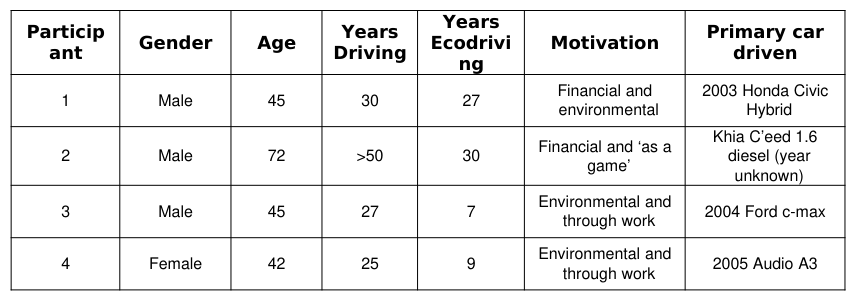
Participants were initially sought from two ecodriving websites: ecomodder.com and hypermiler.co.uk. These websites provide a platform for those interested in both the technologies and behaviours associated with fuel efficient driving, offering news of new technologies, advice on saving fuel when driving, and providing a space for the community to discuss experiences and practices. A request for participation was posted to the forums hosted on each website. From this, two individuals contacted the current authors; one was a member of the forums on ecomodder.com, the other on hypermiler.co.uk. Two more participants were contacted through the ECOWILL project, details of which can be found from www.ecodrive.org. This European-wide project aims at providing information on ecodriving to the general public, as well as undertaking formal, academic research into various ecodriving aspects, including research involving driving instructors trained and experienced in teaching ecodriving techniques to individuals.
In all cases, participation was entirely voluntary, without any payment (monetary or otherwise). Due to the geographically dispersed nature of the participants (one in the U.S. one in Germany, one in Scotland, one in England), face-to-face interviews were not possible; hence three interviews were conducted using Skype™, with the other conducted over the telephone (as per this participant’s preference). Each interview lasted approximately one hour. Relevant participant information is provided in Table 3.
Table 3: Interviewee information
To elicit information regarding each specific driving situation a procedure similar to that described in Jenkins et al. (2010) was followed. Each expert was introduced to the Decision Ladder model and asked about his goals for each activity. The left hand side of the diagram was then populated with information regarding the cue or cues responsible for bringing to attention the need for some action. Then the expert was asked to list the sources of information he uses to build an understanding of the current state of the system, i.e. what cues in the environment will later go on to affect his decision making process. The top section of the diagram was populated through a discussion of the options available to the driver and how these impact on the chosen goal, be it efficiency or otherwise. Then the target state was discussed; this largely related to the selection of accelerator pedal position and particularly points along the roadway. Finally, the task required to achieve this target state, and the necessary procedure, were discussed.
Following the discussions it became clear that ‘deceleration (full stop less likely)’ was too broad a category, insofar as the information used to guide performance when approaching a road curvature was sufficiently different to the information used in other slowing events to warrant its own Decision Ladder. As such, this model has been broken down into two separate models; ‘deceleration for road curvature’ and ‘deceleration for other slowing event’. For the purposes of brevity, only the ‘deceleration for road curvature’ Decision Ladder will be discussed in detail here. This is presented in figure 3.
INTERPRETING THE MODEL As this research is interested in the decision making processes specific to ecodriving in particular situations, the goal of the activity being modelled was identified as ‘to decelerate from a higher speed to a lower speed in order to negotiate a road curvature whilst maintaining safety and minimising overall fuel consumption for the journey’.
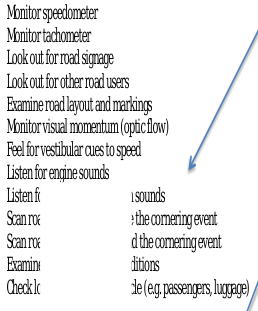
It can be seen from the left hand side of figure 3 that once the alert has been raised that there is curvature in the road ahead (i.e. it has been seen), the driver scans for cues, both within and outside of the vehicle, to build an understanding of the system state; this can also be thought of as developing an awareness of the situation. In terms of useful information, the driver may attend to, for example, the speedometer and tachometer, other road users, the road layout, markings and signage both before and (if possible) after the road curvature, as well as physical movement (i.e. vestibular cues), visual momentum (i.e. the passing of the road scene outside the vehicle) and the sounds of the engine and car-road interactions (e.g. tyre noise at moderate to high speeds). These information sources allow the driver to establish an understanding of the road environment, the state of the driver’s own vehicle (e.g. speed, acceleration, weight characteristics), the weather conditions, and the behaviour of other road users.
Figure 3. Decision Ladder for ‘deceleration for road curvature’
In the top part of the diagram the driver may cycle through the potential options for action, and consider the effect that the current system state will have on these possibilities For example, based on an understanding of the system state, the driver can estimate the effect of engine braking and different levels of hydraulic (i.e. traditional, brake- pedal initiated braking) and regenerative braking (where this is applicable) on the state of the system as a whole. Also considered here are the effects the current weather conditions may have on the driver’s ability to perform certain actions and the impact on the chosen goal. For the purposes of this analysis, a primary goal is to be able to decelerate, in the most fuel-efficient manner, down to a speed that is appropriate to safely negotiate the road curvature. This is achieved by minimising the use of the hydraulic brake pedal, or conversely, maximising the use of the vehicle’s momentum to carry it to the corner. Of course, safety will always be paramount in an on-road situation. The state of the system may therefore impact on the ability to turn the corner efficiently, for example in icy conditions or in conditions of heavy traffic flow.
The right hand side of this upper section also has two other, potentially conflicting goals, namely to conform to social pressure and to reach the destination as quickly as possible. Each one of the subject matter experts raised both of these issues. One can imagine various situations in which speed is critical, from the emergency (for example a pregnant mother, going into labour, being rushed to hospital) to the relatively mundane (for example rushing home from work in order to get back before the TV repair technician arrives). In terms of social pressure, this can come from both within and outside the vehicle. For those pressures coming from within the vehicle, one can imagine, for example, a situation in which a young driver succumbs to peer pressure to drive more aggressively (an established finding, particularly for young men (e.g. Conner, Smith, & McMillan, 2003)). Pressures coming from outside the vehicle relate to the behaviour of other road users, for example other drivers’ use of their horns to influence the driver’s behaviour, or the act of driving very close to the rear of the driver’s vehicle to encourage the driver to go faster (see e.g. (Åberg, Larsen, & Beilinsson, 1997) for a discussion on the effect of the social environment on driver behaviour and perceptions).
Moving down the right hand side of the diagram, the target state (assuming the goal of fuel-efficient negotiation of the corner) can be understood in terms of the use of the accelerator pedal, or more specifically, the time and road position (dependent on current speed) at which the foot should be removed from the accelerator pedal in order to coast, from the current speed, down to the required cornering speed. This involves an understanding of the current speed, the ideal speed for cornering, and the deceleration characteristics of the vehicle when using only engine braking (i.e. without the use of the hydraulic brake). This knowledge of target state necessarily leads on to an understanding of the task, i.e. when to remove the foot from the accelerator pedal, and the procedure, i.e. remove the foot and minimise hydraulic brake use.
DISCUSSION
As was discussed earlier in this paper, the prototypical Decision Ladder represents all the possible information elements that may be used to guide a particular decision; it does not present any one particular course of action or sequence of steps. The Decision Ladder presented here offers such a description of the decision-making processes for the activity of negotiating a road curvature in a fuel-efficient manner. The way in which an individual will progress from the alert stage to the execute stage will depend on a number of factors, from the characteristics of the driver (e.g. novice or expert) to the information available at a specific location (e.g. signage may differ, visibility may be different depending on time of day or weather). Furthermore, a driver support system may be designed in such a way as to support different paths through the model; given the right information presentation method, it may be possible to support skill-based ecodriving behaviours even in the novice driver.
The aforementioned shortcuts through the Decision Ladder, namely the shunts and leaps, are often associated with actors of different experience; novices are expected to progress linearly, and with notable effort, through the diagram in its entirety, whereas experts may use a particular cue in the environment on which to base immediate action. It may be possible, however, to encourage such shortcuts through the careful design of information presented to the driver in the vehicle, i.e. vehicular interface design. A primary aim of doing so is to transform a cognitive task into a perceptual task. The question is, therefore, how do we support skill-based control in the novice ecodriver?
Here it may be useful to draw on the theory of direct manipulation interfaces (DMI) (e.g. Hutchins, Hollan, & Norman, 1986). This approach emphasises the need to represent objects of interest and to allow the users to act directly on what they can see in the display; it both provides an “attempt to display the domain objects of interest and allow the operator to act directly on those objects” (Rasmussen & Vicente, 1989, p. 527) and allows the operator “to rely on the perceptual cues provided by the interface to control the system” (p.525, ibid.). Note that these quotes come not from DMI proponents, but from the creators of Ecological Interface Design (EID; Rasmussen & Vicente, 1989; Vicente & Rasmussen, 1992), a design approach intimately linked with the SRK taxonomy. Both design approaches argue for the benefits of taking advantage of the human sensorimotor system, i.e. to encourage behaviour at the skill-based level. In terms of the task under analysis here, the fuel-efficient cornering of the road vehicle, one could imagine a system that informs the driver, through some salient stimulus, of the particular behaviour required as well as the time at which that particular behaviour should be performed (given the goal of fuel-efficiency). When one considers that the task in question is largely related to the accelerator pedal (note that the ‘task’ box on the right of figure 3 talks of removing the foot from the pedal at a given road position), the possibility of providing tactile or haptic feedback through the accelerator pedal becomes one that satisfies both the tenets of EID (and, in turn, the SRK taxonomy) and those of the DMI approach.
In order to support skill-based behaviour, an information system should provide information that encourages the driver to take a shortcut through the Decision Ladder as low down in the diagram as reasonably possible; in this case, this would likely support a ‘leap’ from the alert that a corner ahead has been detected, to the knowledge of the task, namely to lift the foot from the accelerator pedal. This would support interaction via time-space signals, a necessary means for encouraging skill-based behaviour, as the stimulus could come at a particular point on the road; this would be determined by a combination of spatial data and speed data (i.e. the faster a car is travelling, the earlier the signal should come to support a full coasting phase) and calculated using already-present information from car radar systems and satellite navigation information. Furthermore, following the suggestion that the operator should be able to act directly on the display, this time-space signal could be presented through the accelerator pedal, as a vibration (e.g. Birrell, Young, & Weldon, 2013), or as an additional counterforce applied to the pedal (e.g. Mulder, Pauwelussen, van Paassen, & Abbink, 2010). This type of system, one that combines the action and control surfaces (i.e. the area onto which an action is performed is one and the same as the area from which information is garnered), would satisfy the theoretical arguments of both the SRK taxonomy and the DMI approach and should, in theory, support skill-based behaviour in the driver. It is this that is the focus of our on-going research project.
CONCLUSIONS
This paper has presented the first step toward the design of an in-vehicle information system that aims to support the very behaviours themselves that characterise fuel-efficient driving. A review of the academic literature and of more publicly available web-based resources on ecodriving resulted in the identification of four distinct activities that have the most significant effects on fuel economy in the road vehicle (with the exception of gear change behaviours). These activities were modelled using Rasmussen’s (1974) Decision Ladders. The activities and the models were then discussed in a small focus group as a means for early validation. Then followed a series of four interviews with subject matter experts to further validate and supplement the models. These interviews resulted in the further specification of the ‘deceleration (full-stop less likely)’ activity into two separate tasks, namely ‘deceleration for road curvature’ and ‘deceleration for other slowing event’.
The ‘deceleration for road curvature’ Decision Ladder was presented and discussed in terms of the possibility for designing an in-vehicle information system that will support drivers, particularly those currently lacking in ecodriving expertise, to perform the ecodriving activities at the skill-based level of cognitive control. The model was also discussed in terms of the tenets of Direct Manipulation Interfaces, with the concept of combining action and control surfaces with accelerator-pedal based haptic feedback offering a potential avenue for future research. While there are examples of these kinds of systems in the extant literature (e.g. Birrell et al., 2013; Hajek, Popiv, Just, & Bengler, 2011; Mulder, Abbink, van Paassen, & Mulder, 2011), the current research provides the first attempt to theoretically ground these efforts in existing descriptions of human control behaviour and approaches to system design.
ACKNOWLEDGEMENTS
This research was joint-funded by the UK’s Engineering and Physical Sciences Research Council (EPSRC) through the Transport and Environment programme, and Jaguar Land Rover PLC.
REFERENCES
Åberg, L., Larsen, L., & Beilinsson, L. (1997). Observed Vehicle Speed and Drivers’ Perceived Speed of Others. Applied Psychology, 46(3), 287–302. Anderson, J. R. (1976). Language, memory, and thought. Hillsdale, NJ: Erlbaum. Anderson, J. R. (1983). The architecture of cognition. Cambridge, MA: Harvard University Press. Anderson, J. R. (1993). Rules of the mind. Hillsdale, NJ: Erlbaum. Barkenbus, J. N. (2010). Eco-driving: An overlooked climate change initiative. Energy Policy, 38(2), 762–769. Bingham, C., Walsh, C., & Carroll, S. (2012). Impact of driving characteristics on electric vehicle energy consumption and range.
IET Intelligent Transport Systems, 6(1), 29–35. Birrell, S. A., Young, M. S., & Weldon, A. M. (2013). Vibrotactile pedals: provision of haptic feedback to support economical driving. Ergonomics, 56(2), 282–92. Conner, M., Smith, N., & McMillan, B. (2003). Examining normative pressure in the Theory of Planned Behaviour: Impact of
gender and passengers on intentions to break the speed limit. Current Psychology, 22(3), 252–263. Devon County Council. (2013). Ecodriving Film. Retrieved January 23, 2014, from http://www.devon.gov.uk/index/video/videotransport/ecodrivingvid.htm ecodrive.org. (2013). The Golden Rules of Ecodriving. Retrieved January 23, 2014, from
http://www.ecodrive.org/en/what_is_ecodriving-/the_golden_rules_of_ecodriving/ Elix, B., & Naikar, N. (2008). Designing safe and effective future systems: A new approach for modelling decisions in future systems with Cognitive Work Analysis. In Proceedings of the 8th International Symposium of the Australian Aviation Psychology Association. Sydney, Australia: Australian Aviation Psychology Association. energy saving trust. (2013). Driving. Retrieved January 23, 2014, from http://www.energysavingtrust.org.uk/Travel/Driving Evans, L. (1979). Driver behaviour effects on fuel consumption in urban driving. Human Factors, 21, 389–398. Ford. (2013). Driving to lower fuel consumption - and emissions. Retrieved September 18, 2013, from
http://www.ford.co.uk/OwnerServices/FuelEconomyandEnvironmentalProtection/FuelEfficientEcoDrvingTips Glaser, R. (1984). Education and thinking: The role of knowledge. Amercian Psychologist, 39, 93–104. Hajek, H., Popiv, D., Just, M., & Bengler, K. (2011). Influence of a multimodal assistance supporting anticipatory driving on the driving behavior and driver’s acceptance. In M. Kurosu (Ed.), Human Centered Design, HCII 2011, LNCS 6776 (pp. 217– 226). Berlin Heidelberg: Springer-Verlag. Hooker, J. N. (1988). Optimal driving for single-vehicle fuel economy. Transportation Research Part A: Policy and Practice,
22(3), 183–201. Hutchins, E. L., Hollan, J. D., & Norman, D. A. (1986). Direct manipulation interfaces. In D. A. Norman & S. W. Draper (Eds.), User Centered System Design: New Perspectives on Human-Computer Interaction (pp. 87–124). Hillsdale, NJ: LEA. Jenkins, D. P., Stanton, N. A., Salmon, P. M., & Walker, G. H. (2009). Cognitive Work Analysis: Coping With Complexity.
Farnham, England: Ashgate Publishing Limited. Jenkins, D. P., Stanton, N. A., Salmon, P. M., Walker, G. H., & Rafferty, L. (2010). Using the Decision Ladder to add a formative element to naturalistic decision-making research. International Journal of Human-Computer Interaction, 26(2- 3), 132–146. Mulder, M., Abbink, D. a., van Paassen, M. M., & Mulder, M. (2011). Design of a Haptic Gas Pedal for Active Car-Following
Support. IEEE Transactions on Intelligent Transportation Systems, 12(1), 268–279. Mulder, M., Pauwelussen, J. J. A., van Paassen, M. M., & Abbink, D. A. (2010). Active Deceleration Support in Car Following.
IEEE Transactions on Systems, Man, and Cybernetics - Part A: Systems and Humans, 40(6), 1271–1284. Pirolli, P., & Recker, M. (1994). Learning strategies and transfer in the domain of programming. Cognition and Instruction, 12, 235–275. Rasmussen, J. (1974). The human data processor as a system component. Bits and pieces of a model. Rasmussen, J. (1983). Skills, rules, and knowledge; signals, signs, and symbols, and other distinctions in human performance
models. IEEE Transactions on Systems, Man, and Cybernetics, 13(3), 257–266. Rasmussen, J., Pejtersen, A., & Goodstein, L. P. (1994). Cognitive Systems Engineering. New York: Wiley. Rasmussen, J., Pejtersen, A. M., & Schmidt, K. (1990). Taxonomy for Cognitive Work Analysis. Roskilde, Denmark: Risø National Laboratory. Rasmussen, J., & Vicente, K. J. (1989). Coping with human errors through system design: implications for ecological interface
design. International Journal of Man-Machine Studies, 31(5), 517–534. Renault. (2013). Eco Driving Tips. Retrieved September 18, 2013, from http://www.renault.co.uk/cars/environment/tips.aspx Ryle, G. (1949). The concept of mind. London: Hutchinson. Stillwater, T. (2011, March). Comprehending consumption: The behavioural basis and implementation of driver feedback for reducing vehicle energy use. The AA. (2013). Eco-driving advice. Retrieved September 18, 2013, from http://www.theaa.com/motoring_advice/fuels-and-
environment/drive-smart.html
Travelfootprint.org. (2013). Reduce yourTravelfootprint - Eco-Driving. Retrieved September 18, 2013, from http://www.travelfootprint.org/ecodriving United Nations. (2013). United Nations Environment Programme: Ecodriving. Retrieved January 23, 2014, from
http://www.unep.org/transport/Programmes/Ecodriving/ Vicente, K. J. (1999). Cognitive Work Analysis: Towards Safe, Productive and Healthy Computer-Based Work. Mahwah NJ: Lawrence Erlbaum Associates. Vicente, K. J. (2002). Ecological Interface Design: Progress and challenges. Human Factors, 44, 62–78. Vicente, K. J., & Rasmussen, J. (1992). Ecological interface design: Theoretical foundations. IEEE Transactions on Systems,
Man, and Cybernetics, 22, 589–600. Waters, M. H. L., & Laker, I. B. (1980). Research on fuel conservation for cars. Report No. 921. Crowthorne, England.
LISTED IN THE AHFE DIGITAL BOOKSTORE CATALOGUE
Explore the complete digital volume
Advances in Human Aspects of Transportation: Part III
Read this individual research paper free through the original publisher, or explore the full digital proceedings book.
ISBN 978-1-4951-2099-2
Explore this ISBN in the AHFE Bookstore ↗Listed in the July 2026 bookstore catalogue; search by ISBN to confirm current availability · Digital book purchase optional