Andres Viscaino - Quito, Luis Serpa-Andrade (2022). Development of a data collection system in the cloud as a storage method. In: Human Factors in Software and Systems Engineering. AHFE Open Access, vol. 61, pp. 97–101. https://doi.org/10.54941/ahfe1002529
Data being a quantitative or qualitative representation by which a symbolic or numerical value is indicated or represented, are used in various fields for which data collection processes are performed, based on the proposed objectives. Therefore, a data collection process was developed through a mobile application and web services, which will serve to evaluate and analyze with the help of an expert in the area, the graphomotor skills of children aged 6 to 8 years with motor disabilities. The results obtained at this stage will generate a large amount of information that will be used in the future for the definition of play activities that will complement the skills or deficiencies derived once the evaluation stage is completed, it will also be possible to implement or improve a completer and more robust database that will serve not only for graphomotor but also for different areas that work with these children.
Information is a relevant element when determining factors of interest in any area of development, where we find a number of tools that help with the process of collecting it, using and applying different models and methodolo- gies that streamline the processing of a large amount of data and ensuring the quality of them. The purpose of this article is to present the methodo- logy used for the construction of a data collection system, which will be used to know and analyze the different levels of graphomotor skills in children from 6 to 8 years of age. Graphomotor skills are a pertinent characteristic in the development of pre-writing, indispensable for communication proces- ses, seeking an effective conventional writing and promoting motor skills. In Ecuador, one of the most used techniques for this is the use of cryptographic techniques, helping to improve posture and graphic movements through con- secutive exercises between fingers, arm, hand, optimizing the performance of writing in the early stages of learning, which is prominent in the educational field, since other types of even more complex learning depend on it (Herrera et al., 2020).
The purpose of this tool is to collect information ranging from the child’s profile to the performance obtained when performing the different activities included in the application as such, representing it by means of signs or graphs that are presented in the intermediary system. All this information is used to determine pedagogical strategies for the development of graphomotor skills, as well as to measure academic performance and contribution components (Galindo et al., 2017).
RELATED WORKS Nowadays, due to the advance of technology, there are a large number of tools that provide support to various areas, starting from the information obtained, analyze it and thus determine certain shortcomings in the proces- ses. However, the fact of dealing with a large volume of data makes all this development slow and unreliable. A clear example is in the area of research, being even more important, since all the information obtained will be used to develop a specific project, that is why the use of tools that streamline the processing and collection of this information is proposed. For example (Pozo- Guzman & Berrezueta-Guzman, 2020) proposes a stream data collection to the monitoring of patients with a positive diagnostic of COVID-19 in remote zones.
In the work from (Katarahweire et al., 2020) a mobile data collection system was developed by means of electronic forms related to the health sector, these forms are developed by a person who is not specifically an expert in technology, and once completed, they are uploaded to a server for later use. The system consists of a client-server architecture, with the client being a mobile device on which the application is installed and the server where the forms to be downloaded are located. The forms that have been completed are temporarily stored on a mobile device, to be later extracted and sent to the server for analysis and processing.
According to the cloud computing to collect and process data, (López- Pérez et al., 2020) presents an assistance system that collect information in the cloud about the behavior of a child during therapy sessions developed by (Berrezueta-Guzman et al., 2020) through a smart home environment using the paradigm of Internet of Things (IoT). Consecutively (Dolón-Poza et al., 2020) process these data in order to estimate the evolution of the therapy process by a machine learning algorithm.
Another proposal for data collection is presented by (Yu, 2021) whose stru- cture is based on blockchain composed of a user layer, extension layer and protocol layer, incorporating features of decentralization, autonomy, infor- mation that is not manipulable and anonymity, all this and more for the purpose of transmitting and updating data securely. The system collects data concerning the physical health in which the user interacts on a structured digital platform in the cloud, employing blockchain technology to process the data and ultimately generate a professional diagnosis. Other important pro- posals that focus on the development of data collection tools are mentioned below:
Development of a Data Collection System in the Cloud as a Storage Method 99
In the same line, (Ngamani et al., 2019) developed a system to collect data through REDcap, which is a platform for data collection through forms that incorporate quality controls in the data and are allusive to web-based clinical research, generates reports, and sends them to the central Came- roon (member country of the International Epidemiological Databases of Africa, whose focus of study is AIDS.) where they will be stored and the respective review, feedback, and subsequent storage will be made.
A system for data collection and management as a basis for epidemiolo- gical research on health factors and disparities, is the one proposed by (Dong et al., 2019), whose purpose as such is to eliminate language and cultural barriers, problems of quality, security, data processing and prepa- ration, seeking to improve the welfare of various populations, focusing in its case on the population of older adults. This system employs a digital platform, which is applied in conjunction with the user to mitigate certain barriers to participation, thus ensuring better data reception. This digital platform allows to monitor and configure the data according to the needs, allowing to manipulate them in a better way.
Also (Alibegovic, 2019) developed a system to collect data regarding the level of adherence in a therapy, since it is an important factor in determining the results and progress of a patient, proposing various meth- odologies for data collection, due to the complexity and quantity of the data, generating reports and indicators suitable for structuring strate- gies, measures and suggestions with patient adherence, even facilitating processes of the medical system.
METHODOLOGY
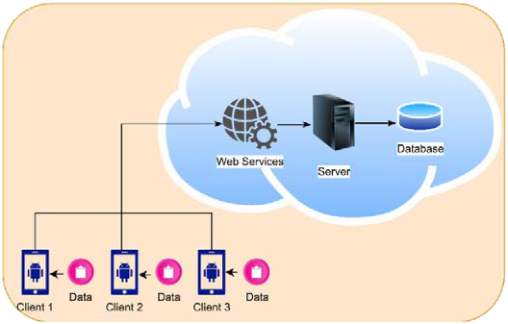
The proposal of the following system is to improve data collection from dif- ferent places and store them centrally in the cloud, managing an easy and accessible environment for users, opting for a mobile application, which fulfills the mediating function between the client (child) and the server. Ini- tially, for the development of the system we had the help of an expert in the area with whom we defined the population to be applied, taking as a percentage child with graphomotor disabilities between 6 to 8 years of age, from which the following data were taken as the basis of their pro- file: personal names, chronological age and mental age, education level and sex. Subsequently, we proceeded to apply and save information regarding the interaction and the score obtained in the activities of the application, these activities involve traces of geometric figures, letters and numbers that the child must complete. A total of 9 activities were incorporated, each with its respective level of complexity according to the established age range.
The data to be evaluated by activity are as follows:
Stroke rating (Achieved, on track and not achieved)
Pressure on paper (Normal, Hypertonic, Hypotonic)
Grip type (3-digital, modal and digital)
Directionality (Good, Bad)
100 Viscaino-Quito and Serpa-Andrade
Figure 1: Operating diagram.
Mood (Stressed, not stressed)
Hand-finger movement (Supination pronation and palmar movement) All these data were saved using web services consumption due to the COVID pandemic, the children were at home and access to them was com- plicated because they are a vulnerable group, because of this we thought of deploying a cloud server to help us with data collection, using Django and Restframework which are high-level Python libraries that help us to perform a rapid development with a clean and pragmatic design.
It was also proposed to replace the expert in the area by a hardware that performs the same task, using the qualification parameters used by the expert to build this system, working with a communication protocol that allows us to communicate between different programming languages, making use of Protobuf (Protocol Buffers) allowing us to serialize data in a structured way.
In the end, what is sought is to obtain a considerable amount of informa- tion, which allows us to determine the needs of the children and their level of graphomotor ability, so that, with the help of the expert system, we can generate recommendations and routines to be performed as established in the report, whose structure is: number of weeks, frequency and number of repetitions per activity.
CONCLUSION
Cloud computing has revolutionized with the services hosted in the same, thanks to this can be accessed from any location to data. Therefore, in this article we develop a cloud data collection system which allows us to access data from any location. Having many services in the cloud such as Amazon and Google, a server of the institution was used in which all services were deployed and thus facilitating the entire collection process. It was determined that the database in the cloud can accommodate all types of data regarding children with disabilities taking into account the privacy of the data which is only accessible by the therapist or administrator.
Development of a Data Collection System in the Cloud as a Storage Method 101
REFERENCES
Alibegovic, E. (2019). Creating an Efficient System of Data Collection on the Patients’ Adherence Level-with a Special View of the Fbih Health System. Inter- national Journal of Innovative Science and Research Technology Berrezueta-Guzman, J., Pau, I., Martín-Ruiz, M.-L., & Máximo-Bocanegra, N.
(2020). Smart-home environment to support homework activities for children. IEEE Access, 8, 160251–160267. Dolón-Poza, M., Berrezueta-Guzman, J., & Martín-Ruiz, M.-L. (2020). Creation of an intelligent system to support the therapy process in children with ADHD. Conference on Information and Communication Technologies of Ecuador, Dong, X., Kong, D., Mendhe, D., & Bergren, S. M. (2019). Leveraging technology to
improve health disparity research: trilingual data collection using tablets. Journal of the American Geriatrics Society, 67(S3), S479–S485. Galindo, E. G., Gómez, A. Z., Rodríguez, M. L., Azofra, A. A., Quesada, A. R., & Ortiz, J. L. O. (2017). Minería de datos educativos para la detección de recursos clave. Revista de Innovación y Buenas Prácticas Docentes, 18–28. Herrera, D. G. G., Lozano, M. I. Á., & Álvarez, J. C. E. (2020). Estrategias Pedagógi-
cas para el desarrollo de la grafomotricidad. Revista Arbitrada Interdisciplinaria Koinonía, 5(1), 508–527. Katarahweire, M., Bainomugisha, E., & Mughal, K. A. (2020). Data classification for secure mobile health data collection systems. Development Engineering, 5, 100054. López-Pérez, L., Berrezueta-Guzman, J., & Martín-Ruiz, M.-L. (2020). Development
of a home accompaniment system providing homework assistance for children with ADHD. Conference on Information and Communication Technologies of Ecuador, Ngamani, L., Ajeh, R., Mbuh, A., Dzudie, A., & Duda, S. N. (2019). Implementation of a REDCap-based research data collection system in Cameroon. Studies in health technology and informatics, 264, 1708. Pozo-Guzman, L., & Berrezueta-Guzman, J. (2020). IoT as an alternative way
to improve the telemedicine methods against COVID-19 in vulnerable zones. Conference on Information and Communication Technologies of Ecuador, Yu, S. (2021). Application of blockchain-based sports health data collection system in the development of sports industry. Mobile Information Systems, 2021.
LISTED IN THE AHFE DIGITAL BOOKSTORE CATALOGUE
Explore the complete digital volume
Human Factors in Software and Systems Engineering
Read this individual research paper free through the original publisher, or explore the full digital proceedings book.
ISBN 978-1-958651-37-7
Explore this ISBN in the AHFE Bookstore ↗Listed in the July 2026 bookstore catalogue; search by ISBN to confirm current availability · Digital book purchase optional