Catherine Harvey, Gary Burnett (2022). The Development of Standard Protocols to Improve the Quality of Driving Simulator Research. In: Advances in Human Aspects of Transportation: Part III. AHFE Open Access, vol. 17. https://doi.org/10.54941/ahfe100756
Simulators are widely used for investigating driving behavior under a variety of conditions. Simulators can provide a high level of relative validity, but levels of absolute validity are questionable. One drawback of simulator studies is the knowledge of participants that they are in an artificial scenario rather than driving on a real road with real consequences for performance and safety. This influences participants’ feelings of presence. There are many factors that influence presence, or the perceived ‘reality’ of a test environment, and in this paper two are discussed in detail: incentives and instructions. The use of incentives to encourage participation in research studies is inconsistent and there are many associated ethical and practical issues. Research papers rarely include descriptions of the instructions given to participants at the start of a study; however, the content and presentation of instructions can have an effect on participants’ behaviours. A methodology for a proposed study to investigate the influence of these factors in a driving simulator environment is also provided. Finally, some hypotheses for the study, based on the theory in this area, are presented for future testing.
As a safety-critical behaviour, driving is often studied in a simulated environment, primarily to minimise risk to participants and researchers and to enable stricter control over experimental variables. Assuming that studies are well-planned and influencing factors tightly controlled, simulator-based research can achieve a high level of relative validity, i.e. the magnitude of the relationship between two or more dependent variables will generally be consistent with the magnitude of the relationship between these same variables in a real driving scenario (Reed & Green, 1999). However, there are various inconsistencies between the simulated environment and the real driving environment, which can reduce the absolute validity of simulation studies, even when the fidelity of the simulated environment (i.e. the faithfulness with which reality is represented) is considered high. This affects the overall ecological validity of simulation studies. An important contributing factor is a lack of negative consequences for poor driving performance in the simulator, due to participants’ awareness that they are in an artificial situation.
The need for standardised measures of driving performance has recently been addressed in the draft SAE standard, J2944 Driving Performance Definitions (see Green, 2013). This document provides consistent terminology and definitions for driving measures and encourages researchers to describe the method of calculation for any performance statistics reported in a driving study. Adherence to this standard will enable driving studies (including those conducted in simulators) to be directly compared, as measures applied by different researchers in different institutions and across countries will be consistent. We argue that there is a need for a standardised protocol to govern not only the measures of driving performance recorded in simulator studies, as suggested by Green, but the entire simulator test process, including all points of contact with participants. Issues of interest include the details provided in the study advertisement, instructions given to participants at the beginning of a test, for which there is currently no standardised protocol, aesthetic elements of the test environment (e.g. signage, safety measures, separation between simulator and control room, appearance of experimenters), characteristics of the experimenter (including personality and experience) and methods for providing incentives for study participation. Manipulating these study characteristics could influence the level of participant ‘buy-in’ to the test situation, potentially increasing their perception of the ‘reality’ of the test environment, which is linked to participants’ feelings of presence (i.e. the measure of the extent to which people believe they are actually driving and not in a virtual environment) (Witmer & Singer, 1994). It is difficult to control all of the above factors in an experimental setting; however, the purpose of this work is to investigate how some of these can influence the behavioural outcomes of a research study, potentially leading to guidance for control over variables in future studies. The first half of this paper explores some of the demand characteristics and uncontrolled factors which can affect the validity of an experimental study. The second half presents a methodology for investigating some of these factors in relation to their influence on the results of a driving simulator study, particularly on participants’ experiences of ‘reality’ as measured by their feelings of presence. The method is currently being applied in an experimental study at the University of Nottingham: results will be presented in full at the AHFE 2014 conference.
STUDY DESIGN CHARACTERISTICS In the proposed study, two characteristics of experimental design are considered:
Incentives
Participant instructions There is a lack of consistency in the use of incentives to encourage people to volunteer for experimental trials and there are many ethical as well as practical issues associated with the payment of study participants. There is even less consensus about the approach to formulating study instructions. As a description of participant instructions is generally not provided in study reports and papers, it is very difficult to replicate the instruction content between different studies and almost impossible to assess how instructions influence experimental results. Following a more detailed discussion of the two experimental design characteristics, we present a methodology for assessing their influence on the results of a simulated driving study. In this case the experimental variables consist of a penalty system, which deducts monetary value from a total payment based on assessed driving violations, and variation in the detail of instructions provided to participants about the driving task at the start of the experiment.
Incentives Experimenters sometimes choose to provide an incentive to participants for taking part in an experimental study. Financial incentives have been frequently used in experimental studies to act as a surrogate to real life forces, such as the safety risk of poor performance in a real world driving environment, encouraging adherence to more realistic behaviours (Dickert & Grady, 1999; Russel, Moralejo, & Burgess, 2000); Wertheimer & Miller, 2007). Incentives are usually monetary, either in the form of a cash payment, voucher or reimbursement of reasonable travel expenses; however, they can also be presented as a gift or in return for course credit, for example, in the case of student Human Aspects of Transportation III (2022) volunteers in university studies. Competition may also act as an incentive to performance and this is evident in areas of sport and business (Locke, 1968). There has always been debate over the ethics of incentives for study participation. The main concerns include the potential influence of an incentive on the motivation of participants, the possibility that participants are coerced into situations which they would not otherwise consent to, the recruitment of only a certain demographic (e.g. people of low socio-economic status who will benefit more from the money), responsibility on researchers for handling large amounts of money, and the influence on the nature of the participant-experimenter relationship, i.e. making it more commercial (Dickert & Grady, 1999; Russel, Moralejo, & Burgess, 2000; Wertheimer & Miller, 2007). In addition, paying participants can significantly increase the financial costs of the study. On the other hand, there are a number of drawbacks to participants taking part in research studies and many argue that participants need to be offered some motivation to volunteer for such studies aside from a sense of moral duty. Drawbacks include time requirements, financial costs to participants (travel, time out of work, etc.), inconvenience, discomfort and even injury (Russell et al., 2000). The majority of literature on the topic of incentives and ethics has been based on medical trials, in which there can be a real risk of adverse physical or psychological effects on volunteers, yet the benefits of such studies in the development of new treatments can be very high. In a study of respondents’ attitudes towards incentives for medical trials, Russell et al. (2000) found that many thought that it was a moral duty to volunteer for such studies, but it is likely that participants taking part in non-medical experiments may not feel as strongly about this.
In simulated driving studies the health risk to participants is very low and the societal benefits not so immediately apparent, at least to the volunteers. There is also often the added factor of commercial interest, as car studies are often partly sponsored by car manufacturers. Participants may feel more positive about accepting incentive payments from large, commercial organisations as these organisations are perceived to be able to afford to pay for research; however, participants may also feel less inclined to cooperate with a study associated with a commercial organisation if it is perceived as having a questionable ethical or moral status (Groves, Cialdini, & Couper, 1992). In the case of car manufacturers, the authors’ experience has indicated that in general people are interested in being involved in research which is perceived to lead to new technological development: this tends to increase motivation to participate. However, the extent to which participation has been hampered by negative views concerning vehicle manufacturers, for example environmental concerns over private vehicle transport, is very difficult to assess.
Previous studies of the effects of incentives have reported varying findings: an incremental effect, no effect, and a decrement on performance have all been observed (Eisenberger & Cameron, 1996). Eisenberger and Cameron (1996) attributed this variation to a number of factors including statistical problems caused by large within-group differences and also effects arising from the method of reward administration. For example, performance is likely to differ when rewards are task-dependent as opposed to task-independent and there are conflicting theories to explain the causes of these differences. In a meta-analysis of studies of incentives, Eisenberger and Cameron (1996) found that performance-independent, tangible rewards (i.e. money, as opposed to verbal praise) which are expected by participants have a detrimental effect on task times; however, they found that quality-dependent (i.e. how well a task was completed), tangible rewards led to an increased interest in tasks amongst participants. Locke (1968) suggested that appropriate incentives can encourage people to accept tasks and set goals that they would not have done on their own, therefore acting to commit participants to certain behaviours that might not otherwise be manifest. However, incentives do not necessarily ensure that the correct goals are being set and that natural behaviour is being observed. For example, Groves et al. (1992) suggested that people feel obliged to reciprocate positive behaviour from the experimenter (i.e. provision of incentives) with positive behaviour of their own (i.e. ‘good performance’), but this positive behaviour may not represent realistic behaviour in all cases, and it could be argued that incentives therefore offer no guarantee of producing natural reactions in participants. There is likely to be continuing debate over whether to offer incentives for study participation; however, in many cases the decision will be based on more pragmatic factors, such as the budget available for the research and the success in recruitment (incentives may be necessary to garner sufficient interest in a study). Accordingly, it is important that researchers understand the possible influence of incentives on the validity of results.
Instructions Instructions are used to provide information to participants about the requirements of their participation in an experimental study. They are usually administered at the start of the test and can be in written or verbal form. The detail of instructions will be dependent on the nature of the study, but will also be influenced by more practical constraints such as time available, experimenter effort and method of presentation. Marcus, Cooper, and Sweller (1996) claimed that instructions must also be designed so that the information they present can be processed in working memory and in a format that is optimal for the information portrayed. Likewise, Locke (1968) argued that in order for instructions to influence behaviour they must be accepted by an individual and translated into goals or intentions; however, few studies have explicitly tested this. Interpretation of instructions is also affected by the attitude and expectations of participants: even if thorough instructions are provided to participants there is no guarantee that every person will read them thoroughly and then act on the information provided (Oppenheimer, Meyvis, & Davidenko, 2009). Furthermore, these issues are very difficult to detect and control for (Oppenheimer et al., 2009).
Edwards (1961, p.275) described instructions used in psychology experiments as ‘at best ambiguous and at worst internally contradictory’. For example, experiments often require the participant to fulfil two or more goals, such as completing tasks and keeping within a time limit, but offer no indication of how these goals should be prioritised. In the driving domain, many studies have tested the performance effects of simultaneously managing a secondary task such as programming a navigation destination and interacting with the primary vehicle controls (e.g., Burnett, Lawson, Millen, Pickering, & Webber, 2013; Harvey, Stanton, Pickering, McDonald, & Zheng, 2011); however, wording of the instructions can potentially provide implicit cues to participants about which one of these activities should be prioritised and this may not be indicative of ‘natural’ behaviour. Edwards (1961) suggested that the absence of information about the relative undesirability of different behaviours is one of the main problems in experimental instructions. Similarly, biased instructions can steer participants to particular behaviours, as has been observed in work on eyewitness identification (Greathouse & Kovera, 2009). Including hints to task success in instructions also positively affects subsequent performance on those tasks, as demonstrated in a study of performance on the Iowa Gambling Task by Fernie and Tunney (2006). In other areas, such as experimental economics, the approach has been to formulate instructions using language which is as neutral as possible to remove reference to context (Abbink & Hennig-Schmidt, 2006), although there is still disagreement over the efficacy of this approach. Abbink and Hennig-Schmidt (2006) discussed the results of various studies which have shown that the alteration of just one or two words in the instructions given to participants before a study had a significant impact on performance, evidence that behaviour under laboratory conditions can be extremely sensitive to small changes in task presentation. Tversky and Kahneman (1981) referred to these types of issues as ‘framing effects’, whereby the presentation of a task leads to unintended and unpredicted behavioural changes (Abbink & Hennig-Schmidt, 2006). The influential work of Tversky and Kahneman (1981) showed that positive framing of a problem (where gains are highlighted) produced risk-averse choices, whereas negative framing (losses are highlighted) produced different and riskier choices, even when the underlying problem was identical in both cases. However, in their study of the effects of instruction framing (as opposed to task framing) in a bribery experiment, Abbink and Hennig-Schmidt (2006) found no significant differences between loaded and neutrally-worded participant instructions in terms of behavioural influence. They suggested that instruction framing effects may be specific to particular contexts. Furthermore, it may not be appropriate to assume that the same framing effects observed with task presentation are evident with instruction presentation, although there has been little work in this specific area to support this assumption.
METHODOLOGY
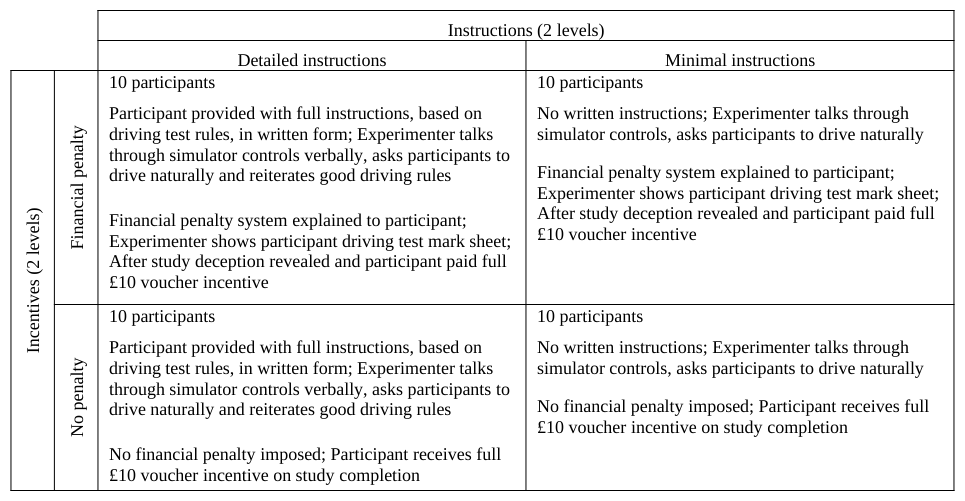
Study Design The aim of the proposed study is to investigate the influence of two variables on driving performance and experience of ‘presence’ in a driving simulator. The first independent variable is participant instructions, with 2 levels: (1) detailed instructions about expected driving performance during the test and (2) minimal instructions. The second independent variable is financial penalty, with 2 levels: (1) financial penalty based upon the number of assessed driving violations and (2) no financial penalty. This design creates four conditions, as shown in Table 1:
Table 1: Four conditions to be tested in the proposed study.
The financial penalty is imposed in the form of a deduction of value from the total amount of vouchers received by the participant on study completion. All participants are offered £10 worth of high street shopping vouchers for participating in the study. This is included in the study advertisement. Half of the participants are allocated to the ‘financial penalty’ conditions: these participants are informed that a financial penalty will be imposed as a deduction of £1 vouchers from the total amount of £10 for every driving violation committed during the drive. Participants are told that the violations are assessed by the experimenter according to the official UK driving test report (Driving Standards Agency, 2011). At the end of the experiment, regardless of performance level, all participants receive the full £10 voucher incentive and the experimental manipulation is explained. Participants in the conditions with no financial penalty also receive the £10 voucher incentive on completion of the test, but there is no discussion of penalties. The financial penalty is designed to increase participants’ perceptions of the negative consequences of driving. In reality, drivers are ‘incentivised’ to drive well by negative consequences related to factors including safety, journey time and fuel costs, but in simulated driving none of these factors apply, so the financial incentive acts as a surrogate for these factors.
The instructions were based upon the current UK Driving Test Report (Driving Standards Agency, 2011), which is used to assess performance in the official driving test. Extracts which were relevant to the simulated scenario were adapted from the explanatory notes of the test report to create the detailed instructions. This covered driving precautions, control, use of mirrors, signals, clearance to obstructions, response to signs / signals, use of speed, following distance, progress, positioning, position / normal stops, and awareness / planning. In the detailed instructions conditions, participants are given a printed copy of the instructions to read through in their own time prior to the test and the experimenter reiterates that they should drive as naturally as possible, as they normally would on a journey to and from work for example, whilst paying attention to the ‘good driving’ instructions they have read. The experimenter then explains the vehicle controls to the participant and talks through the task. In the minimal instructions conditions, participants are not provided with the detailed instructions sheet. In these conditions the experimenter asks the participants to drive ‘naturally’ and introduces the vehicle controls. The instructions were designed to make participants aware of the safety and control aspects of driving in an attempt to stimulate a similar ‘mindset’ to that experienced in real driving. An aim of this study is to test whether this approach can increase participants’ perceptions that the simulator is a real driving environment, by reducing their awareness of the artificiality of the situation.
Experimental Design and Participants The study uses a between-participants design, with 10 participants per condition, requiring a total sample of 40. The sample will consist of male and female drivers with a range of ages. Participants are randomly allocated to one of the four conditions. Participants are required to hold a full UK driving licence and have at least one year of driving experience on UK roads. There is also a requirement that participants have not previously been involved in a driving simulator study, as this could influence their perceptions of the test environment.
Procedure Prior to attending the test, participants are asked to complete an online version of the Driver Behaviour Questionnaire (Reason, Manstead, Stradling, Baxter, & Campbell, 1990). This is used to assess the frequency of self-reported driving errors and violations committed by participants in the past year in order to provide a ‘baseline’ performance measure with which performance on the test can be compared. At the start of the main study each participant is asked to complete a demographic questionnaire, consent form and simulator sickness assessment questionnaire. This is followed by a practice session to familiarise participants with the driving simulator. After the practice session, participants will drive through a predefined scenario, lasting 20 minutes.
The study is carried out using the Human Factors Research Group driving simulator, at the University of Nottingham. The simulator is a fixed-base system, consisting of a Honda Civic cabin (right-hand drive). The road scene is projected onto a 270° curved projection screen with three projectors providing full peripheral coverage. Separate LCD monitors display feeds for the rear- and side-view mirrors. The simulated environment is generated using STISIM Drive™ version 2 software (System Technology Inc., CA, USA) which also records driving performance data. The scenario used in this study consists of a simple three-lane motorway driving task. The driver starts on a slip lane and has to join the main carriageway at the start of the drive. Participants are instructed to maintain position in the inside lane of the motorway at all times during the drive, keeping to a safe speed for the road type. Traffic is included in the scenario in both directions. Participants are not required to negotiate other vehicles and no safety-critical events induced by other vehicles are included. If the vehicle is driven over the road edge a crash is simulated: in the event of a crash the simulator scenario automatically resets to the point at which the crash occurred and the participants will be asked to resume driving from that point. This feedback was designed to encourage participants to drive in a natural way, demonstrating that there are negative consequences of poor driving performance. In each condition music clips are played in the car at set intervals, interspersed with silent periods of the same length. The participants are told that the study is intended to investigate the influence of music on driving; however, the purpose of this is actually to reduce the focus on driving performance. This is intended to make the experience more realistic, as in real driving there would normally be some division of attention between the primary driving task and internal or external distractions, e.g. radio, conversations, personal thoughts. The driver is instructed to pull on to the hard shoulder after 20 minutes via a recorded message played in the vehicle cab: this is the end of the test.
Following the drive, participants are asked to complete two questionnaires to assess their feelings of presence in the simulated environment: the presence questionnaire (Witmer & Singer, 1994) consisting of 32 questions requiring ratings on a 7-point scale and the Independent Television Commission - Sense of Presence Inventory (ITC-SOPI; Lessiter, Freeman, Keogh, & Davidoff, 2001) consisting of 38 questions requiring agreement ratings on a 5-point scale. They also complete a post-trial questionnaire to test for motion sickness symptoms. Participants are then debriefed, given the £10 voucher incentive for their participation and asked to sign a post-trial consent form. The real purpose of the study is revealed to participants at this stage and they are told that they can withdraw their results if they wish.
Data Analysis
Driving performance data are recorded by the simulation software and these include mean speed, number of speed exceedances, number of centreline crossing and number of road edge excursions. Subjective data on driver behaviour, demographics, simulator sickness and experience of presence are collected via questionnaires. This data will be analysed using appropriate statistical and descriptive methods and compared across the conditions to investigate any effects of the two independent variables. In the following section, the hypotheses to be tested in the proposed study are discussed.
DISCUSSION
Despite the proliferation of research on the effect of rewards, there have been no previous studies on the effect of incentives in simulated driving studies. Similarly, there has also been a dearth of investigation into the influence of instructions on the outcomes of driving studies. The methodology proposed in this paper is designed to address this lack of understanding in this domain. Based on the theoretical and experimental evidence discussed previously, it is possible to make some predictions for the results of the proposed study.
According to previous work on the effect of incentives, which has covered a fairly broad range of areas, it would be sensible to hypothesise that in this study the penalty system would encourage participants to follow the ‘good driving’ instructions more carefully than when no penalty system is imposed. The reward in this study is ‘quality- dependent’, although it is expressed as a decrement in reward for poor performance rather than an increment for good performance, and according to Eisenberger and Cameron (1996) this is likely to increase interest in the task, which could potentially enhance participants’ feelings of presence. In the condition with monetary penalty but no instructions it would be likely that the penalty system would not have such a strong effect as there are no instructions which the participants could have been more encouraged to follow. However, the penalty system might still influence the participants’ adherence to their extant knowledge of driving rules. In the ‘no penalty’ conditions, it might still be assumed that participants are motivated to perform well by a sense of moral duty (Russell et al., 2000) or by an expectation that their involvement will contribute to science or human welfare (Orne, 1962), but when compared with the ‘monetary penalty’ conditions, participants would lack that extra motivation to produce an even higher level of performance. It is, however, very difficult to predict how incentives will influence performance and feelings of presence in a driving simulator as previous evidence comes from such divergent contexts.
In the case of instructions, the evidence is even less consistent, making predictions in this context particularly difficult. It is expected that those participants provided with the ‘good driving’ rules will exhibit more of these good behaviours during the test, as assessed by adherence to speed limits, lane excursions, steering wheel reversals and other driving performance metrics. However, these characteristics are not necessarily indicative of ‘natural’ behaviours. In fact, it could be the case that the cognitive load imposed on participants by the highly detailed instructions could serve to disrupt their performance on the main task, in contrast to minimal instructions which would leave free processing capacity to perform well on the task. This is something which will need to be examined during and after the study. Stronger evidence is likely to come from the presence ratings and it is expected that a greater feeling of presence will be experienced by participants in the detailed instructions conditions, as the information is designed to provide contextual cues which are more realistic to the driving environment. Conversely, it will be very difficult to assess how much attention each participant gave the instructions and whether they translated to any real performance effect. For example, Orne (1962) found that people participating in experimental studies were prepared to carry out a wide range of instructions with a high degree of diligence, even when presented with tasks which were deliberately designed to be frustrating, unrewarding and boring. When people are asked to participate in an experimental situation their motivation to comply with requests seems to change dramatically from normal circumstances and it is therefore difficult to infer behavioural and performance effects from experimental studies like simulator trials.
This research is designed to highlight the effects of incentives and instructions on drivers’ behaviour in a simulator environment. The findings will be used to make recommendations about how study design characteristics should be controlled. Like the proposed SAE standard on driving performance metrics, this information will be important in the standardisation of study design for simulator experiments and will be of significance to human factors researchers and practitioners working in the area of driver behavior.
REFERENCES
Abbink, K., & Hennig-Schmidt, K. (2006). Neutral versus loaded instructions in a bribery experiment. Experimental Economics, 9(2), 103-121. Burnett, G. E., Lawson, G., Millen, L. Pickering, C. A., & Webber, E. (2013). Designing touch-pad user interfaces for right-hand
drive vehicles: an investigation into where the touchpad should be located. Behaviour and Information Technology, 32(9), 874-887. Dickert, N., & Grady, C. (1999). What's the price of a research subject? Approaches to payment for research participation. The New England Journal of Medicine, 341(3), 198-203. Driving Standards Agency. (2011). DL25 driving test report form. London: HMSO. Edwards, W. (1961). Costs and payoffs are instructions. Psychological Review, 68(4), 275-284. Eisenberger, R., & Cameron, J. (1996). Detrimental effects of reward: reality or myth? American psychologist, 51(11), 1153-
1166. Fernie, G., & Tunney, R. J. (2006). Some decks are better than others: the effect of reinforcer type and task instructions on learning in the Iowa Gambling Task. Brain and Cognition, 60(1), 94-102. Greathouse, S. M., & Kovera, M. B. (2009). Instruction bias and lineup presentation moderate the effects of administrator
knowledge on eyewitness identification. Law and Human Behavior, 33(1), 70-82. Green, P. (2013). Standard definitions for driving measures and statistics: overview and status of recommended practice J2944.
Paper presented at the Automotive User Interfaces and Interactive Vehicular Applications: AutoUI Eindhoven. Groves, R. M., Cialdini, R. B., & Couper, M. P. (1992). Understanding the decision to participate in a survey. Public Opinion Quarterly, 56(4), 475-495. Harvey, C., Stanton, N. A., Pickering, C. A., McDonald, M., & Zheng, P. (2011). To twist or poke? A method for identifying
usability issues with the rotary controller and touch screen for control of in-vehicle information systems. Ergonomics, 54(7), 609-625. Lessiter, J., Freeman, J., Keogh, E., & Davidoff, J. (2001). A cross-media presence questionnaire: the ITC-sense of presence inventory. Presence: Teleoperators and Virtual Environments, 10(3), 282-297. Locke, E. A. (1968). Toward a theory of task motivation and incentives. Organizational Behavior and Human Performance, 3(2),
157-189. Marcus, N., Cooper, M., & Sweller, J. (1996). Understanding instructions. Journal of Educational Psychology, 88(1), 49-63. Oppenheimer, D. M., Meyvis, T., & Davidenko, N. (2009). Instructional manipulation checks: detecting satisficing to increase statistical power. Journal of experimental psychology, 45(4), 867-872. Orne, M. T. (1962). On the social psychology of the psychological experiment: with particular reference to demand
characteristics and their implications. American psychologist, 17(11), 776-783. Reason, J., Manstead, A., Stradling, S., Baxter, J., & Campbell, K. (1990). Errors and violations on the road: a real distinction?
Ergonomics, 33(10/11), 1315-1332. Reed, M. P., & Green, P. A. (1999). Comparison of driver performance on-road and in a low-cost simulator using a concurrent telephone dialling task. Ergonomics, 42(8), 1015-1037. Russell, M. L., Moralejo, D. G., & Burgess, E. D. (2000). Paying research subjects: participants' perspectives. Journal of Medical
Ethics, 26(2), 126-130. Tversky, A., & Kahneman, D. (1981). The framing of decisions and the psychology of choice. Science, 211(4481), 453-458. Wertheimer, A., & Miller, F. G. (2007). Payment for research participation: a coercive offer? Journal of Medical Ethics, 2008(34), 389-392. Witmer, B. G., & Singer, M. J. (1994). Measuring presence in virtual environments. Alexandria, VA: United States Army
Research Institute for the Behavioural and Social Sciences.
LISTED IN THE AHFE DIGITAL BOOKSTORE CATALOGUE
Explore the complete digital volume
Advances in Human Aspects of Transportation: Part III
Read this individual research paper free through the original publisher, or explore the full digital proceedings book.
ISBN 978-1-4951-2099-2
Explore this ISBN in the AHFE Bookstore ↗Listed in the July 2026 bookstore catalogue; search by ISBN to confirm current availability · Digital book purchase optional