Bridie Scott-Parkera, Paul Salmona, Natassia Goodea, Teresa Senserrickb (2021). Key Players and Their Interactions Within the Young Driver Road Safety System: Perspectives and Partners. In: Advances in Human Aspects of Transportation: Part II. AHFE Open Access, vol. 16. https://doi.org/10.54941/ahfe100687
Young driver road safety has persisted as a global problem for over 50 years, despite a plethora of intervention. Interventions have emerged from a driver-centric approach, and as such predominantly focus upon “fixing-the-driver”. An alternative approach with traction in other safety critical, high risk, domains is systems thinking, which recognises there are a multitude of influential actors (eg, government agencies, community groups) within the broader road safety system that influence young driver safety. Premised on a description of the young driver road safety system (YDRSS) that describes the actors across six levels, interviews were held with 42 actors important in young driver road safety. Synthesis of semi-structured interview transcripts revealed some horizontal integration (interaction amongst actors in the same level) and limited vertical integration (interaction between actors in lower and higher levels), suggesting the current YDRSS is ineffective. A systems approach integrating findings from the driver-centric approach whilst deepening understandings of the complex web of interrelationships amongst actors offers a unique solution to a complex problem. Thus the interviews have revealed avenues of intervention in the YDRSS that can lead to improvements in their road safety and in the road safety of all who share the road with them.
Road crashes are the leading cause of death for persons aged 15-29 years (World Health Organization, 2013). The earliest period of independent driving (typically ages 16-18 years) is associated with the most risk. This higher level of risk has been attributed to driving inexperience (McCartt et al., 2009) and age- or development-related factors (Johnson & Jones, 2011). Accordingly, young driver road safety interventions have primarily focused upon “fixing the driver” through mechanisms like driver education and training, and graduated driver licensing (GDL), which is a system designed to allow the novice to commence driving in lower risk conditions, allowing “graduation” with in- creased experience and maturity. Whilst GDL has proven to be the most effective intervention to date in reducing the young driver road toll, this appears principally to be through exposure control, and a point of diminishing returns seems to have been reached (e.g., Williams, 2011). Rather than persisting in “fixing the driver”, Scott-Parker et al. (in press) have argued that it is time to reform how young driver road safety is understood and managed by imple- menting systems thinking which seeks to address the factors that influence and shape young driver behaviour, thus building upon and integrating knowledge and experience gained through previous research.
To comprehensively understand the young driver road safety system (YDRSS), Scott-Parker et al. (in press) opera- tionalised a popular systems-orientated model of accident causation, Rasmussen’s (1997) risk management frame- work (RMF) in the realm of young driver road safety. Figure 1 depicts Rasmussen’s RMF’s characterisation of the social, organisational and technical components influencing safety, applied within the YDRSS. It is important to note that for the young driver road system to maintain safety, vertical integration is vital: that is, actions and deci- sions at higher levels should influence the actions at lower levels, whilst information generated at lower levels should inform actions and decisions at higher levels (Rasmussen, 1997; Svedung and Rasmussen, 2002). The key drivers of vertical integration amongst the actors (eg, government agencies, community organisations, high schools) at the various levels are communication and feedback.
Government policy and budgeting Decisions and actions regarding young driver road safety including the development of behaviour-regulating laws and legislation; provision of funding for interventions; policy development.
Regulatory bodies and associations Conversion and informing of young driver legislation by regulatory bodies, research organisations and others
with financial interest in young driver road safety.
Local area government, planning, budgeting, company management Integration of government policy including road rules into driving. Parents are the ‘local government’ by virtue
of intra-familial dynamics.
Technical and operational management Other influential and authoritative bodies and organisations with a direct influence on young driver behaviour
and decision-making.
Physical processes and actor activities The young driver themselves and the psychosocial influences upon their driving behaviour.
Equipment and surroundings The actual physical environment in which the young person drives.
Figure 1. Rasmussen's risk management framework in the context of the young driver road safety system (Rasmussen, 1997) Scott-Parker et al. (in press) classified the contributing factors in young driver crashes identified in previous research according to Rasmussen’s RMF. Perhaps unsurprisingly given the predominant fix-the-driver approach, the majority of factors were positioned at the physical processes and actor activities level (level 5). Classifying the young driver road safety countermeasures according to Rasmussen’s RMF similarly revealed a predominance of interventions that focus directly on changing young driver behavior through training or education. Finally, to gain an understanding of who exactly is sharing the responsibility for young driver safety, an actor map using Rasmussen’s RMF was created that identified key actors in young driver road safety in the Queensland context. Building on this, the authors con- ducted a study that attempted to identify (a) the roles of, and (b) the interactions between, the multiple actors identi- fied in Queensland’s YDRSS, and more broadly across Australia as appropriate. The aim of this paper is to report the findings of this study, which took the path less travelled by focusing upon how actors other than the young driv- ers themselves view the YDRSS.
Figure available in the original PDF paper.
METHOD
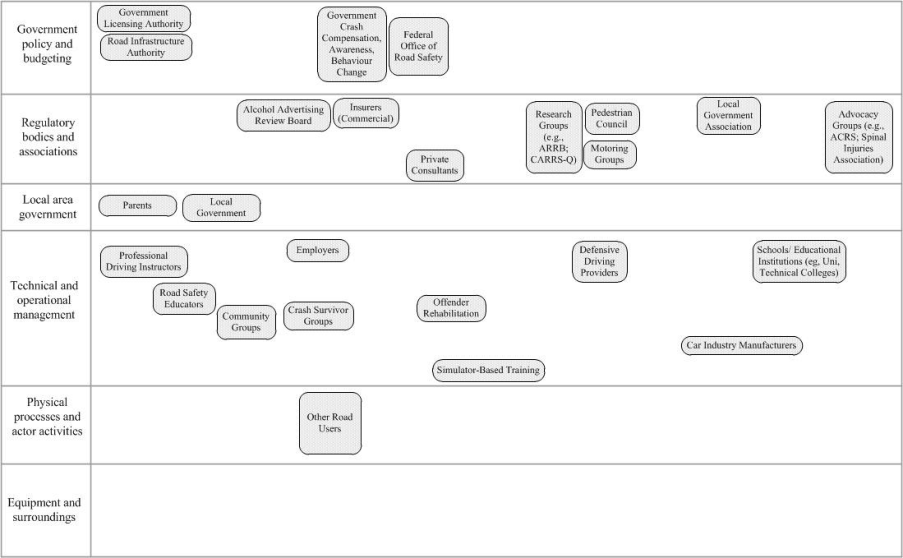
Participants Forty-two participants represented 25 actors (see Figure 2) identified as playing a key role in the YDRSS. Fre- quently one individual spoke for an actor, therefore individual opinions/experiences are likely to have been represented.
Figure 2. Actors who participated in the research project
Design, Procedure and Analyses Emails were sent (and if required, online enquiries were submitted) to more than 140 individuals and organisations, in Queensland specifically and more broadly across Australia, inviting participation in the study. In the instance of government departments and larger non-government organisations, multiple individuals were contacted using the extensive young driver networks of the first and fourth authors. Telephone and semi-structured face-to-face inter- views were conducted by the first author at mutually-convenient times. Questions included “What role does your or- ganisation play in the YDRSS?”, “Who are the other organisations or stakeholders (actors) in the YDRSS?”, “Which of these organisations/stakeholders do you interact with?”, and “Which of these organisations/stakeholders don’t you interact with?” Finally, participants were asked if they could suggest what was needed to improve young driver road safety. The question “What are the roles of these other organisations/stakeholders in the YDRSS?” was aban- doned early in the interview process as actors struggled to respond. Mp3 recordings of interviews facilitated verifi- cation of the accuracy and completeness of notes taken during the interviews. Perceived roles of, and interactions between, actors were synthesised and summarised according to the respective Rasmussen’s RMF sociotechnical level. The study was approved by the University of the Sunshine Coast Human Ethics Committee (A/13/510).
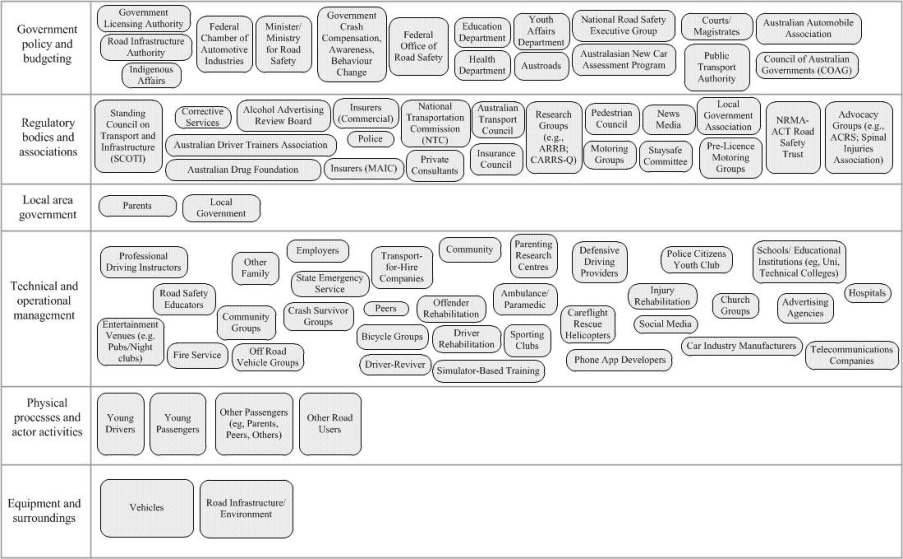
RESULTS: ACTOR ROLES AND INTERACTIONS Delineating interactions and non-interactions at the individual actor level, and more generally at a macro sociotech- nical level, are vital to understanding and effectively managing the YDRSS. As such, the first step is to more fully understand who the actors are, and at what level in Rasmussen’s they are positioned. Based on the participant re- sponses, an Actor Map was created positioning the 79 identified actors (see Figure 3).
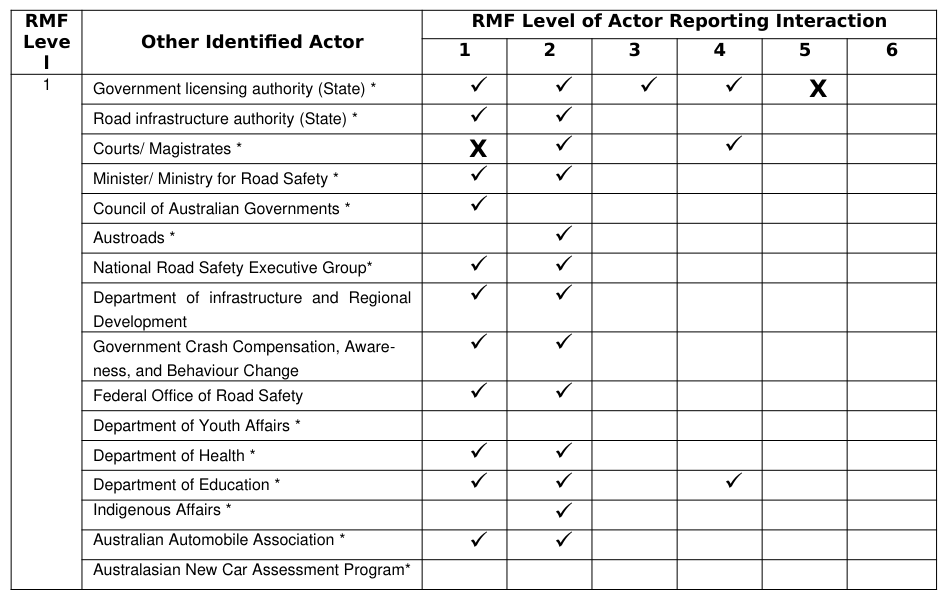
Further, Table 1 summarises the interactions and identified non-interactions among and within the various so- ciotechnical levels of Rasmussen’s RMF reported by the participants. The interactions and the roles of the participat- Human Aspects of Transportation II (2021) ing actors will be elaborated upon in the following paragraphs.
Figure 3. Actor Map of the young driver road safety systemTable 1: Summary of interactions reported by actors in the young driver road safety system RMF Level of Actor Reporting Interaction RMF Leve
Level 1: Government Policy and Budgeting The government level includes agencies, organisations and stakeholders that are involved in the development of be- haviour-regulating laws and legislation, provide funding for interventions, and develop young driver policy at a state and/or federal level. As can be seen in Figure 3, 17 level 1 actors were identified as playing a role in the YDRSS, the government departments and bodies operating at either a state or federal level. Four individuals represented the four participating actors in level 1. Half of these participants stated that they did not play a direct role in the YDRSS; rather, they believed that their role in the system was through indirect efforts undertaken to assist other actors with a direct role in YDRSS, and as such the majority of their interactions occurred with other level 1 actors. Indirect ef- forts reported by all participants included funding education programs that target young drivers (e.g., SDERA, http://www.sdera.org.au/, Keys 2 Drive, https://www.keys2drive.com.au/default.aspx); an advisory role in which they make evidence-based recommendations to government Ministers and departments; and educating the broader driving community through mechanisms such as the media regarding driving risks for all. Actors with a national scope advised that the commonwealth role in GDL focuses upon higher level policy focus. Similar to the experience of the United States (http://www.ghsa.org/html/stateinfo/laws/license_laws.html), in Australia, there is no national GDL program, rather each state and territory is responsible for the individual components at each level (Senserrick, 2009), and the enforcement of both general and GDL-related driving rules. Despite this a number of actors operating at a state/territory level (Australia is comprised of six states and two territories) advised that a national best-practice GDL program has been under consideration. As can be seen in Table 1, the majority of interactions involving actors from level 1 involve other actors in level 1, representing horizontal integration, followed by interactions with actors in level 2 and level 3.
Level 2: Regulatory Bodies and Associations The regulatory bodies and associations level includes agencies that convert and inform young driver legislation, with agencies frequently having a vested financial interest in young driver road safety. As can be seen in Figure 3, 21 level 1 actors were identified as playing a role in the YDRSS, with 16 representatives of 6 level 2 actors sharing their perspectives regarding their role in the YDRSS. A number of themes emerged. Whilst a more active role was reported by actors in level 2 than by actors in level 1, many indirect roles were also reported, in both pre-crash and post-crash phases (see Haddon’s matrix; Runyan, 2008). Some actors emphasised their capacity for an independent voice, i.e., that they could ‘freely speak’ for young drivers as they were not obligated by funding arrangements, in contrast to other actors who relied upon government funding for day-to-day operations and/or specific research and other activities. The majority of actors were actively engaged more broadly in road safety research, often including young driver road safety research specifically, and research ranged from commissioned to higher degree research projects. At this level there was also an emphasis upon translating research into policy and practice through advo- cacy, education, media, publications, community engagement, business decisions such as reduced insurance premi- ums, and funding activities of community groups. Much focus remained at the state and local level, with one actor only identifying a role at an international level, in which there were collaborations with prominent research centres based in the United States (such as the Centers for Disease Control and the University of Michigan Transportation Research Institute). Contrasting to the majority of the interactions reported by the level 1 actors, level 2 actors re- ported greater vertical integration with other actors in the YDRSS, including upwards to level 1 actors and down- wards to levels 3, 4 and 5 actors in particular (see Table 1).
Level 3: Local Area, Government, Planning and Budgeting Level 3 includes agencies involved in integrating government policy, such as general road rules and GDL, into driv- ing, and two actors were identified as playing a role in the YDRSS (see Figure 3). Perhaps unique to the safety criti- cal domain of young driver road safety, intra-familial power and authority means that parents of young drivers are perceived as operating as a form of local government for their child. Two of the four participating level 3 actors were parents (one male) of Learner drivers who shared their perspectives regarding their position and role in the YDRSS. The role of parents was seen as primarily being operationalised in the motor vehicle as their Learner child drove. Roles included a combination of active direction and guidance in driving logistics (such as safe vehicle use, safe road use, and safe interaction with fellow drivers); education regarding driving risks and managing these (such as maintaining lane position on single lane country roads); and reinforcement of safe driving messages and behav- iours (such as ‘don’t drink and drive’). Parents were generally isolated nodes within the YDRSS, with limited inter- action with other actors in any other level, and thus limited vertical and horizontal integration in the YDRSS. In con- trast, the other two participants representing local government actors interacted with other local, state and common- wealth departments and ministers in focusing upon building capacity at the local level to address road safety gener- ally whilst developing statewide networks, representing upwards vertical integration. Engineering, education and en- forcement were reported as key components in the YDRSS, and as such these components also guided funding ex- penditure, further exemplifying vertical integration within the YDRSS (see also Table 1).
Level 4: Technical and Operational Management The technical and operational management level comprises actors who are involved in crash prevention and post- crash efforts, and as such can directly influence young driver road safety, including organisations such as crash sur- vivor and community groups, and rehabilitation providers. As can be seen in Figure 3, 33 level 4 actors were identi- fied by the participants. Ten participating representatives of 16 actors in level 4 reported a mix of prevention and post-crash roles in the YDRSS. Prevention roles principally involved instruction and education. A breadth of practi- cal, on-road driver training and instruction providers reported that they directly engage with young drivers, including providing education regarding vehicle and body capabilities (e.g., defensive driving providers), community-based supervision (Learner mentor programs), and reinforcement of learning messages off-road (e.g., simulator-based learning). Education of young drivers occurred directly through road safety programs, injury prevention programs (often including presentations by individuals who have sustained a permanent traumatic injury from a road crash), and education as part of secondary health class curriculum. Actors such as vehicle manufacturers believed that they played a role in the YDRSS via such mechanisms as ensuring that young drivers operate as safe a vehicle as possible through vehicle programs such as the Australasian New Car Assessment Program (ANCAP). In addition, there was Human Aspects of Transportation II (2021)
a strong sense of corporate responsibility, with employers mindful that young employees such as apprentices were also young drivers, and that older drivers indeed were likely to be parents of young drivers, thereby supporting or- ganisational efforts to improve driver safety more broadly. Further, community responsibility was evidenced by ac- tors supporting evidence-based young driver road safety education programs (by providing financial and social capi- tal), in addition to sponsoring community-based road safety awards. These roles suggest some horizontal and verti- cal integration within the YDRSS by actors involved in crash prevention.
Post-crash roles in the YDRSS included young driver rehabilitation (for purposes such as reducing criminal sen- tences and to improve future driving behaviour) and restorative justice (which brings together incarcerated offenders and victims of road crashes as part of the healing process for grieving families). For a number of actors involved in the YDRSS during both pre- and post-crash stages, a key role was imparting the message to young drivers that driv- ing is a privilege and a responsibility, rather than a right to which they are entitled. Pre- and post-crash roles also in- cluded advocacy and advisory roles, lobbying actors in levels 1 and 2 for systemic change, particularly decision- makers in level 1 who can directly influence young driver road safety policy, demonstrating upwards vertical inte- gration. Advocacy for safer vehicles exemplifies downward vertical integration. It is noteworthy also that there was some horizontal integration within level 4, such that actors like community groups and road safety educators ap- proached schools as a way to access young drivers (see also Table 1).
Level 5: Physical Processes and Actor Activities The physical processes and actor activities level includes the young drivers themselves and the way in which they behave on the road. As can be seen from Figure 3, it also includes other influences upon young driver behaviour, such as young and other passengers, and other road users. Three experienced drivers who share the road with young drivers discussed their position and role in the YDRSS. Key roles included teaching younger family members to drive (siblings, children); modelling safe driving behaviour to younger family members; and modelling safe driving behaviour to young drivers, actors stating that it is a responsibility for mature drivers to set good examples, particu- larly if they see “if he can get away with it (risky driving behaviour) I can too”. Interestingly, a participant with sub- stantial country driving exposure (with commensurate high driving speeds, poor roads and poor night visibility) ad- vised that one of their main roles in the YDRSS was to safely get out and/or stay out of the close proximity of young drivers. Thus not only would the personal safety of the experienced driver be maintained as they would not be in- volved in a crash with a young driver (a key priority), but the safety of the young driver would not be influenced by interaction with the experienced driver. No three level 5 actors reported YDRSS vertical integration (see Table 1).
Level 6: Equipment and Surroundings Level 6 represents the physical and technological infrastructure surrounding young drivers, including the road infra- structure and the vehicle they drive. This section of Rasmussen’s RMF was represented by Car Industry Manufactur- ers (level 4) and Local Government Associations (level 2) (see Figure 3).
RESULTS: WHAT NEEDS TO HAPPEN TO IMPROVE YOUNG DRIVER ROAD SAFETY?
Participants were asked if they could suggest what was needed to improve young driver road safety, in light of the roles and (non)interactions they had earlier divulged. Interestingly, apart from a handful of actors in Level 1, there was much support for the research project, evidenced as strong consensus regarding the need to:
Identify who are the actors;
Delineate the roles played by the actors;
Clarify the extent/non-extent of interactions amongst the actors;
Eliminate unnecessary ‘re-invention of the wheel’ through coordination of actors;
Ensure evidence-based practices and policies are operationalised by actors, and that such information is shared in a manner that can be easily understood by actors;
Improve the transparency of funding arrangements (and thus identifying potential control of research, pol- icy and practices) for actors;
Promulgate the need for the safety system of young drivers to incorporate both targeted and general road safety policy and practices by actors;
Recognise that responsibility for young driver road safety should not be borne by young drivers and their parents alone, and that there are many other highly-influential actors;
Engage with youth, which was reported as highly challenging for many actors;
Reconsider state-based approaches when the national problem requires a national approach by actors; and
Recognise that young driver road safety is not limited to the realm of road safety, and that domains such as parenting and health (e.g., drugs and alcohol) can be highly influential and as such, key actors.
As such, the current research findings regarding identifying actors in the YDRSS, their role, and interactions and non-interactions between actors and within the YDRSS more broadly is vital. Most participants across all levels of the Actor Map advised that there were likely other informal (and thus indirect) interactions with other actors of which they were unaware of, however they could not suggest at the time of the interview exactly what these may en- tail. There was recognition by most actors in all levels of the concept that “good partnership is important”, however were less certain in how to initiate and maintain such partnerships/collaborative efforts, particularly when there was much unknown about who is out there, and what is currently being done in the young driver space.
Furthermore, most actors in the higher levels (1 and 2 especially) believed that they were “already interacting effec- tively with everyone” in the YDRSS. The pervasive issue of young driver road crashes is clear evidence against this argument, however. The lack of interaction may simply be because actors are do not consider the breadth of actors involved in the YDRSS, particularly beyond their own level, or what exactly their role should or even could be rela- tive to these; as reflected by one actor who characterised their role as: “so embedded, [yet] so innocuous”. Some ac- tors in levels 2 and 4 expressed exasperation with their own “failed attempts” to improve young driver road safety. A “silo mentality” (level 4 actor reflecting upon competitive nature of research and intervention efforts) was re- ported in the realm of the YDRSS, and “no one thing is a silver bullet” was recognised. Further, a number of actors in levels 2 and 4 reported there was a need for a coordinator of the YDRSS, possibly at a national level.
A number of participants representing actors in level 1 and 2 advised that it was difficult to gain traction and main- tain momentum for interventions in the YDRSS, with much interest in GDL reforms during the late 20th/ early 21st century giving way to recent declines of interest in other forms of intervention which could augment and/or improve GDL in an era of competing financial priorities. Actors in level 2 argued that “leaders in the debate are needed to maintain and make changes”. Actors in levels 1 through 4 believed schools and other educational institutions were an ideal and oft-under-utilised path to access young people with various interventions to improve their road safety. Teachers (level 4) specifically stated it was difficult to access driver education/ training resources reliably for their students. “Information sharing is essential”, with many actors in levels 4 reflecting that “this is not always happen- ing” when they were very keen to operationalise best practice for pre-crash intervention but did not know what that actually entailed. This point is particularly relevant to commissioned and other research conducted by actors in level 2, which typically is targeted at a government or academic audience, rather than a lay audience. A “national centre of excellence” in young driver road safety, including best-practice resources and additional supporting information such as research grants, potential collaborations etc, was suggested as a repository that could be freely and readily accessed by, and relevant to, all actors at all levels of the YDRSS. Competitive funding appears to have fostered competitiveness within the YDRSS, with many passionate actors striving to make a difference on a small budget that may preclude them from integrating best practice, further alienating them from other actors within the YDRSS.
Parents were recognised by actors in levels 1 through 5 as playing an important part in their young drivers’ road safety, further supported by the extant peer-reviewed literature. For example, participating parents (level 3) reported (a) that they are usually the most common driving supervisor during the Learner phase; (b) that parents and other road users (level 5) are a model of driving behaviours and attitudes during the Learner phase and beyond (a number of actors in levels 1 and 2 also recognising that parents are a model for a decade and a half before the child actually starts to drive themselves); and (c) that parents can and do reinforce good driving behaviour. However, based on the limited number and variety of interactions reported by parents – despite many actors across the Actor Map reporting they interact with parents – actors in the YDRSS do not seem to be engaging effectively with parents nor sustaining that engagement. In addition, actors in levels 1, 2 and 4 in particular recognised the need for community support (pre- and post-crash actors in level 4) and engagement within the YDRSS; however actors in level 2 who were ac- tively engaged in translating research into practice also noted some past difficulties engaging with the community and were apprehensive about repeating these efforts.
There was some debate regarding what could and/or should be the role of professional driving instructors (level 4), and the extent and nature of actor-interaction with instructors. Representatives of the instructor actor advised that a potential obstacle to changing the role and any interactions with instructors, for example efforts to align instructors with other actors at higher, the same and lower levels through vertical and horizontal integration, would need to con- sider the competitive nature of the professional driving instruction industry. Specifically, undercutting of costs is commonly reported in an effort to sustain business in tough economic times, and there was also some concern re- garding the consistency and completeness of instruction in a (perceived-to-be) largely unregulated industry. Instruc- tors also believed their industry was an “old school network” and thus was not receptive to innovation and change.
Some actors in level 2 (particularly those involved in advocacy and policy and practice translation) and level 4 (par- ticularly those interacting with young people in a number of risk-related domains) expressed dismay that young drivers were seen as an end-point, rather than as an integral actor in their own road safety. Young drivers need sup- port, and teachers were viewed as sounding boards for a wealth of issues ranging from unsatisfactory or incomplete interactions with licensing authorities, to resisting negative peer pressure.
GENERAL DISCUSSION A number of important observations regarding the identified actors, roles, interactions, and posited needs to improve young driver road safety can be made.
Firstly, in comparison to the breadth of actors within the six Rasmussen’s RMF sociotechnical levels identified by Scott-Parker et al. (in press), considerably more actors – not only at a state or local level – were identified as playing a role in the YDRSS in Queensland. This was either through direct (such as licensing) and indirect (such as an ex- emplar of best practice) efforts. This means that previous efforts to map the YDRSS, based on young driver road safety expertise, appear to have underestimated the structure and size of the YDRSS. For an optimal systems ap- proach to young driver road safety, all actors in the YDRSS should be identified. In addition, interviews with actors who have not contributed to the current research project (see Table 1) are likely to identify additional, heretofore-un- realised, actors important in the YDRSS. In addition, the need for alternatives for youth to “let off steam” apart from in a car on the road was also mentioned by a number of actors in level 4 in particular, consistent with development- related factors in adolescence (e.g., Bingham et al., 2008; Keating, 2007). Actors within these potential domains were not captured in the current research project, and therefore should be considered more fully in future research. Transparency regarding who is an actor, the role they play, and interactions (both direct and indirect) within the YDRSS can also assist the efforts of actors ‘on the coal face’ in level 4 who report struggling with limited financial and social capital. Furthermore, many actors reported that they were “already interacting effectively with everyone” in the YDRSS, however the findings of the research project suggests otherwise.
Secondly, whilst at a macro-level it appears that there is much interaction between actors within and across levels on the YDRSS, there is substantial variability in the extent and nature of any interactions. For example, within level 1, one actor only reported interacting with two other identified actors across two levels, whilst other actors in level 1 reported interacting directly and actively with more than one dozen actors across the six sociotechnical levels. In ad- dition, actors generally varied widely in their reports regarding other actors in the young driver road safety with whom they do not interact. Rasmussen’s RMF describes the importance of vertical integration for safety manage- ment: that is, actors at different levels of the system need a constant level of interaction with each other. Without this, systems lose control of safety. Delineating interactions and non-interactions at the individual actor level, and more generally at a macro sociotechnical level, are vital to understanding and effectively managing the YDRSS. Therefore to operationalise, and then maximise, the YDRSS, such diverse interaction experiences need to be recog- nised. Indirect interactions merit further consideration, particularly given the frequent reported use of intermediary actors ‘closer’ to the young driver by actors perceived as ‘further’ from the young driver. Whilst an optimal YDRSS remains to be determined, it is possible that direct interactions may be of more importance, especially in the case of actor efforts being diluted or waylaid through the involvement on an intermediary actor. Further, the unidirectional relationship suggested by the interactions summarised in Table 1 suggests that vertical and horizontal integration may not be occurring within and across the six sociotechnical levels of Rasmussen’s RMF. It is noteworthy that it remains unknown whether bidirectional relationships amongst all actor pairings is desirable, possible or practical. Nonetheless, the diminishing progress in reducing youth road trauma suggests there are improvements to be achieved and the present results, particularly the unidirectional relationships and lack of vertical integration, offer potential avenues to explore in future intervention efforts. In addition, given that a recent survey of Learners in Queensland found that over 90% of them had used the services of a professional driving instructor (Scott-Parker et al., 2011) it appears that the road safety of the young driver may be enhanced through maximising the effectiveness of their interactions with young drivers and their parents.
Thirdly, as shown in Table 1, based on the feedback from the participants, there appears to be incomplete knowledge and knowledge sharing regarding the YDRSS within and across the six sociotechnical levels. Actors are aware of a number of other actors who play a role in the YDRSS, but for whatever reason they are not interacting with them. Reasons for interaction and non-interaction merit further investigation, particularly whether certain barriers to inter- action need to be removed (or at a minimum, ameliorated) for the YDRSS to be effective. In addition, the YDRSS needs to maximise both mobility and safety, two oft-conflicting goals for transport policy-makers (level 1 actors) (Bates et al., 2010). A limitation of the current research is the small sample of participants representing approxi- mately one-third of the identified actors, and that as such the views of the participating actors may not be representa- tive of actors within the specified sub-categories (e.g., community groups, schools and educational institutions), or the six sociotechnical levels of Rasmussen’s RMF. It is noteworthy however that there is no reason to suspect that those with more integrated views – i.e., in terms of the unidirectional and lack of horizontal and vertical interactions findings – have been systematically excluded. Wider sampling efforts are required, and as such this will help clarify whether the knowledge-sharing issue pervades the YDRSS or, less likely, is specific to the current sample only.
Fourthly, the prevalence of empty boxes in Table 1 suggests that the majority of actors in all six sociotechnical lev- els of the YDRSS interviewed for this study were unaware of or did not come to mind as prominent ‘who is sharing the responsibility’ for young driver road safety in their own level, as well as in higher and/or lower levels. Whilst the pressures of recalling during an interview may have contributed to this deficit, it is possible that the actors simply were not aware. Systems thinking suggests that increased awareness of who is actually sharing the responsibility for young driver road safety is a vital first step for both horizontal and vertical integration and for the system to foster and maintain young driver road safety.
Fifthly, the literature abounds with tomes regarding the importance of parents in young driver road safety (e.g., Beck et al., 2003; Brookland and Begg, 2011; Goodwin et al., 2010; Hellinga et al., 2007; Lahatte and Le Pape, 2008; Mc- Cartt et al., 2007; Scott-Parker et al., 2012; Sherman et al., 2004; Simons-Morton and Ouimet, 2006; Taubman-Ben- Ari et al., 2005; Williams, 2006), further illustrated by the interactions and roles reported by the research partici- pants. Yet the two parents interviewed as part of the project did not report interacting with other actors in the YDRSS. It is important to note however that two parents is not representative of the experiences of parents gener- ally, and that future research will examine the perspectives and experiences of a larger parent sample. Notwithstand- ing this sampling limitation, the parents did not feedback upwards (through levels 1 and 2), sideways (through level 3), and through levels 4, 5 and 6 apart from their interactions with their young driver child. Thus it appears that these two parents are not embedded in a system characterised by vertical integration, which has ramifications for the effi- cient and effective operation of the YDRSS. Difficulty engaging with parents in the Queensland-context is consis- tent with recent parent-engagement difficulties experienced in the United States (e.g., Simons-Morton et al., 2006); however engagement with parents is possible and young driver road safety benefits have been demonstrated (e.g., Simons-Morton, 2007). Notwithstanding this, it is important to note that – as evidenced in the AcciMap and the summary table – “parents do not shoulder all the responsibility” (level 2 actor) for young driver road safety. In addi- tion, whilst the current research project focus was upon the perspectives of partners in the YDRSS, the next step is to widely sample young drivers themselves, including the mandatorily-supervised Learner driver, and the indepen- dent Provisional (intermediate) driver, regarding their perceptions and experiences in the YDRSS.
CONCLUSIONS
Rather than persisting in “fixing the young driver”, with only moderate success, it is time to reform how young driver road safety is understood and managed by implementing systems thinking as way to understand and address the factors that influence and shape young driver behaviour. Interviews with 42 participants representing 23 Actors who were identified as important players in the YDRSS further elucidated the role these actors believe they play. In addition, the interviews revealed a wealth of other actors in the YDRSS, some of whom the actors interact with directly or indirectly. Application of Rasmussen’s RMF revealed some horizontal integration amongst actors, whilst in general there was a paucity of vertical integration, particularly feedback upward through the actors represented across the Rasmussen’s RMF’s six sociotechnical levels. Further, many suggestions were made by actors regarding research and operational needs consistent with systems thinking within the domain of young driver road safety, ranging from eliminating unnecessary ‘re-invention of the wheel’ through coordination of actors to recognising that young driver road safety is not limited to the realm of road safety, and that other domains such as parenting and health (e.g., drugs and alcohol) can be highly influential. Research directions include exploring the YDRSS from the perspective of the young driver themselves, additional efforts to seek the perspectives of other actors identified as playing a role in the YDRSS, and wider sampling and investigation of the experiences and perspectives of parents.
REFERENCES
Bates, L., Watson, B., & King, M. (2010). Mobility and safety are conflicting goals for transport policy makers when making de - cisions about graduated driver licensing. International Journal of Health Promotion and Education, 48(2), 46-51. Beck, K. H., Shattuck, T., Raleigh, R., & Hartos, J. (2003). Does graduated licensing empower parents to place greater restric-
tions on their newly licensed teens’ driving? Health Education and Behavior, 30(6), 695-708. Bingham, C. R., Shope, J. T., Zakrajsek, J., & Raghunathan, T. E. (2008). Problem driving behaviour and psychosocial maturation in young adulthood. Accident Analysis and Prevention, 40, 1758-1764. Brookland, R., & Begg, D. (2011). Adolescent, and their parents, attitudes towards graduated driver licensing and subsequent
risky driving and crashes in young adulthood. Journal of Safety Research, 42, 109-115. Goodwin, A. H., Foss, R. D., Margolis, L., & Waller, M. (2010). Parents, teens and the Learner stage of graduated driver licensing. Washington. AAA Foundation for Traffic Safety. Hellinga, L. A., McCartt, A. T., & Haire, E. R. (2007). Choice of teenagers’ vehicles and views on vehicle safety: Survey of par -
ents of novice teenage drivers. Journal of Safety Research, 38, 707-713. Johnson, S. B., Jones, V. C. 2011. Adolescent development and risk of injury: using developmental science to improve interventions. Injury Prevention 17: 50-4. Keating, D. P. (2007). Understanding adolescent development: Implications for driving safety. Journal of Safety Research, 38,
147-157. Lahatte, A., & Le Pape, M. C. (2008). Is the way young people drive a reflection of the way their parents drive? An econometric study of the relation between parental risk and their children’s risk. Risk Analysis, 28(3), 627-634. McCartt, A. T., Hellinga, L. A., & Haire, E. R. (2007). Age of licensure and monitoring teenagers’ driving: Survey of parents of
novice teenage drivers. Journal of Safety Research, 38, 697-706. McCartt, A. T., Mayhew, D. R., Braitman, K. A., Ferguson, S. A., & Simpson, H. M. (2009). Effects of age and experience on young driver crashes: Review of recent literature. Traffic Injury Prevention, 10, 209-219. Rasmussen, J., 1997. Risk management in a dynamic society: A modelling problem. Safety Science 27(2/3), 183-213. Runyan, C. W. (1998). Using the Haddon Matrix: Introducing the third dimension. Injury Prevention, 4, 302-307. Scott-Parker, B., Bates, L., Watson, B., King, M. J., & Hyde, M. K. (2011). The impact of changes to the graduated driver licens -
ing program in Queensland, Australia on the experiences of Learner drivers. Accident Analysis and Prevention, 43(4), 1301-1308. Scott-Parker, B., Goode, N., & Salmon, P. (in press). The driver, the road, the rules.....and the rest? A systems-based approach to young driver road safety. Manuscript for a Systems Thinking special issue of Accident Analysis and Prevention. Scott-Parker, B., Watson, B., King, M. J., & Hyde, M. K. (2012). “They’re lunatics on the road”: Exploring the normative influ-
ences of parents, friends, and police on young novice’s risky driving decisions. Safety Science, 50, 1917-1928. Senserrick, T. (2009). Australian graduated driver licensing systems. Journal of the Australasian College of Road Safety, February, 20-26. Sherman, K., Lapidus, G., Gelven, E., & Banco, L. (2004). New teen drivers and their parents: What they know and what they
expect. American Journal of Health Behavior, 28, 387-397. Simons-Morton, B., & Ouimet, M. C. (2006). Parent involvement in novice teen driving: A review of the literature. Injury Prevention, 12(SI), i30-i37. Simons-Morton, B. (2007). Parent involvement in novice teen driving: Rationale, evidence of effects, and potential for enhancing
graduated driver licensing effectiveness. Journal of Safety Research, 38, 193-202. Simons-Morton, B. G., Hartos, J. L., Leaf, W. A., & Preusser, D. F. (2006). The effects of the checkpoints program on parent-imposed driving limits and crash outcomes among Connecticut novice teen drivers at 6-months post licensure. Journal of Safety Research, 37, 9-15. Svedung, I., Rasmussen, J., 2002. Graphic representation of accident scenarios: Mapping system structure and the causation of
accidents. Safety Science 40, 374-417. Taubman-Ben-Ari, O., Mikulincer, M., & Gillath, O. (2005). From parents to children – Similarity in parents and offspring driving styles. Transportation Research Part F, 8, 19-29. Williams, A. F. (2006). Parents’ views of teen driving risks, the role of parents, and how they plan to manage the risks. Journal of
Safety Research, 37, 221-226. Williams, A. F. (2011). Commentary: Graduated licensing – Moving forward or standing still? Traffic Injury Prevention, 12, 207-209. World Health Organization. Road Traffic Injuries. Fact Sheet No 358. March 2013. Available at: http://www.who.int/mediacen-
tre/factsheets/fs358/en/ . Accessed April 15, 2013.
LISTED IN THE AHFE DIGITAL BOOKSTORE CATALOGUE
Explore the complete digital volume
Advances in Human Aspects of Transportation: Part II
Read this individual research paper free through the original publisher, or explore the full digital proceedings book.
ISBN 978-1-4951-2098-5
Explore this ISBN in the AHFE Bookstore ↗Listed in the July 2026 bookstore catalogue; search by ISBN to confirm current availability · Digital book purchase optional