Braden Trauth (2024). Applying Pattern Awareness to Human Centered Design and Systems Thinking. In: Interdisciplinary Practice in Industrial Design. AHFE Open Access, vol. 144, pp. 57–67. https://doi.org/10.54941/ahfe1005118
Pattern Awareness in nature is innate in every human and cultures around the world have employed it to navigate the world around them. Permaculture Design has aggregated and employed many of the most ubiquitous patterns found in natural systems around us, from the universal to individual organisms and taught how to apply these patterns to design. These Patterns are the foundations of systems as the energy flows behind these systems follow these patterns. Teaching students about pattern awareness helps them understand how systems work and flow. There are many fundamental patterns that reflect systems around us, including dendritic patterns, network patterns, concentric patterns and spiral patterns to name a few. Students can see these patterns existing in nature and even within them. Through that visual learning it helps them understand how the products, systems the products exist within and even digital interfaces they design flow through users lives and the world around them, just as in natural systems. Applying Permaculture Principles such as "Design from Patterns to Details (of the Pattern)" also help them understand how to apply this knowledge. Through this process they are able to design more comprehensive products that meet users, producers and business needs. This paper will share educational methods and student results of applying this material in Design Theory and Methods Courses in conjunction with Studio courses.
Teaching students about systems design can be very difficult due to how abstract this concept is. Systems often include many touch points, nodes or decision points that can be complex to understand and visualize. Natural patterns serve as a visual representation of systems which can help students understand how a designed system, be it human centered or otherwise, may unfold, making these concepts easier to grasp and to design for. Patterns exist in the natural world, both living and non-living, all around us. Because of this, Pattern Awareness in nature is innate in every human and cultures around the world have employed it to navigate, survive and thrive in the world around them. However, design has danced directly and indirectly with these patterns since its inception, not recognizing this powerful tool that can help us see and design a world with new eyes. As my Permaculture Teacher, Bill Mollison states “If we were to reach an understanding of the basic,
underlying patterns of natural phenomenon, we will have evolved a powerful tool for design, and found a linking science applicable to many disciplines” (Mollison, 1988).
THE BACKGROUND OF PERMACULTURE, PATTERN AWARENESS & APPLYING IT TO SYSTEMS THINKING Permaculture Design was developed in the 1970’s by Bill Mollison and David Holmgren. A short definition of Permaculture is that it is an ethical, ecolog- ical design philosophy and is possibly the most sustainable design solution out there if we don’t find an ‘ideal’ sustainable energy source to move us beyond fossil fuel. By the publication of Mollison’s 3rd book on the subject, Permaculture: A Designer’s Manual (Mollison, 1988) Mollison had incorpo- rated a chapter on the subject entitled, Pattern Understanding. He cites many classic books at the end of this chapter that relate to this topic including well known authors such as Christopher Alexander, Benoit Mandelbrot, James Lovelock, MC Escher and Fritjof Capra to name a few. Mollison condenses some of this core knowledge into very applicable approaches. He delves into the topic of Pattern Awareness in this chapter as a foundation for the Perma- culture Design process. After teaching, observing and contemplating about these concepts for years and reading other books that came later like Think- ing in Systems by Donella Meadows (Meadows, 2008), I began to come to understand that these Patterns were in fact a foundational element of Systems Design and Human Centered Design (HCD). In my experience, understand- ing this helps one become more adept at understanding the many types of systems and how they work, including HCD.
However, Mollison points out along with some of his cited authors, and I’ve continued to discover, that these patterns encompass most if not all of human society, ranging from language, music, seasons and the calendar of the year, plant identification, growth patterns of plants, reproductive pat- terns of living organisms, water shed patterns through a landscape and much more. They are arguably everything around us. They help us navigate the built world, be it the use of the consistent pattern of stop lights at an inter- section, to manage the flow of a network based system of roads, visualized in maps, the interface on a computer employing a dendritic pattern to link screen to screens or the scatter pattern of application icons across the screen. They underlie the systems of the world around us, be it natural or manmade. The beauty of natural patterns are that they are physical manifestations of systems that move energy and thus create the mater all around us. At their core, that is exactly what they do, move energy from concentrate to diffuse and vice versa, from one area to another, creating the building blocks of life or on the flip side, the energetic flow towards dissipation. Life is built on repli- cating patterns. That relation to life is where the root word of pattern comes from, meaning father or pater in Latin. On the flip side, its physical mani- festation, matter has its roots in Latin with the word mater, or mother, the bearer of physical human life, as one of my permaculture colleagues, Doug Crouch informed me years ago. The roots of these words underscore that patterns underlie the matrix of matter. Or to quote Victor Papanek, with
Applying Pattern Awareness to Human Centered Design and Systems Thinking 59
his reference to patterns “The planning and patterning of any act toward a desired, foreseeable end constitutes the design process.” Any attempt to sepa- rate design, to make it a thing-by-itself, works counter to the fact that design is the primary underlying matrix of life (Papanek, 1985).
CORE PATTERNS & TEACHING STUDENTS ABOUT THEM Mollison’s core Patterns that he gleaned from ecology and teaching Perma- culture around the world are a good foundation to begin with. However, many Permaculture Teachers have expanded on those and aggregated many of the most ubiquitous patterns found in natural systems around us, from the universal to individual organisms and taught how to apply these pat- terns to a design. Mollison recommends examining how societies, past and present and nature employ patterning to begin to understand it. Holmgren’s Permaculture Principle “Design from Patterns to Details” helps us apply the appropriate pattern to create an effective solution, often a detail, based on the natural flow of energy, witnessed in existing systems. The flip side of the principle is if we aren’t recognizing the pattern then we are most likely in a detail of a pattern and need to zoom out through either space or a time lapse video to recognize the pattern we’re working with. Solar (annular) and Lunar (monthly) patterns are an example of the time factor of patterns in the natural world. The classic movie, Koyaanisqatsi also does a great job of highlighting patterns through timelapse film (Koyaanisqatsi, 1982). Network patterns on maps help us navigate the details of roads. Leverage, or least change for great- est effect, is another Permaculture principle among others that make systems ecologically efficient and teaches how to design those systems.
The design exercise I created for the students, entitled ‘Pattern Awareness’ was for a Design Theory & Methods Course that I taught to 42 4th year Industrial Design students in the fall of 2023. I had introduced students to these concepts in previous classes but never had a formal design project to reinforce it. This course complimented several studio courses that inherently have systems thinking built into them. Some of the studio topics included Service Design, Mobile Robotics, Packaging and an Entrepreneurial Maker Studio. I presented to them a slide show that was shared with me from a fellow Permaculture Teacher, Doug Crouch, which was created by Bear Kauffman of the Strybing Arboretum in San Francisco, CA about the various natural and human made Patterns (Kaufmann, 2007). I also shared infor- mation about Patterns that I compiled from Mollison, other Permaculture authors like Peter Bane and my own knowledge, experiences and observa- tions. I have used this slide show and my personal presentation for years in our Permaculture Design Certification with the Cincinnati Permaculture Institute and have found it comprehensive and pedagogical in its presenta- tion to open students up to this way of thinking. After the presentation I asked them to select one of their designs/systems or a design/system out in public and present how a specific pattern type applies to it. However, some examined multiple or all of the patterns. I then explained to them that this will hopefully help them see patterns/systems that exist in all of our designs and make it easier to design solutions that harmonize with the natural and,
60 Trauth
consequently, human patterns all around us. I had them share their work with the class for 2 minutes. I kept this assignment relatively simple to see where they would take it. Examples of the students work are below. Here is a concise list of the patterns that I shared with them along with the amount of students that referenced it at the start of each pattern. They are listed in relational scale, building pedagogically to assist in understanding, with more details about the ones students chose.
13 - Concentric/Radial: These patterns start with a center point and have rings moving outward. Examples: The Solar System, a trees growth rings, an impact on water creating waves, A City center radiating out into the suburbs.
Design Application: A concentrated area of resources, time or use and dispersed outward. Tracking concentrated activity and its dispersal helps designers understand HCD more effectively.
9–Spirals/Helix: Spirals are a combination of a line (beginning and an end) with a circle (continuously cycling and returning to the same anchor point). However, building on the previous rotations work builds progress, growth, rebirth and regeneration. The Fibonacci Sequence is a very precise form of spiral, which is witnessed in many forms of nature and the physical world, down to Atomic bubble chambers (Phaidon, 2002). Sunflowers exemplify this pattern with opposing spirals. Growing spirals in nature always have a time element to create or sometimes to recognize the pattern, such as when a snail is growing its shell through accretion, or the spiral growth of life itself, returning every pass around the sun to the same point from the previous year but with new growth. Spirals are always dependent on the past to get to the present. There are other forms of spirals to that are created by flow patterns being disrupted, such as:
Fibonacci Sequence or Golden Ratio: This one is common in design, given its long history of application in things like art and architecture. The Golden Ratio and Fibonacci Sequence are very similar when they generate a spiral (Kaufmann, 2007).
Von Karman Trails (Mollison, 1988): Spirals created by disturbance in flows, like water, creating opposing vortices after the disturbance.
Ekman Spirals (Mollison, 1988): It’s half a Von Karman Trail, when wind blows across land and hits a fixed object like a tree or wall.
Helixes are used in nature to absorb impact or for compact storage of information as exemplified in DNA (Kaufmann, 2007).
Design Application: Understanding how a design may evolve or grow over time, or how a user may grow or evolve over time and how a product may evolve to grow with their needs. Educational tools can be a good example of this as children grow.
4 - Flow/Streamlines: These can be a flow in an ocean or wind across land, picking up resources. They can also be subsets of dendritic patterns, like a river watershed. These exist in nature to move resources in response to
Applying Pattern Awareness to Human Centered Design and Systems Thinking 61
natural energies, like gravity. The more crenelated and slow moving, the more resources are captured, as in a swamp, marsh land.
Turbulence: Turbulence is similar to Flow or Streamlines except the two resources impacting each other achieve homogeneity at some point, unlike streamlines or flow patterns where the two resources impacting each other remain distinctly different (Kaufmann, 2007).
Design Application: These transfer resources, from source to sink.
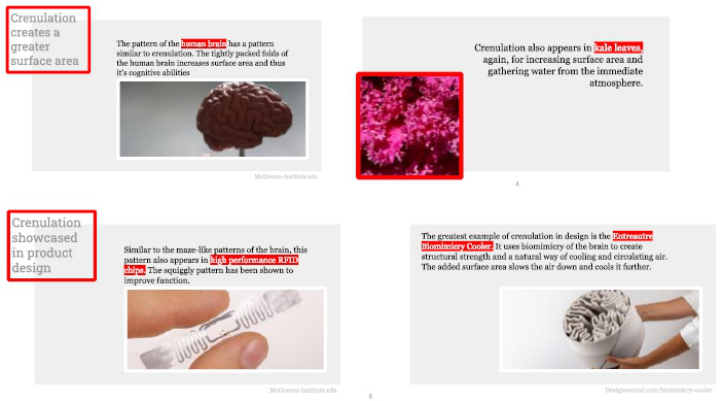
2 - Crenelations: This pattern is similar to Flow or Streamlines as that they move resources, but have more surface area to increase resource capture or productivity as seen in human intestines (Kaufmann, 2007). However, flow is minimal for if it did it would smooth it out, as in a flowing eroded coastline. Cumulus clouds, ponds and trees leaves are also examples of this. Human Intestines, despite their small volume within our body, measure upwards of 20ft to exemplify this. Some of the most pro- ductive ecosystems globally, like swamps and marshes employ this pattern (Jacke, 2005). Air filters often have crenelated patterns to increase surface area to capture particles in a small area too.
Design Application: This increases productivity if space is limited.
3 - Gradients: Gradients are gradual transitions such as pressure, color spectrums, temperature, acidity and elevation. They have gradual transi- tions between dualities, creating variable intervention points.
Design Application: Beyond color gradients for color theory, this can be employed in understanding demographics, especially around age, but also used with concepts like volume or brightness.
3 - Scatter/Tessellations: Scatters can seem like a random dispersal but are often times caused by variable distribution of resources as seen in savan- nahs, species populations or clouds (Mollison, 1988) (Manning et al., 2006). Tessellations are similar, but more like a puzzle, like Escher’s work. I combined these two as they are very similar, except the voids in a scatter pattern may not be physically present like in a tessellation pattern because of invisible resources to the naked eye (Lancaster & Belyea, 2006).
Design Application: Accounting for scale is critical to recognize this pattern and to understand why it’s arising. Underlying resources, often times not visible, allow this pattern to arise. This is critical to help understand how to apply it, which might align more with design research than product design per se. Demographics is a good example of why a product might be successful, creating a scatter pat- tern of product uptake amongst that demographic. Economics, other resources or cultural reasons may explain the uptake. A marketing campaign for a brand is a good example as the dollars and strategic placement throughout our lives are what create its existence.
62 Trauth
4 - Branching/Dendritic: These are very recognizable in temperate humid climates as it’s the pattern of deciduous trees in the winter. It is also exem- plified in their roots, concentrating diffuse energy and resources from their leaves and branches into their trunk and back out again to diffuse roots that gather water and nutrients to send to its leaves and fuel its living pattern. These patterns exist within many natural systems including water- sheds, our cardiovascular system and lungs within humans. These systems often have around 5–8 orders (Mollison, 1988). In trees this may be the trunk, primary and secondary branches followed by twigs and leaves. River watersheds have similar orders of rivers, creeks, streams, rivulets (Mollison, 1988). These systems are reflected in our filing systems, menus on websites and apps.
Design Application: This pattern is terminal unlike Fractal or Net- work Patterns. Because of that, this pattern reflects our concen- tration, manufacture, distribution and disposal patterns of making products. This is valuable to think about for designers as we design a circular economy, in how we can reclaim and concentrate resources again to make new ones, a reversed dendritic pattern from the products distribution, similar to a tree above and below ground.
8 - Networks: Networks or webs are similar to dendritic patterns in their capacity to move resources. However, they don’t rely on a central node like a trunk to move resources, rather moving them through numer- ous interconnecting branches. This builds resilience in systems, as if one web fails then there’s numerous other webs to move resources through (Kaufmann, 2007). These exist in many natural and man-made systems including mycelial networks, spider webs, our brain’s neural networks and road systems (Cerqueti et al., 2019).
Design Application: Roads and the Internet are common examples of this. Networks, over a centralized dendritic system, are a way to integrate resilience into systems.
4 - Fractal: Fractals are naturally occurring patterns with exponential growth built into them, yet became more understood after Francois Man- delbrot identified a mathematical equation to replicate these patterns infinitely. This equation has many applications including calculating the surface area of human lungs (Weibel, 1991). They have been employed in smartphone antenna design, to increased their capacity in signal capture with a smaller antenna, increasing signal capture from 1 to 5 signals com- pared to extended antennae’s (PBS Nova: Fractals: Hunting the Hidden Dimension, 2011).
Design Application: This is a universal pattern that underlies self- replicating, evolving systems such as living systems. This pattern is critical for anything sustainable given that foundational aspect of it. However, many artificial human systems also follow this pattern.
Applying Pattern Awareness to Human Centered Design and Systems Thinking 63
0 - Sinks: Sinks store resources as a very slow moving system, where they are not immediately captured by a fast moving system. It takes a lot of energy to extract resources from sinks. They are replicated throughout the planet, be it the ocean, bedrock, the atmosphere or a landfill, ideally to deposit materials not beneficial to life (Kral et al., 2018). Nature and Circular Design aim to prevent beneficial resources reaching sinks through creating reuse/repair/recycling nodes within a network and work to keep those resources cycling within the system.
0 - Scales of organization: This pattern became more recognizable with the advent of flight and orbiting the earth. However, dendritic patterns are a good representation of it. Examples of this include our governing boundaries such as neighborhoods, villages, towns, townships, or cities, counties, states, countries, continents and planet earth (Kaufmann, 2007). Rae and Charles Eames classic video, Powers of 10 explore this pattern, employing time and space by zooming out by a power of 10 every 10 sec- onds until they are out of the solar system and then reverse it by zooming in by a power of 10 every 1 second. This pattern can also relate back to our first pattern, radial patterns. This encapsulates all the patterns we just learned about through the scales they exist within and can facilitate designers when addressing such issues.
As the numbers show, students gravitated towards the most common and recognizable patterns in the world they live in, with Radial/Concen- tric, Spiral/Helix and Network patterns receiving the most attention. This underscores potential for further development of this exercise for more equal distribution. Identifying these patterns, visually, begins to help students see the pattern underlying the world around us, be it in manufacturing, distri- bution, use, repair or disposal or more broadly, the human or natural world, and helps them grow as a designer. Each design case will have its own chal- lenges but if they can understand what detail they are working on in relation to the greater patterns or systems and its aims, it will help them map it out and design the appropriate details based on the needs of the rest of the sys- tem. By giving them a visual representation of how systems move resources it helps them understand how each decision in a design helps the flow in vari- ous ways. To take it a step further, one can reference Donella Meadow’s book, Thinking in Systems as it examines the actual flows of resources through sys- tems to achieve an end result (Meadows, 2008). Each system is different but, based on my experience and research, align with one of these patterns. If the pattern is not recognized then chances are the designer is focusing on a detail and needs to zoom out. Each pattern has different terminology to describe how they move energy or resources through a system, including nodes or touch points for dendritic/branching systems or networks, waves or zones for radial patterns, lines for spirals, and relativity for gradients to name a few.
STUDENT PROJECTS The following student projects are the better examples of the student’s results of this exercise in my class. Each student picked up unique aspects of this
64 Trauth
learning, in which the sharing of their work helped other students learn about other angles of this topic. Each example hones in on a piece of a pattern or system, as all products do. Some projects mislabeled the pattern or don’t label it at all unfortunately. The ones that align with a users needs within their system are typically the most successful designs because of the user focus.
Crenelation Patterns in Nature and Design by Grace Nichols This first one explores Crenulations in the world, complimented by their use in the designed world, which increases functionality and productivity of the products exemplified here. This is more of a pattern than a system, how- ever the pattern enforces success within systems as is the case with good design
Figure 1: Patterns in nature awareness by Grace Nichols, fall 2023.
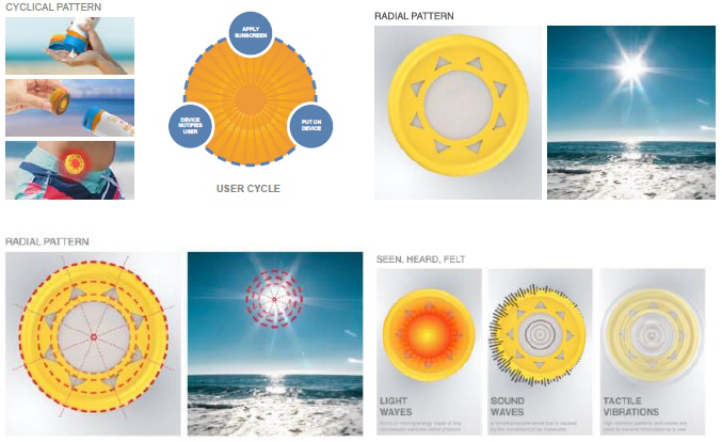
Radial Patterns & A Sunblock Timer by Logan Oskey This project ties in with radial patterns on many fronts. Because sunburn results from time exposure to the sun, the product embodies the archetypal shape of time and the sun, a radial pattern, conveniently defined by the bottle, to synthesize with the users needs. All users operate within a system, and this system is to minimize the impacts of extended periods of time in the sun through notifications about the time to reapply. It employs sound, light and vibration, all radial patterns radiating out, to draw the users attention to reapply sunblock when the timer has concluded. The radial pattern keeps the design extremely simple.
Applying Pattern Awareness to Human Centered Design and Systems Thinking 65
Figure 2: Radial & cyclical patterns by Logan Oskey, fall 2023.
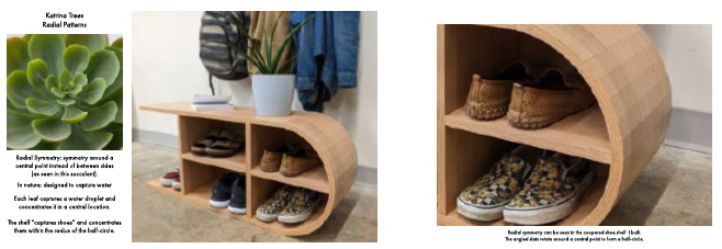
Radial (& Fibonacci Spiral) Patterns, Shoe Rack by Katrina Trees Katrina’s project looks at the product as a node in a persons journey into and out of the house. A product that interfaces in that space to capture and organize the resource of shoes. The product inherently does that similarly to the fibonacci pattern a succulent uses to direct water to itself since it evolved in dry climates.
Figure 3: Radial patterns by Katrina Trees, fall 2023.
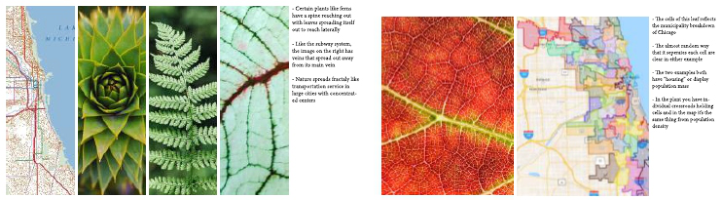
Population Map Patterns and Transportation Relating to Nature by Wesley Reed Wesley looks at large scale systemic transportation network and dendritic patterns around Chicago and relates it to the network and dendritic patterns seen in plants. These network and dendritic patterns within plants help move resources (and people) just as these transportation networks do.
66 Trauth
Figure 4: Population map patterns and transportation by Wesley Reed, fall 2023.
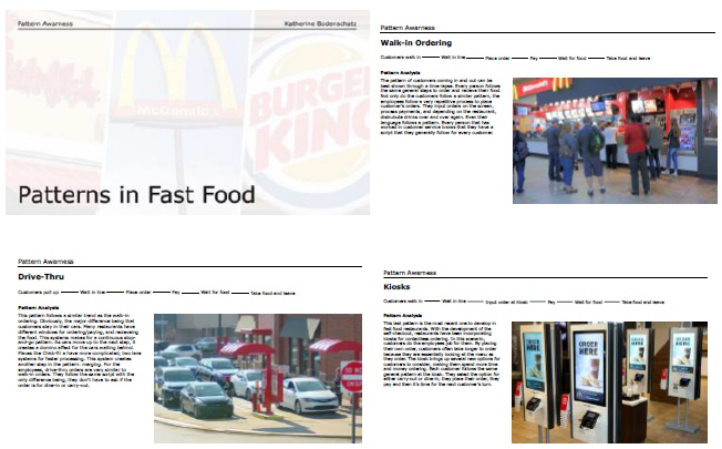
User Flow Patterns in Fast Food by Katherine Bodenschatz Katherine does a good job of identifying the flow pattern, touchpoints and the dendritic pattern of computer menus, all part of the network of fast food ordering, seeing possible opportunities for a better experience. How- ever, she did not label it or link it to a natural pattern, of which there are many that could be referenced, like a river flowing, and would help illustrate its connection to the natural world.
Figure 5: Patterns in fast food by Katherine Bodenschatz, fall 2023.
CONCLUSION
Through this short design exercise it became clear that it could be imple- mented earlier in the student’s careers, possibly in the 2nd or 3rd year, in hopes of better understanding of the patterns that underlie their research and design solutions earlier and throughout their academic career. This would allow the development of other design projects in subsequent years that can
Applying Pattern Awareness to Human Centered Design and Systems Thinking 67
reinforce this skillset in various ways. This would give them more time to observe and contemplate natural patterns and their implications for designed systems within manufacturing, distribution, use in the physical or virtual worlds and ultimately repair and disposal. Through this process they are able to design more comprehensive products that meet users, producers, business and nature’s needs, each another touch point on that journey. This may also help students become more agile designers in a world dominated by systems and patterns. This is especially true with the development of tools like gen- erative AI, which is based on large data sets to recognize patterns in order to develop novel solutions within those parameters, and thus helping them grow as designers and stay ahead of this technology in an ever increasingly complex world.
REFERENCES
Cerqueti, R., Ferraro, G. & Iovanella, A., 2019. Measuring network resilience through connection patterns. Reliability Engineering & System Safety, Volume 188, pp. 320–329. Gabrys, J., 2009. Sink: The Dirt of Systems. Environment and Planning D: Society
and Space, 27(4), pp. 666–681. Jacke, D. &. T. E., 2005. Edible Forest Gardens. White River Junction, VT: Chelsea Green. Kaufmann, B., 2007. Patterns, Pattern Application & Edge - Strybing Arboretum.
San Francisco: s.n. Koyaanisqatsi. 1982. [Film] Directed by Godfrey Reggio. United States of America: Francise Ford Coppola. Kral, U., Morf, L., Vyzinkarova, D. & Brunner, P., 2018. Cycles and Sinks: Two key
elements of a circular economy. s.l., The 4th International Conference on Final Sinks. Lancaster, J. & Belyea, L., 2006. Defining limits to local density: Alternative views of abundance-environment relationships. Freshwater Biology, 51(4), pp. 783–796. Manning, A., Fischer, J. & Lindenmayer, D., 2006. Scattered trees are key-
stone structures - Implications for conservation. Biological Conservation, 132(3), pp. 311–321. Meadows, D. H., 2008. Thinking In Systems: A Primer. 1st Edition ed. White River Junction: Chelsea Green Publishing. Mollison, B., 1988. Permaculture: A Designer’s Manual. Sister’s Creek, Tasmania,
Australia: Tagari Publications. Papanek, V., 1985. Design for the Real World: Human Ecology and Social Change.
2nd Edition ed. Chicago, IL: Academy Chicago Publishers. PBS Nova: Fractals: Hunting the Hidden Dimension. 2011. [Film] Directed by Michael Schwarz and Bill Jersey. s.l.: s.n. Phaidon, 2002. Heaven & Earth: Unseen by the Naked Eye. First Edition ed.
New York City: Phaidon Press Inc. Weibel, E. R., 1991. Fractal geometry: A design principle for living organisms. American Journal of Physiological - Lung Cellular and Molecular Physiology, 261(6), pp. L361–L369.
LISTED IN THE AHFE DIGITAL BOOKSTORE CATALOGUE
Explore the complete digital volume
Interdisciplinary Practice in Industrial Design
Read this individual research paper free through the original publisher, or explore the full digital proceedings book.
ISBN 978-1-964867-20-5
Explore this ISBN in the AHFE Bookstore ↗Listed in the July 2026 bookstore catalogue; search by ISBN to confirm current availability · Digital book purchase optional