Helmi Rashid, Muhammad Izzat Nor Ma’arof, Abdul Rahman Omar, Sukarnur Che Abdullah, Roseleena Jaafar (2021). Evolution of a New Adjustable Motorcycle Test Rig for Measuring Motorcyclist Fatigue during Prolonged Riding. In: Advances in Human Aspects of Transportation: Part II. AHFE Open Access, vol. 16. https://doi.org/10.54941/ahfe100663
Motorcycle Engineering Test Lab (METAL), Faculty of Mechanical Engineering, Universiti Teknologi MARA, 40450 Shah Alam, Selangor Darul Ehsan, Malaysia ↗
Studies concerning motorcycle have been an overwhelming area of research interest since the past few years. This trend of studies focuses on many issues relating to motorcycle including design, safety, accident preventions, fatalities statistics, ergonomics and many more. In performing these studies, researchers have used many methodologies, tools and also equipment in acquiring their data. In this study, the evolution of a new adjustable motorcycle test rig is introduced. Combination of computer aided design (CAD) and finite element analysis (FEA) software made it possible to design and simulates the test rig’s conceptual design before being fabricated. The test rig was designed to provide full adjustability for researchers to replicate established motorcyclist riding postures based on the Riding Posture Classification (RIPOC) system. The test rig setup also provides elements of environmental effects to give a more real riding experience and better fidelity to motorcyclist respondents during experiments. By having such test rig that is coupled with electronic data logger and telemetry devices, studies concerning riding postures and fatigue can be done in a much proper method and controlled experimental setup with better safety for both the respondents and researchers. Adjustable attributes provided on the test rig makes it a unique design of its own and is being patented to protect the author’s Intellectual Property Rights (IPR) on the test rig design.
The increase of motorcycle accidents every year (Organization, 2013) had made this a very alarming issue amongst motorcycle researchers to study more on how to prevent and reduce those accidents. Many factors has been previously identified to cause such motorcycle accidents including age and gender, the use of safety devices, weather and environment, road and highway designs, motorcycle and rider characteristics, influence of alcohol and drug abuse and also other road users fault (Keall & Newstead, 2012; Pinto, Cavallo, & Saint-Pierre, 2014; Schneider, Savolainen, Van Boxel, & Beverley, 2012). Apart from these factors, aspect of the motorcyclist or human factors contributing to such motorcycle accidents were also been studied previously (Ampofo-Boateng, Muzlia, Parnabas, Abdullah, & Sueb, 1999; Hurt & Dupont, 1977; Macdonald, 1985) and now becoming more significant to motorcycle researchers. Human Aspects of Transportation II (2021)
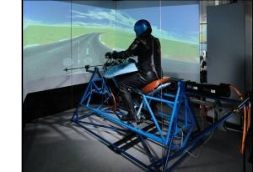
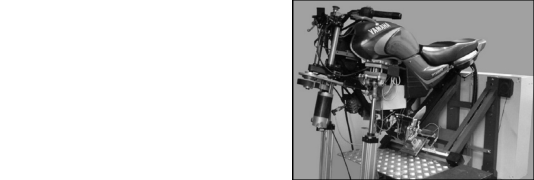
Not like other vehicle simulators that have been long established by many institutions and agencies, whether for academic, industrial or commercial purpose, the bibliography of motorcycle simulators is quite lacking (Nehaoua, Arioui, & Mammar, 2011). However, current trend has changed where a number of the studies have started to use motorcycle simulators in collecting their data as a mean of replicating real motorcycle riding experience for their respondents (Cossalter, Doria, & Lot, 2004; Crundall, Crundall, & Stedmon, 2012; Crundall, Stedmon, Saikayasit, & Crundall, 2013; Huth, Biral, Martin, & Lot, 2012; A. W. Stedmon, Brickell, Hancox, Noble, & Rice, 2012). Besides that, most of the current motorcycle simulators mainly offer one type of riding posture based on their design or type of motorcycle being used on the simulator (see Figure 1, Figure 2 and Figure 3).
Figure 1. DIMEG riding simulator (Huth et al., 2012) Figure 2. MotorcycleSim simulator (A. W. Stedmon et al., 2012)Figure 3. IFSTTAR motorcycle riding simulator (Benedetto et al., 2014) These types of motorcycle simulators were mainly focused on studying the interactions between the motorcyclist and the displayed surrounding environment according to different setups. Moreover, the motorcyclist were also tested for their behaviors and response towards road hazards besides testing for new accident precaution measures in preventing motorcycle accidents.
Besides the aforementioned motorcycle related studies, aspect of ergonomics especially involving motorcyclist fatigue can also best suit the use of motorcycle simulators. In a previous study reported by the Department for Transport, London, (Horberry, Hutchins, & Tong, 2008), they concluded that there is a significant paucity of motorcyclist fatigue study especially studies that employed appropriate experimental control. The few studies found mainly relied on self-report data and more research to investigate correlation of motorcyclist fatigue and motorcycle accidents are essential (Perez-Fuster, Rodrigo, Ballestar, & Sanmartin, 2013). This was mainly caused by the inconsistent terminology and understanding of the motorcyclist fatigue itself. Despite this gap, efforts in investigating this ergonomics aspect of motorcyclist were pioneered by several researchers but with the use of a real motorcycle with different methodologies (Balasubramanian & Jagannath, 2014; Velagapudi, Balasubramanian, Adalarasu, Babu, & Mangaraju, 2010). The aims of the studies were identifying motorcyclist fatigue through several on road testing using a surface electromyography (sEMG) device and procedures. However, the motorcycle used in the studies limit the researchers to perform various riding postures to be tested on their respondents and exposes their respondents to real road hazards.
Hence, to investigate motorcyclist fatigue by using a motorcycle test rig that can be adjusted to suit various riding postures is essential in narrowing this research gap. In contrast to a motorcycle simulator cost of development, a motorcycle test rig provides lower cost of investment to develop. However, both means of replicating a real motorcycle riding experience faces the same fidelity and validity issues when using either a simulator or a test rig (Benedetto et al., 2014; Huang & Gau, 2003; Jamson & Jamson, 2010; A.W. Stedmon, M.S.Young, & Hasseldine, 2009). In compromising this issue, a new adjustable motorcycle test rig is introduced by researchers from the Motorcycle Ergonomics Test Lab, Faculty of Mechanical Engineering, Universiti Teknologi MARA Malaysia to provide better fidelity of motorcycle riding experience with a controlled environment effects for motorcycle ergonomics research purpose especially for prolonged motorcycle riding.
CONCEPTUAL DESIGN AND STRUCTURAL ANALYSIS Motorcycle Test Rig Chassis Design
The primary design stage of this adjustable motorcycle test rig started with outlining several design concepts from current motorcycle models. With the basis of different motorcycle provide different riding postures, the main reference for designing this test rig chassis was based on the established Riding Posture Classification (RIPOC) system (Ma’arof & Ahmad, 2012). Four types of riding postures namely as RIPOC Type 1 (forward leaning), Type 2 (upright), Type 3 (seatback-leg-forward) and type 4 (double forward) were respectively considered for the test rig design concepts to be adjusted according to those riding postures.
Initial sketches of the chassis concept were brainstormed to generate ideas and finally being finalized using Pugh decision matrix selection method with specific concepts criteria (Kuppuraju, Ittimakin, & Mistree, 1985; Thakker, Jarvis, Buggy, & Sahed, 2009). Scores and ratings were determined and the highest total average score gained by one of the design concepts was selected as the preliminary design. The preliminary design was modeled using CATIA V5R20 computer aided design (CAD) software for better visualization (see Figure 4).
Figure 4. Initial CAD design concept of adjustable motorcycle test rig
Figure available in the original PDF paper.
Adjustability features were considered for the handle bar, seat and foot peg designs whereby the positioning of these main parts on a motorcycle generally influences different riding postures on different models of motorcycles (Ma’arof & Ahmad, 2012). Besides that, the chassis also advanced from the concept of human’s rib cage and spine having it to be named as RISCTM (Rib and Spine Chassis) that gives room for an innovative collapsible motorcycle tank to be included on it. The aforementioned characteristics of the test rig narrows down the fidelity issues of replicating various motorcycle riding postures onto only one test rig.
Structural Finite Element Analysis (FEA) This adjustable motorcycle test rig chassis went through a series of revisions to best suit the functionality and fabrication constraints of the test rig. A detail design of the test rig chassis was modeled using the CATIA V5R20 CAD software to generate a finite element model for further structural FEA simulations. Concurrently, a free body diagram (FBD) of the test rig chassis was produced to calculate all reacting forces acting on it and to identify boundary conditions for limiting the degree of freedom (DOE) during the FEA simulations. The finite element model was assigned with mild steel for the material property and meshed using a linear tetrahedron mesh before being loaded with a 90kg weight for the FEA simulations using one of the Computer Aided Engineering (CAE) packages provided in the CATIA V5R20 CAD software (see Figure 5).
Figure 5. Finite element model for the FEA simulations
Figure available in the original PDF paper.
The structural FEA simulations were done to predict the behavior of the test rig chassis under certain loading of the motorcyclist. This enabled the research team to identify possible maximum stresses and deflections that may lead to structure failure (Mingzhou, Qiang, & Bing, 2002) during operation. By this, an optimum design of the test rig chassis can be developed with better factor of safety. Results from the FEA simulations shown a slight Von Mises stress on both end supporters of the test rig with minimal deflection and a 1.07 acceptable factor of safety (see Figure 6).
Figure 6. Maximum Von Mises stress, maximum deflection and deformation results from FEA simulations FABRICATING THE PROTOTYPE
Figure available in the original PDF paper.
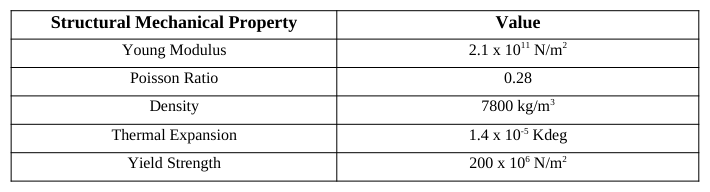
Acquiring of Material The material used in the fabrication works to build the adjustable motorcycle test rig prototype was mild steel. It was the same properties of mild steel that was used to simulate the FEA in CATIA V5R20 CAD software (see Table 1). Other materials used range from different types of bolts and nuts, ready stock motorcycle seat, handle bar clip on and foot peg, and other few motorcycle accessories as an effort to provide better replication and fidelity.
Table 1: Mild steel material properties (Riley, Sturges, & Morris, 2006) Structural Mechanical Property Value
Fabrication Works The adjustable motorcycle test rig was fabricated in-house at the Machine Shop, Faculty of Mechanical Engineering, Universiti Teknologi MARA Malaysia to protect its IPR. Prior to the fabrication, series of FEA simulations and design revisions were done to confirm the strength and sturdiness of the test rig chassis. Mild steel was extensively used to build the first prototype of this test rig due to its strength and low cost consideration. Weight of the test rig was not a substantial factor as for the design was not meant to be mobile. Metal inert gas (MIG) welding was used to bond the structures together giving the prototype a rigid and robust chassis quality (see Figure 7).
Figure 7. Fabrication works of the test rig prototype
Figure available in the original PDF paper.
During the fabrication works, the test rig design also went through some design revisions due to fabrication constraints. The revised designs were analyzed again using FEA to observe any obvious changes to its maximum Von Mises stress and deflection on the structure. It was found that the revisions on the design did not affect much on the strength of the structure but only a minimal increase in total weight that was not substantial to the design criteria.
HUMAN-MACHINE-ENVIRONMENT-INTERFACE (HMEI) SETUP Environmental Elements
Amongst the risk factors that contributes to motorcycle accidents is the surrounding weather and environment (Jones, Gurupackiam, & Walsh, 2013; Keall & Newstead, 2012; Schneider et al., 2012). Environmental effects including wind gust, heat, and noise are elements that motorcyclist directly experience when riding motorcycles. Hence, it is crucial to include these effects in the adjustable motorcycle test rig setup to provide a near-to-real riding experience for the respondents during the experiments. This effort will also narrow the fidelity issue by providing a better replication of on-road motorcycle riding experience into an indoor simulation. Apart from that, including the elements of environment into the test rig setup will complete the interfaces between human-machine interfaces (HMI) into another extent of human-machine-environment interfaces (HMEI) (Ma'arof, Ahmad, Abdullah, & Karim, 2012).
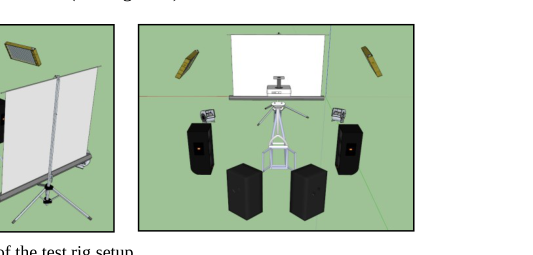
Environmental elements that were considered to be included into the test rig setup are elements of visual, wind gust, heat and noise. A projector and a screen are used as the visual aid to project real video of motorcycle riding activity that was recorded in prior to the setup. To acquire this, a JVC Adixxion action camera was used to capture real footage and sound on a real motorcycle. The projector is placed on an overhead projector stand and the screen is located in front of the test rig providing a clear visualization of what does a motorcyclist sees in front of him/her when riding a real motorcycle.
To replicate the wind gust and heat to the motorcyclist on the test rig, industrial fan blower and heater are installed into the test rig setup. Wind speed and heat intensity are based on motorcycle speed and also the typical surrounding climate and weather of Malaysia. The overall layout concept was drafted using Google SkecthUp 2013 to have an overview of how should the placements of the test rig setup looks like (see Figure 8).
Figure 8. Layout concept of the test rig setup Integration of Adjustable Motorcycle Test Rig and Surrounding Elements
To create another near-to-real riding experience on the test rig and to give the respondents the feel of controlling the test rig like handling a real motorcycle, the throttle on the test rig acts like a real motorcycle throttle. Simplified electronic controller made it possible to use the throttle as the fan blower and video speed controller. By having this, when the respondent’s starts to rotate the throttle (accelerate), the speed of the fan blower will start to build up supplying sufficient wind gust to the respondents and the video will also start to speed up. The throttle also controls the sound level of the surrounding speakers that includes the sounds of other vehicles, motorcycle engine, exhaust and other sounds captured in the footage. These conditions replicate how wind gust starts to blow back the respondent as if when accelerating on a real motorcycle and the video shows that the motorcycle is in a moving condition, while the surrounding sounds add up the near-to-real riding experience on the test rig setup. Heat from the heater is controlled and monitored during experiments to give the right heat intensity as if the respondents are really riding under the sun.
MEASURING MOTORCYCLIST FATIGUE It is known that body posture, muscle fatigue and musculoskeletal disorder (MSD) are three main elements that are related to one another especially in a sitting condition (Abdul Hadi Abdol Rahim & Ibrahim Othman, 2010; Balasubramanian & Jagannath, 2014; Balasubramanian, Jagannath, & Adalarasu, 2014; Karmegam et al., 2009; Mörl & Bradl, 2013; O'Sullivan et al., 2010; O’Sullivan, McCarthy, White, O’Sullivan, & Dankaerts, 2012; Srinivasan & Balasubramanian, 2007; A. W. Stedmon, 2007; Velagapudi et al., 2010). However, studies related to motorcyclist fatigue that employs proper method and experimental setup are lacking (Horberry et al., 2008). Hence, introducing this adjustable motorcycle test rig is significant to help researchers to understand more on this motorcyclist fatigue matter.
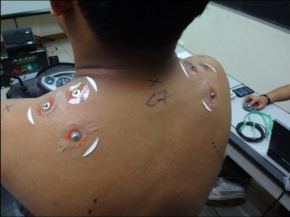
As for muscle fatigue is best being measured using a surface electromyography (sEMG) device, motorcycle researchers has started to use this device in acquiring muscle activity patterns on motorcyclist (Balasubramanian & Jagannath, 2014; Velagapudi et al., 2010). In those studies, different procedures were used to measure their respondent’s muscle activity using the sEMG device, but the motorcycle that they used apparently limited to one type of motorcycle model. This limit the exploration of muscle activity patterns using various riding postures that constitutes from different types of motorcycle models. However, it is still possible if they have the access to various types of motorcycle models to be used and tested. This will require a big group of motorcyclist to lend their motorcycle and will surely be a big constraint to the researchers to gather such a big group together for this purpose (A.W. Stedmon et al., 2009). Henceforth, using this test rig makes it possible to replicate various riding postures based on various motorcycle models. This gives motorcycle researchers the opportunity to study muscle activity patterns using various riding postures that relates to muscle fatigue.
Pilot tests have been done using this test rig setup coupled with a sEMG device where results of the muscle activity show different patterns when assuming different riding postures (see Figure 9). Further tests were done to validate the muscle activity patterns consistency when sitting on the test rig with certain riding posture compared to sitting on a real motorcycle with the same riding posture. Prior to these sEMG data collection and experiments, issues concerning ethics in the study have been approved by the UiTM Research Ethics Committee.
Figure 9. Pilot tests in measuring muscle activity patterns
CONCLUSIONS
Risk factors contributing to such motorcycle accidents have been identified previously listing from many factors including the motorcyclist themselves (Keall & Newstead, 2012; Pinto et al., 2014; Schneider et al., 2012). In studying the aspect of motorcyclist that includes their behavior, response, physiology and interactions during riding a motorcycle, human factors or ergonomics studies relating to these aspects are essential. It is now becoming an interesting research area to explore in an effort to help reducing motorcycle accidents that are keeping on increasing every year.
Henceforth, researchers at the Motorcycle Ergonomics Test Lab, Faculty of Mechanical Engineering, Universiti Teknologi MARA Malaysia had made another breakthrough in motorcycle ergonomics studies by introducing a new adjustable motorcycle test rig for studying motorcyclist posture and fatigue matters. As part of the experiment equipment to be used in another study framework that focuses on measuring motorcyclist muscle fatigue in prolonged riding, this test rig provides another alternative of an experimental setup that is much proper within a controlled environment. The unique attributes that the test rig comprises enabled it to be patented to protect the authors Intellectual Property Rights (IPR) upon the test rig’s design.
The idea of developing a means of platform to measure motorcyclist fatigue that causes motorcycle accidents started to evolve from this study. Knowing that cost of development to build a motorcycle simulator is highly expensive for such studies, the authors opt to develop only a motorcycle test rig that is much lower in cost. Benchmarking and referring to current motorcycle simulators that are available, apparently most of them only provide one possible riding posture that is based on the type of motorcycle model that they acquire in their simulators. This opens another opportunity for the authors to design and develop a motorcycle test rig that can be adjusted to suit various riding postures, mainly the riding postures established by the RIPOC system (Ma’arof & Ahmad, 2012). Although the test rig can be adjusted, maximum and minimum adjustments to the handle bar, seat and foot pegs are still based on real motorcycle dimensions to avoid any odd riding postures that are impossible to be performed on existing motorcycle type of models.
Fidelity of the test rig in replicating a near-to-real motorcycle riding experience is sustained through the environmental element effects included in the test rig setup. Effects of wind gust, heat and noise during real motorcycle riding are created with the aid of various equipment and control system. Besides that, the test rig chassis itself is being specifically designed to look like a motorcycle that uses several motorcycle accessories on it to give a better feel of motorcycle riding experience to the respondents. By having all these attributes, a better fidelity of a motorcycle test rig was successfully developed for the use of various potential motorcycle ergonomics studies.
However, ongoing studies are still being done by the researchers at the Motorcycle Ergonomics Test Lab to enhance the capability of this test rig to another extent. Elements of vibrations will be included in the test rig setup as another package of creating another near-to-real riding experience on the test rig. This decision will need a big investment of cost to implement. Sophisticated control systems coupled with high tech hardware involving hydraulics and pneumatics systems will contribute most to the high investment cost of implementation. However, it will be worth it to invest in such a big cost as for more exploration on motorcyclist interactions towards their surrounding and body response can be performed. Besides that, the test rig interface is also being considered to be upgraded to use a programmable and fully interactive system for instance the STISIMS Drive system and interface. By using such system, the respondents riding the test rig have the opportunity to have better control and interaction with the displayed interface. This system has been proven to be very supportive and good in simulating road conditions with the capability of setting up own hazards preferences for any condition (Crundall et al., 2013; A. W. Stedmon et al., 2012). The throttle control, brakes and clutch can also be synchronized with the interface making it another big advantage to have such system integrated into the test rig. Thus, it does not only limit the use of the test rig for studies concerning motorcyclist postures and fatigue, but also opens other opportunities for further motorcycle ergonomics studies in the mere future.
However, to replicate a rainy day riding environment using the test rig setup is impossible and very risky as for the electronics devices used on the test rig setup is not meant to be used outside during raining condition. Hence, the environment being replicated is only limited to non-raining condition and an assumption is made that riding motorcycle in a rainy day increase the risk of the motorcyclist to get involved in a road accident. Therefore, it is clear that this risk is high enough to forbid motorcyclist to ride during raining condition and allows researchers not to consider raining condition in their studies. Nevertheless, how high does raining condition risk the lives of motorcyclist on the road that contributes to motorcycle accidents can be further studied and explored.
ACKNOWLEDGMENT
The authors would like to acknowledge the Ministry of Education (MOE) Malaysia for providing the research fund for this research study through the Fundamental Research Grant Scheme (FRGS/1/2014/TK01/UITM/02/3). Special thanks to the research team at the Motorcycle Ergonomics Test Lab, Faculty of Mechanical Engineering, Universiti Teknologi MARA Malaysia especially to Muhammad Hafizudin Kamal, Muhammad Firdaus Azhar, Wan Muhammad Syahmi Wan Fauzi, Mohd Afham Azmi and also Muhammad Adzri Adzman. Special thanks also to Rohani Haron, expert physiotherapist from Faculty of Health Sciences, Universiti Teknologi MARA Malaysia, the technicians at the Machine Shop, Faculty of Mechanical Engineering, Universiti Teknologi MARA Malaysia and also to the Human Factors and Ergonomics Society of Malaysia (HFEM) for their continuous support upon this study.
REFERENCES
Abdul Hadi Abdol Rahim, Abdul Rahman Omar , Isa Halim, Alias Mohd Saman,, & Ibrahim Othman, Mas Alina, Suhadiyana Hanapi. (2010, 5-7 December 2010). Analysis of Muscle Fatigue associated with Prolonged Standing Tasks in Manufacturing Industry. Paper presented at the 2010 International Conference on Science and Social Research (CSSR 2010). Ampofo-Boateng, Kwame, Muzlia, Syarifah, Parnabas, Vincent, Abdullah, Nabilah, & Sueb, Rosilawati. (1999). Human Factors
and Motorcycle Accidents in Malaysia: Universiti Teknologi MARA. Balasubramanian, V., & Jagannath, M. (2014). Detecting motorcycle rider local physical fatigue and discomfort using surface electromyography and seat interface pressure. Transportation Research Part F: Traffic Psychology and Behaviour, 22, 150-158. Balasubramanian, V., Jagannath, M., & Adalarasu, K. (2014). Muscle fatigue based evaluation of bicycle design. Applied
Ergonomics, 45(2, Part B), 339-345. Benedetto, Simone, Lobjois, Régis, Faure, Vérane, Dang, Nguyen-Thong, Pedrotti, Marco, & Caro, Stéphane. (2014). A comparison of immersive and interactive motorcycle simulator configurations. Transportation Research Part F: Traffic Psychology and Behaviour, 23, 88-100. Cossalter, Vittore, Doria, Alberto, & Lot, Roberto. (2004). Development and validation of a motorcycle riding Simulator. Paper
presented at the World Automotive Congress, Barcelona, Spain. Crundall, E., Crundall, D., & Stedmon, A. W. (2012). Negotiating left-hand and right-hand bends: a motorcycle simulator study to investigate experiential and behaviour differences across rider groups. PLoS One, 7(1), e29978. Crundall, E., Stedmon, A. W., Saikayasit, R., & Crundall, D. (2013). A simulator study investigating how motorcyclists approach
side-road hazards. Accident Analysis and Prevention, 51, 42-50. Horberry, T., Hutchins, R., & Tong, R. (2008). Motorcycle Rider Fatigue: A Review. London: Department for Transport. Huang, Jiung-Yao, & Gau, Chung-Yun. (2003). Modelling and designing a low-cost high-fidelity mobile crane simulator.
International Journal of Human-Computer Studies, 58(2), 151-176. Hurt, H.H., & Dupont, Cj. (1977). Human Factors in Motorcycle Accidents. SAE Technical Papers. Huth, V., Biral, F., Martin, O., & Lot, R. (2012). Comparison of two warning concepts of an intelligent Curve Warning system for motorcyclists in a simulator study. Accident Analysis and Prevention, 44(1), 118-125. Jamson, Samantha L., & Jamson, A. Hamish. (2010). The validity of a low-cost simulator for the assessment of the effects of in-
vehicle information systems. Safety Science, 48(10), 1477-1483. Jones, S., Gurupackiam, S., & Walsh, J. (2013). Factors influencing the severity of crashes caused by motorcyclists: Analysis of data from Alabama. Journal of Transportation Engineering, 139(9), 949-956. Karmegam, K., Ismail, M.Y., Sapuan, S.M., Ismail, N., Bahri, M.T. Shamsul, Shuib, S., & Seetha, P. (2009). A Study on
Motorcyclist’s Riding Discomfort In Malaysia. Engineering e-Transaction, 4(1), 39-46. Keall, M. D., & Newstead, S. (2012). Analysis of factors that increase motorcycle rider risk compared to car driver risk. Accident Analysis and Prevention, 49, 23-29. Kuppuraju, Nagesh, Ittimakin, Prawit, & Mistree, Farrokh. (1985). Design through selection: a method that works. Design
Studies, 6(2), 91-106. Ma'arof, M Izzat Nor, Ahmad, Ismail N, Abdullah, Nik R, & Karim, Shamsury A. (2012). Motorcycling Riding Issues: Understanding the Phenomenon and Development of Ergonomics Intervention in Improving Perceived Comfort for Prolonged Riding. Paper presented at the International Conference on Design and Concurrent Engineering (iDECON 2012), Melaka.
Ma’arof, M Izzat Nor, & Ahmad, Ismail N. (2012). Proposed Standard Method for Motorcycle Nomenclature System. Paper presented at the 2012 Southeast Asian Network of Ergonomics Societies Conference (SEANES), Langkawi. Macdonald, Wendy A. (1985). Human factors and road crashes: A review of their relationship (D. o. M. Engineering, Trans.):
University of Melbourne. Mingzhou, Su, Qiang, Gu, & Bing, Guo. (2002). Finite element analysis of steel members under cyclic loading. Finite Elements in Analysis and Design, 39(1), 43-54. Mörl, Falk, & Bradl, Ingo. (2013). Lumbar posture and muscular activity while sitting during office work. Journal of
Electromyography and Kinesiology, 23(2), 362-368. Nehaoua, L., Arioui, H., & Mammar, S. (2011, 20-23 June 2011). Review on single track vehicle and motorcycle simulators.
Paper presented at the Control & Automation (MED), 2011 19th Mediterranean Conference on. O'Sullivan, Kieran, O'Dea, Patrick, Dankaerts, Wim, O’Sullivan, Peter, Clifford, Amanda, & O’Sullivan, Leonard. (2010).
Neutral lumbar spine sitting posture in pain-free subjects. Manual Therapy, 15(6), 557-561. O’Sullivan, Kieran, McCarthy, Raymond, White, Alison, O’Sullivan, Leonard, & Dankaerts, Wim. (2012). Can we reduce the effort of maintaining a neutral sitting posture? A pilot study. Manual Therapy, 17(6), 566-571. Organization, World Health. (2013). Global Status Report on Road Safety 2013 - Supporting A Decade of Action: World Health
Organization. Perez-Fuster, P., Rodrigo, M. F., Ballestar, M. L., & Sanmartin, J. (2013). Modeling offenses among motorcyclists involved in crashes in Spain. Accident Analysis and Prevention, 56, 95-102. Pinto, Maria, Cavallo, Viola, & Saint-Pierre, Guillaume. (2014). Influence of front light configuration on the visual conspicuity
of motorcycles. Accident Analysis & Prevention, 62, 230-237. Riley, William F., Sturges, Leroy D., & Morris, Don H. (2006). Mechanics of Materials (6th ed.): Wiley. Schneider, W. H. th, Savolainen, P. T., Van Boxel, D., & Beverley, R. (2012). Examination of factors determining fault in twovehicle motorcycle crashes. Accident Analysis and Prevention, 45, 669-676. Srinivasan, J., & Balasubramanian, V. (2007). Low back pain and muscle fatigue due to road cycling-An sEMG study. Journal of
Bodywork and Movement Therapies, 11(3), 260-266. Stedmon, A. W. (2007). Motorcycling is a pain in the neck, numb bum, aching wrists - Or all these things! A rider comfort survey. Stedmon, A. W., Brickell, E., Hancox, M., Noble, J., & Rice, D. (2012). MotorcycleSim: A user-centred approach in developing
a simulator for motorcycle ergonomics and rider human factors research. Advances in Transportation Studies(27), 31-48. Stedmon, A.W., M.S.Young, & Hasseldine, B. (2009). Keeping It Real or Faking It: The Trials and Tribulations of Real Road Studies and Simulators in Transport Research Contemporary Ergonomics 2009: Taylor & Francis. Thakker, A., Jarvis, J., Buggy, M., & Sahed, A. (2009). 3DCAD conceptual design of the next-generation impulse turbine using
the Pugh decision-matrix. Materials & Design, 30(7), 2676-2684. Velagapudi, S. P., Balasubramanian, V., Adalarasu, K., Babu, R., & Mangaraju, V. (2010). Muscle fatigue due to motorcycle riding. SAE Technical Papers.
LISTED IN THE AHFE DIGITAL BOOKSTORE CATALOGUE
Explore the complete digital volume
Advances in Human Aspects of Transportation: Part II
Read this individual research paper free through the original publisher, or explore the full digital proceedings book.
ISBN 978-1-4951-2098-5
Explore this ISBN in the AHFE Bookstore ↗Listed in the July 2026 bookstore catalogue; search by ISBN to confirm current availability · Digital book purchase optional