Grzegorz Dobrzyński, Włodzimierz Choromański, Krzysztof Fiok (2021). Simulation Study of Wheelchair Manoeuvrability. In: Advances in Human Aspects of Transportation: Part II. AHFE Open Access, vol. 16. https://doi.org/10.54941/ahfe100676
The article presents simulation study results of maintaining a pre-set trajectory by wheelchairs. The objects of the study were the models of electric and manual wheelchairs. The aim of these simulations was to analyse the influence of various drive models on the capability of maintaining a pre-set trajectory.
The issues of simulation researches of four-wheel vehicles, wheelchairs in particular, are dealt with by a few research centres in the world. A high level of construction diversity of these wheelchairs is a result of the demand among users in relation to the functionality of this means of transport, but first of all it is directly connected with requirements concerning adaptation to various types of disabilities. A wheelchair designed for a particular person is selected in such a way that during its use the person applies possibly the most extensive parts of healthy muscles. This allows for improving mental comfort of the disabled through ensuring them a relatively independent existence, but also enables them to keep fit. Therefore, the manual wheelchairs are most often used by people suffering from paraplegia or other impairments of walking ability, however, with properly functioning upper limbs. More complex motor impairments require assistance of an able-bodied person in moving this type of wheelchair, which limits self- reliance of the disabled. In such cases it is indispensable to use a wheelchair with autonomous drive e.g. electric.
The paper presents simulation study results of maintaining a pre-set trajectory by wheelchairs. The objects of the study were the models of electric and manual wheelchairs. The aim of these simulations was to analyse the influence of various drive models on the capability of following a pre-set trajectory. For the purpose of simulation the wheelchairs (fig. 1) designed within the framework of Eco-Mobility Project realized at the Faculty of Transport of Warsaw University of Technology have been selected.
THE OBJECT OF SIMULATION RESEARCHES The object of the researches are the prototypical and continuously developed constructions, namely, an electric wheelchair with stair-driving option and a manual wheelchair driven by levers (fig.1). The present paper is part of activities aiming at designing a universal simulation environment of various construction wheelchair movement. This environment is to play the role of a tool for virtual prototyping and experiment. In the abovementioned activities, the research problem is the assessment of influence of regulation parameters and dynamic features of a simulation model on the capability of maintaining a pre-set trajectory.
Fig. 1 Prototypical construction of an electric wheelchair and a wheelchair driven by levers Scientific researches within the area of simulation studies of maintaining a pre-set trajectory concern mainly motor vehicles. The issues within the range of wheelchairs are dealt with only by a few research centres in the world. The basic difference in models used in these centres is the method of pre-setting a driving direction. In the case of wheelchairs, the most frequently used manoeuvre is turning through rotational speed diversification of wheels on a given axle. Swivel casters are placed on the other axle.
For simulation model construction Matlab – Simmechanics environment has been used. The structure of this model has been presented in Fig 2. The figure presents the division into the main modules of the model. The module constitutes a combination into a group of elements commonly realizing a given function.
Each of given modules of this model is defined in accordance with nominal model assumptions and represents respectively:
1. – the module including mass parameters of the frame with the seat together with rigidly connected drives, gears and levers etc.
2. (RR, RL, FR, FL) – module representing the wheels: RR and RL are respectively rear right and rear left wheels, FR and FL are respectively front right and front left wheels together with a swivel axle. The rear wheels together with the frame make a rotational kinematic pair without friction. The front wheels are connected with a swivel axle as a rotational kinematic pair without friction. The swivel axle is connected with the frame as a rotational kinematic pair with friction. Axis of rotation of the swivel axle is vertical.
3. – module representing decisions of the person driving the wheelchair. The task of this module is to reflect the reaction of the person who is trying to maintain a pre-set trajectory at a given speed.
4. – module representing the source of the driving torque. In the case of an electric wheelchair, it represents electronic control system of the wheelchair. For the sake of these simulations, the module structure has been limited to a speed control system and driving direction by means of pre-setting the driving torque. In the case of a manual wheelchair, this module represents upper limbs as the source of the driving torque whose value is pre-set in a periodic manner.
Fig. 2 Flowchart presenting the structure of simulation model prepared in Simmechanics Module No. 1 Structure – Wheelchair Frame and a Human Being
The simulation objective was task realization of driving on a flat surface maintaining a pre-set driving direction. With such a task, the nominal model of module no.1 has been simplified to rigid bodies of the structure comprising:
body of the frame with the seat together with rigidly connected drives, gears and levers etc,
body representing a human being rigidly connected with body of the frame,
bodies representing rear right and left wheels. The rear wheels together with the frame make a rotational kinematic pair without friction,
the front wheels are connected with a swivel axle as a rotational kinematic pair without friction. The swivel
axle is connected with the frame as a rotational kinematic pair with friction. Axis of rotation of the swivel axle is vertical. This model is presented in , indicating the assumed coordinate systems. The origin of the coordinate system connected with the body of the wheelchair frame is situated in the middle of rear wheel axle.
Fig. 3 Nominal model prepared for simulation of maintaining a pre-set trajectory
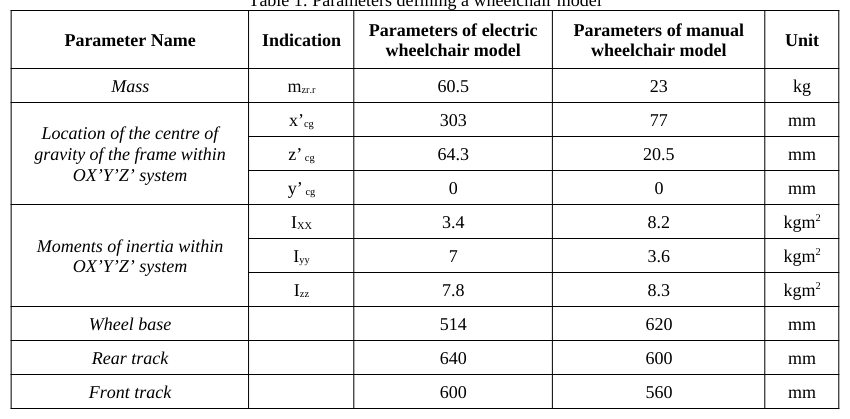
When modelling the frame, its mass parameters were described excluding from the whole structure the mass parameters of rotating wheels’ elements. The values have been set in Table 1.
Table 1: Parameters defining a wheelchair model Parameters of manual Parameter Name Indication Parameters of electric wheelchair model wheelchair model Unit
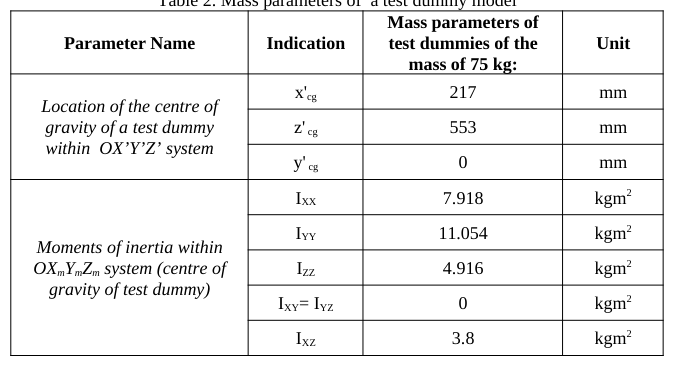
When building a simulation model of a human body it was simplified to a rigid body. A similar simplification was applied in paper (Choromanski, 2009). In addition, the guidelines were taken into consideration that are included in the standard PN-ISO 7176-11 Wheelchairs: Test dummies (PN-ISO 7176-11:1998) and The anthropometric atlas of the Polish population - data for design (Batogowska and Słowikowski, 1994). Table 2 comprises the nominal values of values defining a test dummy model.
Table 2. Mass parameters of a test dummy model Mass parameters of Parameter Name Indication test dummies of the Unit mass of 75 kg: x'cg 217 mm
Wheel Models In a simulation model, two pairs of wheels have been defined that differ from each other, namely, front and rear. The MF-Tyre program has been used, which was designed by the university TU Delft (Web Page: http://home.tudelft.nl/) and TNO organization (Web Page: http://www.tno.nl). MF Delft Tyre provides a semi- empirical tyre model to be applied in various simulation environments, among others, in Matlab – Simulink – SimMechanics environment. In the description of grip, the equations of Pacejka’s magic formula have been used (Pacejka Formula Magic). Tyre deformations have been described by the so called brush model [20]. The model is designed for calculations of forces affecting a tyre in a static state or in a slowly variable state of dynamic interactions the frequencies of which do not exceed 8Hz. The model is designed for steerability tests of a vehicle during cornering conducted in simulation researches of virtual pre-prototyping on non-deformed (flat) surfaces. In view of the above, the model meets the criteria of a wheelchair design. In the present paper the model in version 6.1.2 with a definition of contact option has been used: smooth road contact, circular cross section (motorcycle tyres).
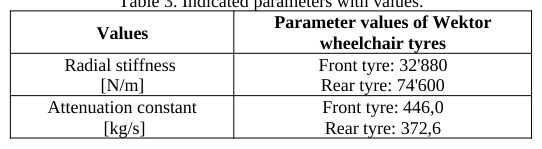
Parameters have been experimentally indicated of radial stiffness and attenuation of tyre model. This stage of works was conducted within the framework of Eco-Mobility Project and has been extensively presented in paper (Dobrzynski and Barwicki, 2011). The tyres tested were pumped to the nominal pressure value stipulated by the producer, namely, 35 psi (241318 Pa).
Table 3. Indicated parameters with values.
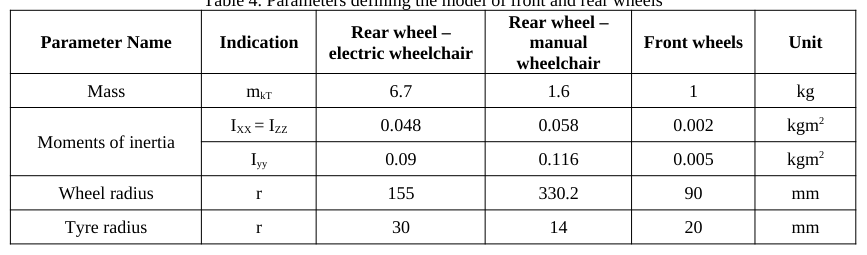
Centres of gravity of wheels are located in their geometrical centres and with reference to the system connected with this location inertia moments have been defined. Parameters defining the model of rear and front wheels have been presented in Table 4. Front wheel parameters were identical for both constructions. Parameters not mentioned here originate from TNO Delf-Tyre definitions of tyres used in motorcycles.
Table 4. Parameters defining the model of front and rear wheels Rear wheel – Front wheels Unit Parameter Name Indication Rear wheel – electric wheelchair manual wheelchair
Module Representing Decisions of the Wheelchair Driver The objective of the module representing decisions of the wheelchair driver is to reflect the reaction of a person who tries to maintain a pre-set trajectory at a given speed. For description of behaviour of a person on a wheelchair, the so called anticipatory control block has been used (Augustynowicz, 2009), , (Bułka et al., 2006).
PID controller used describes the reaction of a person driving within the process of joystick angle inclination or decisions concerning diversification of manual power driving the wheelchair levers. The controller reflects psychomotor features of the driver. The segment „saturation” describes maximum value of inclination of joystick lever that can be realised by the driver. At the system output a signal is obtained which controls the difference of moments driving the wheels of the values maintaining the pre-set values accounting for typical reactions of the driver and technical limitations of the pre-setting system operation.
Fig.4 Diagram of module representing decisions of a wheelchair driver.
Parameters of the controller applied have been analysed further in the paper. The following values have been assumed as nominal ones: P=1; I=0.1; D=1; The speed of model movement is pre-set through the defined characteristics and it gradually increased to 1.2 m/s. The maximum speed value (PN-EN 12184:2010), at which the wheelchair can move equals v=3.33m/s.
Module of Driving Torque Pre-Setting The module representing the object of pre-setting the driving torque in an electric wheelchair plays the role of an electronic control system. Its operation is limited to speed and driving direction control systems (Grzesiak et al., 2011), (Kozłowski et al., 2011). The diagram of this module is presented in Fig. 5.
Fig. 5. Diagram of the module representing electronic control system of a wheelchair This module operates on the basis of rotational speed of wheels feedback. This system has the structure with average speed controller (Kozłowski et al., 2011).
Parameters of controllers used have been analyzed further in the paper. The following values have been assumed as nominal ones:
Equation reproduced from the original PDF.
Simulation Researches Simulation researches were conducted in Matlab-Simmechanics environment. The solver "ode15s stiff/NDF" was used for calculations. The studies conducted allowed for drawing up characteristics of the whole model response to coercion, which is the pre-set trajectory. The trajectory on which the wheelchair is moving is dependent on mass parameters of the model, contact parameters and elements of control system. What is also important are the psychomotor features of a person driving the wheelchair as well as a pre-set speed. Only the combination of the features of these elements allows for analysis of the whole model behaviour. Detailed descriptions of operation of these elements of the model are included in the paper (Dobrzynski, 2013).
Fig. 6 presents the characteristics of PID controller operation representing human properties for nominal parameters.
Time [s]
Czas [s]
Fig. 6 PID controller operation – human being: red line - deviation, green line – registered value on controller output One of the significant elements of researches on dynamic systems properties is the study of dependence of system model response on its parameter changes. The analysis results presented so far were prepared for nominal parameters. Further in the paper, an attempt has been made at assessment of parametric sensitivity in relation to human model features. Assuming various values of parameters of the model, a situation was simulated in which a wheelchair is driven by persons of different psychomotor predispositions.
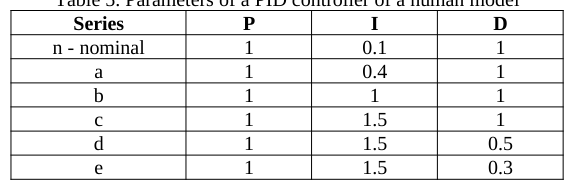
Nominal parameters of a PID controller constituting a human model have been assumed on the basis of (Augustynowicz, 2009), (Bułka et al., 2006), (Grzesiak, 2011). Subject literature concerning the models of persons driving wheelchairs is not known to the authors, therefore parameters have been assumed describing vehicle drivers. Nominal values and parameter values of a PID controller for subsequent series of simulations have been set in Table 5.
Table 5. Parameters of a PID controller of a human model Series P I D n - nominal 1 0.1 1 a 1 0.4 1 b 1 1 1 c 1 1.5 1 d 1 1.5 0.5 e 1 1.5 0.3
As a result of simulations conducted the influence of parameters of the human element model has been observed on the behaviour of simulation model. In order to picture the differences in operation of this controller, the graph (Fig. 7) has been prepared which shows deviation and regulation for simulation with nominal parameters and subsequent series (a-e) with altered parameter values.
Fig .7 Operation of PID controller of a human model at various settings
The drawn up characteristics presenting trajectories of a wheelchair model movement for subsequent simulation series (), presents parametric sensitivity of the whole system. When analysing the above graphs one can observe series for which the model after manoeuvres oscillates around a pre-set direction gradually decreasing the amplitude. These are series n, a, b, c. These cases correspond with proper operation of control system.
In series d, e maintenance of inclinations amplitude has been observed from a pre-set direction within the whole period of simulation, which means lack of stabilization of a wheelchair driving direction. At the assumed control system, the wheelchair behaves differently depending on the assumed parameters of a human model.
Fig. 8 Trajectories indicated by an electric wheelchair model obtained at various settings of a PID controller of a human model At the next step of simulation the abovementioned series of parameters describing decision model of a human being, a manual wheelchair has been used for a describing model. The results of these simulations have been set in Fig.9.
Fig. 9 Trajectories indicated by the a manual wheelchair model obtained at various settings of a PID controller of a human model The above simulations allowed for omitting parameters, which when applied to the control system in the prototype, could pose a threat to safety of the persons driving the wheelchair during the tests. These activities also allowed for limiting the range of parameters tested on the prototypical construction discussed here.
CONCLUSIONS
The authors of the present paper have discussed simulation researches within the range of driving on a designated trajectory. The simulation results have been presented of a model designed within Matlab-Simmechanics environment. These simulations were conducted in two stages. At the conclusion of stage I, results were obtained for the nominal model, which became the basis for comparison with simulation results for altered parameters in stage II.
The simulation results have indicated the need for constructing a control model of different parameters and also of a different structure (e.g. accounting for a learning model of a human). It seems reasonable to undertake works aiming at identification of parameters of a human model controlling a wheelchair. The results obtained should be treated as an initial analysis of the issue, because in the simulations, descriptions of models were used of a human driving a motor vehicle, in relation to whom different requirements are formulated due to higher driving speeds.
The simulation models prepared give the possibility of conducting further research work comprising the following:
Analysis of parameter libraries of tyre models of a complex structure.
Analysis extension of control structures of vehicles driver by two electric motors.
ACKONWLEGMENT The described research was financed from the ECO-Mobility project WND-POIG.01.03.01-14-154/09. The project was co-financed from the European Regional Development Fund within the framework of Operational Programme Innovative Economy Human Aspects of Transportation II (2021)
REFERENCES
Augustynowicz A. (2009), "Modelling of a car driver type", Publishing House of Opole Univertsity of Technology, Opole.
[URL: http://www.dbc.wroc.pl/Content/3706/SiM_232_scal_popr.pdf ]. Batogowska A., Słowikowski J., (1994), "Anthropometric atlas for the adult poulation of Poland for design purposes", Institute of Industrial Design, Warsaw. Bułka D., Walczak S., Wolak S., (2006), "Preview predictor driver mode used ID computer program for the simulation of car
accidents", Reasearch Bulletin of Kielce University of Technology, Mechanics 84, p.147, Kielce. Dobrzyński G, Barwicki M., (2011) "Parameter identification for simulation model of a“Simple Tire” used on an electric wheelchair", Report on work conducted within the framework of Eco-Mobility Project UD/0145/1160/2011. Dobrzyński G., (2013), Doctoral thesis: "Synthesis of the mechatronic wheelchair properties as a part of the transport systems
for people with disabilities", Faculty of Transport of Warsaw University of Technology, defence of doctoral thesis: 25.01.2013, [access on 10.04.2013 at: http://bcpw.bg.pw.edu.pl/publication/4062] Grzesiak L., Choromański W., Grabarek I., Kamiński G., Ufnalski B., Sczypior J., Brach P., Choromański K., Ambrożak A., Nowak J., Kozłowski M., Tomczuk K., Barwicki M., Orłowski J., (2011) "New Concept of an Electrical City Car and its Infrastructure", Polish-Chinese seminar materials, PAN, ECO-Mobility, Warsaw University of Technology, ITS, Warsaw 16 – 17 June 2011. Kozłowski M., Tomczuk K., Szczypior J., (2011), "Methodology of determining basic technical parameters of electric-drive
car", Electrical Review, issn 0033-2097, 87 no. 10/2011 pp. 299 – 304. PN-EN 12184:2010 "Electrically powered wheelchairs, scooters and their chargers - Requirements and test methods". PN-ISO 7176-11:1998 "Wheelchairs – Test dummies". Work by multiple authors edited by Włodzimierz Choromański, (2009) "Transport of the disabled – innovative wheelchairs for persons with motor disabilities", Publishing House of Warsaw University of Technology, Warsaw 2009. TNO: Netherlands Organisation for Applied Scientific Research TNO - Web Page: http://www.tno.nl . TU Delft: Delft University of Technology – Web Page: http://home.tudelft.nl/. Zegelaar P. W. A., (1998), "The dynamic response of tyres to brake torque variations and road unevennesses", Delft University
of Technology, podręcznik ze strony web page: http://www.tno.nl .
LISTED IN THE AHFE DIGITAL BOOKSTORE CATALOGUE
Explore the complete digital volume
Advances in Human Aspects of Transportation: Part II
Read this individual research paper free through the original publisher, or explore the full digital proceedings book.
ISBN 978-1-4951-2098-5
Explore this ISBN in the AHFE Bookstore ↗Listed in the July 2026 bookstore catalogue; search by ISBN to confirm current availability · Digital book purchase optional