Michael L. Bernard, Asmeret B. Bier (2019). Analytical Capability to Better Understand and Anticipate Extremist Shifts Within Populations in Failing States. In: Advances in Cross-Cultural Decision Making. AHFE Open Access, vol. 6. https://doi.org/10.54941/ahfe100186
The difficulty in adequately assessing geopolitical and sociocultural dynamics of extremist groups has led to failures in understanding, anticipating, and effectively responding to shifts in their movements and allegiances. Recent attacks in Africa highlight the need to more precisely understand and anticipate changes in societal attitudes and behaviors due to radicalization. This is particularly important as new extremist cells and affiliates have sprung up in parts of Southeast Europe, Asia, and Africa. A significant concern is their stated intent to plan and conduct attacks against populations within these regions. This paper describes an effort to build upon existing capabilities to assess the phenomena that gives rise to the support for extremism, shifts in allegiances, and active engagement in violent acts against indigenous populations. The focus of this effort is to assess how the dynamics of allegiance formation between various groups and society are impacted by conflict and by third-party interventions. We also seek to help determine how and why extremist allegiances co-evolve over time due to changing geopolitical, sociocultural, and military conditions. The aim of this paper is to discuss our initial effort to assess the dynamic interactions between an extremist group and an indigenous population over time.
This paper describes an initial effort by Sandia National Laboratories to develop a capability to help assess the phenomena that give rise to active engagement in extremism and its effects on societies. The intent of this effort is to investigate underlying attitudinal and behavioral shifts over time due to the influence of extremist groups. Our test case involves extremist groups in Africa. In this case, we are considering how certain decisions affect economic and social stability in different parts of Africa and how the resulting tension may affect this society. This region was selected because of the immediate and long-term threats posed by extremist groups. For this effort we are defining an extremist group as composed of individuals that display preoccupation with an ideology, religion, or political cause to such a degree that it leads to pursuit of violence as a tactic or strategy for imposition of its members’ views on mainstream groups (see also Finlay, 2010).
To accomplish this effort, we are computationally modeling the interaction dynamics within and between transnational extremist groups in response to military, social, economic, and political intercessions. We are using a data- and theory-supported assessment capability, Behavioral Influence Assessment (BIA), to better understand and anticipate (with quantifiable uncertainty) how the dynamics of allegiance formations between various groups and society are impacted by active conflict and by third-party interventions. We are also considering how and why extremist allegiances co-evolve over time due to changing geopolitical, sociocultural, and military conditions. BIA is anchored to a theoretically consistent psychological, social, and economic foundation for analyzing behaviors of individuals and populations over time in response to military, diplomatic, and other influences (Backus et al., 2010; Bernard & Backus, 2009, Bier et al., 2011). BIA assesses multiple scales of behavior associated with the external world. The system emphasizes response/counter-response actions—the recognition of which can reduce surprises and counter-productive influences. The underlying modeling structure is based on a synthesis of expert opinion and data, including cultural and institutional constraints and conditions. Formal validation and analysis of simulation results characterize model confidence and robustness, including probability ranges of success despite uncertainty. The model uses a synthesis of data-supported, psychological and social (psychosocial) theories of group decision- making, as well as theory-based analytical studies of socioeconomic data. The psychosocial element models key cognitive processes underlying how people make decisions and express behaviors. It incorporates such elements as belief/attitude/motivation formation, framing, and strengthening by incorporating theories that are (1) mutually consistent; (2) can be integrated into a complete representation of behavior; and (3) can be instantiated, tested, and verified using accessible data. Data and SME input are used to calibrate the model, test hypotheses regarding behaviors, and quantify uncertainty. The resulting capability can delineate the temporal unfolding of societal tensions due to the social, economic, environmental, and political stresses. The models are designed to be broadly applicable (with modification), across different ethnic, political, and social groups, including regional dynamics and rest-of-the-world reactions to behaviors. For a broader discussion of BIA see Bernard, Backus, & Bier; and Bier & Bernard in this issue of the proceedings.
Dynamic modeling of extremist groups When we study societies that are significantly influenced by extremist groups (EG), we do not model the group in isolation, since no group operates in complete isolation. In fact, many of the EGs that exist today are at least loosely affiliated with other international groups (Pillar, 2001). Moreover, local group dynamics often depend on interactions within and between people and leaders that can be greatly affected by external influences. External influences can involve a wide range of events and actions, from the imposition of new government in the area of interest or in neighboring countries to natural disasters or military incursions by foreign powers. The effect of these influences depends on the nature of the society being affected.
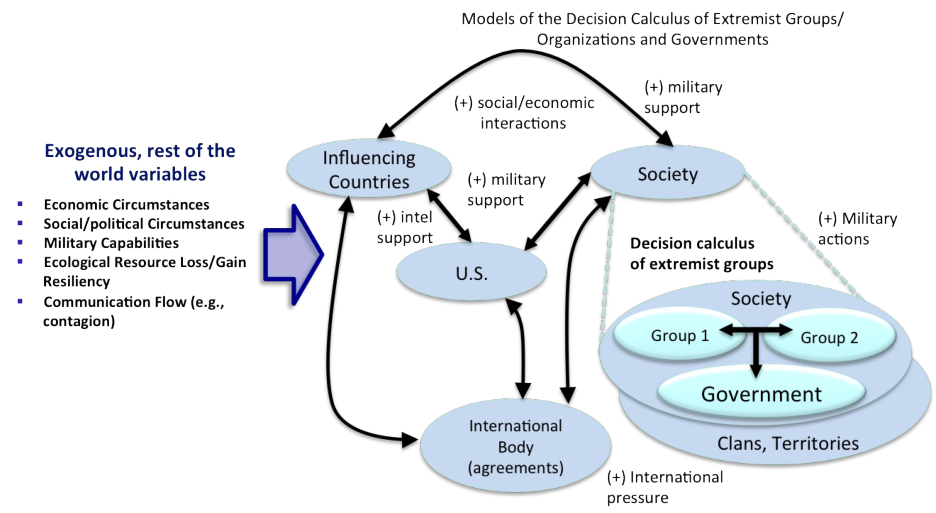
Extremist groups commonly seek to garner support from the local community by providing services and dispensing their brand of justice and law. This involves interacting with the community and groups outside of the community. Often, events that occur outside the purview of a local group may affect that group through its interaction with more transnational, affiliate groups. Of course, how EGs work within the culture and society of local communities can have a large effect on the support they receive. Their interaction with established cultures, tribes, clans, and other indigenous populations is often an indication of their actual support in the community (Martins, 2008; Thaler et al., 2013). This focus, however, can clash with more transnational objectives of expanding the influence of the group by focusing on broader international issues. For example, the use of a more global presence within a country that is suspicious of foreigners may actually undermine support (Hansen, 2013). An understanding of the potential effects of these types of influences is important, since they can affect the support, and thus the strength and influence, of EGs. To broadly assess these types of influences, we focused our assessment on the interactions between the entities described above. Figure 1 shows the general influences within a society that we are currently modeling. Here, the interactions between the United States, other influencing countries, international bodies, and the country or region itself are being represented. Within the country or region, the specific governmental body and various groups (both extremist and non-extremist) are also being represented. Together, these entities interact with each other in varying degrees. Exogenous influences, such as global socioeconomic and geopolitical conditions, military capabilities, ecological conditions, and the flow of information, all have some degree of influence over these interactions. These interactions can change over time due to dynamic shifts in internal and external conditions. Thus, to better understand these influences, we believe it is necessary to not only model the behaviors of EGs, but also determine how their interactions with other groups, and the external or ‘physical’ world, dynamically co-evolves in response to events and conditions over time.
Figure 1. Conceptual view of the modeled interactions
SYSTEM MODEL DEVELOPMENT Feedback processes among groups and the physical world unfold dynamically and can cause the outcome of an intervention to deviate from the desired direction. They can also lead to counter-responses that generate new concerns without improving the original issue. The delay between behaviors and impacts can cause secondary dynamics that make it extremely difficult to know whether the fluctuating behavioral responses and counter- responses will ultimately lead to the desired outcome. The computational modeling of these dynamic interactions needs to address this dynamic evolution, which is most readily modeled using differential equations. The differential equations used in these models not only simulate dynamics, but also causally describe why the dynamics occur (Bier et al., 2011).
The process for developing a BIA model using the system dynamics methodology starts with a description of the problem questions that are to be addressed. There is no attempt to model the entire system, but only those aspects of the system relevant to the focus problems. The next step is to develop a causal-loop diagram that relates all the interactions embodied in the theories (McFadden, 1984). The casual loop diagram is then extended (via a stock and flow diagram) to explicitly detail the flow of information and physical quantities through the system (Sterman, 2000). A key feature is the designation of stocks that represent things that accumulate—for example, the accumula- tion of information, experience, monetary, or physical quantities. These stocks are called “state variables” and they largely characterize the nature of the system and its responses. The difference in the value of stocks over time increments is the “differential” part of the computational modeling approach. The exact mathematical expression of theory is anchored in the flows into and out of the stocks. Only those theories that have a measurable meaning, supportable, at least in principle, by historical or experimental data, are included in the model. The data determines the parameters that control the progression of the simulated values through time. Rigorous statistical techniques determine the appropriate parameters and the uncertainty associated with their use. This uncertainty can later define the confidence in the results of an intervention analysis (Bier, 2010).
Causal loop diagram
Figure 2 shows the initial structure for one aspect of the full BIA assessment via a causal loop diagram. This initial assessment focuses on how EGs can use food as a means to obtain greater power and influence. A causal loop diagram illustrates the structure of a system using arrows to indicate causal relationships. Arrows with + symbols indicate a positive relationship (if the source variable changes, it causes the affected variable to change in the same direction), and arrows with – symbols indicate negative relationships (the two variables change in different directions). Positive and negative feedback loops can also be identified in these diagrams. Figure 2, for example, shows the complete causal loops regarding how EGs can affect the availability of food aid for communities. Here, the diagram indicates general relationships that will be discussed in detail below, shown in figures 3-7.
m i g r a t i o n t o c i t i e s n u m b e r o f - f a r m e r s
-
f o o d a l l o c a t i o n
g o v e r n m e n t a l +
i n f r a s t r u c t u r e
c a p a b i l i t i e s
+ d r o u g h t -
+
+ f o o d + a v a i l a b i l i t y
g o v e r n m e n t
f o o d a i d
p o w e r - -
+ f r a c t i o n o f a v a i l a b l e
+ f o o d h e l d b y f o o d g o i n g t o E G
+
E G -
+ f o o d a v a i l a b l e f o r
+ E G p o w e r
p e o p l e n o t i n E G +
+
+ f o o d s o l d b y E G
E G m a n a g e m e n t + c a p a b i l i t i e s + - E G f u n d s
E G + + r e c r u i t m e n t e x t e r n a l f u n d i n g -
t o E G
Figure 2. Causal loop diagram of EG interaction focusing on food availability and power
Figure available in the original PDF paper.
Figure 3 highlights a positive feedback loop pertaining to EG power and food allocation. In this scenario, the EG seeks to shift the allegiance of the population towards them. As EG recruitment increases (voluntary and/or through conscription) so does their power. This comes at the expense of governmental bodies (which can be the local government or international entities such as the United Nation, African Union, etc.). As the governmental bodies are weakened, their ability to allocate foodstuff is reduced. Thus, the availability of foodstuff for the indigenous population is reduced. This has the effect of increasing the attractiveness of EGs and the population’s willingness to join an EG because of their ability to siphon off foodstuff from governmental bodies and potentially distribute it to segments of the population that are more receptive to the EG.
m i g r a t i o n t o
m i g r a t i o n t o
c i t i e s n u m b e r o f
c i t i e s n u m b e r o f
-
-
f a r m e r s
f a r m e r s
- f o o d a l l o c a t i o n
- f o o d a l l o c a t i o n
g o v e r n m e n t a l
g o v e r n m e n t a l
+ i n f r a s t r u c t u r e
+ i n f r a s t r u c t u r e
c a p a b i l i t i e s
c a p a b i l i t i e s
+ d r o u g h t
+
-
d r o u g h t -
+
+
+
+
f o o d
f o o d
+ a v a i l a b i l i t y
g o v e r n m e n t
+ a v a i l a b i l i t y
g o v e r n m e n t
f o o d a i d
f o o d a i d
p o w e r
p o w e r
-
-
-
-
+ f r a c t i o n o f a v a i l a b l e +
+ f r a c t i o n o f a v a i l a b l e +
f o o d h e l d b y f o o d g o i n g t o E G
f o o d h e l d b y f o o d g o i n g t o E G
+
+
E G
+
-
E G
+
-
f o o d a v a i l a b l e f o r
f o o d a v a i l a b l e f o r + E G p o w e r
+ E G p o w e r
p e o p l e n o t i n E G
p e o p l e n o t i n E G
+
( - )
( + ) +
+
+
+
+
f o o d s o l d b y
f o o d s o l d b y
E G
E G
E G m a n a g e m e n t
E G m a n a g e m e n t
+ c a p a b i l i t i e s
+ c a p a b i l i t i e s
+ - E G f u n d s
+ - E G f u n d s
E G
E G
+ +
+ +
r e c r u i t m e n t e x t e r n a l f u n d i n g
r e c r u i t m e n t e x t e r n a l f u n d i n g
Figure 4 shows how an EG can profit from foodstuff allocation. Here, reductions in the ability of governmental bodies to protect and properly distribute foodstuff reduces food availability for the population. A portion (sometimes as high as 50%) of the available foodstuff is taken by the EG to be used by their soldiers and sold for revenue (Harper, 2012). These funds help support EG recruitment, which increases the group’s power and also increases their ability to seize more foodstuff. Other factors that affect this loop are external funds from transnational EGs, population migration away from farming areas to the cities, and droughts.
Figure 5 shows a negative feedback loop which demonstrates that as the EG grows, there is an associated greater need to manage the EG funds, foodstuff, recruitment activities, and the indigenous populations under their control. As the EG acquires greater responsibilities, they have more and more difficulty in managing these responsibilities. This causes greater inefficiencies and increases the likelihood for dissention within the population under their control. This situation can occur when an EG changes from a small protest and/or criminal organization to an organization that needs to manage larger populations. For example, when an EG assumes management of entire geographical regions, they need to administer such things as the police, schools, and infrastructure. The management of these things poses a risk to the organization if they are not well managed. The scenario where an EG has grown beyond its ability to manage itself and the population under it control has been seen in a number of cases (Besancon & Dalzell, 2013; Milton-Edwards, 2008). If it occurs, the EG may face new pressures (internal and external), which poses a risk to the survivability of that group.
m i g r a t i o n t o
m i g r a t i o n t o
c i t i e s n u m b e r o f -
c i t i e s n u m b e r o f -
f a r m e r s
f a r m e r s
f o o d a l l o c a t i o n -
-
g o v e r n m e n t a l
f o o d a l l o c a t i o n
+
g o v e r n m e n t a l
i n f r a s t r u c t u r e
+
c a p a b i l i t i e s
i n f r a s t r u c t u r e
+
c a p a b i l i t i e s
d r o u g h t -
+
+ d r o u g h t -
+
+ f o o d
+ f o o d
+ a v a i l a b i l i t y
g o v e r n m e n t
+ a v a i l a b i l i t y
g o v e r n m e n t
f o o d a i d
f o o d a i d
p o w e r
p o w e r
-
-
-
-
+ f r a c t i o n o f a v a i l a b l e +
+ f r a c t i o n o f a v a i l a b l e +
f o o d h e l d b y f o o d g o i n g t o E G
f o o d h e l d b y f o o d g o i n g t o E G
+
+
+ E G
E G
-
- +
f o o d a v a i l a b l e f o r
f o o d a v a i l a b l e f o r +
+
E G p o w e r
E G p o w e r
p e o p l e n o t i n E G
p e o p l e n o t i n E G
( + ) +
+
+
+
+
+ f o o d s o l d b y
f o o d s o l d b y
E G
E G
E G m a n a g e m e n t
E G m a n a g e m e n t
+ c a p a b i l i t i e s
+ c a p a b i l i t i e s
E G f u n d s + -
+ - E G f u n d s
E G
( - )
E G
+ +
+ +
r e c r u i t m e n t e x t e r n a l f u n d i n g
r e c r u i t m e n t e x t e r n a l f u n d i n g
-
-
t o E G
t o E G
Figure 5. EG management Figure 6. EG conscription
Figure available in the original PDF paper.
Figure 6 shows a positive feedback loop where a reduction in the availability of foodstuff causes a shortage of foodstuff for indigenous populations. This causes a greater pressure for individuals to join an EG in order to obtain greater security. Moreover, the conflict itself will make it more difficult for farmers to produce and sell foodstuff, thus, adding an incentive for them to join the EG. This produces a greater ability of the EG to recruit and conscript individuals into the EG. This produces a larger number of EG soldiers, which could cause a greater disruption in farming areas producing foodstuff. This, along with drought, would cause a reduction in food availability. This cycle continues to be reinforced until negative loops counter these cycles.
Causal loop conclusions and behavior indicators Using a causal loop analysis, we were able to evaluate some of the major interaction effects within this dynamic EG- society system. The main conclusions of this particular assessment is the notion that the fighting between the EG and governmental bodies can create a positive feedback loop whereby the conflict is an indirect cause of recruitment, which increases the ability of the EG to participate in the conflict. While the distribution of foodstuff is often essential to the population, it can also serve to support and strengthen the EG by providing a means for food and revenue. A better understanding these causal loops could disrupt this cycle, thereby reducing the influence of EGs.
The process of creating causal look assessments from a set of problem questions is typically iterative. Once the assessments have been sufficiently developed, more specific and measurable potential behaviors can be derived. For example, a general behavior that is at an appropriate level of granularity for a broader, systems model can be discretized into more precise behavioral elements. The behavioral elements that are generated should be at a sufficient level of granularity that is appropriate for the type of analysis that will be conducted and should conceivably be measurable. At this stage, multiple subject matter experts (SME) can expand on the behavioral elements or create their own set of behavioral elements. These behavioral elements may pertain to groups/organizations, or even to types of people (e.g., government, social, or business leaders, etc.). The process of generating these behavioral elements begins with a pre-defined conceptual idea regarding the specific domain of interest at a fairly broad, systems level. That is, one may be interested in a particular range of behaviors pertaining to a specific type of individuals as they interact within a group or country. Causal loop assessments are instrumental to help determine that. Constraining the type of behaviors one is interested in modeling makes the problem-set more tractable and helps determine the behavioral cues that are most relevant. For instance, as displayed in Figure 1, the initial conceptual model may incorporate several groups that will generate a larger and more specific set of behavior indicators to be integrated into a larger modeling structure.
EXAMPLE ASSESSMENTS OF EG SUPPORT Within BIA, modeled humans (individuals or group of individuals) can be exposed to endogenous stimuli (i.e., efferent or “top down” sensations) and exogenous (environmental) stimuli. Stimuli can be generated within the BIA system as interactions between entities, where relevant stimuli serve as cues that can stimulate a particular belief regarding a behavior or condition that is occurring. However, the same stimuli may be interpreted differently among different groups, causing different beliefs to arise. These beliefs may stimulate pre-existing attitudes associated with norms and perceptions of the current environment. It also may stimulate levels of emotional affect (positive and/or negative) associated with the belief. Together, this has the potential for stimuli to activate motivations to perform different types of behaviors by different groups.
Group/population model To further explore the interactions between EGs and populations within their control, we used BIA to assess the interactions between these two groups. In this assessment we modeled an EG entity that has control over a geographical region and that makes decisions regarding allowable behaviors and trade. Another entity represents the local population, whom the EG seeks to satisfy and control. We can call this the group/population scenario. This modeled scenario, like many models of human behavior, involves substantial feedback and nonlinearity. Inputs to the model are highly uncertain (especially those involving cognitive processes) and highly variable (especially economic and social factors). An overview of the interactions within the group/population model structure is shown in Figure 7. In this scenario we are focusing on the availability of foodstuff for a population within a region under EG control. This scenario was chosen because of previous and current international crises associated with food shortages. It was also chosen because the ability to administer food is a good litmus test for the ability of the EG to generate support within the indigenous population. In this model, food demand is based on population and the availability of foodstuff. If the availability of food declines too quickly population satisfaction will decline, causing support of the EG to decline and resistance to increase. The modeled EG attempts to avoid this situation by implementing actions that could increase the availability of food for populations under their control. The EG will seek to use revenues (imposed taxes, extortion, theft, etc.) to pay for food appropriations. If these revenues are insufficient to cover the appropriations, the EG must find additional revenues to pay for it. When the EG creates additional revenues, the cost of foodstuff increases, which decreases population satisfaction and thus further reduces population support for the EG and increases resistance.
Popula on
FoodCost
Support
Food Demand
Popula on Resistance
Popula on
Food Appropria ons Money Supply
Figure 7. Overview of the EG-food model structure for the group/population model
Figure available in the original PDF paper.
The model works as described above, but detail is included to specify how decisions are made and how non- cognitive variables are calculated. The model simulates behaviors based on utility functions and qualitative choice theory (Ben-Akiva & Lerman 1985; Train 1986). The population in this model has three major decisions to make based on cues in the model. The population’s demand for foodstuff is based on the cost (availability/price) of the foodstuff. Population resistance is determined by the cost of the foodstuff and a general cost index of goods in the society. Population support is also based on food and general cost indices, but also takes resistance activity into account. The EG has just one decision to make in this scenario: where they would like to set food cost, using the food appropriation. This decision is based on population support and population resistance, and is aimed at keeping population satisfaction with the EG high enough not to poses great resistance.
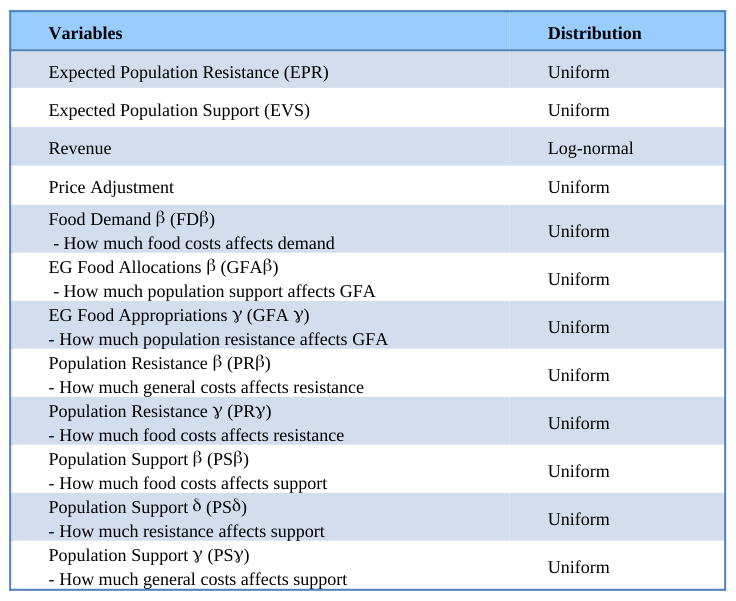
There are 12 cue inputs to the group/population model that were considered uncertain (see Table 1). The expected population resistance and support indicate levels that the EG considers desirable. Revenue is defined by a log- normal distribution. The cost adjustment describes the fraction of the indicated change in price that will actually occur. The remaining uncertain inputs are coefficients on utility functions. These inputs indicate the magnitude of the effect that a particular societal event or trend will have on a decision.
Table 1. Uncertain inputs to the population/group model
These 12 cue inputs were used to assess the degree of population support for the EG over time. Figure 8 shows a 50- run Monte Carlo simulation result of population support within the group/population model. Each line in figure 8 represents a full time series for the output population support for a simulation with random values for each of the 12 uncertain inputs in table 1. While each simulation exhibits a different pattern over time, there is a somewhat robust pattern that is shared between the simulations. At the beginning of each simulation, the EG seeks to gain support from the population by appropriating foodstuff for the allied population under their control. This causes population support to increase. However, the EG has to exact services to compensate for the appropriation, which after a time lag causes an increase in the ‘cost’ of the foodstuff. Thus, after an initial rise, population support for the EG can greatly decline below its initial level. What is important to note is that most situations cause the EG’s support to collapse. There are, however, a small number of outlier situations where the collapse does not occur. A causal reach-back of the analysis indicates under what (few) circumstances this outcome does not occur. Secondary interventions can prevent these circumstances from occurring, or conversely, the verification of such existing circumstances would indicate that an alternative intervention strategy is needed. This process can greatly limit blind- siding and ineffective interventions. Assessing the situations where the EG’s support does not collapse within the population enables us to focus on these specific variables. For example, in the group/population model, extremist group allocations of support, such as foodstuff (GFA[Equation or mathematical symbol available in the original paper PDF]) is the most robust predictor for population support for EG across time. The actual cost (in money, labor, etc.) to the population for the foodstuff (PA) is the second to most robust predictor of support. The third to highest predictor of support over time is the general expected population support (EPS). This is basically the general affinity of the population towards the ideals of the EG (a positive shift towards the EG). The other variables in the model do not significantly contribute to the support of EG over time.
Figure 8. Population support over time (Using Monte Carlo simulation (N=50))
Figure available in the original PDF paper.
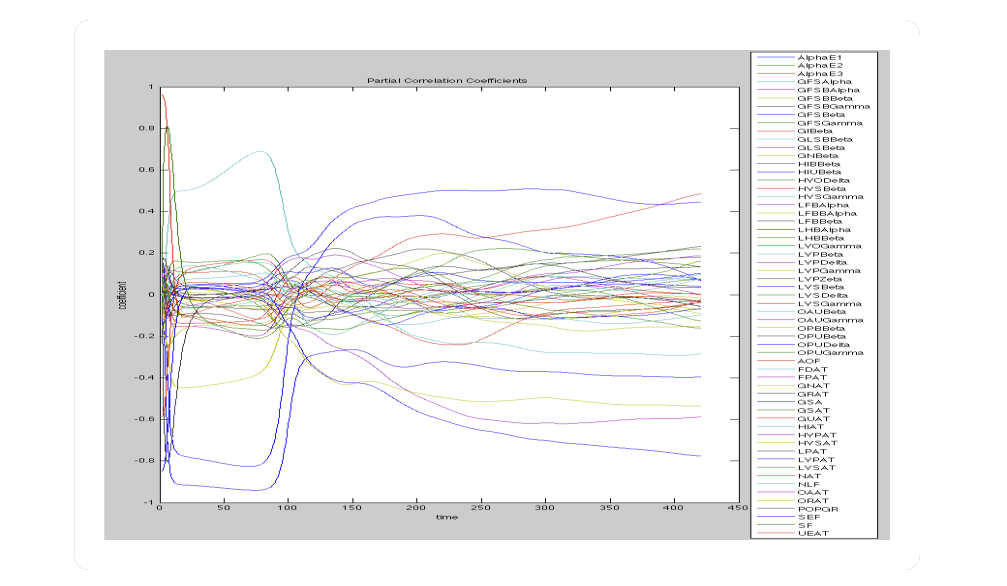
Partial correlation coefficients measure the strength of the linear relationship between each uncertain input and the output of interest, correcting for the linear effects of other inputs. These coefficients can vary from -1 to 1, with a value farther from 0 indicating a stronger relationship. Partial correlation coefficients over time for all of the uncertain inputs (in relation to support from populations that would typically be sympathetic to the EG) are shown in figure 9.
By plotting partial correlation coefficients over time, we can see that the relative strengths of correlations for different inputs change over time. That is, some inputs (e.g., courses of actions) may be very effective in producing certain outputs (e.g., behavior shifts), while other inputs may be ineffective. Very early in the simulation, most of the inputs are highly correlated with the output of interest. After just a few time steps, EG food allocations (GFA[Equation or mathematical symbol available in the original paper PDF]) emerge as very highly correlated input. Toward the end of the simulation, GFA[Equation or mathematical symbol available in the original paper PDF] reduces in influence, and other factors emerge as highly correlated with the output (behavior) of interest. This type of assessment can help determine the effectiveness of specific policies, programs, and actions over time. That is, a policy, program, or action may start off positively, but ultimately lead to negative outcomes. When this is the case, they can be eliminated or modified so that they produce positive outcomes over time.
Figure 9. Partial correlation coefficients over time for all of the uncertain inputs in relation to population support for EG
Group/population model conclusions The group/population model is meant to provide an example of the type of assessments being developed to evaluate the social, political, and economic conditions that both support and reduce the influence of extremist groups over time. This focus on how the availability of foodstuff can potentially affect their support is our initial effort to produce a full BIA model of the dynamic interactions between EG, governmental bodies, international governmental bodies, and other groups. The results of this assessment suggest certain scenarios that can affect a population’s support of an EG over time. As discussed above, EG support for the population through distributing foodstuff can have a significant and lasting positive effect on an indigenous population’s support of an EG.
MODEL CONFIDENCE With this statistical knowledge, we can provide confidence intervals on the results of the model analyses that test interventions. By simultaneously performing uncertainty quantification for model parameters and potential interventions, BIA can determine the portfolio of interventions that have the highest (quantified) probability of success despite uncertainty. It can also quantify the risk associated with the intervention not performing as anticipated. Additionally, BIA can perform sensitivity analyses to determine what minimal additional information is needed to maximally reduce uncertainty and further assure the proposed interventions produce the desired outcome throughout the time horizon of interest. Because the model is causal, decision-makers can reach-back into detailed results of the simulation to independently evaluate the nuanced processes that caused the predicted outcomes. Moreover, the same process can determine early warning fingerprints whose measurement today or during the initial implementation of an intervention can verify or exclude the possibility of critical conditions/outcomes.
Our confidence management process involves on-going, collaborative assessment of BIA model outputs to ensure that the final product will provide useful information for the desired application. This process includes elements that take place during the modeling process, as well as some that are implemented using a completed model. This confidence management process was designed to inform the project team and end users about the level of confidence they should have in the model, as well as identifying potential improvements to the model and process that could strengthen this confidence. Confidence management consists of a suite of techniques in the categories of documentation, verification, validation, uncertainty quantification, and sensitivity analysis.
GENERAL CONCLUSIONS This paper describes an effort to better understand how EG within failing states in Africa understand their reality; why populations choose to support or resist EG; how EG organize themselves socially and politically; and why and how their beliefs shift over time. Our initial models and assessments focused on how the distribution of foodstuff and interactions with governmental bodies, populations, and conditions (e.g., drought) dynamically affect the support of EG over time. First we performed causal loop assessments to determine the interaction effects of foodstuff allocations, governmental bodies, and EG. These assessments are necessary in framing the BIA models for more specific group and country behavioral assessments in response to specific actions or conditions. Then we developed an initial BIA model that addressed EG support across different scenarios. The assessments suggest conditions that are associated with a potential collapse in support for an EG over time. Other conditions may have little to no effect on EG support over time. Further development of BIA will include more detailed modeling and assessments of inter- and intra- governmental body, population, and EG dynamics.
REFERENCES
Ben-Akiva, M. & Lerman, S. R. (1985). Discrete Choice Analysis: Theory and Application to Travel Demand. MIT Press: Cambridge, MA. Backus, G., Bernard, M., Verzi, S., Asmeret, B., Glickman, M. (2010). Foundations to the unified psycho-cognitive engine.
Sandia National Laboratories technical report SAND Report 2010. Bernard, M. L. Backus, G. (2009). Model the interaction between leaders and society during conflict situations. Annual Meeting of the System Dynamics Conference, Albuquerque, NM. Bernard, M. L., Backus, G. A., & Bier, A. B. (2014). Behavioral Influence Assessment (BIA): A multi-scale system to assess
dynamic behaviors within groups and societies across time. In Proceedings of the 5th International Conference on Applied Cross-Cultural Decision Making (2019)
Human Factors and Ergonomics AHFE 2014. Besancon, M., & Dalzell, S. (2013). The soldier and the street: East African CIMIC in Somalia and beyond. Inter-University Seminar on Armed Forces and Society, Chicago, IL Bier, A. B. (2010). Sensitivity Analysis Techniques for models of human behavior. Sandia National Laboratories technical
report SAND Report 2010. Bier, A. B., Bernard, M. L., Backus, G., Glickman, M., & Verzi S. (2011). Using a hybrid cognitive-system dynamics model to anticipate the influence of events and actions on human behaviors. 29th International Conference of the System Dynamics Society, Washington, D.C. Bier, A. B. & Bernard, M. L. (2014). Validating a hybrid cognitive-system dynamics model of team interaction. In
Proceedings of the 5th International Conference on Applied Human Factors and Ergonomics AHFE 2014. Finlay, W. M. L. (2010). The propaganda of extreme hostility: Denunciation and the regulation of the group. British Journal of Social Psychology, 46, 323-341. Hansen, S. J. (2013). Al-Shabaab in Somalia: The history and ideology of a militant Islamist group, 2005-2012. Oxford Press:
New York. Harper, M. (2012). Getting Somalia wrong? Faith, war and hope in a shattered state. Zed Books: London. Martins, A. C. R. (2008). Mobility and social network effects on extremist opinions. Physics and Society, 1-7. McFadden, DL. (1984). Econometric analysis of qualitative response models. Handbook of Econometrics, Volume II. Chapter
24. Elsevier Science Publishers BV. Milton-Edwards, B. (2008). The ascendance of political Islam: Hamas and consolidation in the Gaze Strip. Third World Quarterly, 8, 1585-1599. Pillar, P. R. (2001). Terrorism goes global: Extremist groups extend their reach. Brookings Review, 19, 34-37. Sterman, JD. (1994). Learning in and about complex systems. System Dynamics Review 10(2-3): 291-330. Thaler, D. E., Brown, R. A., Gonzalez, G. C., Mobley, B. W., & Rohan, P. (2013). Improving the U.S. military’s understanding
of unstable environments vulnerable to violent extremist groups. RAND. Arroyo Center. Train, K. (1986). Qualitative Choice Analysis. MIT Press: Cambridge, Massachusetts
ACKNOWLEDGEMENTS
This research was possible in part by funding from the United States Department of Defense. Sandia National Laboratories is a multi-program laboratory managed and operated by Sandia Corporation, a wholly-owned subsidiary of Lockheed Martin Corporation, for the U.S. Department of Energy’s National Nuclear Security Administration under contract DE-AC04-94AL85000. Approved for unlimited release: SAND: 2014-1648C
LISTED IN THE AHFE DIGITAL BOOKSTORE CATALOGUE
Explore the complete digital volume
Advances in Cross-Cultural Decision Making
Read this individual research paper free through the original publisher, or explore the full digital proceedings book.
ISBN 978-1-4951-2095-4
Explore this ISBN in the AHFE Bookstore ↗Listed in the July 2026 bookstore catalogue; search by ISBN to confirm current availability · Digital book purchase optional