Walter Perry (2019). Socio-Cultural Capability Requirements across All Phases of Military Operations. In: Advances in Cross-Cultural Decision Making. AHFE Open Access, vol. 6. https://doi.org/10.54941/ahfe100195
In modern military operations, it is critical that commanders and their staffs be sensitive to the social and cultural norms of populations with whom they must interact. Most military operations have the mission of promoting stability and reconstruction, or eventually evolve to such after major combat. Gaining the cooperation of the local population is critical to a secure environment. This paper identifies the socio-cultural capabilities needed to execute military missions, identifies which of these the military has access to, and proposes mitigating measures to close requirement gaps. We identified 27 missions across all phases of military operations along with 12 socio-cultural capability requirements organized in five categories: planning, communication and coordination, gaining detailed cultural awareness, engaging the population and assessing the impact of this engagement. We identified several gaps but in general, we found that substantial progress has been made in terms of closing these gaps. Personal initiative accounted for a large fraction of these efforts and attests to the growing appreciation among military personnel for the important role of socio-cultural capabilities. Although we provide recommendations to fill specific gaps, finding ways to encourage personal initiatives will nurture the development and testing of original ideas that could be used to address socio-cultural needs more broadly.
In modern warfare it is critical that Commanders and their staffs be sensitive to the social and cultural norms of host nations. Most military operations have the mission of promoting stability and reconstruction, or eventually evolve to such after major combat as in Iraq. Gaining the cooperation and active assistance of the local population is critical to ensuring a secure environment. The Army and Marine Corps doctrine manual on counterinsurgency operations emphasizes the importance of understanding the local culture and social structure (FM 3-24, 2006): …staffs should identify and analyze the culture of the society as a whole and of each major group within the society. Social structure comprises the relationships among groups, institutions, and individuals within a society; in contrast, culture (ideas, norms, rituals, codes of behavior) provides meaning to individuals within the society.
Although this addresses counterinsurgency operations, the Army and Marine Corps recognize that understanding a society’s culture and social structure is necessary in all phases of military operations.
This paper identifies the socio-cultural capabilities needed to execute missions and tasks across the full spectrum of military operations, identifies which of these the military has access to, and proposes mitigating measures to close requirement gaps. The analysis draws on the capability-based assessment (CBA) process. A CBA is designed to identify solutions to provide the warfighter with capabilities needed to accomplish missions. A CBA consists of three parts: the Functional Area Analysis (FAA) resulting in the identification of needed capabilities; the Functional Needs Analysis (FNA) resulting in the identification of gaps in the required capabilities identified in the FAA process; and the Functional Solutions Analysis (FSA) resulting in the identification of means to fill the capabilities gaps.
THE MISSIONS The full spectrum of military operations is described in terms of operational phases. Joint Publication 3-0, Joint Operations, describes the military operations phasing model. This model is designed to organize operations by helping Commanders and their staffs to think through an entire campaign from the early shaping phase through the combat phases to reestablishing civil authority in the host nation. There are six phases identified. Although presented as a sequence, it is clear that there is considerable overlap of the phases of an operation, thus precluding a distinct separation between phases. This reality highlights the need to integrate socio-cultural factors throughout a military operation. (Joint Publication 3-0, 2010)
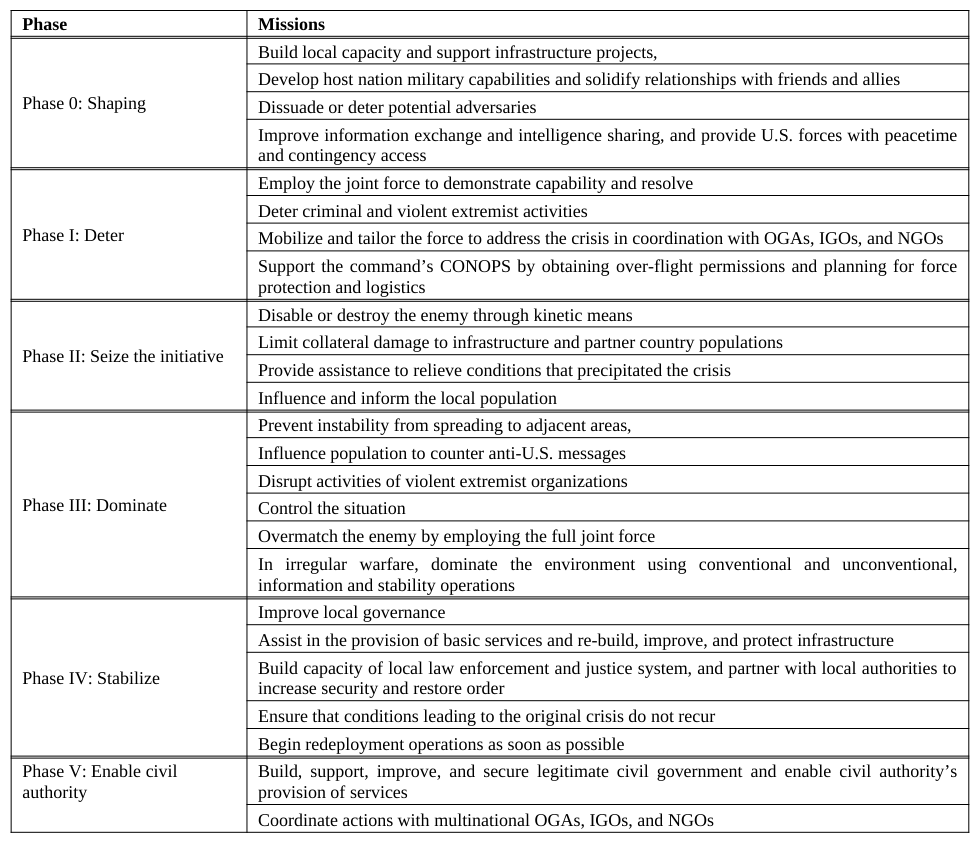
We describe the activities associated with each of the operational phases along with the missions drawn from the sources cited above. For each phase, we summarize the mission set by citing the major objectives associated with the phase. The full list of missions is included in Table 1.
Phase 0: Shaping: This phase consists of benign military operations designed to enhance international legitimacy and gain international support for U.S. Military and national objectives. The focus is on building local capacity, developing host nation military capabilities, and dissuading potential adversaries. The objective is to create a favorable opinion of the United States and to establish or reinforce relations with friendly countries.
Phase I: Deter: In this phase, the objective is to demonstrate resolve by engaging in preparatory actions that clearly demonstrate that a joint force is both capable and committed to deterring enemy activity. Some of the activities in this phase include demonstrating capability, deterring criminals and violent extremists, and gaining support for the command’s operations concept. In general, U.S. forces move pro-actively to prevent a potential attack or crisis.
Phase II: Seize the Initiative: If adversaries cannot be deterred, the U.S. may move quickly to launch combat operations to seize the initiative, regardless of whether it is a hostile nation state or a non-state group posing the threat. In non-combat operations the objective is to apply appropriate joint force capabilities to gain the initiative. Phase II activities can include offensive combat operations designed to destroy an adversary, kill or capture its senior leaders, reduce its freedom of movement, dislodge its forces from their positions, and degrade an enemy’s capability to threaten U.S. or allied interests, or undertake acts of violence.
Phase III: Dominate: This phase focuses on breaking the enemy’s will for organized resistance or, in non-combat situations, control of the operational environment. If the United States succeeds in seizing the initiative from an adversary, it can attempt to dominate the environment and prepare to transition from offensive operations to longer- term stability operations. In Phase III, the United States might conduct continuous operations aimed at suppressing threat networks and isolating threat groups, including violent extremist organizations, operating within a partner country.
Phase IV: Stabilize: This phase applies when there is not a functioning government in the host nation, or only a weakly functioning government in place. This scenario may arise from the collapse of a regime. The phase is characterized by the transition from combat operations to stability operations. In this phase the United States may be compelled to step in and use military forces to provide basic security, re-build critical infrastructure, and ensure that the essential needs of the host country population are met, including medical needs.
Phase V: Enable Civil Authority: In Phase IV, the joint force has assisted the re-establishment of governance by a host country. In Phase V the joint force focuses on providing support to a legitimate, functioning government, one that it may have helped establish. Support to a functioning government is provided in accordance with some agreement. U.S. Military forces will typically work in coordination with other U.S. government agencies, foreign government agencies, and NGOs and IGOs.
We identified 27 missions across the full spectrum of military operations (Table 1). These missions were culled from several Joint Staff, Major Command and Service documents. They are, in essence, summaries of more theater- specific missions and tasks. We reviewed Joint Publication 3-0, which describes activities that Commanders might anticipate in various phases of a theater campaign. We consulted the planning guidance and tasks assigned to combatant Commanders in the Joint Strategic Capabilities Plan (Joint Strategic Capabilities Plan, 2008). We reviewed Joint Warfighting Center materials to identify tasks organized by type of operation developed for mission analysis and published in the Universal Joint Task List, a Chairman of the Joint Chiefs of Staff manual (CJCSM 3500.04C, 2002). Finally, we took future missions into consideration by reviewing scenario data published for each of the selected combatant commands in the Multi-Service Force Deployment documents promulgated by the Joint Staff.
Table 1: Military Missions by Phase
THE SOCIO-CULTURAL CAPABILITIES Across the globe, in commands, theaters, and campaigns, there is an increasing recognition that socio-cultural knowledge and expertise is critical for the success of military missions. The U.S. Military and its allies are increasingly dealing with internal conflicts within states, responding to complex humanitarian emergencies, and other situations far outside the scope of “traditional” state-to-state warfare (TRADOC OE White Paper, 2009). In these new operational environments, the enemy is often not a clearly discernible group, and may change rapidly from day to day. Such environments call for new capabilities that can assess and make productive use of operationally relevant information regarding the social and cultural landscape of the area of operations. As recent campaigns have shown, this is no small feat. Human terrain is inherently local and by its nature rapidly evolving. Our next task then was to develop a list of socio-cultural capabilities necessary to meet this challenge.
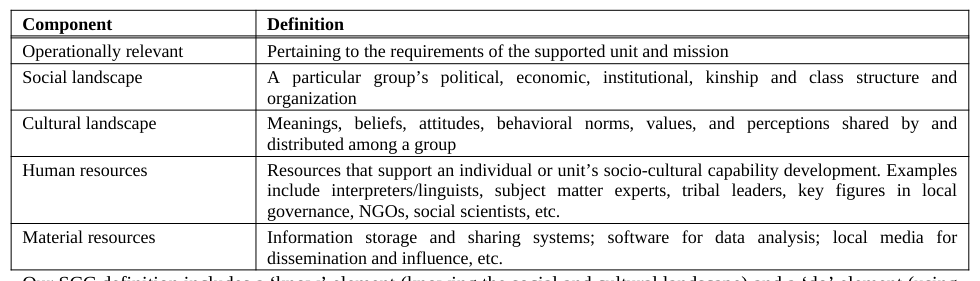
The first step in developing a list of required socio-cultural capabilities (SCCs) required our developing a working definition of the term itself. We assembled a team of military experts (most of them former U.S. Military officers) and social science experts with applied research backgrounds in Anthropology, Psychology, Political Science, and Public Health. The research team conducted a literature search for descriptions of how socio-cultural knowledge and research had been used to inform military operations, as well as calls for improvements in the use of socio-cultural knowledge for future military operations. This involved consulting doctrine, military documents such as reports from Human Terrain Teams, academic journals and books, and the existing RAND literature on the topic. In addition, we vetted the definition of SCCs with military and non-military experts during one-on-one and group interviews we conducted over the course of the study. This process produced the following definition: A socio-cultural capability is the ability to employ human and material resources to gather, synthesize, analyze, interpret and share operationally relevant information about a population’s social and cultural landscape, and use this to inform and assist the planning, preparation, execution and assessment of a military operation
We further defined the bolded elements of the above definition. Table 2 summarizes these additional definitions.
Table 2: Socio-Cultural Component Definitions
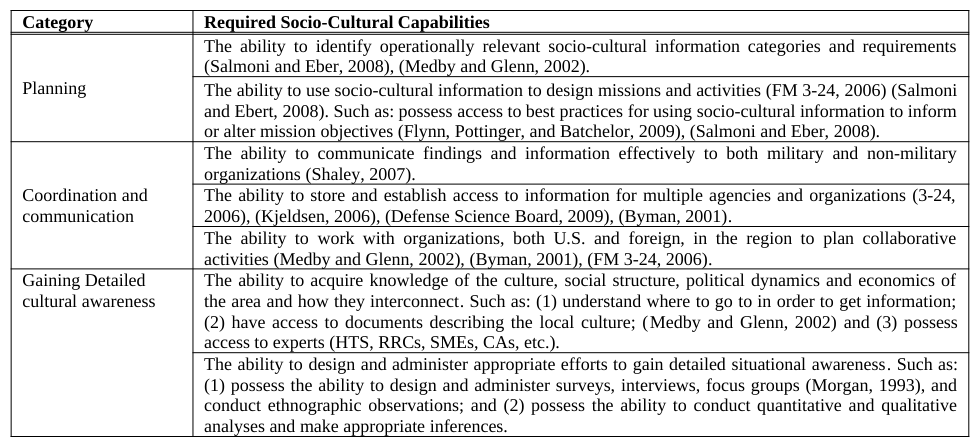
Based on interviews with approximately 30 military and non-military experts and an extensive literature review we reduced a rather long list of socio-cultural capabilities to a manageable set of 12 which we divided into five categories. The categories were organized to approximate a chronological progression of how socio-cultural capabilities might be used throughout the planning and execution of military missions. They consist of planning, communication and coordination, gaining detailed cultural awareness, engaging the population and assessing the impact of this engagement. We describe the categories below and Table 3 lists the associated required socio-cultural capabilities.
Planning: For the purposes of mission planning, the Commander must have the ability to discover the features of the human terrain that are most operationally relevant—in other words, to know what needs to be known. Furthermore, he must have the ability to make use of socio-cultural information to inform mission objectives. This requires the ability to identify relevant socio-cultural information and use it to plan operations.
Coordination and Communication: One critical socio-cultural capability is the capacity to communicate information and coordinate productively with other parties operating in the area of interest (AOI). This requires the ability to communicate findings and information to both military and non-military organizations and to work well with organizations in the region to plan collaborative activities.
Gaining Detailed Cultural Awareness: The most important and arguably most difficult required capability is the capacity to obtain valid and reliable operationally relevant information regarding the social and cultural landscape of an AOI. Some of the requirements in this category include the ability to acquire knowledge of the culture, social structure, political dynamics and economics of the area and how they interconnect, design and administer efforts aimed at obtaining this information, and verify the accuracy and reliability of the information.
Engaging the Population: Increasingly, through the use of provincial reconstruction teams, female engagement teams, and the like, the U.S. Military is recognizing the need for and difficulty of engaging in sensitive interactions with the local population in a culturally appropriate manner. This requires an ability to communicate with the local population, build trust, and productively interact with them. A number of initiatives attempting to address these challenges have been undertaken. “Smart cards” with basic phrases in the local language and information about the culture have been issued to deploying personnel (Davis, 2010).
Impact Assessment: After socio-cultural capabilities have been employed in the pursuit of mission success, it is important to assess the impact of these efforts in order to inform future mission planning. This requires an ability to obtain reliable information on post-engagement conditions and the ability to understand the implications of local changes for successive engagements. For example, effectiveness of language training courses is routinely assessed. Within the Army, “language tests are mandatory for soldiers who have received foreign language training at government expense,” excluding survival-level courses (Army Regulation 11-6, 2009). However, annual retesting of speaking skills is not currently required for all language-dependent military occupational skills. The Defense Language Transformation Roadmap sets proficiency level goals for language professionals (Defense Language Transformation Roadmap, 2005).
Table 3: Socio-Cultural Capabilities by Category
SOCIO-CULTURAL CAPABILITIES BY OPERATIONAL PHASE With the missions and the required socio-cultural capabilities identified, the next step was to identify which socio- cultural capabilities were needed to accomplish the missions across all phases of military operations. We proposed to develop a matrix with the 27 missions as rows and the 12 socio-cultural capabilities as columns. The result was to be a matrix with 314 cells containing the manner in which the column socio-cultural capability can assist in accomplishing the row mission. Figure 1 illustrates the matrix structure. We refer to the cell entries as “intersections.”
Socio-Cultural Capability
The intersection
The Role of the SCC in
Military Mission
accomplishing the Military Mission
Figure 1. Intersections of SCCs by Mission Activities
Figure available in the original PDF paper.
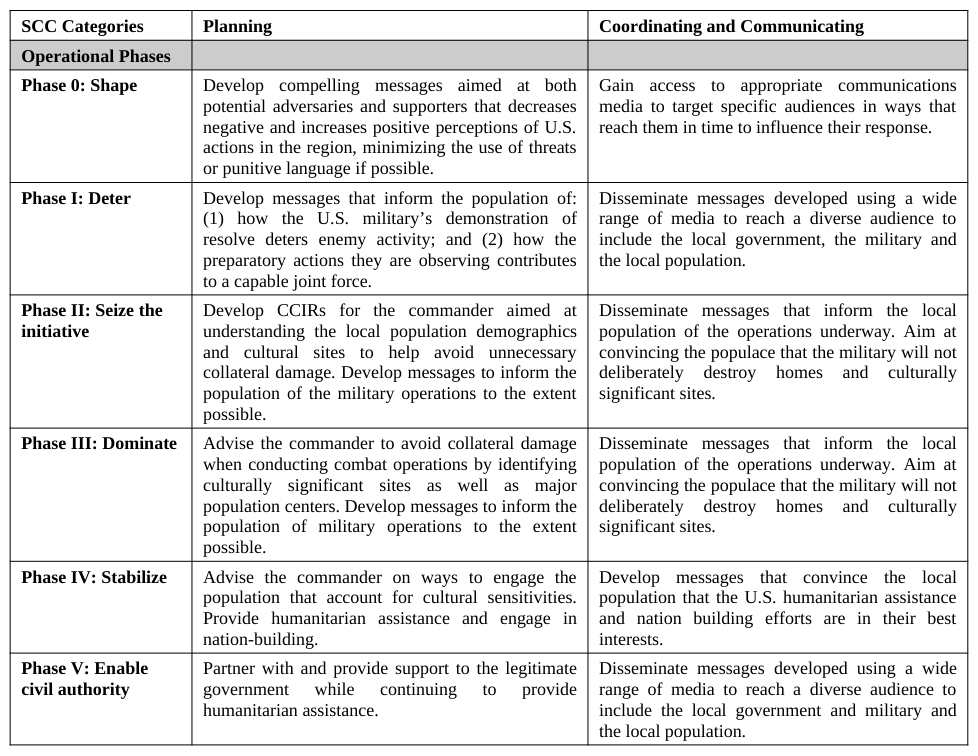
While useful for validation purposes and to produce a large base of “raw data” for further work, this level of resolution was found to be excessively specific and therefore not likely to be useful for military planners or other operatives across the diversity of conditions found in different COCOMs and operations. Thus, once we created the set of mission activities and socio-cultural capabilities described above, we created a diminished matrix consisting of the six phases as rows and the five categories as columns. This resulted in a more manageable matrix consisting of 30 cells. The socio-cultural capability categories and phases intersect at a more general level. Table 4 illustrates the process by depicting two of the five category columns and all six of the operational phases.
Table 4: Sample Intersections of Phases by SCCs SCC Categories Planning Coordinating and Communicating
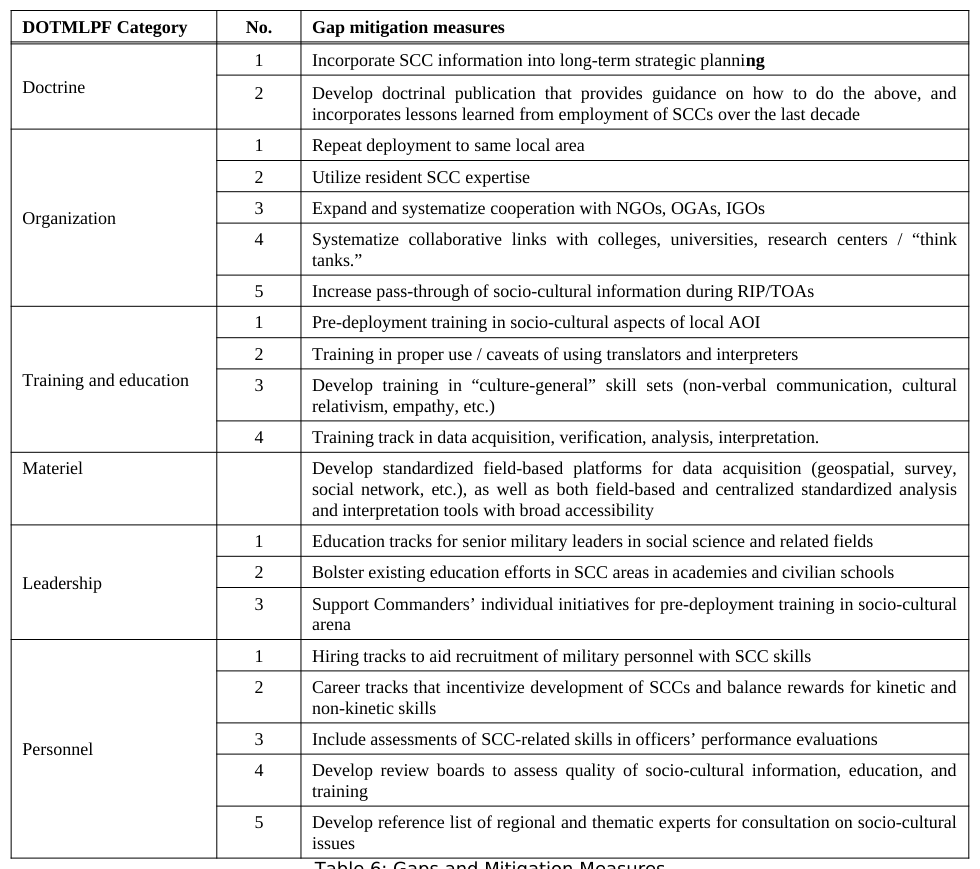
GAPS AND MITIGATION MEASURES Our research consisted of reviewing the pertinent socio-cultural literature and military documents in addition to conducting several interviews of military and non-military personnel. In the process, we identified several gaps in the provision of SCCs, organized along our five major categories. We noted that not all gaps constituted a complete lack of capability. Some were due to limited access to required capabilities or limited knowledge that such capabilities existed. In addition, competing priorities resulted in precluding access. The following is a summary of our major findings and recommendations. Table 6 lists all the gaps we uncovered in this research along with the measures we recommended to mitigate the gaps arranged by Doctrine, Organization, Training and education,
Materiel, Leadership, Personnel, and Facilities (DOTMLPF). We have omitted Facilities from the list as it had not been mentioned in any of our interviews. The numbers at the head of each column refers to the coded gap mitigation measure listed by DOTMLPF category in Table 5.
Table 5: Gap Mitigation Measures DOTMLPF Category No. Gap mitigation measuresTable 6: Gaps and Mitigation Measures
Table available in the original PDF paper.
CONCLUSIONS
In Planning, we identified challenges in finding the appropriate personnel to use socio-cultural knowledge in the service of strategic planning. Our research also indicated that the continuing use of “one size fits all” directives or plans based on hunches rather than data was a problem in the use of SCCs in planning missions and activities. In Coordination and Communication, we identified several gaps related to SCCs, many related to cross-cultural interactions between military and non-military organizations as well as difficulties coordinating among different military entities. Negative perceptions of the U.S. Military by international government organizations (IGOs) and non-governmental organizations (NGOs) present a significant challenge to prospects for supplementing SCCs through collaborative effort with other organizations operating in the area of interest.
In Gaining Detailed Cultural Awareness, we found there to be a gap in the ability to access up-to-date, verified information about specific areas of interest, as well as a lack of systematic approaches and systems for obtaining, analyzing, storing, and sharing socio-cultural information. Similarly, we discovered a lack of sufficient access to military and non-military personnel with the methodological and area expertise to cover the wide range of areas of interest covered by the military. With respect to Engaging the Population, our research identified the need for increased training in languages and/or the use of interpreters and translators, as well as a better capacity to build productive relationships with local populations, engage local leaders, and resolve conflicts in culturally appropriate ways. We identified significant gaps in Impact Assessments, most notably the fact that impact assessment for the provision of SCCs is not systematically incorporated in standard operating procedures. Additionally, military socio- cultural education and training has not been systematically assessed.
Our research team used the DOTMLPF framework to provide recommendations to mitigate these gaps (Table 6). We recommend a doctrinal or doctrine-like publication that focuses on lessons learned in the provision of SCCs during the past decade, as well as the use of SCCs in long-range strategic planning. With respect to Organization, we recommend organizing repeated deployments to the same local areas as well as improving processes during Relief in Place/Transfer of Authority operations to transfer socio-cultural knowledge and ensure the proper hand-off of relationships with key leaders. As well as building greater socio-cultural capacities within the armed forces, we recommend expanding and systematizing relationships with NGOs and IGOs, as well as universities and think tanks that provide access to SCCs.
With respect to Training, we recommend expanding the provision of socio-cultural knowledge specific to the precise area pre-deployment (rather than regional or national training), expanding training in the use of interpreters and translators, and also expanding training in “culture general” skill sets, including empathy, suspension of judgment, and the ability to adapt to new cultural environments. For the category of Materiel, we recommend establishing systems for the standardized acquisition, analysis, and interpretation/validation of both existing sources of information and new streams of data from units deployed and collecting data in the field. As a model, we point to the SERENGETI system developed at AFRICOM. SERENGETI is an Africa-centric data repository that is populated with open source data according to a specific architecture and taxonomy. It was developed in AFRICOM’s knowledge development division (Lee, undated). We make several recommendations pertaining to Personnel. First, we suggest instituting specialized hiring efforts and promotional tracks to both attract personnel with socio-cultural skill sets and to reward the expansion of these skills during service members’ careers. We also recommend making SCC-related parameters a systematic part of officers’ performance evaluations and implementing efforts to monitor and assess socio-cultural training and education.
On the whole, we found that substantial progress has been made in terms of building socio-cultural capabilities, and that when gaps emerged there were at least limited attempts to address unmet needs. Personal initiative accounted for a large percentage of these ad-hoc efforts and attests to the growing appreciation among military personnel for the important role of socio-cultural capabilities in achieving mission goals. Although we provide recommendations for how to fill specific gaps, finding ways to encourage and support personal initiatives will not only help meet SC needs as they arise in specific locales, but will nurture the development and testing of original ideas that could be used to address SC needs more broadly. Issues that on the surface appeared unrelated to socio-cultural issues were often the main impediments to building greater SC knowledge and skill sets: a position’s promotion potential, the length and repetition of deployments to an area, the commissioning of assessments, and the quality of the rotation process. Resolving these over-arching issues would likely produce marked improvements over multiple SCC categories and as such, might be cost-effective areas for focusing future SCC reform efforts.
REFERENCES
Abbe, Alison, Lisa M. Gulick, and Jeffrey L. Herman, Cross-Cultural Competence in Army Leaders: A Conceptual and Empirical Foundation, ARI Study Report No. 2008-01. Arlington, Va.: U.S. Army Research Institute for the Behavioral and Social Sciences, 2008.
Abbe, Allison, and Stanley M. Halpin, “The Cultural Imperative for Professional Military Education and Leader Development,” Parameters, Vol. 39, No. 4, Winter 2009-2010, pp. 20-31.
Black, J.S. and L. W. Porter, “Managerial Behaviors and Job Performance: A Successful Manager in Los Angeles May Not Succeed in Hong Kong,” Journal of International Business Studies, Vol. 22, 1991, pp. 99-113.
Brett, J.M., and S. Okumura, “Inter- and Intracultural Negotiation: U.S. and Japanese Negotiators,” Academy of Management Journal, Vol. 41, 1998, pp. 495-510.
Byman, Daniel, “Uncertain Partners: NGOs and the Military,” Survival, Vol. 43, No. 2, Summer 2001, pp. 87-114.
Chief of Naval Operations, Language Skills, Regional Expertise and Cultural Awareness Strategy, Washington, D.C.: U.S.
Navy, January 2008.
Department of Defense, The Defense Language Transformation Roadmap, January 2005.
Flynn, Michael T., Matt Potting, and Paul D. Batchelor, Fixing Intel: A Blueprint for Making Intelligence Relevant in Afghanistan, Washington, D.C.: Center for a New American Security, 2009.
Gelfand, M.J., and N. Dyer, “A Cultural Perspective on Negotiation: Progress, Pitfalls, and Prospects,” Applied Psychology: An International Review, Vol. 49, 2000, pp. 62-100.
Gelfand, M.J., M. Erez, and Z. Aycan, “Cross-Cultural Organizational Behavior,” Annual Review of Psychology, Vol. 58, 2007, pp. 479-514.
Headquarters, Department of the Army, Counterinsurgency, FM 3-24 / MCWP 3-33.5, Washington, D.C., December 2006.
Headquarters, Department of the Army, Army Foreign Language Program, Army Regulation (AR) 11-6, Washington, D.C., 31 August 2009.
Headquarters, Department of the Army, Training and Doctrine Command (TRADOC), Operational Environment 2009-2025, Ft.
Monroe, Va., TRADOC OE White Paper V-6, August 2009.
Jager, S.M., “On The Uses of Cultural Knowledge,” Strategic Studies Institute of the U.S. Army War College: Monograph,
2007.
Jandora, J., “Military Cultural Awareness: From Anthropology to Application,” Landpower Essay No. 06-3, The Institute of Land Warfare, November 2006.
Joint Chiefs of Staff, Joint Strategic Capabilities Plan, Washington, D.C.: Department of Defense, 2008.
Joint Chiefs of Staff, Joint Operations, Joint Publication 3-0, Department of Defense, Washington, D.C.: March, 2010.
Joint Chiefs of Staff, Universal Joint Task List, CJCSM 3500.04C, Washington, D.C.: Department of Defense, 2002.
Kjeldsen, Stig, Training Impact Assessment of the United Nations Civil-Military Coordination (UN-CMCoord) Course, Geneva, Switzerland: United Nations Office for the Coordination of Humanitarian Affairs, 2006.
Lee, Bari A., IKD Knowledge Development Division, SERENGETI, U.S. Africa Command, “US Africa Command: Delivering Cultural Competence,” Briefing, Stuttgart, Germany, Not Dated.
LeGree, Larry, The Battle for the Minds: IO and COIN in the Pashtun Belt, Military Review, September–October 2010, pp. 21-
31.
Medby, Jamison Jo and Russell W. Glenn, Street Smart: Intelligence Preparation of the Battlefield for Urban Operations, MR- 1287-A, Santa Monica, Calif.: RAND Corporation, 2002. As of February 25, 2011: http://www.rand.org/pubs/monograph_reports/MR1287.html.
Morgan, David L., ed., Successful Focus Groups: Advancing the State of the Art, Thousand Oaks, California: Sage Pubilcations, 1993.
Morris, M.W., K. Y. Williams, K. Leung, R. Larrick, M. T. Mendoza, D. Bhatnagar, J. Li, M. Kondo, J. Luo, and J. Hu, “Conflict Management Style: Accounting for Cross-National Differences,” Journal of International Business Studies, Vol. 29, 1998, pp. 729-747.
Office of the Under Secretary of Defense for Acquisition, Technology and Logistics, Report of the Defense Science Board Task Force on Understanding Human Dynamics, Arlington, VA, 2009.
Ohbuchi, K., and Y. Takahashi, “Cultural Styles of Conflict Management in Japanese and Americans: Passivity, Covertness, and Effectiveness of Strategies,” Journal of Applied Social Psychology, Vol. 24, 1994, pp. 1345-1366.
Rochelle Davis, “Culture as a Weapon System,” Middle East Report, 225, Summer 2010, http://www.merip.org/mer/mer255/davis.html.
Salmoni, Barak A. and Paul Holmes-Eber, Operational Culture for the Warfighter: Principles and Applications, Quantico: Marine Corps University Press, 2008.
Shaley, Orit, “Constructing Multi-Dimensional Perspective of Multiculturalism in Armed Forces,” in Cees M. Coops & Tibor Szvircsev Tresch, eds., NATO Defense College: Cultural Challenges in Military Operations, Rome, Italy: NATO Defense College, 2007, pp. 130-140.
Sheer, V.C., and L. Chen, “Successful Sino-Western Business Negotiation: Participant’s Accounts of National and Professional Cultures,” Journal of Business Communication, Vol. 40, 2003, pp. 50-85.
Stenmark, T., Looking for Gold Nuggets in the Melting Pot: Language, Cultural Awareness, and the Fourth Generation Warrior, Maxwell Air Force Base, AL: Air Command and Staff College, April 2006.
Sullivan, J., R. B. Peterson, N. Kameda, and J. Shimada, “The Relationship Between Conflict Resolution Approaches and Trust —A Cross Cultural Study,” The Academy of Management Journal, Vol. 24, 1981, pp. 803-815.
Tyler, T.R., E. A. Lind, and Y. J. Huo, “Cultural Values and Authority Relations: The Psychology of Conflict Resolution Across Cultures,” Psychology, Public Policy, and Law, Vol. 6, 2000, pp. 1138-1163.
LISTED IN THE AHFE DIGITAL BOOKSTORE CATALOGUE
Explore the complete digital volume
Advances in Cross-Cultural Decision Making
Read this individual research paper free through the original publisher, or explore the full digital proceedings book.
ISBN 978-1-4951-2095-4
Explore this ISBN in the AHFE Bookstore ↗Listed in the July 2026 bookstore catalogue; search by ISBN to confirm current availability · Digital book purchase optional