We compare several conceptual metaphors for POVERTY – location, enemy, disease, plant, burden - as they appear in English, Russian and Spanish using two different corpora. We additionally explore the English poverty is a location metaphor in detail, looking at the relative importance of its different dimensions and at the picture of poverty is a location that these dimensions suggest. These analyses provide a prototype for future cross language analyses of metaphor to provide cultural insight.
Metaphors describe or explain one concept (the target) using words or phrases that are also closely associated with some other thing or idea (the source concept). In the metaphorical sentence “Syrian refugees in Lebanon [are] drowning in poverty” (TopNewsToday, 2013) “poverty” is the target and “drowning in” is a phrase clearly associated with a body of water. This metaphor thus likens what is happening to these people in poverty to what might happen to them in a body of water. To paraphrase the sentence and make the comparison explicit, it means something akin to: ‘poverty like a body of water is overwhelming, smothering, incapacitating and possibly killing Syrian refugees in Lebanon’.
Typically, as metaphors are often explained, the target concept is an abstraction, and the source concept is something concrete and familiar. The language and ideas associated with the source supply terms that indicate to the reader salient properties of the target, frequently carrying with them a sensory and emotional component. Thus many, but not all, metaphors depend on sources from the material world, either natural or man-made. However, it also happens that abstractions, even though targets of metaphors in one context, can serve as source concepts for other metaphors. So while poverty is the target in the sentence cited above, it is the source in the passage “The other poverty is the poverty of ideas. Let us ask each of our leaders and politicians for just one relatively new and interesting idea to solve a pressing problem. Just one.” (Schwartz, 2014).
Cross-Cultural Decision Making (2019)
Edited by T. Ahram, W. Karwowski and T. Marek
In our work we call the metaphorical words or phrases (‘drowning in’ and ‘poverty of’ in the two cited sentences) the relation, because these words relate, or link, the target to the source concept. A specific instance of a metaphor, “drowning in poverty”, is called a linguistic metaphor. A conceptual metaphor is defined by a number of related linguistic metaphors with the same target and source concepts (Lakoff & Johnson, 2003; Deignan, 2005). The presence of a conceptual metaphor indicates that the people using its various inter-related descriptive phrases regularly discuss one idea in terms of the properties of the other. For example, the concept of poverty (hereafter POVERTY, when meant as a concept) is frequently likened to the concept of place or location. Many phrases suggesting POVERTY is like a LOCATION are common in English: “live in poverty”, “climb out of poverty”, “road to poverty”. In standard metaphor terminology, we say the conceptual metaphor comparing poverty and location, in English, is POVERTY IS A LOCATION.
The existence of the POVERTY IS A LOCATION conceptual metaphor in a culture in no way implies that POVERTY is always conceived of as a LOCATION. There are many conceptual metaphors used with POVERTY and they appear to vary with language. We address several – POVERTY IS A DISEASE, POVERTY IS AN ENEMY, POVERTY IS A PLANT, and POVERTY IS A BURDEN. However, when POVERTY is described as a LOCATION, and a LOCATION with a number of inter-related properties then certain aspects of POVERTY are emphasized.
Dimensions of the Source Concept Not all metaphors employing the same source domain highlight the same features of it. Two common POVERTY IS A LOCATION phrases, “fallen into poverty” and “trapped in poverty”, refer to different aspects, or dimensions, of a protagonist’s possible relationship to a LOCATION – that a person can enter it, and that a person can remain there. These different dimensions carry very different import. The linguistic metaphors associated with them evoke different kinds of reality, imply different mental imagery, and suggest different affective judgments.
One way of dealing with this variety of source dimensions is to consider each a different conceptual metaphor, with obvious relationships analyzed as hierarchical relationships among them, or other combinations of conceptual metaphors operating in concert (Barcelona, 2001). Our team’s general approach is ‘bottom up’ or corpus-driven (Deignan, 2005). We believe the jury is still out on what level of aggregation or abstraction is useful for naming and defining a conceptual metaphor source (Ritchie, 2003, Krennmayr, 2013). At the same time, we need a method of organizing related linguistic metaphors that can capture the similarity of their semantics. We call the aspects or features of a source dimensions. The dimensions of the source LOCATION are: (i) getting into, (ii) getting out of, (iii) existing in, and (iv) properties of. We begin to develop this concept to be able to compare metaphors at a corpus scale on the basis of meaning. We employ the dimensions for POVERTY IS A LOCATION to support one of the comparative studies described below.
THE PRESENT STUDY In this study, we compare several POVERTY conceptual metaphors – LOCATION, ENEMY, DISEASE, PLANT, BURDEN - as they appear in English, Russian and Spanish. We additionally explore the English POVERTY IS A LOCATION metaphor in detail, looking at the relative importance of its different dimensions and at the picture of POVERTY IS A LOCATION that these dimensions suggest. This analysis of dimensions suggests a prototype for future cross language analyses of metaphor to provide cultural insight.
The genesis of the project was to compare the importance of a metaphorical source across cultures on the basis of corpus evidence. The work is ongoing so we now only provide a preliminary report. Since conceptual metaphors tell us something about the way that people think, and they have both shared and differing behavior in different cultures (Deignan, 2003), source domains is one obvious point of comparison. If one culture group relies heavily on certain sources for discussing POVERTY, it could tell us something interesting about how poverty is viewed and dealt with in that culture (Thibodeau & Boroditsky, 2011). The broader importance of certain metaphor sources across many domains could also imply more general insights into a culture. Do US Americans, for example, rely as heavily on conflict and competitive metaphors as it sometimes seems they do? Is this a characteristic of the culture? Is it present in some cultures and not others, and so forth. But to answer such questions we need to have a way of defining and measuring importance.
Cross-Cultural Decision Making (2019)
Edited by T. Ahram, W. Karwowski and T. Marek
The validity of our corpus-based comparison across cultures rests on the resolution of two core problems: how to quantify importance and how to make appropriate comparisons using our available corpora. Our Analyses section rests on our solutions to these problems. However, we make our working assumptions explicit here as they determine the potential theoretical impact of our findings.
Importance We now rely on two quantitative measures of importance, frequency of use and elaboration. Frequency of use is the number of times a metaphor appears in a corpus. For example, we compare the number of POVERTY IS A LOCATION metaphors in an English corpus, expressed as a percentage of all the POVERTY metaphors in that corpus, to the number of POVERTY IS A LOCATION metaphors in a Russian corpus, also as a percentage of all the Russian poverty metaphors.
Our second measure of importance is elaboration or variation of expression across a dimension of the conceptual metaphor. It is a measure of semantic richness not unlike a word’s contextual diversity (Adelman, Brown, & Quesada, 2006) or number of senses or features (Pexman et al., 2008; Yap et al., 2012). Our justification for elaboration is that the number of ways or varieties of expressions that a language uses to express fundamentally the same idea reflects the centrality of this metaphor to that culture. At a minimum, the degree of variation in how a core metaphorical idea is expressed reflects a breadth of language users, registers, genres, document and spoken language contexts for the metaphor.
The dimensions of the source domain help us categorize linguistic metaphors into groups with similar meanings. At this point we have only operationalized the elaboration measure for the English POVERTY IS A LOCATION conceptual metaphor and use it to compare the importance of the different dimensions of this metaphor in English. However, the method is theoretically possible to extend to other comparisons of source importance.
To be clear, frequency and elaboration are only two of the possible measures of metaphor importance. As developed here they are preliminary, as they are limited to the one strongest relation and would fail to detect the importance in a situation of several weaker but associated relations. Other possible measures of metaphor importance, for example, include (a) composite measures of sensory vividness and emotional arousal, (b) usage patterns over extended time periods, (c) association of particular metaphors with foundational religious, literary, and intellectual texts. These latter measures are more complex to develop than frequency and elaboration, and their full development awaits a later phase of this work.
Comparability We employed two rather different corpora in our comparisons, to see how sensitive our conclusions were to the nature of the corpus on which they were based. The characteristics of each corpus required the use of rather different methods for searching for metaphors to calculate frequencies. Later phases of this work will endeavor to compare and coordinate the results from different corpora more closely.
Our team’s metaphor database (Shaikh et al., 2014) is based on a four-language corpus (English, Russian, Spanish and Farsi) drawn from Internet sources, heavily weighted toward a variety of newspapers, online news sources and blogs, primarily from 2008 to the present. The database consists of linguistic and conceptual metaphors automatically discovered for a limited number of target domains focused on government and social issues, of which POVERTY is one (Strzalkowski et al., 2013, Broadwell et al., 2013). For the work reported in this paper, the POVERTY linguistic metaphors were checked for accuracy and manually assigned to conceptual metaphors by senior linguists. The process for discovery and proposal of the linguistic metaphors, however, was entirely automatic. An identical method of linguistic metaphor identification is employed across all four languages, but our systems for all four languages are not yet of equal maturity. Searches and frequency counts in this database are easy to perform and take into account a wide range of lexical and syntactic variants in each language.
The second corpus we used is the Google books corpus, readily searchable in the Ngram Viewer (Michel et al., 2010). We searched Google books from 2005 to 2008, using the American English, Russian and Spanish corpora. The data for these corpora are the most recent available (version 20120701). Google books collection is larger than Cross-Cultural Decision Making (2019)
Edited by T. Ahram, W. Karwowski and T. Marek
our collection and contains a wider range of genre and subject matter. The books also employ a more formal language than the shorter Internet news texts and blogs of our team developed corpus. Neither corpus incorporates extensive examples of every day speech, but both represent language understood by a broad audience, although our own corpus includes fewer examples of specialized language (such as from the academy or professions) than does Google books.
To use the ngram index we searched for frequencies of known metaphorical phrases. We know from the results of our own automated metaphor discovery, as well as from the work of other researchers (Cameron & Deignan, 2006), that many linguistic metaphors employ fixed lexical sequences. We used such fixed expressions to obtain counts of known linguistic metaphors. Many of the fixed expressions -- for example, “mired in poverty” -- employ relations that correspond to those metaphorical relations stored in our team database. Therefore, we used the POVERTY metaphors discovered in the team developed database as a guide for linguists to develop the lists of English, Russian, and Spanish phrases to be searched in the Google books index.
Relations: Strong Versus Weak Links to the Metaphorical Source Crucially, the fixed expressions (for ngram searching) must be reliably indicative of the source domains we wish to compare. Thus, we introduced a distinction between relations that are tightly linked to the source concept and relations that are only compatible but not exclusively linked with a particular source concept. For example, the sentence “Syrian refugees in Lebanon [are] drowning in poverty” already cited tightly links poverty to a body of water, likely of some depth. However, the sentence “They were rescued from poverty and given a job” (Watts, 2012) could be considered only compatible with the notion of drowning. It indicates poverty as a danger, but implies no single source of danger. In our comparison of sources “rescue from” could easily apply to four of the five source domains we examined (LOCATION, DISEASE, ENEMY, and BURDEN, but not PLANT).
We intend our frequency counts to indicate the relative importance of the sources (Figure 2), therefore we used only phrases where the relations were strongly tied to the specified source domains. Finally our measures within and across languages and cultures capture relative proportion. The metaphoricity of the fixed phrases as well as their utility for cross language comparison was concluded from their presence in our database. The strength of their ties to the source domains was judged by members of the linguistic team.
RESULTS
We have performed three comparative studies to throw light on the utility of our approach as well as to discover differences and similarities between POVERTY metaphors using the sources LOCATION, DISEASE, ENEMY, PLANT and BURDEN among three languages. The first uses the database we are developing. The second makes a similar comparison based on Googlebooks ngram searches. The third addresses the elaboration measure. We focus on English and Russian for the first comparison, on English, Russian and Spanish for the second, and on English POVERTY IS A LOCATION metaphors for the third analysis.
1. Frequency of POVERTY Metaphor Source Domains: English and Russian
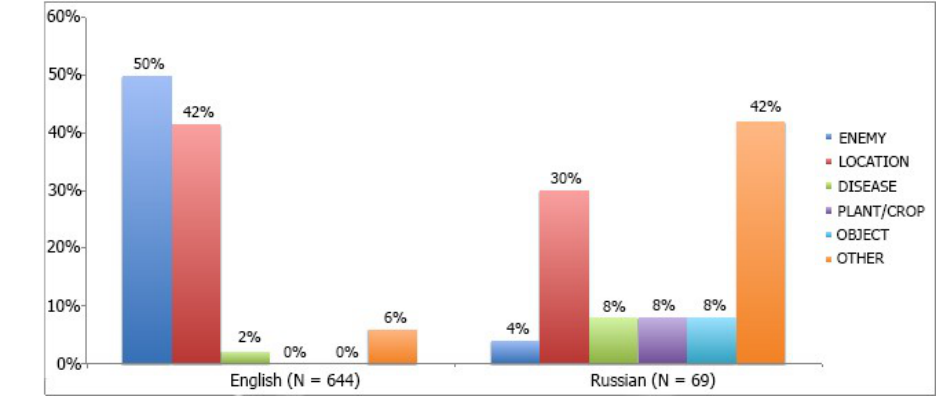
Using frequency as a measure of importance, we compare the frequency of POVERTY metaphors in our team metaphor database in several domains for English and Russian. The results are shown in Figure 1. For this comparison we count the number of instances of POVERTY metaphors associated with each of five sources – DISEASE, LOCATION, ENEMY, PLANT, and BURDEN. These five cover the most frequent sources for English and Russian in our database. BURDEN is also included as we use it in the second comparison below. In the database, the metaphors were automatically discovered in text, manually reviewed for accuracy and manually assigned to source domains. We consider POVERTY a state of being, and POVERTY IS A LOCATION to belong to the metaphor A STATE OF BEING IS A LOCATION (Lakoff, Espenson, & Schwartz, 1994) and thus to include relations indicating many types of locations such as high and low places, bodies of water, confined spaces.
Cross-Cultural Decision Making (2019)
Edited by T. Ahram, W. Karwowski and T. Marek
Figure 1: Initial comparison of source frequencies for poverty metaphors
We caution that the English and Russian results are incomplete and reflect the status of a database continuing under development. However, we present them to indicate the potential utility of such a comparison as a method based on metaphor suggesting insights into culture. Additionally, we used the more common relations and associated sources in our database as a basis for developing the ngram searches used in our second comparison.
2. Frequency of Poverty Metaphor Sources Based on Ngram Searches: English, Russian, Spanish
Relying again on frequency as a measure of importance, we compare the frequency of POVERTY metaphors in English, Spanish and Russian using source domains of DISEASE, LOCATION, ENEMY, PLANT AND BURDEN. The frequencies were obtained from ngram searches of Google books. For expediency one relation was selected to stand for the source in each language. These relations were selected based on two criteria: strong and unambiguous links to a single source and high frequency levels for that relation within the conceptual metaphor (target + source). Generally this resulted also in their being frequent relations for that conceptual metaphor in the team database. These relations were selected independently for each language.1 While this use of a single relation to represent each source may not be ideal, searches in English suggest that one relation will tend to overwhelm others in frequency for any particular conceptual metaphor. For example, almost 60% of all occurrences of the 59 identified POVERTY IS A LOCATION relations, used in our third comparison study, were variants of “live in poverty”. For purposes of estimating importance such a comparison can thus be indicative.
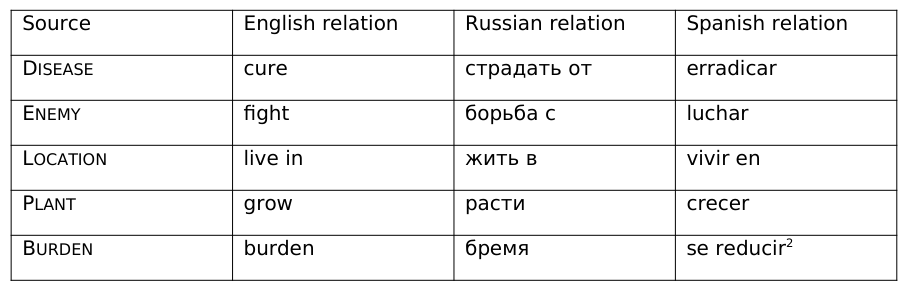
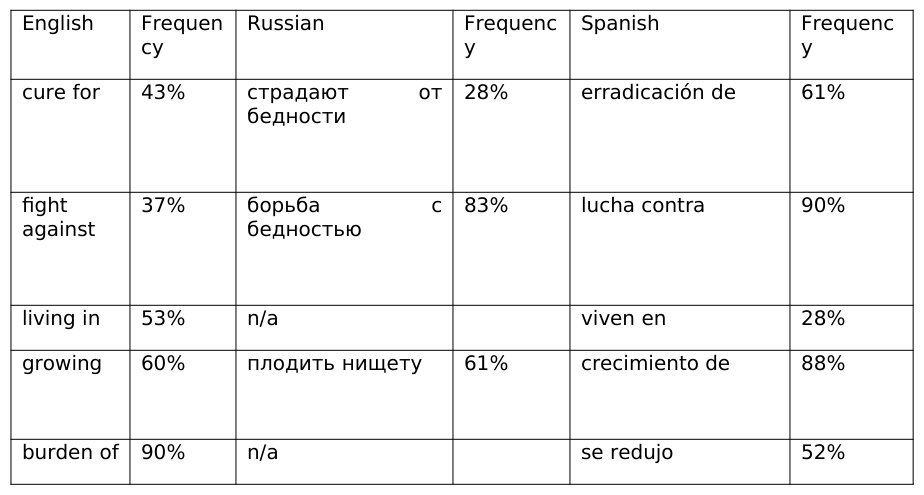
Each relation can occur in multiple syntactic forms, such as “curing poverty” and “cure for poverty”. The relative frequencies of these forms vary. A linguist enumerated the possible forms for each relation for each language, disregarding their likelihood as to actual occurrence. We then searched for every form and summed the results. Table 1 shows the relations used in each language for each source. Note that we determined the relation separately for each language and did not translate. For example, страдать от means suffer from, not cure. The syntactic forms that provided the most frequent results are shown in Table 2.
1 A separate attempt, intended for comparison, to use translated terms based on high frequency English relations yielded few or no ngram search results from the other languages. Cross-Cultural Decision Making (2019)
Edited by T. Ahram, W. Karwowski and T. Marek
Table 1. Key relations for the five source domainsTable 2. Top most productive syntactic form by relation.
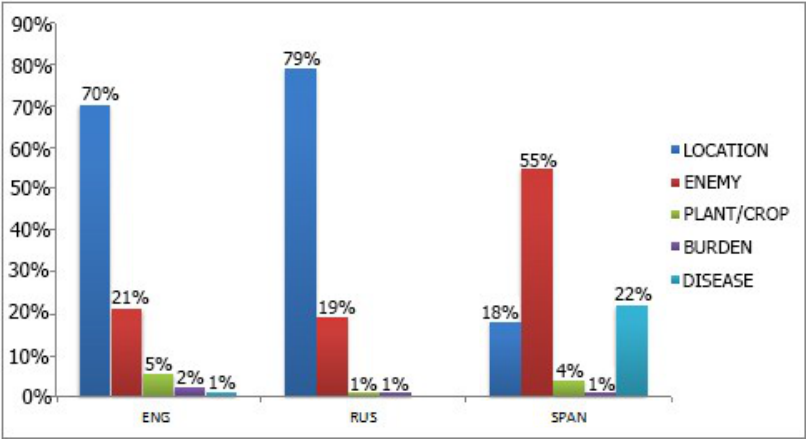
The search of Ngram strings in English, Russian and Spanish results in about 73000 hits in English, 5400 in Russian and 49000 in Spanish. Figure 2 depicts the distribution of source domains for POVERTY, expressed as a percent of total hits in each language. In English and in Russian, the most common source domain associated with poverty is LOCATION with percentages at 70% and 79% respectively. The second most common is ENEMY with percentages at about 20%. These two constitute more than 90% of all POVERTY metaphors that we detected in English and in Russian. The distribution looks very different in Spanish, where relations of ENEMY are most prevalent and constitute 55% of all metaphors that we detected. Spanish also differs from the other two with respect to the proportion of DISEASE metaphors- 22% in Spanish and fewer than 1% in English.
2 This relation requires additional testing in Spanish for the ambiguity of its relation to BURDEN. Cross-Cultural Decision Making (2019)
Edited by T. Ahram, W. Karwowski and T. Marek
Figure 2: Comparison of frequency of POVERTY metaphor sources based on Google books Ngram searches 3a. Elaboration as Possible Measure of Importance: Comparing the Importance of Dimensions in American English POVERTY IS A LOCATION
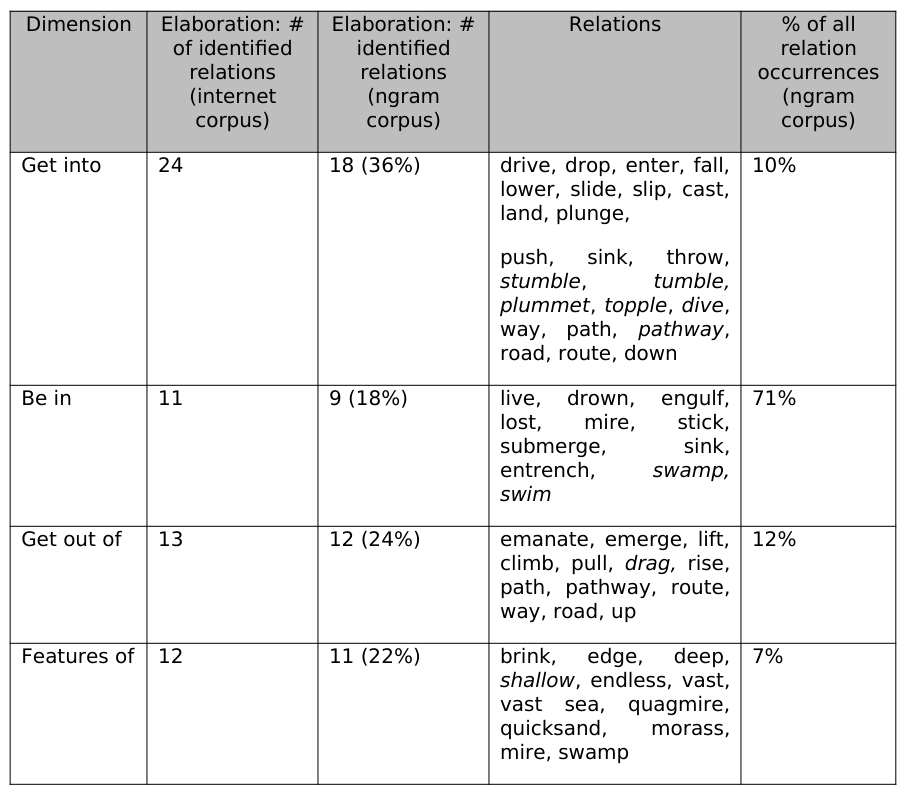
An extensive search of English POVERTY IS A LOCATION metaphors in Google books (2004-2008) enabled us to compare the importance of the different dimensions of POVERTY IS A LOCATION in contemporary American English. We then compare the elaboration measure to the frequency measure of importance. We exhaustively catalogued the list of POVERTY IS A LOCATION relations for English, emphasizing those associated with the three dimensions Get into, Get out of and Be in. As these are focused on verbs, most employing prepositions indicating location, they constitute a more tractable list to prepare than relations for Features of, which can include a wide variety of descriptive relations.
Table 3 shows the relations searched for in the ngram corpus and their association with each dimension. All were extensively tested by the linguist, using manual review of returns from the Google internet index, to determine that 1) they were used metaphorically with poverty in an estimated 90% or more of cases and for 2) close association with the LOCATION source. Some apparently obvious phrases, for example “place of poverty”, were not used because they frequently occur in literal as well as some metaphorical contexts. Certain of the relations have a significantly different meaning depending upon their syntactic form, such as “sink into poverty” (implying the process of sinking) and “sunk in poverty” (implying the process is complete and now the condition of being pertains) and thus may be associated with different dimensions. All relations were tested for natural occurrence using the Google internet corpus (see column 4). However, some relations occurring in that corpus did not appear in the ngram books corpus (those in italics in column 4).
Cross-Cultural Decision Making (2019)
Edited by T. Ahram, W. Karwowski and T. Marek
Table 3. Percent of relation occurrences for each POVERTY IS A LOCATION dimension, based on ngram corpus
This initial comparison of the importance of each dimension based on elaboration and on frequency does not suggest a close correlation between these two possible measures. Even restricting the analysis to the first three dimensions as potentially being more reliably enumerated than the fourth suggest that importance based on frequency and importance based on elaboration are distinct properties of metaphors.
3b. What kind of place is poverty?
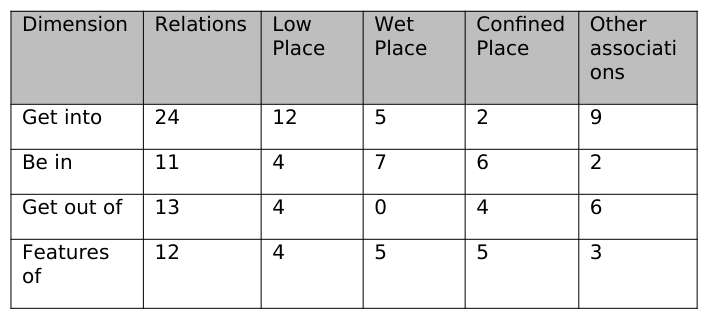
States of being are treated as LOCATIONS. However, different states of being can be viewed as different kinds of locations. The semantics of the relations, categorized within each dimension, tell us what kind of location poverty is. We have the following in English, based on possible expressions developed and tested for each POVERTY IS A LOCATION dimension. Each expression was examined and categorized depending upon whether its meaning suggested a low place, a wet place or a confined place, or none of these qualities. For example, “fall into” means going downwards, and thus implies a low place. A “mire” is a swampy place, and so “mired in”, frequently used with “mud” in its literal use, implies a wet place, as well as confinement, since it means one cannot get away.
Table 4 shows that fully two thirds of the relations identified for talking about POVERTY IS A LOCATION in English Cross-Cultural Decision Making (2019)
Edited by T. Ahram, W. Karwowski and T. Marek
are associated with at least one characteristic of lowness, wetness or confinement. Fourteen, or roughly 25% of these terms are associated with at least 2 of these characteristics. The remaining terms are mostly neutral to the type of location poverty is, being expressions such as “live in”, “route to” or “pathway from”.
Table 4: Relations for POVERTY IS A LOCATION metaphors in English Dimension Relations Low Place
CONCLUSIONS
The analyses we have performed suggest that both frequency and elaboration can be employed to explore the importance of a metaphor or of metaphor dimensions within and across languages. However, the relationship between these two measures requires further exploration because they appear to reflect different properties of metaphors. Employing the Google ngram corpus provides a significant extension of our capability to investigate metaphorical usage within and across languages. We were somewhat surprised by the differences across our database and the Google ngram corpus and will continue to compare corpora as our database expands. The difference between relative frequencies of various metaphorical phrases and expressions in the Google Books and the Internet database suggests that more detailed comparisons are warranted.
ACKNOWLEDGEMENT
This work was supported by the Intelligence Advanced Research Projects Activity (IARPA) via Department of Defense US Army Research Laboratory contract number W911NF-12-C-0024. The U.S. Government is authorized to reproduce and distribute reprints for Governmental purposes notwithstanding any copyright annotation thereon. Disclaimer: The views and conclusions contained herein are those of the authors and should not be interpreted as necessarily representing the official policies or endorsements, either expressed or implied, of IARPA, DoD/ARL, or the U.S. Government.
REFERENCES
Adelman, J. S., Brown, G. D. A., and Quesada, J. F. (2006). Contextual diversity, not word frequency, determines word-naming and lexical decision times. Psychological Science, 17, 814-823. Barcelona, A. (2001). On the systematic contrastive analysis of conceptual metaphors: case studies and proposed methodology.
In M. Pütz, Niemeier, S., Dirven, René (Eds.), Applied Cognitive Linguistics II: Language Pedagogy, 117-146. Cross-Cultural Decision Making (2019)
Edited by T. Ahram, W. Karwowski and T. Marek
D., Clancy, D., Norvig, P., Orwant, J., Pinker, S., Nowak, M. A., & Aiden, E. L. (2011) Quantitative analysis of culture using millions of digitized books. Science, 331, 176-182. Pexman, P. M., Hargreaves, I. S., Siakaluk, P. D., Bodner, G. E.,& Pope, J.(2008).There are many ways to be rich: effects of three measures of semantic richness on visual word recognition. Psychonomic Bulletin, & Review, 15, 161–167. Ritchie, D. (2003). “ARGUMENT IS WAR” – Or is it a game of chess? Multiple meanings in the analysis of implicit metaphors.
Metaphor and Symbol, 18, 125-146. Schwartz, B. (2014). The other poverty: The poverty of ideas. Retrieved from http://bobmschwartz.com/2014/01/07/the-otherpoverty-the-poverty-of-ideas/. Shaikh, S., Strzalkowski, T., Liu, T., Broadwell, G. A., Yamrom, B., Taylor, S., Feldman, L., Cho, K., Boz, U., Cases, I.,
Peshkova, Y., & and Lin, C-S. (2014). A Multi-cultural repository of automatically discovered linguistic and conceptual metaphors. The 9th Edition of the Language Resources and Evaluation Conference. Strzalkowski, T., Broadwell, G. A., Taylor, S., Feldman, L., Yamrom, B., Shaikh, S., Liu, T., Cho, K., Boz, U., Cases, I., & Elliott, K. (2013). Robust extraction of metaphors from novel data. Proceedings of the First Workshop on Metaphor in Natural Language Processing. (pp. 67-76). Meta4NLP, The 1st Workshop on Metaphor in NLP. Atlanta, GA. Thibodeau, P. H., Boroditsky, L. (2011). Metaphors we think with: The role of metaphor in reasoning. PLoS ONE, 6, 1-11. TopNewsToday (2013). Syria refugees in Lebanon drowning in poverty, says Oxfam. Retrieved from
http://world.topnewstoday.org/world/article/8742619/. Watts, J. (2012). Violence in the vineyard. Retrieved from http://nampaumc.org/sunday-april-1-2012/. Yap, M. J., Pexman, P. M.,Wellsby, M., Hargreaves, I. S., & Huff, M. J.(2012). An abundance of riches: cross-task comparisons of semantic richness effects in visual word recognition. Frontiers in Human Neuroscience, 6, 1-10.
Cross-Cultural Decision Making (2019)
LISTED IN THE AHFE DIGITAL BOOKSTORE CATALOGUE
Explore the complete digital volume
Advances in Cross-Cultural Decision Making
Read this individual research paper free through the original publisher, or explore the full digital proceedings book.
ISBN 978-1-4951-2095-4
Explore this ISBN in the AHFE Bookstore ↗Listed in the July 2026 bookstore catalogue; search by ISBN to confirm current availability · Digital book purchase optional