Michael L. Bernard, George A. Backus, Asmeret B. Bier (2019). Behavioral Influence Assessment (BIA): A Multi-Scale System to Assess Dynamic Behaviors Within Groups and Societies Across Time. In: Advances in Cross-Cultural Decision Making. AHFE Open Access, vol. 6. https://doi.org/10.54941/ahfe100198
Sandia National Laboratories, in cooperation with the United States European Command’s (EUCOM) Strategic Foresight (SF) branch, has developed an initial capability to better understand and anticipate likely responses to events by groups within countries under EUCOM’s area of responsibility. The Behavioral Influence Assessment (BIA) system is a theory-based analytical capability that is intended to enable analysts to better assess the influence of events on groups interacting within a country or region. These events can include changes in policy, man-made or natural disasters, war, or other changes in environmental and economic conditions. To help achieve this, BIA models the dynamic social/political/economic actions and counter-actions between groups in response to events over time. This paper outlines the rationale and general results produced by this effort. This includes a discussion of: 1) underlying psychological, social, and economic theories that are synthesized within its structure; 2) inclusion of data and expert opinion into the modeling structure; 3) methods used to computationally instantiate theories, data and opinion; 4) types of assessments that are generated; and 5) implications of these assessments in comparison to current events.
A common problem associated with the effort to better understand dynamic behaviors of different groups within various countries is the shear difficulty in gathering appropriate subject matter expertise across relevant domains of interest. Even with a sizable collection of subject matter experts (SME), one’s cognitive ability to fully comprehend the dynamic nature of populations, particularly over time and considering feedback effects, can be limited. That is, humans’ ability to contemplate higher-dimension interaction effects within and between groups is more easily restricted to a small number of behaviors and counter-behaviors across time. In addition, the contribution of behavioral, social, and economic theories regarding how groups and countries, as a whole, make decisions is often not fully considered. Yet, an understanding of dynamic human behaviors is typically considered important when assessing country behaviors and, thus, should be addressed. A common question is how can this be accomplished in a more systematic manner? Recently, the phenomena underlying the societal dynamics that drives stability and instability in countries has become understandable enough to pose testable hypotheses amenable to simulation (Acemoglu & Robinson, 2009). Ultimately, we believe this can produce the ability to better hypothesize and assess impacts associated with various policies and actions.
The main focus of this work is to present an approach taken by Sandia National Laboratories to assess the dynamics and key psychosocial and economic processes underlying how people make decisions and express behaviors over time. Included in these simulations are behaviors that affect the decision making of others, creating complex feedback loops within and between individuals and groups. Each simulated behavior is a function of individual psychosocial characteristics (described below) along with environmental and group dynamic factors. The goal of this work is to minimize the likelihood of decisions that lead to undesirable consequences by providing a more systematic analysis of group perceptions, beliefs, intentions, and behaviors. Its focus is on likely dynamic repercussions of actions, not on point predictions.
The basis for this computational framework, known as the Behavioral Influence Assessment (BIA) tool, is a synthesis of data-supported psychosocial theories of human behavior (Bernard & Backus, 2009; Bier et al., 2011). The legitimacy of this synthesis is supported by an independent assessment of theory-based analytical studies of historical socioeconomic data. In other words, we have integrated the set of elements from psychosocial theory that are consistent with economic theory, experimental data, and historical data pertaining to human behavior. The result is a unified framework that connects the multiple scales of human behavior (from individual to societal interactions) to the external (geopolitical, physical, and socioeconomic) world. The simulation framework is thus a model of human behavior determined by local perceptions of world conditions, contained in a feedback process that links behaviors, conditions, and events and shows how they unfold over time. Our analysis emphasizes these response and counter-response progressions, whose recognition can prevent counter-productive behaviors.
BIA uses a hybrid cognitive-system dynamics computational approach that integrates psychological, social, socioeconomic, and system dynamics theory relevant to a region. This includes characterization of people within a society, interactions between governmental and nongovernmental groups, and external variables such as global changes in the geopolitical and economic climate. This is designed to capture outcome distributions used to investigate attitudinal and behavioral reactions to policies and actions within countries. The theories used are limited to ones that can be: 1) integrated into a representation of behavior; 2) translated into a set of computational equations; and 3) instantiated, tested, and verified using accessible data. The structure is populated using psychosocial, economic, and geopolitical information from subject matter expert guidance, reports, opinion polls, social media, and economic data. While the information that populates the BIA structure is specific to particular countries, its structure is general enough to be applied to any geographical region.
Computationally, the BIA structure consists of a modeling framework, model simulators, and an analysis engine. The current structure allows for various cross-modeling domains (i.e., different countries and groups), information sharing, and visualization. For example, Figure 1 shows a simplified conceptual representation of a hypothetical BIA structure that involves the modeling of two interacting groups and several leaders. Exogenous inputs to the model (e.g., global economic factors and general population-support) influence the dynamic interactions within and between the entities. Each simulated behavior is a function of psychological characteristics along with environmental and group dynamic factors. This enables the assessment of group behavior as it reacts to the perceptions of others and world conditions.
Figure 1. Conceptual diagram of the full systems view of BIA
RESEARCH DESIGN AND METHODOLOGY The underlying psychosocial theories
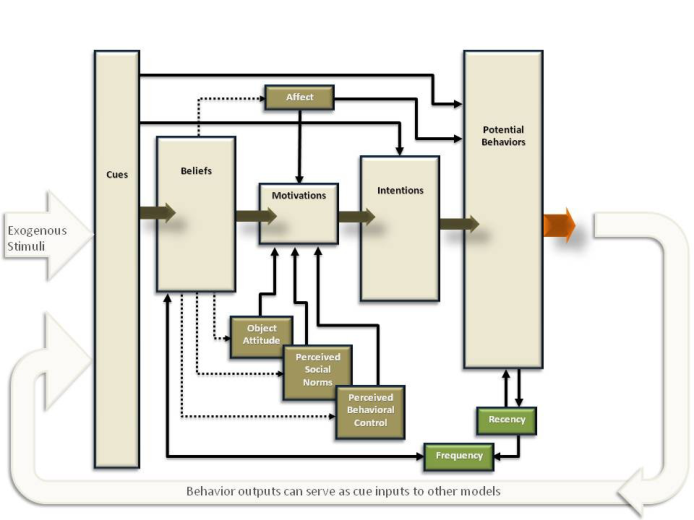
In order to make sense of and predict our environments, humans attempt to find patterns in stimuli. If relevant, the stimuli can be perceived as cues that can stimulate particular beliefs. However, because of differences in culture and experiences among individuals, the same stimuli may be interpreted differently and stimulate different beliefs. Beliefs may stimulate other cognitive processes such as emotional reactions (which we more broadly characterize as positive and negative affect), attitudes, expectations associated with perceived social norms, and perceived behavioral control over potential behaviors associated with that belief or series of beliefs. These things may help stimulate a motivation to perform some specific type of behavior. If the motivation is high enough, it can stimulate an intention or set of intentions to perform some type of behavior. The intention to perform a specific behavior is typically a function of what is actionable. Thus, upon assessing the environment, intentions that are not attainable will lose strength while intentions that are attainable will gain strength. Moreover, the valance associated with affect (low to high positive, low to high negative) will mediate the selection of behavior (Bernard & Smith, 2006). The actual behavior that is realized is a function of the intent, associated affect, and the perceived environment indicating that behavior is indeed actionable. Additional factors that affect the likelihood of a behavior being realized include how often and how recently that behavior has been previously acted upon. That is, previous behaviors are a good predictor of future behaviors (Ouellette & Wood, 1998). This process is exemplified in the conceptual diagram of the BIA psychosocial (decision) model, shown in Figure 2.
Formation of beliefs In the BIA decision model, a belief is considered to be an estimate of some attribute or state in an environment that may affect an existing attitude or give rise to a new one. When a belief rises to full consciousness it will be compared to a belief “template” that is stored in long-term memory. These templates store semantic perceptions of self and environment as beliefs and serve to categorize/classify and structure one’s belief of one’s world. In this sense, semantic memory is made up of categories (class of objects that belong together) and concepts (mental representations of a category) for later retrieval.
Figure 2. Conceptual diagram of the psychosocial (decision) model
To make a decision about category membership within a belief, an item is compared against some stored cue representation of the category (Markman, 1999). If the cue similarity is strong enough, then it is concluded that the item is part of that belief category. If the differences are great enough between belief categories, then new categories can be spawned to reflect this diversity. Each cue membership and its associated belief category are specific to an individual or group. That is, one individual may have a different set of potential beliefs than another individual. Moreover, similar beliefs may contain different cue memberships, with different percentages of cue evidence associated with each belief. Groups that share similar cultures and/or religious backgrounds may have a common set of general beliefs and related set of cue memberships that may different from other, less similar, groups. It stands to reason that the further apart one group is from another, the less similar the cue memberships and beliefs will be.
In our simulations, the instantiation of this concept involves the representation of environmental cues and relevant knowledge in a manner that accommodates pattern recognition. Patterns of cues may be associated with a known or potential situation or state. If the activation of cues indicates a match between an on-going situation and a cognitive representation associated with a particular belief, a belief is generated that might ultimately direct behavior. In this simulation, each cue provides some degree of evidence (a continuum from 0 to 1) associated with one or more beliefs. Conceptually, the system represents the fundamental processes associated with both individual and group/ organizational (aggregate) decision-making. The notion that cues, in many circumstances, can trigger a belief without the need for extensive deliberation has been proposed by Klein and colleagues (1993) in their model of recognition-primed decision making (RPD). With respect to attitudes, beliefs are thought to be associations or linkages that people establish between attributes of attitude objects (Fishbein & Ajzen, 1975). An attitude can be thought of as a general and relatively enduring evaluative response to an attitude object, where an attitude object can be a person, a group, an issue or a concept (Visser & Clark, 2003). This evaluative response generally has some degree of favor or disfavor, approach or avoidance, or attraction or aversion toward that object (Ajzen, 1991; 2005). This is expressed in differences in affective valence or direction in that they can be “bifurcated into positive and negative evaluations” (Eagly & Chaiken, 1993, p. 4). A configuration of attitudes can form an ideology, which are attitudes clustered around some societal theme, such as communism verses capitalism (Converse, 1964).
Modeling behaviors A general theoretical model supporting the notion that attitudes and intent play a large role in predicting behavior is the theory of planned behavior (TPB). The TPB postulates a process in which behaviors are influenced by (a) current attitudes towards a specific behavior, the (b) subjective norms associated with acting out that behavior, and (c) the perception that carrying out this behavior is within the person’s control. The combination of these factors forms a behavioral “intention” state, which then can serve to drive that person’s actual behavior (Ajzen, 1991; 2005; Madden, Ellen, & Ajzen, 1992). It is asserted in the TPB that an individual’s intentions capture the factors that influence some type of behavior, which is indicative of one’s effort to perform that behavior. While the TPB is most certainly one of the most used and cited behavioral models within social psychology (Cooke & Sherran, 2004), it has been critiqued for being too restrictive in scope (e.g., Perugini & Bagozzi, 2001). Its parsimony is typically considered one of its strengths, enabling it to be robust across a wide variety of behaviors and cultures. However, this can come at a cost of reduced predictive power. In principle, the model can, and was intended to be, open to additional predictor variables, such as emotion (Ajzen, 2005). Indeed, researchers including Ajzen have developed extensions to the TPB so as to increase its predictive strength for various types of behaviors (for example, see Beck & Ajzen, 1991).
An extension to the TPB in both depth and breadth was developed by Perugini and Bagozzi (2001). Their conceptual model, termed the model of goal-directed behavior (MGB), is intended to explain a larger percentage of variance associated with behavior than the TPB. The MGB asserts predictor variables of attitude, positive and negative affect, subjective norms, and perceived behavioral control, which drive desires. Desires, in turn, drive intentions, which drive behaviors. Frequency of past behavior mediates desires, intentions, and behaviors. In the MGB, Perugini and Bagozzi chose the more specific term “desire” instead of motivation. BIA uses the more hierarchically expansive term, “motivation” to represent a broader range of drives. As with the TPB, perceived behavioral control also mediates behavior. In addition, recency of past behavior serves to mediate current behaviors. Perugini and Bagozzi argue that individuals take into account both their attitudes and affect regarding potential achievement or failure with respect to a sought after goal. That is, an attitude is an “evaluative response towards an object or act that, once learned, is triggered automatically” (p. 82). The processes underlying affect, on the other hand, are “more dynamic and entail self-regulation in response to feedback” (p. 82). As discussed above, adding these predictor variables should, in many circumstances, explain a higher percentage of the variance associated with behavior. In addition, including frequency and recency of behavior as predictor variables, the MGB further broadens the TPB, providing greater predictability. Indeed, in comparing the MGB to the TPB across two common behaviors revealed that the MGB does explain a larger percentage of accounted variance (approximately 25%) than the TPB (Perugini & Bagozzi, 2001).
Processes underlying economic behaviors In parallel with the described psychosocial theories, a set of behavioral economic theories—also extensively evaluated with experimental and historical data—have been incorporated into the general BIA framework. The theories perfectly mesh with the discussed psychosocial theories. This is not surprising, since economics can be described simply as people making choices. In fact, there is abundant time-series data on economic decisions across culture, which overlaps with psychosocial views of those same decisions.
The physical and economic behavioral implications are readily simulated using basic aspects of conventional simulation methods such as system dynamics, engineering, and economics. Societal and economic behaviors can be thought of as a consequence of behavioral decisions and, thus, decisions can be thought of as the process of making choices. Accordingly, all behaviors are the consequence of choices that are made. This notion is outlined by McFadden (1984), who pioneered the use of (psychologically framed) qualitative choice theory (QCT). QCT quantitatively determines the importance people place on information, tastes, beliefs, and preferences when making decisions. The robust parameterization of QCT is often based on data readily obtainable in the field. Other techniques can further determine the correct functional representation of the QCT utility formulation for the problem at hand (Keeney & Raiffa, 1976). A key part of the decision process is the filtering of information and the extent to which experience biases the decision process. At a group level, the probabilistic nature leads to a mean-value response because random variation in one direction by a single individual is balanced by the reverse variation of another individual. The enduring aspects of the population (society) dominate the group behaviors. The identification of the transient and stable components of the decision process use co-integration (also Granger Causality) methods pioneered by Granger (1969). These same methods also ascertain the filtering and delayed- response processes associated with information perception and behavior. These methods and others are summarized in Backus and Glass (2006). These techniques can integrate disparate perspectives and information, qualitative as well as quantitative, into analysis and decision support systems. The methods are compatible with orthodox macroeconomic assumptions and used for all matter of choices (including those associated with security). The actions taken to repeat or approximate an individual’s reference perceptions are known as purposive actions. Purposive actions exist in a complex and constantly changing environment (e.g., ecological forces, such as temperature and human forces, such as social structure). For this reason, humans maintain multiple reference perceptions for various aspects of their lives and continually compare these reference perceptions to perceptual cues from the environment. (For instance, the way we want something to taste is a reference perception and the amount of salt we add is a purposive action to alter the taste to match our reference perception.) Any purposive action that is taken will be compared to the respective environmental cues and to the individual’s reference perception of that event. Purposive actions continue as long as there are undesirable discrepancies between the reference perception and the environment. The psychosocial model described is embedded within a system dynamics model to make (economic) decisions for the individuals and groups of individuals that the model simulates in the form of “cognitive entities.” Each of these entities has a separate cognitive model. For example, there may be a cognitive model of a type of individual (leader), a group supporting that leader, and a group opposing that leader. In this case there would be three cognitive entities that will be assessed.
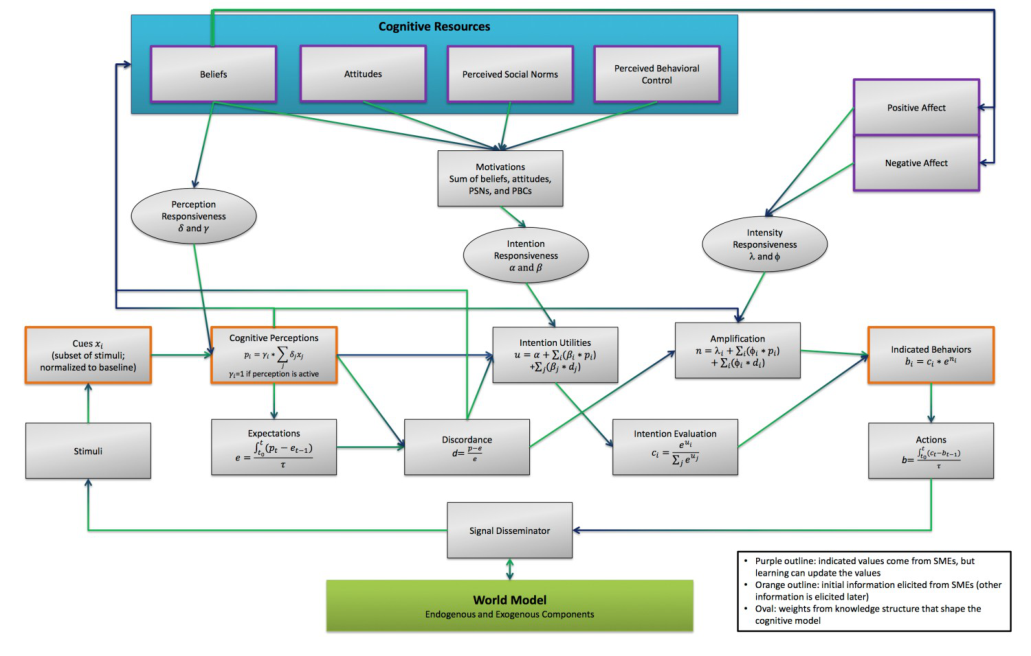
Computational foundations of the BIA framework Within BIA, modeled entities structure and process information in the manner illustrated in Figure 2, which is mathematically represented in Figure 3. Figure 3 shows an example mapping between the conceptual, psychosocial model structures (left) and the mathematical implementation of that model structure (right). (A larger visualization of the mathematical representation is shown in Figure 4). Here, stimuli are the physical realization of world conditions and human actions. When an individual places these stimuli in context, they become cues that inform or effect behaviors. As discussed above, the grouping of cues forms a pattern. (For example, the observation of asphalt, cars, sidewalks, and buildings act as cues, giving you the belief that you are on a city street). Beliefs typically take on importance when they are incongruous with or different from expectations. Expectations are often the memory of the status quo or the anticipation of future conditions. Cognitive resources are employed to produce a learned attitude toward a condition (the condition being a perceived notion or incongruity) or our learned ability to respond to a condition. Our cognitive resources and beliefs of a situation (via notions and incongruities) act together to help us evaluate the choices we have to respond to those conditions. The result represents our intentions. The execution of those intentions further depends on the level of the incongruity and our attitudes toward that behavior. Once a behavior is initiated, it takes time before it becomes an action affecting the external world (including other individuals). Depending on the proximity or our social network, the realized consequence of our actions becomes the cues to some individuals but not to others. The feedback logic of one entity’s behavior becoming another entity’s cues, possibly through the intermediation of external physical processes, explicitly captures the social network considerations that are often seen in more abstract, agent-based modeling.
Figure 3. Conceptual diagram of the psychosocial model
Each block in the math diagram contains equations that are fully elucidated in Backus et al., (2010). Note that each block can process large flows of data. There are typically a large number of stimuli generating a large number of notions, leading to a large number of potential choices and behaviors, across a number of individuals. Some of the differences to note between Figure 2 and Figure 4 are, for example, the decomposition of "intentions" in Figure 2 into several subcomponents shown in Figures 4, such as intention utilities and intention evaluation.
It takes time to cognitively recognize a set of cues. Cues can also produce emotive notions that characteristically occur faster than cognitive notions and use minimal information. The emotive notions can set the “mood” for processing the cognitive information, often adding a risk aversion element to the choice invoked by the cognitive information (Forgas, 1995; Lerner & Keltner, 2000). Research shows that emotive and non-motive components are both part of the normal processing that leads to behavior (Martin, Ward, Achee, & Wyer, 1993; Zajonc, 1984). The model explicitly recognizes and uses both these categories of information flow. In addition, Figure 4 contains what are noted as “Tiering Loops.” Specific notions (such as you realizing there is a fire in your house), can dramatically amplify your realization of stimuli/cues, such as the location of doors and other occupants of the house. Similarly, making one decision may affect your selection of a related decision. The same is true for executing behaviors. Attitudes affect the importance you may place on information. Attitudes are explicitly calculated in the model and are based on cognitive resources (experiences, abilities, and beliefs). Learning is noted as conditioning in the model and is an effort to reduce an incongruity by developing the ability to accommodate or effectively respond in the presence of a notion. Attitudes, emotive content and cognitive information all act to determine the utility of a choice. These utilities come together to shape the probability of making a specific choice. Limitations in mental processing and physical response mean the individual must prioritize notions and behaviors when either becomes potentially excessive (Dolan, 2002; Gigerenzer & Goldstein, 1996). For example, changing the radio station when you hear a song you dislike is quickly neglected when you see the car ahead of you hit another car. Moreover, Figure 4 depicts the psychological components that interact, feedback, and combine to produce behavior. People are constantly exposed to a large number of stimuli. They attempt to find patterns in these stimuli to help predict their environments. Only a small fraction of stimuli can be processed and recognized as relevant cues for prediction. A specific pattern of these cues can produce a belief and general notion regarding the current environment. In the model, relevant cues include political, social, physical and economic conditions. The inflation rate, for example, is an economic cue that may lead to a notion about the health of the economy.
Figure 4. The full representation of the BIA system
The process of representing behavior The BIA modeling process begins at a systems level. At this level, we seek to understand the key influencers from organizations and conditions to represent the overall dynamics within and between entities. Sub-system structures may also be included to represent physical processes within the broader system, such as a supply chain. The general scope of the structure is determined from the overarching question(s) that are posed via an analyst consumer. At this stage, the process of generating possible sub-questions begins. Vetting the sub-questions with an analyst consumer helps to further refine this structure. The specific expression pertaining to each influencer and what choices or behaviors those influences can invoke has to be determined through the use of SME guidance and available data. SMEs can hypothesize beliefs and more abstract “notions” that are not reflected in the data. Analytical methods can allow an estimate of how those hypothesized behaviors could occur based on knowledge of an individual’s behaviors in other circumstances.
Representing potential behavioral responses and counter-responses is first achieved through causal-loop diagraming, which causally relates all the interactions embodied in the theories (see Bernard & Bier in this issue of the proceedings). The causal loop diagram is then mapped to a stock-and-flow diagram that explicitly details the flow of information and physical quantities through the system. A key feature is the designation of stocks that represent the accumulation of information, experience, monetary, or physical quantities. These stocks are called “state variables” and they largely characterize the nature of the system and its responses. The change or difference in the value of stocks over increments of time is the “differential” part of the differential-equation approach to computational modeling. The exact mathematical expression of the theory is anchored in the accumulation of flow into and out of the stocks. The mathematical expression of the flows comes from a causal interpretation of the theory into the language of mathematics. Only those theories that have a measurable meaning, supportable, at least in principle, by historical or experimental data, are included in the model. The data determines the parameters that control the progression of the simulated values through time. Rigorous statistical techniques determine the appropriate parameters and the uncertainty associated with their use. This uncertainty can later define the confidence in the results of an intervention analysis. This general process is shown in Figure 5.
DynamicAssessments
Subject Ma er Experts
Psychological/groupModels
Country Interac onModels
- L o w -inco m e P O T E N T IA L B E H A V I O R ( P B ) F R E Q U E N C Y R E L I V A N C E O F B E H A V I O R
P e rce iv e d e m p ha s is o f ho us in g b uild b y
+ - g o v o n m ain ta in in g th e H igh S ES go v e rn m e nt - s ta t us qu o sa t is fac tio n w ith
Lo w SE S + - + go ve r nm e nt sa tis fac tio n w ith + P B 1 T o r e q u e s t a n t w ic e t h e n u m b e r o f p o l i c e i n p o p u l a t e d a r e a s o f t h e c o u n t r y 2 x ( p e r y e a r ) Y E A R 0 . 8 0 . 4 go ve rnm en t P B 2 T o r e q u e s t t h e n u m b e r o f p la i n s h ir t p o l ic e in p o p u la t e d a r e a s o f t h e c o u n t r y 8 x Y E A R 0 . 3 0 . 7 - + + - P B 3 T o g iv e t h e p o li c e p e r m i s s i o n t o u s e fo r c e f o r c r o w n in t im id a t io n 1 x Y E A R 0 . 4 0 . 6 G o v e rn m e n t H igh SE S + co m m itm e n t t o la w
s up po r t fo r go v
a n d o rd er c an d id a te + P B 5 T o p e r m it t h e p o l ic e t o h a r a s s o p p o s it io n t o t h e g o v e r n m e n t 4 Y E A R 0 . 5 0 . 5 +
+ - B P 7 T o p u b li c a l ly s u p p o r t l a w s a n d / o r i s s u e o r d e r s i n c r e a s i n g g o v c o n t r o l s o v e r s o c i e t y 4 Y E A R 0 . 8 0 . 4
- B P 8 T o in c r e a s e f u n d i n g fo r l o w S E S s e r v ic e s 1 Y E A R 0 . 3 0 . 9
P ro t e sts
All-SourceData
Figure 5. A simplified example of the BIA modeling process
Uncertainty analysis techniques can determine the potential for behaviors to affect the policy selection of external security interventions. (The assessment of these intercessions is the actual purpose of the model.) However, the model cannot generate potential behaviors that are beyond the imagination of SMEs and are not reflected in available data. These unknown unknowns are a limitation in all realms of physical and social science. Nonetheless, the use of decision theory, SME guidance, and data should produce the best representation possible, despite uncertainties. To model the consequence of behavioral influences, it is necessary to not only model the initial behaviors of affected individuals and groups, but to also determine how interactions with other individuals and the physical world, over time, can alter the outcome. The feedback processes among individuals and the physical world unfold dynamically, which could cause the outcome of an intervention to initially go in the desired direction, but in the long-term lead to counter-responses that that are contrary to the desired goal. That is, the delay between behaviors and impacts can cause secondary dynamics that make it extremely difficult to know whether the ups and downs of behavioral responses and counter-responses will ultimately lead to the desired outcome.
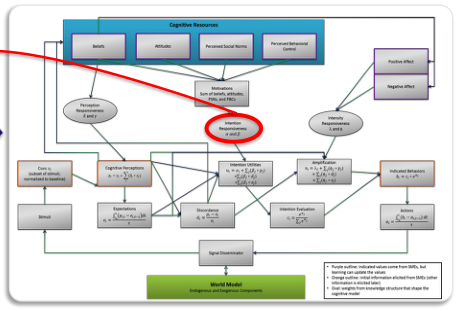
As the model is developed, domain information is used to add specificity to the structure. It is determined which entities (individuals or groups) should be modeled at a more detailed level. The domain information consists of quantitative data and SME guidance. This information is recorded via the BIA’s “Knowledge Structure” datasheets. The BIA Knowledge Structure is consistent with the psychosocial theories of decision-making and is organized in a manner that characterizes the decision processes of specific individuals or group of individuals. Knowledge structures capture information such as beliefs, motivations, norms, attitudes, general affect, intentions, and previous and current behaviors of specific groups, organizations, and/or individuals. For example, formulas that are circled in Figure 6 are populated with information, via the Knowledge Structure, also shown in Figure 6. As these structures are developed, increasingly more detailed domain information is used to populate the models and to help ensure that the systems-level and detail-level structures are consistent. That is, this information can be used to further strengthen the overall systems structure. The quantitative data consist of survey polls, economic output reports and projections, demographics, and the like that provide useful information pertaining to beliefs, attitudes, behaviors, and trends.
Figure 6. Example of a Knowledge Structure showing belief, motivation, and potential behavior information
Figure available in the original PDF paper.
This approach to modeling is made possible by assuming a fixed (but potentially very large) set of potential behaviors embodied in a representation of the individual or group. The representation contains the preferences and personality characteristics pertinent to the relevant decision-making. While the magnitude of interactions may change, the model does not produce new paths of cognition. All potential interactions are determined via initial parameterization of the model. Over time (at most a couple of years and often on the order of weeks), the simulation will be less predictive in that the modeled individuals or groups will change their behaviors outside the domain of their historical experience and habits. This will require updating the parameters within the models.
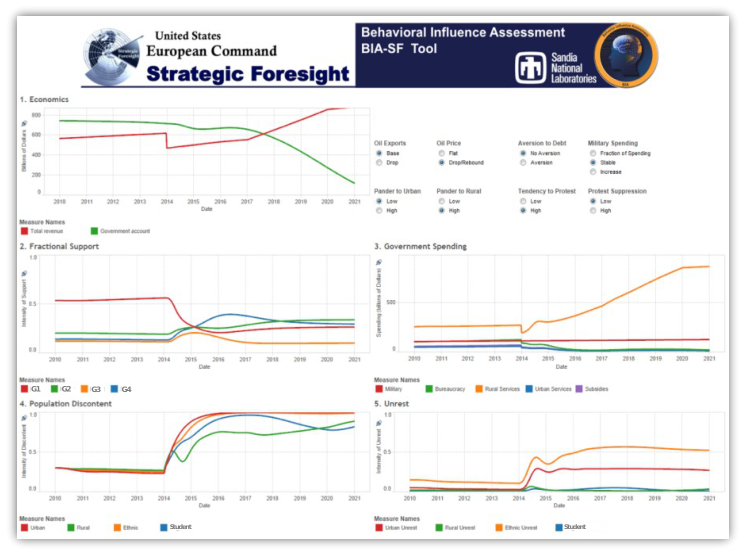
BIA ASSESSMENTS An example of actual BIA assessment output is depicted in Figure 7. The assessments shown below are designed to reveal likely responses (and counter-responses) to potential actions or events as well as the geopolitical and economic processes behind the responses for specific groups of interest. The BIA architecture underlying these assessments consists of a modeling framework, simulators, and an analysis and visualization engine. The current BIA modeling architecture provides for the storage of BIA models, the execution of those models by compatible simulators, and the analysis of run results by various analysis engines. The integration with simulators and analysis engines leverages a plug-in architecture to convert data repository records into a compatible format for various commercial visualization tools. Other arbitrary types of records that could represent source references or other supplemental information can be tied to models to provide deep traceability from a run or an analysis. The current BIA architecture also includes a flexible database engine within the modeling framework to support organization of models, runs, and references. We have developed a progressively more complex BIA modeling architecture to enable more efficient cross-modeling domain, simulation and assessments, information sharing, knowledge structure development, and visualization. For each model run, and change in a model run, BIA provides a dynamic hypothesis and analysis. The dynamic hypothesis shows the core drivers of the system dynamics and the model output presents the actual model runs. The duration of a modeled scenario ranges from as short as one week to as long as two decades. Figure 7 shows an example of the assessment interface built for EUCOM.
G1 G2 G3 G4
Student Student
Figure 7. An example of BIA assessment output
Working with EUCOM’s Strategic Foresight branch, which is focused on using advanced information technology to inform command decision-making, strategy development, and planning, BIA assessed such things as: (1) political and social reactions to various governmental actions in response to perceived internal and/or external influences or threats; (2) the long-term effect that changes in economic and/or social conditions have on the amount of support given to various groups; (3) the long-term social/political stability-effects related to various funding priorities within countries; and (4) potential interactions between countries due to changing geopolitical conditions. Strategic
Foresight is currently providing insight into strategic risks and opportunities within EUCOM’s operational environment through the analysis of socio-cultural futures in the mid- to long-term (greater than 24 months). The BIA assessment interface shown in Figure 7 analyzes individual/group perceptions, beliefs, intentions, and behaviors associated with potential societal actions (over time). These actions are in response to the behaviors of government and non-governmental entities, as well as exogenous (outside) variables. The exogenous variables are often hypothetical conditions that could occur, such as changes in global economic conditions, changes in global oil/gas markets, cross-border violence, migration into or existing a country, conflict, and the like. As these variables change, so does the model’s assessment of potential political, social, and economic reactions of groups and societies.
Model confidence Within BIA, historical data and SME information become the raw data used to calibrate and parameterize the models. Uncertainty in the data is explicitly determined through the statistical process of uncertainty quantification to develop model parameters. This process provides confidence intervals on the results of the model analyses that test interventions. By simultaneously performing uncertainty quantification for model parameters and potential interventions, BIA can determine the portfolio of intersessions that have the highest (quantified) probability of success despite uncertainty. It can also quantify the risk associated with the intervention not performing as anticipated. Additionally, BIA can perform sensitivity analyses to determine what minimal additional information is needed to maximally reduce uncertainty and further assure the proposed interventions produce the desired outcome throughout the time horizon of interest. Moreover, because the model is causal, decision-makers can reach-back into detailed results of the simulation to independently evaluate the nuanced processes that caused the predicted outcomes and find leverage points that would be maximally effective at altering outcomes. Furthermore, the same process can determine early warning fingerprints whose measurement today or during the initial implementation of an intervention can verify or exclude the possibility of critical conditions and outcomes.
CONCLUSIONS
The intent of this document is to provide a brief discussion of the BIA framework. Results suggest that BIA can provide a data-driven analytical capability, consistent with psychosocial and economic theory, usable for assessing national security policies and operations. We are still developing the secondary components needed for greater usability. Most of the sub-components have been thoroughly tested in previous studies. Still, the full integration of all the parts into a comprehensive framework is a research and development effort. The framework is currently being tested with detailed data sets and realistic scenarios. Albeit limited, our experience with the use of the system to-date indicates that the approach we are taking is sound and can produce the expected capabilities. Initial assessment of BIA suggests that it is consistent with the general processes underlying human behavior, inclusive of cultural, biological, and institutional constraints, and conditions. The BIA framework is based on first principles that can encompass an unlimited number of entities with any number of alternative decisions, and with any level of interrelationship complexity. The theories used were limited to ones that 1) were mutually self consistent, 2) would integrate into a complete representation of behavior from stimuli through to action, 3) would translate to a unique set of computational equations, and 4) could be instantiated, tested, and verified using accessible data. This structure and discipline allowed for 1) use of readily available data on individual or regions to calibrate the model, 2) use of subject matter expert data to sparsely augment data as needed, 3) testing of hypotheses surrounding alternative interventions and behavioral responses, 4) quantification of the uncertainty (risk) that an intervention will produce the desired results, and 5) time-dependent consequential counter-responses to follow from an intervention. Most importantly, the BIA framework is designed to naturally capture the implications of new (even unique) information flows that may be considered in information operations or other interventions.
REFERENCES
Acemoglu, D. & Robinson, J. (2009). Economic origins of dictatorship and democracy. Cambridge University Press. Ajzen, I. (1991). The theory of planned behavior. Organizational Behavior and Human Decision Processes, 50, 179-211.
Ajzen, I. (2005). Attitudes, personality, and behavior. (2nd Ed.). New York: McGraw-Hill. Backus, G., Bernard, M., Verzi, S., Asmeret, B., Glickman, M. (2010). Foundations to the unified psycho-cognitive engine.
Sandia National Laboratories technical report SAND Report 2010. Backus, G. & Glass, R. (2006). An agent-based model component to a framework for the analysis of terrorist-group dynamics.
Sandia National Laboratories technical report SAND2006-0860. Bernard, M. L. Backus, G. (2009). Model the interaction between leaders and society during conflict situations. Annual Meeting of the System Dynamics Conference, Albuquerque, NM. Bernard, M., L. & Smith, B. (2006). The effects of emotional states and traits on risky decision-making. Sandia National
Laboratories technical report SAND2006-7642. Beck, L., & Ajzen, L. (1991). Predicting dishonest actions using the theory of planned behavior. Journal of Research in Personality, 25, 285-301. Bier, A., Bernard, M. L., Backus, G., Glickman, M., & Verzi S. (2011). Using a hybrid cognitive-system dynamics model to
anticipate the influence of events and actions on human behaviors. 29th International Conference of the System Dynamics Society, Washington, D.C. Converse, P. E. (1964). The nature of belief system in mass publics. In D.E. Apter (Ed.), Ideology and discontent (pp. 206-261).
New York: Free Press. Cooke, R., & Sheeran, P. (2004). Moderation of cognition–intention and cognition–behavior relations: A meta-analysis of properties of variables from the theory of planned behavior. British Journal of Social Psychology, 43, 159-186. Dolan, R. J. (2002) Emotion, cognition, and behavior, Science, 298, (8) 1191-1194. Eagly, A. H. & Chaiken, S. (1993). The psychology of attitudes. Fort Worth, TX: Harcourt Brace Jovanovich. Fishbein, M. & Ajzen, I. (1975). Belief, attitude, intention, and behavior: An introduction to theory and research. Reading, MA:
Addison-Wesley. Forgas, J. P. (1995). Mood and judgment: The affect infusion model (AIM), Psychological Bulletin, 117 (1) 39-66. Granger, C. W. (1969). Investigating causal relations by econometric models and cross-spectral methods. Econometrica: Journal of the Econometric Society, 424-438. Gigerenzer, G. & Goldstein, G. D. (1996). Reasoning the fast and frugal way: Models of bounded rationality, Psychological
Review, 103 (4) 650-669. Keeney, R. L. & Raiffa, H. (1976). Decisions with multiple objectives. New York NY: John Wiley & Sons. Klein, G. A., Orasanu, J., Calderwood, R., & Zsambok, C. E. (Eds.). (1993). Decision making in action: Models and methods.
Norwood, NJ: Ablex Publishing Corporation. Lerner, J. S. and Keltner, D. (2000) Beyond valence: Toward a model of emotion-specific influences on judgment and choice.
Cognition & Emotion, 14 (4) 473-493 Madden, T. J., Ellen, P. S. & Ajzen, I. (1992). A comparison of the theory of planned behavior and the theory of reasoned action.
Personality and Social Psychology Bulletin, 18, 3-9. Markman A. B. (1999). Knowledge representation. Mahwah, NJ: Erlbaum. Martin, L. L., D. W., Ward, J. W., & Achee, Wyer, R. S. (1993). Mood as input: People have to interpret the motivational implications of their moods. Journal of Personality and Social Psychology, 64, 317-326 McFadden, D. (1984). Econometric analysis of qualitative response models. Handbook of Econometrics, Volume II. Chapter 24.
Elsevier Science Publishers BV. Ouellette, J. A., & Wood, W. (1998). Habit and intention in everyday life : The multiple processes by which past behavior predicts future behavior. Psychological Bulletin, 124, 54-74. Perugini, M., Bagozzi, R. P. (2001). The role of desires and anticipated emotions in goal-directed behaviors: Broadening and
deepening the theory of planned behavior. British Journal of Social Psychology, 40, 79-98 Visser, P. S., & Clark, L. (2003). Attitudes. In A. Kuper & J. Kuper (Eds.), Social Science Encyclopedia. London: Routledge.
ACKNOWLEDGEMENTS
This research was possible in part by funding from the United States Department of Defense. Sandia National Laboratories is a multi-program laboratory managed and operated by Sandia Corporation, a wholly-owned subsidiary of Lockheed Martin Corporation, for the U.S. Department of Energy’s National Nuclear Security Administration under contract DE-AC04-94AL85000. Approved for unlimited release: SAND 2014-1539C.
LISTED IN THE AHFE DIGITAL BOOKSTORE CATALOGUE
Explore the complete digital volume
Advances in Cross-Cultural Decision Making
Read this individual research paper free through the original publisher, or explore the full digital proceedings book.
ISBN 978-1-4951-2095-4
Explore this ISBN in the AHFE Bookstore ↗Listed in the July 2026 bookstore catalogue; search by ISBN to confirm current availability · Digital book purchase optional