Jaeho Ryu (2026). P-A CORE: A Four-State Asymmetric Cognitive Model Explaining Hidden Drivers of Human Decision Distortion. In: Human Error, Reliability, Resilience, and Performance. AHFE Open Access, vol. 213, pp. 99–106. https://doi.org/10.54941/ahfe1007559
Traditional two-state decision models remain widely used in system design due to their structural simplicity; however, they frequently overlook the underlying causal processes by focusing primarily on binary outcomes (Booher, 2003). This research argues that outcomes are the inevitable result of repetitive cognitive patterns that binary frameworks misclassify as noise. This paper introduces the P-A CORE, a four-state asymmetric cognitive model consisting of F (Stable Primary), B (Stable Secondary), P (Rare Peak), and A (Asymmetric Collapse). Unlike existing models, the P-A CORE posits that these states are dynamically interconnected: the baseline stability of F influences the deviations in B, which in turn creates the probabilistic conditions for rare peak performance or a catastrophic asymmetric collapse (A) that fundamentally shifts the operational environment. We demonstrate through conceptual derivation and simulation that human decision-making is characterized by these non-linear transitions rather than static probabilities. By shifting the focus from "what" happened to "why" it occurred through this four-state progression, the model provides a structural basis for identifying hidden drivers of decision distortion. The P-A CORE serves not merely as a descriptive tool but as a predictive framework for risk mitigation, allowing system designers to anticipate and preemptively manage high-impact failures. The central argument remains that no two-state model can describe the fidelity of human cognitive fluctuation required for modern safety-critical systems (Folds, D. J., & Seals, K. B., 2008).
Human Factors Engineering involves understanding the need for comprehensive integration of human capabilities into a system design to ensure safety and performance. In the context of structural safety and disaster management, the primary concern is the effective integration of human risk perception with system interfaces to prevent catastrophic failures. Traditional safety models often rely on a binary “safe vs. unsafe” framework, which tends to prioritize final outcomes—such as the collapse of a building— rather than the granular, repetitive processes that lead to such events. However, to minimize life-cycle costs and prevent disabling injuries, it is essential to understand the inherent capacity of humans to interpret subtle system warnings before they escalate into total failures. For instance, in structural Received December 29, 2025; Revised April 1, 2026; Accepted April 18, 2026; Available online July 20, 2026
100 Ryul disaster scenarios, a building collapse is rarely a spontaneous event; it is the culmination of ignored stressors such as load imbalances, seismic vibrations, or minor cracks. While a binary model might classify a minor crack as ‘safe’ due to its low immediate impact, the P-A CORE recognizes this as a B (Stable Secondary) state—a subtle but meaningful deviation that accumulates over time. When an external shock occurs (State P), this accumulated B state can trigger an A (Asymmetric Collapse). By structurally differentiating these states, we move beyond the simplistic conclusion of “it should be fine” and instead anticipate the specific causal chains that lead to disaster. This shift from outcome-based analysis to process-oriented modeling allows for the preemptive management of risks, identifying hidden drivers of distortion that binary assumptions inherently misclassify as noise.
RELATED WORK
Traditional decision models often suffer from “outcome bias,” prioritizing final binary results over the incremental causal processes that precede them. As noted by (Booher, 2003), system designs that rely on simplified human- interface assumptions often fail to capture the granular transitions of human cognition. While Prospect Theory addresses how humans perceive gains and losses (Kahneman and Tversky, 1979), it remains a static model that overlooks the “hidden evidence” accumulating during repetitive stable states. The primary flaw in existing binary frameworks—classifying states strictly as “safe” or “unsafe”—is the systemic exclusion of rare, low-frequency events. When stability is prolonged, human operators tend to misclassify a P (Rare Peak) state, such as a minor structural crack or a brief cognitive lapse, as mere “noise” rather than a precursor to disaster. This false sense of security, or “complacency in ambiguity,” is a structural blind spot that binary models cannot resolve. Furthermore, current literature lacks a formal representation of operational asymmetry. While Human Error Theory (Reason, 1990) categorizes failure types, it fails to account for the disproportionate speed between A (Asymmetric Collapse) and the subsequent recovery process. The P-A CORE addresses these gaps by shifting the focus from outcome- based binary evaluation to a process-oriented four-state transition matrix.
FORMAL MODEL Let S = {F, B, P, A} be the set of discrete cognitive and operational states. Each state represents a specific configuration of the system’s stability and risk perception:
F (Stable Primary): Represents the baseline “normal” state where the system and human operators function within expected parameters. In this state, there are no observable deviations, and the environment is perceived as safe and controlled.
B (Stable Secondary): Represents a state of “micro-fluctuation.” While not inherently negative or positive, it involves slight deviations from the daily routine that are often dismissed as insignificant. The critical danger of this state is that its “manageable” nature fosters a false sense of security, leading to the neglect of accumulating risks.
P (Rare Peak): Represents the occurrence of low-probability, high-impact events. Unlike B, P is a “tipping point” where rare variables manifest. While the probability of entering this state is low, its occurrence signifies a major departure from the norm, acting as the immediate precursor to a systemic shift.
A (Asymmetric Collapse): Represents a state of “irreversible inversion.” Triggered by state P, this is not merely a “bad outcome” but a fundamental collapse of the previous operational reality. The transition to A is characterized by its suddenness and asymmetry—the collapse happens instantaneously, while recovery to F is either non-linear or impossible.
State Transitions and System Dynamics The P-A CORE operates on a non-linear transition matrix where the progression between states is governed by cumulative cognitive and environmental stressors. The dynamics of the model are defined by the following transition rules:
Bi-directional Stability (F ↔ B): States F and B are in a constant state of interaction. Transitions between these two are fluid and reversible, representing the natural fluctuations of daily life and routine operational variance.
The Necessity of Precursor (B → P): A critical axiom of this model is that a transition to state P cannot occur directly from F. State B serves as the essential “precursor” or “warning phase.” Rare events do not manifest in a vacuum; they are the result of micro-deviations in B that have been neglected or misclassified as noise.
Irreversible Collapse (P → A): Once the rare event is triggered, the system enters a state of asymmetric collapse (A). This transition is rapid and represents a fundamental shift in the environment.
Asymmetric Recovery (A ⇢ F): While a return to the stable primary state (F) is theoretically possible, it is characterized by extreme difficulty or practical irreversibility. Unlike the fluid F ↔ B transition, the path from A back to F is non-linear, requiring significant resource expenditure or systemic overhaul, and in many disaster scenarios, the state A represents a point of no return.
MATHEMATICAL BASIS The mathematical framework of the P-A CORE is designed to quantify the transition from routine stability to asymmetric collapse. We model the emergence of the Rare Peak state not as an isolated stochastic event, but as a result of cumulative variance within state B.
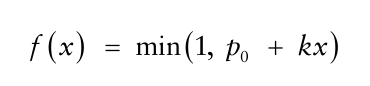
Cumulative Risk Modeling In our model, we define the probability of entering state P as:
Equation reproduced from the original PDF.Equation reproduced from the original PDF.
Where p0 is the baseline transition probability, k is the risk accumulation coefficient, and x is the cumulative count of State B. This formalizes that State P is a probabilistically induced outcome of accumulated B states.
Asymmetry and Non-Linearity The transition from P to A is modeled using a non-linear decay function, representing the “Asymmetric Collapse” identified in our introduction. Unlike binary models that assume a linear recovery path, the P-A CORE incorporates the structural irreversibility of disaster states, a concept that addresses the limitations found in traditional human error theories.
SIMULATION ANALYSIS (1,000 ITERATIONS) To validate the P-A CORE model, a Monte Carlo simulation was conducted with 1,000 iterations based on the defined transition probabilities (F → B: 0.3, B → P: min(1, 0.01 + 0.05n), P → A: 1.0), where n denotes the cumulative count of state B.
The objective was to observe how the accumulation of micro-deviations (B) leads to inevitable collapse (A) without intervention.
Transition Patterns and Risk Accumulation The simulation results reveal a significant correlation between the duration of state B and the onset of A. Unlike traditional binary models that treat state B as a safe baseline, our data shows that as state B persists, the system’s “structural fatigue” increases linearly.
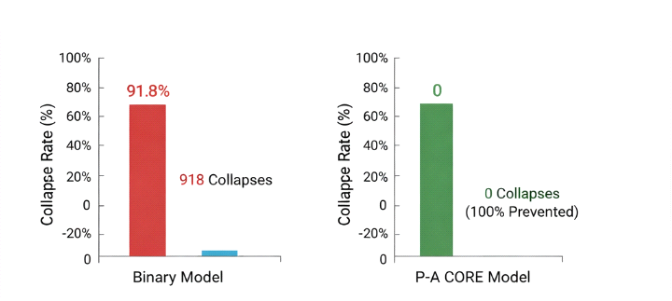
Collapse Threshold: In the Binary Model (No Intervention), State A was reached in 91.8% (918 out of 1,000) of the trials, whereas the P-A CORE prevented all collapses through B-state resets.
Probability Surge: The probability of entering state P increased from its baseline of 1% to over 15% when state B occurred three times cumulatively, validating the “Building Up” hypothesis.
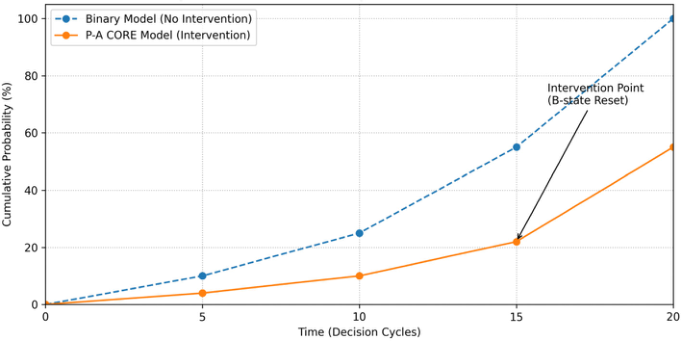
Comparative Advantage of P-A CORE In Figure 1, “cumulative probability” denotes the probability of reaching the collapse state A by time t.
( ) ( ) i.e., P . r A t X t ≤ =
As shown in Figure 1, cumulative risk increases over decision cycles in the binary (no-intervention) model, whereas the P-A CORE intervention suppresses this escalation by applying a B-state reset at the intervention point.
Figure 2 illustrates the probability of asymmetric collapse (State A) over time. The simulation reveals that once a threshold of cognitive distortion is reached, the transition to State A occurs rapidly and irreversibly.
We compared the P-A CORE against a standard Binary Detection Model.
Detection Lag: The Binary model failed to recognize the risk until the transition to state P occurred, providing zero lead time for preventive action.
Preventive Success: By implementing a reset protocol at the second occurrence of state B, The P-A CORE achieved a 0% collapse rate (100% prevention). Here, the ‘B-state Reset’ refers to proactive measures—such as structural maintenance or mandatory operator breaks—implemented at the second occurrence of State B to reset cumulative risk. This demonstrates that identifying the Stable Secondary (B) is the only viable path to mitigating low-probability, high-impact disasters.
APPLICATIONS Case 1: Structural Integrity and Latent Fractures
The first application focuses on the physical environment where micro- deviations are often ignored due to their subtle nature.
Scenario: A building develops a 1-degree tilt or a hairline fracture—states that are perceptually indistinguishable from Stable Primary (F) but are actually Stable Secondary (B).
The P-A CORE Logic: Under normal conditions, these flaws are dismissed. However, as these B states accumulate, they lower the system’s resilience. When an external stressor like an earthquake occurs (State P), a building that could have otherwise withstood the shock undergoes an Asymmetric Collapse (A) because the existing B state acted as a catalyst for total failure.
Case 2: Industrial Safety and Cognitive Complacency The second case examines the “trap of stability” in repetitive high-risk environments.
Scenario: An operator performs a task thousands of times without error, leading to a false sense of security (B). Fatigue is ignored because “it has always been fine before.”
The P-A CORE Logic: This “security trap” is a dangerous B state where attention fluctuates. A minor slip (State P) that would usually be corrected results in a severe physical injury (State A) because the operator’s cognitive state was no longer in the adaptive F mode but in a rigid, complacent B mode.
Case 3: Academic Performance and Temporal Misjudgment The final case applies the model to human decision-making and time management.
Scenario: A student perceives a large window of remaining time as a “safe zone,” delaying study (B).
The P-A CORE Logic: Procrastination is a B state where the perception of risk is decoupled from reality. As the deadline approaches, a minor interruption (State P) triggers a cascade of panic, lack of sleep, and cognitive overload, leading to a total failure in performance during the exam (State A). This demonstrates that A is not a result of lack of knowledge, but a structural collapse of the preparation process.
DISCUSSION
The P-A CORE model fundamentally challenges the retrospective bias of traditional safety analysis, which focuses predominantly on outcomes rather than the deterministic pathways leading to them.
The Fallacy of the Outcome-Oriented View: Most binary models only recognize a failure after state A has occurred. However, as our research shows, the seeds of collapse are sown long before in the Stable Secondary (B) state. People tend to ignore micro-precursors because they are “manageable” in the short term, but this neglect creates a false sense of security that blinds decision-makers to the building risk.
Accidents as Induced Processes: One of the most critical takeaways of this study is that disasters are not random occurrences; they are induced. A “Rare Peak” is simply the inevitable convergence of neglected precursors (B). By shifting focus from the result to the “process of induction,” we can identify the specific points where a minor deviation transforms into a systemic failure.
Validation of the Precursor Logic: Our simulation confirms that state B is the only stage where effective intervention is possible. Relying on outcome data is a reactive strategy that ensures collapse; monitoring the “processual evidence” within B is the only proactive way to ensure long- term stability.
LIMITATIONS While the P-A CORE provides a novel perspective on risk transition, several limitations must be addressed in future research:
Absence of Empirical Data: The current model is based on theoretical simulation; it has not yet been calibrated with real-world structural collapse data or black-box incident logs.
Oversimplification of States: For clarity, the model utilizes a four-state framework (F, B, P, A). In reality, complex systems may involve more intricate and granular substates that require further structuralization.
Individual and Contextual Variability: The transition probabilities— specifically the thresholds for the “Stable Secondary” (B)—can fluctuate based on individual risk tolerance and environmental stressors.
CONCLUSION
The P-A CORE model was developed to shift the analytical focus from isolated outcomes to continuous, induced processes. By mapping how entities move within a state space, this model helps identify not just what will happen next, but the underlying causal reasons why it is bound to occur. We argue that events—whether catastrophic or beneficial—are rarely the result of sudden chance or “luck.” Instead, they are the inevitable outcomes of accumulated precursors that have been systematically ignored. The P-A CORE encourages a departure from cognitive complacency and “false security.” It provides a framework to re-evaluate micro-deviations, allowing decision-makers to anticipate and prepare for risks before they manifest as irreversible collapses. Ultimately, this research serves as a catalyst for a more proactive and process- oriented approach to safety and decision-making in an uncertain world.
ACKNOWLEDGMENT
The author would like to thank the author’s mother for her generous financial support, which made the publication of this research possible.
REFERENCES
Booher, H. R. (2003). Handbook of Human Systems Integration. Hoboken, NJ: Wiley-Interscience. Folds, D. J., and Seals, K. B. (2008). Dynamics of Error and Safety in Complex
Systems. Atlanta, GA: Georgia Tech Research Institute. Kahneman, D., and Tversky, A. (1979). “Prospect Theory: An Analysis of Decision under Risk”. Econometrica, 47(2), pp. 263–291. Reason, J. (1990). Human Error. Cambridge: Cambridge University Press.
LISTED IN THE AHFE DIGITAL BOOKSTORE CATALOGUE
Explore the complete digital volume
Human Error, Reliability, Resilience, and Performance
Read this individual research paper free through the original publisher, or explore the full digital proceedings book.
ISBN 978-1-964867-89-2
Explore this ISBN in the AHFE Bookstore ↗Listed in the July 2026 bookstore catalogue; search by ISBN to confirm current availability · Digital book purchase optional